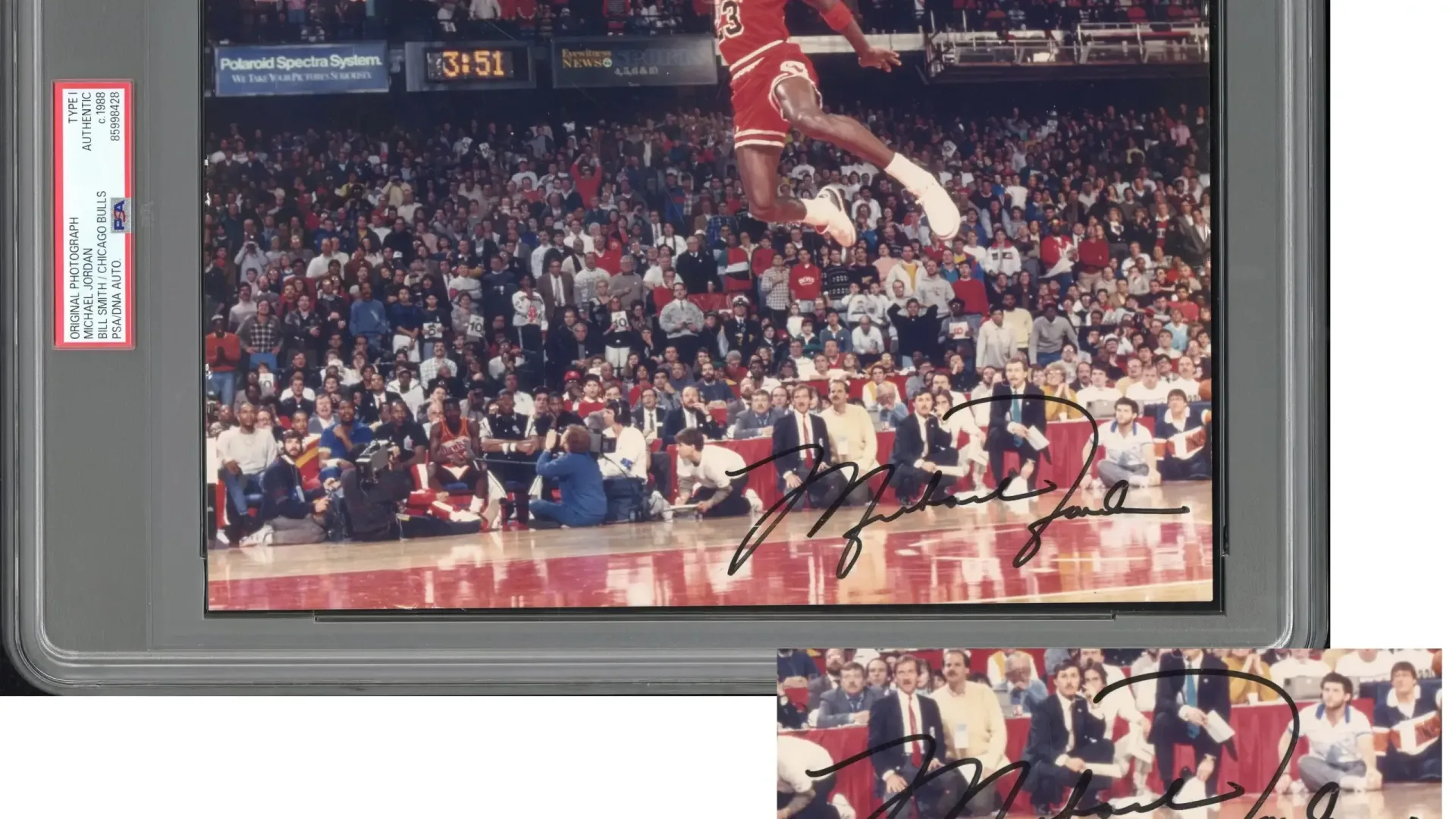
Original sports photographs occupied the spotlight in a fall auction led by Michael Jordan and Kobe Bryant material, with a signed image of Jordan’s famous 1988 NBA Dunk Contest foul-line dunk reaching $179,340 and a signed, inscribed Kobe Bryant pre-rookie photograph bringing $65,011.
The Bryant result is described as a public-sale record for any Kobe Bryant photograph. Dated Sept. 29, 1996, the image comes from one of Bryant’s earliest Los Angeles Lakers photo shoots. Its appeal is concentrated in a notably specific combination of factors: an early-career point in Bryant’s story, a Lakers association, an autograph and inscription, and a distinct original-photo format.
Jordan’s top result centered on an image collectors can identify immediately: the foul-line dunk from the 1988 contest. The offered photograph was signed and cataloged as a Type I Photo. That $179,340 price was the high point among the Jordan and Bryant lots detailed from the sale.
A sale driven by recognizable moments and original-photo status
The auction results show why original photographs can stand apart from more familiar sports collectibles such as cards or posters. A card may reproduce a photograph for a broad release, while an original photo is itself the collectible object offered. In this group, the individual image, its athlete, its moment and its physical presentation all matter to the result.
For more context, explore Skydance Plans Paramount+ and HBO Max Bundle for Early 2027.
“Type I” appears repeatedly in the catalog descriptions for the leading lots, including the Jordan dunk, the 1991 championship image and several historic baseball and football photographs. The available sale details do not spell out a technical definition or grading standard for that label. What is clear is that it was a central part of how these lots were identified and presented, alongside whether a photo was signed, dated, associated with a rookie card, or tied to a documented sporting moment.
That distinction matters for collectors evaluating auction descriptions. “Original,” “Type I,” “signed,” “inscribed,” “rookie” and “used for” are not interchangeable claims. Each describes a different element of an item’s identity. The results here do not establish that any one descriptor alone determines value; rather, the strongest lots combine several layers of significance.
- Subject: Jordan and Bryant are two of the hobby’s most collected athletes.
- Moment: The Jordan image captures one of basketball’s enduring contest highlights.
- Career timing: Bryant’s photograph is dated from 1996 and identified as pre-rookie.
- Physical and cataloged attributes: The major lots carry original-photo and Type I designations, while some also include signatures or inscriptions.
- Historical connection: Other lots were connected to rookie-card imagery, a first NFL game, integration history, or a major championship.
Jordan lots cover spectacle, emotion and arena action
Jordan accounted for three notable sales in the auction. The $179,340 signed foul-line dunk photo represents a performance moment: a single action attached to the 1988 NBA Dunk Contest. Its visual clarity is part of its importance. Even without a game box score or championship context, the photograph depicts a defining piece of Jordan iconography.
Related coverage includes Michael Jordan and Kobe Bryant Type 1 Photos Lead Major Fall Auction Sales.
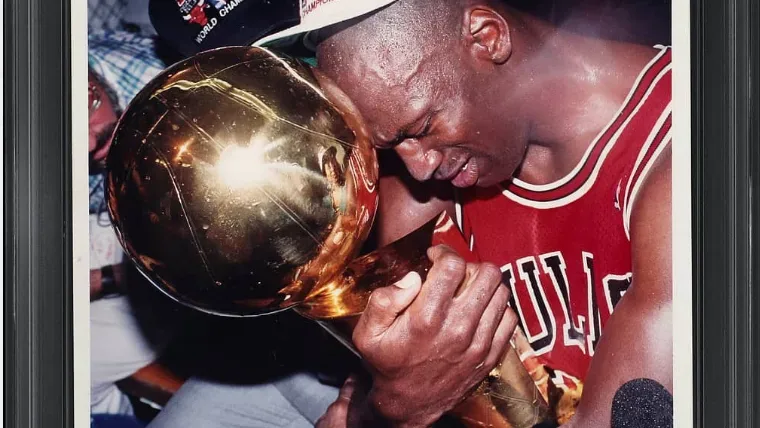
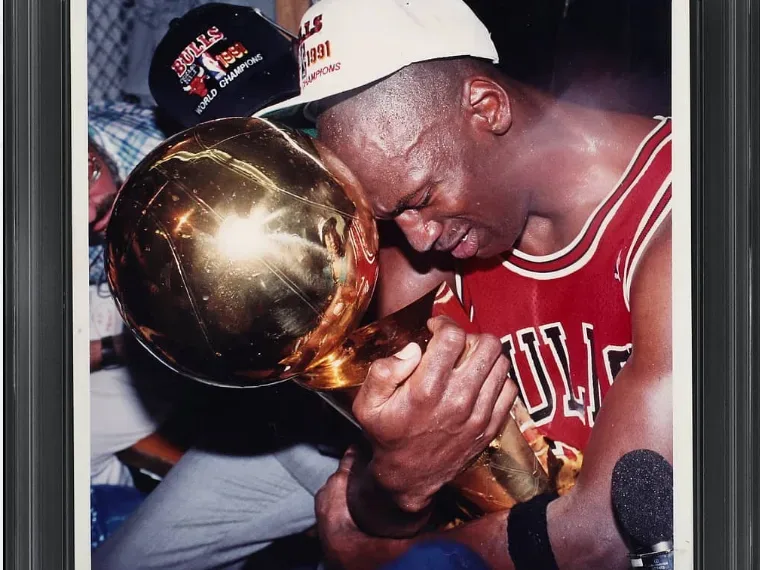
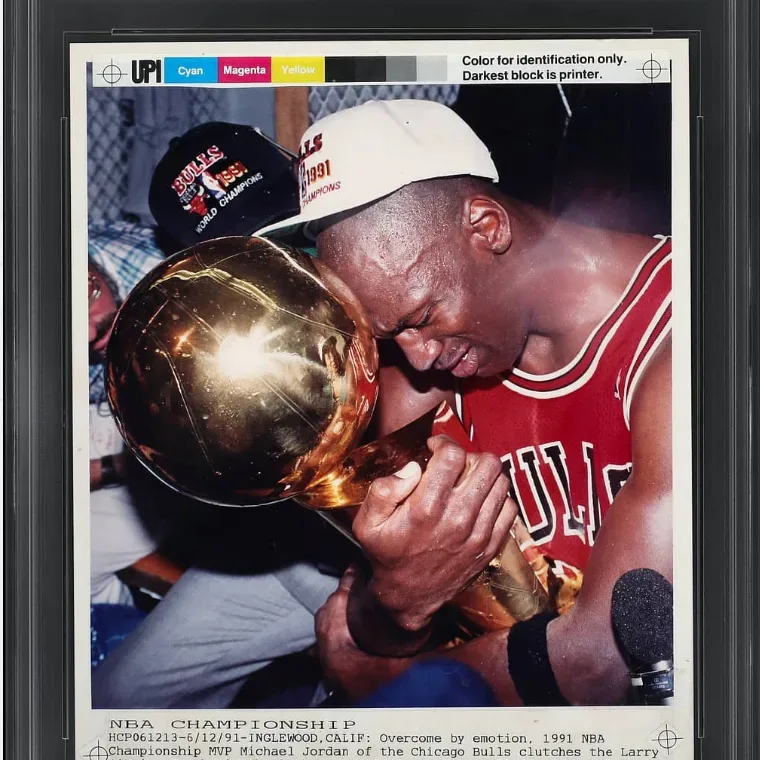
A second Jordan image recorded a very different kind of landmark. A one-of-a-kind Type I photograph known as “Tears of Triumph” sold for $25,648. Taken by Ken Levine, it shows Jordan holding the 1991 NBA championship trophy while crying with his father, James Jordan, after Jordan’s first NBA title.
The contrast between the two Jordan results is useful. One is about athletic elevation and a widely remembered contest image; the other is about the emotional aftermath of a championship. The $25,648 result does not diminish the latter image’s historical resonance. It instead illustrates that collectors can value distinct kinds of significance differently: a signature, the familiarity of an action image, and the particular way an event entered sports culture can all be relevant.
The third Jordan lot, a signed 1996 Type I original photograph of him dunking at United Center, sold for $29,890. Taken together, the three sales provide a compact cross-section of what collectors pursue in Jordan photography: a contest spectacle, a championship document and a home-arena action shot.
Kobe Bryant’s early Lakers image establishes a benchmark
Bryant’s $65,011 sale set the reported public-auction mark for a Bryant photograph. The Sept. 29, 1996 photo is specifically described as signed and inscribed, and as coming from Bryant’s earliest Lakers photo shoot.
For collectors, “pre-rookie” is an important timing descriptor in this context. It signals that the item is positioned at the start of the athlete’s professional story, rather than being from a later, more established period. The sale description also anchors the image to a precise date, which makes its early-career placement more concrete than a general claim that it is an early Bryant photo.
It is worth keeping the record language narrow. The result is a record for the public sale of a Kobe Bryant photo, based on the auction’s stated comparison. It should not be broadened into a claim about every private transaction or every form of Bryant collectible. Auction records are category-specific, and the category here is a Bryant photograph sold publicly.
Historic photographs broaden the auction beyond basketball
Although Jordan and Bryant led the headline results, the auction ranged across sports and eras. A 1957 Jim Brown photograph used for his 1958 Topps rookie card sold for $146,400. The connection between an original photograph and a recognizable trading-card issue gives that lot a direct bridge between photo collecting and card collecting: it is not merely an image of a star, but the image used for a specific rookie-card design.
A photograph from Barry Sanders’ NFL debut on Sept. 10, 1989 sold for $10,370, described as a record for a Sanders photo. Like Bryant’s benchmark, that wording is limited to the photo category. The appeal is also event-based: the item is tied to Sanders’ NFL debut rather than simply an undated playing-day scene.
A 1946 Jackie Robinson Montreal Royals Type I original photo brought $40,260. The photograph is connected to Robinson’s minor-league integration season, adding historical context beyond player popularity. A May 12, 1955 Roberto Clemente rookie Type I original photo realized $27,755, while a 1930s Bobby Jones Type I photograph, inscribed to fellow golfer Dick Metz, sold for $25,132. The Jones image is noted as hanging at both the USGA Museum and Augusta National Golf Club.
These lots demonstrate that original-photo demand is not restricted to one sport or one collector profile. The auction included basketball, football, baseball and golf, with value propositions ranging from debut and rookie associations to cultural history and personal inscriptions.
What the results mean for collectors
The principal takeaway is not that every old sports image will command five- or six-figure prices. The detailed results point in the opposite direction: the biggest numbers are attached to unusually concentrated significance. Jordan’s dunk photo joins an iconic moment to a signature and a Type I designation. Bryant’s record image combines a precise early date, an early Lakers shoot, a signature and an inscription. Brown’s sale has a direct rookie-card-image connection.
Collectors considering original sports photography can take a disciplined approach to reading listings. First, identify exactly what the description claims. Is the photo dated? Is the athlete shown in a milestone event? Is it signed or inscribed? Is there a stated connection to a card, season or venue? Then keep those claims separate rather than assuming one implies another.
Second, compare like with like. A public-sale record for an athlete photograph is not the same thing as a record for that athlete’s cards, jerseys or memorabilia. A photo tied to a rookie card is a different collecting proposition from an unsigned action image, even if both depict the same player. And a one-of-a-kind photograph documenting a championship moment may have a different audience from a widely recognizable contest photo.
Finally, the sale underscores an often-overlooked point about sports imagery: photographs can preserve both the action and the meaning around it. Jordan airborne at the foul line, Jordan holding a trophy beside his father, Bryant at the beginning of his Lakers career, Robinson during his Montreal Royals season—each lot is attached to a moment collectors can place within a larger sports narrative. That ability to connect a physical image to a specific story is the common thread running through the auction’s strongest results.