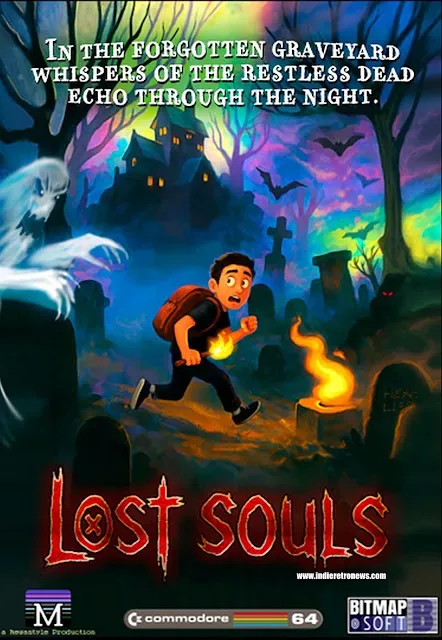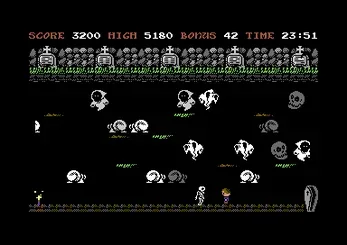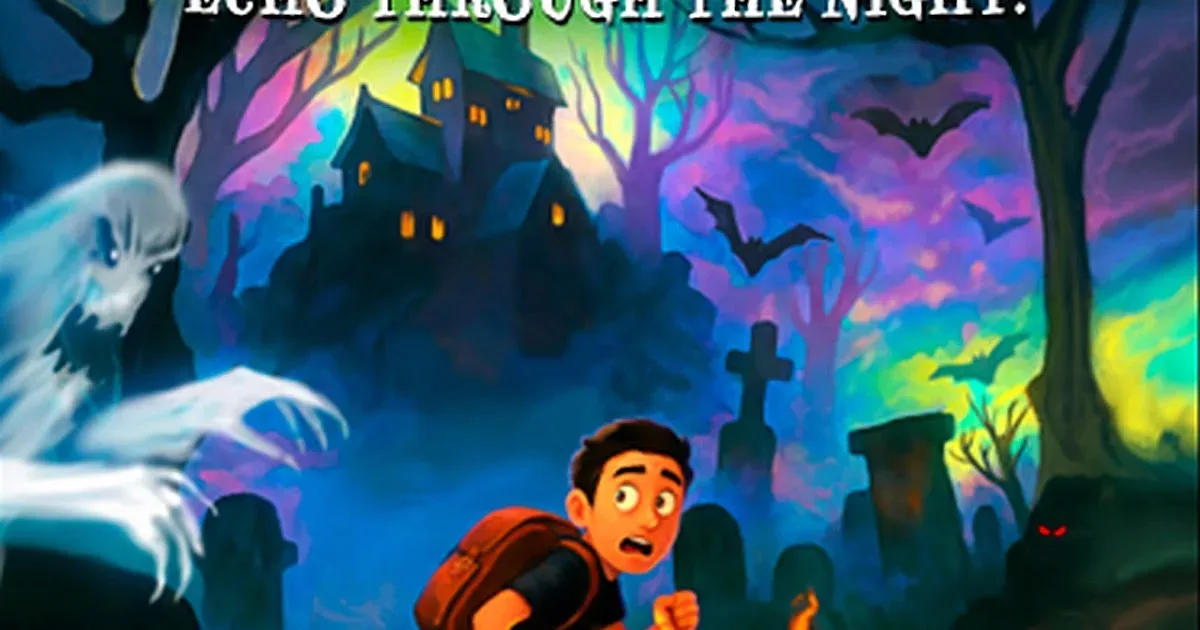
Lost Souls brings a focused arcade-horror premise to the Commodore 64: enter a shadowy graveyard, collect the torches needed for the job, and light 25 lanterns on ancient gravestones before midnight. The reward is narrative as well as mechanical. Completing the task frees a spirit trapped between worlds; failing to do so leaves it in darkness.
Megastyle’s game is built around a strict deadline and a particularly severe form of danger. The creatures and shadows occupying the cemetery do not directly kill the player, but contact with one immediately returns them to the very beginning of the quest. That means every route through the graveyard has to be weighed against the clock, and a mistake can cost far more than a moment of delay.
A compact goal with high stakes
The central objective in Lost Souls is easy to express but demanding in practice: illuminate all 25 lanterns before the clock reaches midnight. In arcade-game terms, this is a completion objective rather than a score chase. Progress depends on interacting with every required lantern, not merely surviving for a set period or clearing a single endpoint.
That structure matters because it gives the graveyard a practical purpose. The player is not simply moving through a spooky setting for atmosphere; each trip into the cemetery is part of a route-planning problem. Lanterns are placed on gravestones, while essential torches are found in the lower grounds. Players must move between those needs while avoiding hostile presences that can undo the entire attempt.
The design therefore turns the setting into the game’s pressure system. A forgotten graveyard filled with whispers, creatures and shadows supplies the horror tone, but the deadline supplies the urgency. Midnight is not just a decorative horror image here. It is the hard limit governing whether the trapped soul can be restored to peace.
What “back to the beginning” means for play
Lost Souls uses what could be described as a full-reset penalty. Rather than reducing health, removing a life in a conventional way, or simply pushing the player a short distance backward, a touch from a lurking threat sends the player to the starting point. The supplied details specifically frame this as a loss of precious progress.
That makes precision central to the experience. Evasion is not a side activity that can be handled casually between objectives. It is inseparable from completion. A player who has already covered much of the graveyard may still need to carefully negotiate the final dangerous stretch, because one collision can turn a near-finished lantern run into a fresh start.
It also creates a clear distinction between the game’s threats and its overall failure condition. The creatures do not directly end the player’s life, but they can create the most damaging possible time loss by resetting the run. Meanwhile, the clock is the ultimate threat: if all 25 lanterns are not lit before midnight, the spirit remains trapped.
Related coverage includes Lost Souls Brings a Midnight Graveyard Challenge to Commodore 64.
For players, the practical implication is that reliable movement may matter as much as raw speed. A faster-looking route is not necessarily the better route if it repeatedly forces close passes with enemies or shadows. Conversely, a safer route only pays off if it still leaves enough time to collect torches and light every required lantern. The tension comes from balancing those two demands, not from combat.
Arcade horror without a combat requirement
The description identifies Lost Souls as an arcade-horror game, and its play loop helps explain that label. “Arcade” here points to immediately understandable rules, rapid consequences and repeat attempts under pressure. “Horror” comes from the haunted graveyard, the trapped spirit, the looming midnight deadline and the dangerous entities that patrol the dark.
There is no stated combat system, weapon set or enemy-defeat mechanic. Instead, the player’s relationship with danger is evasive. The essential skill is to navigate around the creatures and shadows accurately while continuing to make useful progress toward the lantern objective.
That is an important expectation to set for anyone drawn in by the graveyard theme. Lost Souls is not presented as a long-form exploration adventure in which players gradually overpower threats. Its stated structure is closer to a tense obstacle course: acquire torches, find lanterns, evade hazards, and preserve the run long enough to meet the deadline.
In that sense, the game’s supernatural premise and its systems reinforce one another. A soul caught between worlds is a fitting narrative for a player caught between advancing quickly and moving carefully. The darkness is not only visual flavor; it is the space in which the game’s reset-causing threats operate and the lanterns must be reclaimed from it.
The team behind the graveyard
Lost Souls credits Kåre Johansen for programming. Roy Widding is credited with graphics, the loading music and the game concept, making Widding’s contribution span both the game’s presentation and its foundational idea. Magnar Harestad composed the music.
The release work also identifies separate contributors for the available formats. Tom Roger Skauen mastered the tape version, Geir Straume handled the CRT version, and Widding created the directory art for the D64 version. All versions are linked by Six.
Those format references are useful shorthand for Commodore 64 players. A TAP version is associated with tape-based loading, while CRT refers to a cartridge image and D64 is a disk-image format. They are not alternate game concepts; they refer to ways the same release can be prepared for C64 use. The credits explicitly identify work tied to each of those versions.
The game is also listed for boxed preorder via Bitmap Soft. Beyond that preorder framing and the named formats, no further pricing, release-window or contents details are established here, so prospective buyers should avoid assuming particular packaging extras or delivery timing.
Why its premise suits the Commodore 64
Lost Souls is notable for choosing a clean, legible objective instead of obscuring its hook behind a broad list of systems. Light 25 lanterns. Do it before midnight. Avoid anything that will reset the attempt. Save the lost spirit. That clarity can make each failure understandable even when it is punishing: the player knows what was lost and why the next run matters.
It also gives the game a potentially strong repeat-play rhythm. A reset does not merely ask players to retry a single jump or one room. It asks them to reconsider the wider route through the graveyard, including when to gather torches and how aggressively to approach dangerous spaces. The available details do not specify enemy patterns, map layout, checkpoints or difficulty options, so those mechanics remain unknown. But the described reset rule alone suggests that route knowledge and controlled movement are likely to be valuable.
For another example of contemporary C64 arcade design that puts dodging at the center of its setup, see Big Ball Back Breaker’s 16-level ball-dodging challenge. Lost Souls takes a very different thematic direction, replacing bright arcade-action framing with a race through a haunted cemetery, but both underline how direct movement challenges remain fertile ground on the platform.
What players can reasonably expect
- A timed objective: all 25 lanterns must be lit before midnight.
- A haunted cemetery setting: the quest unfolds among graveyards, shadows and lurking creatures.
- Torch collection: torches from the cemetery’s lower grounds are needed to progress with the lantern task.
- Precision evasion: contact with a threat returns the player to the beginning rather than directly ending their life.
- A focused rescue story: success frees the lost spirit, while failure leaves it trapped in darkness.
- Named C64 formats: tape, CRT and D64 versions are credited as part of the release work.
Lost Souls ultimately stakes its identity on pressure rather than excess. Its graveyard is a place to be learned, its lantern count is a concrete checklist, and its midnight deadline keeps every detour meaningful. For C64 players looking for an atmospheric seasonal arcade challenge, the appeal is in that tight loop: keep moving, avoid the shadows, and make enough light before time runs out.