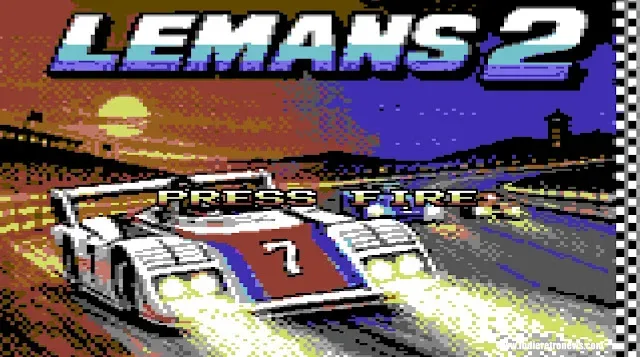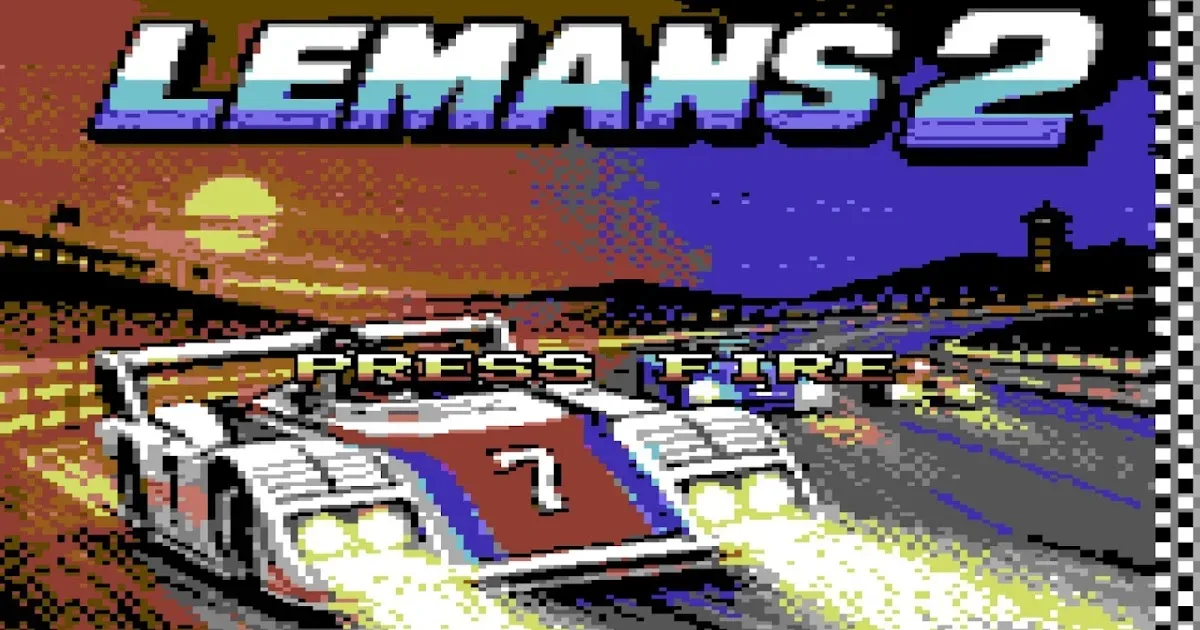
ZeroG Labs has released version 1.3c of Lemans 2, its Commodore 64 top-down arcade racer inspired by the earlier Lemans. The stated headline change is a new full-screen title cover, while the game’s central race-against-the-clock design remains intact: launch from the lights, thread through traffic, reach checkpoints and keep the run alive.
That may sound like a modest update, but a title screen is part of the game’s first impression—particularly on a machine where the journey from loading a program to entering a run can feel like a ritual. More importantly, version 1.3c does not appear to turn Lemans 2 into a different kind of racer. Its appeal remains rooted in immediate, score-focused driving, smooth scrolling and the escalating pressure of a timer that can be replenished but never allowed to run down.
For more recent Commodore 64 project news, see our look at DOOM64 Final Demake’s C64 action and dynamic floors.
A race built around time management
Lemans 2 uses a familiar arcade-racing premise with a sharp risk-and-reward structure. Players begin at the starting lights and must overtake a crowded field of rival cars while travelling through a series of checkpoint sections. Passing a checkpoint extends the remaining time, but the reserve is capped at 60 seconds. In practical terms, strong driving is not simply about keeping the car pointed forward. It is about repeatedly earning enough time to continue while making the most of the traffic that stands between one checkpoint and the next.
The timer is the game’s most important constraint. A collision or spin-out removes valuable seconds, turning a single handling mistake into a direct threat to a run. That creates a meaningful choice whenever the road narrows or bends: a player can attempt a more aggressive pass for speed and points, or leave more room and protect the clock. The design encourages concentration because neither approach is consequence-free. Caution may cost momentum; contact costs time.
Checkpoints, in this context, are timed progress markers rather than merely locations on a course. Reaching one adds to the time available for the next segment. The 60-second ceiling matters because it prevents unlimited banking of time. A player who reaches a checkpoint with a healthy reserve gains breathing room, but cannot build an endlessly safe buffer. Maintaining a run therefore remains the objective even when things are going well.
Overtakes are also the scoring engine
Survival is only part of Lemans 2’s arcade proposition. The game awards a 1,000-point bonus for every 10 cars overtaken, so traffic is not just an obstacle course. It is the route to a better score. The best runs demand a balance between clean passing and survival, especially since crashes and spins reduce the same resource required to reach later checkpoints.
This is a classic high-score loop: learn the road, identify safer passing opportunities, preserve the clock and convert confidence into overtakes. There is no indication that the update changes this scoring model, which is significant for players who value continuity. Version 1.3c’s presentation adjustment arrives without displacing the system that gives each attempt its urgency.
Related coverage includes Lemans 2 Version 1.3c Brings a New Full-Screen Cover to Commodore 64 Racing.
The game also auto-saves its high-score table, allowing players to enter three-character initials. That small feature is especially well suited to an arcade game. Scores are not merely momentary results; they become a persistent local target, whether the machine is used by one player refining a route or a group comparing runs.
Conditions change the demands of the road
Lemans 2 moves through several environments rather than presenting one uniform stretch of tarmac. Its routes include green countryside and lakeside roads, then shift into snow, night and fog conditions. The courses are described as remixed and are packed with chicanes, bends and narrow straights, giving the scenery a direct gameplay role rather than treating it as background decoration.
A chicane is a quick sequence of opposing turns designed to interrupt a straight line. In a top-down racer, it asks the player to make rapid directional corrections while judging nearby vehicles. Narrow straights can create a different problem: they seem simple, but leave little lateral space for safely clearing rivals. When traffic is dense, a straight corridor can become as dangerous as a corner.
Snow introduces the idea of slipperier conditions, while fog and night reduce visibility. The night stages are particularly notable because headlights illuminate only part of the darkness ahead. That restriction changes the information available to the player: upcoming bends and cars may emerge later, leaving less reaction time. It is a straightforward visual device, but one that reinforces the game’s central need for precise control rather than merely adding atmosphere.
The varied conditions also help explain why a simple top-down format can sustain repeat runs. Track knowledge remains valuable, yet the road is not presented as an identical, fully visible challenge from start to finish. Players must handle different visual conditions as well as the traffic, timer and scoring pressure.
Sound, scenery and smooth movement support the arcade pace
The presentation includes SID-engine sound effects, tire screeches, grandstands and overhead bridges along the course. The SID is the Commodore 64’s sound chip, widely associated with the machine’s distinctive electronic audio. Here, its role is to give immediate feedback to the action: tire noise underscores the car’s movement, while sound effects and trackside elements help sell the sense of a race in progress.
Trackside scenery matters in a scrolling driving game because it gives the road context and makes speed easier to read. Grandstands suggest event atmosphere; bridges provide changing landmarks along the route. These elements are not presented as mechanical additions, but they contribute to a more legible and lively course as the screen scrolls.
Smooth scrolling is also central to this style of game. In a racer where the player is constantly judging bends, gaps and the position of rival cars, visual movement needs to remain readable. Lemans 2’s scrolling has been highlighted as a strength, and that directly serves the precision demanded by the timer and collision penalties.
Joystick and paddle support broaden the control options
Lemans 2 supports standard joysticks as well as Commodore paddles. The choice is useful because the two control types offer different physical approaches to steering. A joystick uses directional movement, while a paddle uses rotational input. Players can select the option that feels more natural for their setup without the game being tied to a single controller format.
That flexibility is relevant to a game built around close overtakes and avoiding spin-outs. Fine steering input can influence how comfortable a player feels attacking chicanes or squeezing by a rival on a narrow section. The available information does not establish whether either control method offers a competitive advantage, but offering both gives players room to decide based on their own equipment and preference.
What version 1.3c means for existing and curious players
The evidence around version 1.3c points to a presentation-focused release rather than a redesign. The new full-screen cover is the identified addition, and the essential identity of Lemans 2 remains the same: a C64 arcade racer in which checkpoints feed the timer, overtakes drive score bonuses, and mistakes drain the resource needed to keep racing.
For existing players, that continuity is the practical takeaway. The update preserves the familiar rhythm instead of asking players to relearn the game’s core systems. For newcomers, the game’s premise is easy to understand but has enough interacting pressures to reward practice: steer cleanly, watch the clock, use traffic for points and adapt to changing visibility and road layouts.
Lemans 2 is not positioned as a simulation of endurance racing. Its top-down perspective, time cap and overtaking bonuses place it firmly in the arcade tradition, where every second and every passing maneuver contributes to a score-chasing run. Version 1.3c keeps that identity in place while giving the game a refreshed opening screen for Commodore 64 drivers ready to chase another set of initials on the table.