Kweepa has released the final version of DOOM64, a Commodore 64 demake that recreates Doom-style first-person action through a set of sharply defined technical compromises. It is the second planned entry in the creator’s id Software conversion trilogy, following an earlier Doom project for the VIC-20.
The name needs a little unpacking. This is not presented as a conversion of the Nintendo 64 game Doom 64. Rather, DOOM64 is a Doom-inspired interpretation built for the Commodore 64, working from the visual identity and assets of the 1993 PC release while adapting the experience to radically different hardware constraints.
That distinction is more than trivia. The project’s central achievement is not an attempt to replicate every graphical technique associated with Doom on a smaller machine. It is an effort to decide which ingredients make a compact C64 game feel recognizably Doom-like, then spend the system’s finite processing time and memory on those ingredients.
A trade-off built around vertical space
Kweepa’s prior VIC-20 Doom project used off-axis walls. In a first-person game, off-axis geometry means walls and corridors can be viewed at angles rather than only in straight-on, orthogonal arrangements. That helps a world feel less boxy, but calculating and drawing those angled surfaces costs valuable processor time.
For DOOM64, Kweepa dropped off-axis angles and redirected those cycles toward dynamic floor and ceiling heights. In practical level-design terms, that means the environment can communicate elevation and vertical variation rather than remaining visually flat from room to room. Floors and ceilings changing height are a major part of how Doom-like spaces gain texture, pacing and a sense that a level has layers rather than simply connected corridors.
It is an especially telling design choice because it prioritizes what players read from the screen over a more expansive geometric rule set. A level made from straighter wall relationships can still create tension through height, shadow and enemy placement. Conversely, supporting more wall angles without the resources for strong depth cues could leave the game looking technically ambitious but visually unclear.
The result is a reminder that demakes are not merely reductions. At their best, they are redesigns. A creator identifies a hardware limit, establishes the effect worth preserving, and finds a compromise that makes the final game coherent on its own terms.
How DOOM64 creates its lighting
The Commodore 64 version uses the machine’s 40-by-25 text display for its lighting effects. Rather than relying on full texture mapping, the game refreshes that display with dithered shading patterns to indicate changes in light.
Related coverage includes DOOM64 Demake Brings Doom-Style Action to Commodore 64.
Dithering is a visual technique that places contrasting pixels or character patterns close together so the eye perceives an intermediate shade or a transition between light and dark. On constrained hardware, it can create an impression of gradients or shadow without needing a distinct color for every level of brightness. Here, the shifting patterns provide an atmospheric tool: areas can look darker, lighter or differently shaded even within the limits of the C64 display approach.
The important point is that this is not texture mapping in the conventional sense. Texture mapping applies an image pattern across a surface in a way that changes with perspective. It is visually powerful, but on this project it was intentionally set aside. Kweepa’s reasoning was aesthetic as well as technical: full texture mapping at the available resolution risked producing a muddy image.
That decision also released memory for other parts of the game. The saved space is used for custom lookup tables, enemy mipmaps and a native soundtrack. A lookup table is precomputed data used to avoid repeatedly performing a costly calculation during play. In a real-time game, this can be the difference between an effect being practical or too slow. Mipmaps are alternate versions of an image intended for different apparent distances or scales; in this context, enemy mipmaps help sprites remain useful at varying ranges.
None of those techniques independently makes a game Doom. Together, however, they show a clear technical philosophy: reserve the expensive work for movement through a world with elevation, make lighting legible through patterns, and protect the limited memory needed for enemies, sound and game-specific data.
Maps designed around immediate visual feedback
The maps were made frame by frame on a grid through a custom editor with instant previews. That workflow matters for a project where elevation and dithered shadows are foundational design tools.
A grid-based editor provides a structured way to place the components of a map, while immediate previews let the designer see whether a change produces the intended image rather than merely trusting numerical values. For a game that favors dynamic height changes, the preview process would be particularly useful for judging whether a raised section reads clearly, whether an adjoining ceiling creates the right sense of enclosure, and whether a lighting pattern adds atmosphere instead of visual noise.
The source material describes the editor as a way to balance elevation and shadows. That balance is central to first-person readability. A dark area may imply danger, conceal an enemy or distinguish a route. Height may create a landmark or make an open section feel more imposing. But if the contrast is too low, the scene becomes difficult to parse; if it is too stark, the shading can overwhelm the geometry. Building each frame with rapid visual checks is therefore a practical response to the system’s limitations, not just a convenience feature.
Sprites, sound and the character of the conversion
The weapon imagery began with sprites from the PC shareware release. Those assets were hand-tweaked, recolored and rescaled for the Commodore 64 version. That is another example of adaptation rather than simple copying: an image suitable for one display format is not automatically suitable for another. Re-palette work changes the available colors, while rescaling must preserve a sprite’s key silhouette and motion cues at a smaller or differently structured presentation.
The audio follows a separate path. Kweepa has said the sounds derive from original PC speaker effects that were decimated, an approach that had also worked on the VIC-20 project. In audio processing, decimation reduces data, commonly by lowering a signal’s sampling detail. The resulting sound is less information-rich, but that reduction can be useful when fitting effects into a restrictive system environment.
Alongside those effects, DOOM64 includes a native soundtrack. “Native” here means music made for the Commodore 64 rather than simply being an untouched recording transferred from elsewhere. Sound is often treated as a secondary detail in technical showcase projects, but the combination of custom C64 music and adapted effects suggests it is being used as part of the game’s overall identity.
Two versions target two different C64 setups
DOOM64 is offered in two editions, reflecting the fact that Commodore 64 players do not all run games in the same way. One standard version is optimized for modern emulators and hardware fastloaders, including the C64 Ultimate. The other is a Krill-powered version intended to maximize disk loading speeds on an unmodified, stock Commodore 64.
That split is practical. An emulator and a modern storage or loading solution can change how a program is accessed, while an original machine with no modifications faces different loading constraints. Providing separate builds means the game can accommodate both a convenience-oriented setup and people using baseline hardware without implying that either audience must accept the other’s compromises.
The Krill-powered option is specifically about disk speed on an unmodified C64. It should not be read as a claim that the game itself has different gameplay or rendering features; the stated purpose is loading performance. Players choosing between the two should therefore focus first on how they intend to run it: emulator or fastloader for the standard version, or original stock hardware for the Krill-oriented alternative.
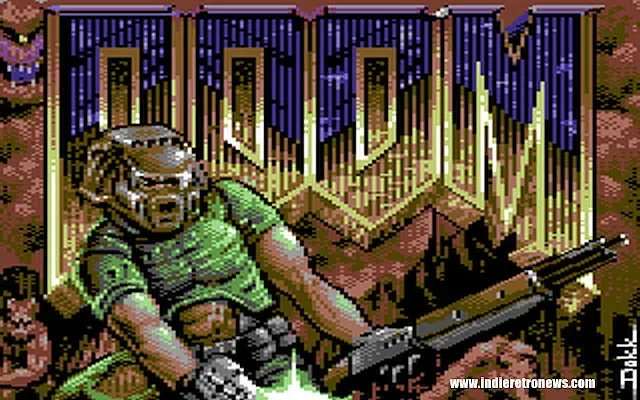
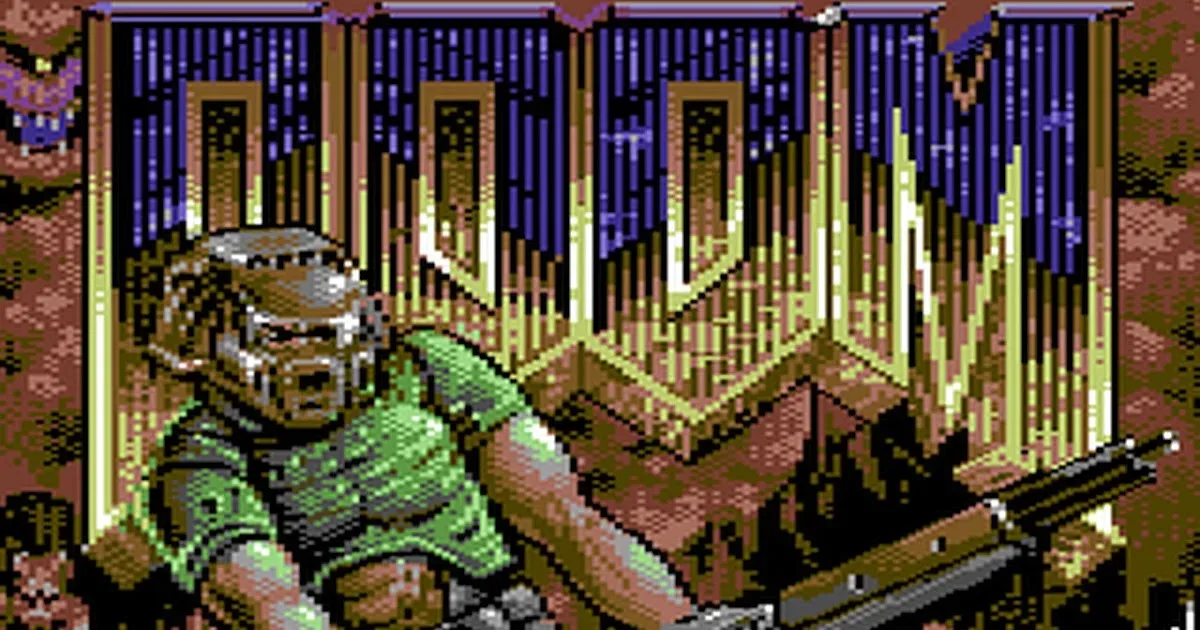
The package also includes a loading splash screen by digital artist Paul Docherty, known as d0kk!. Loading screens are easy to dismiss, but on disk-based retro hardware they are part of the experience’s framing. A dedicated illustration turns waiting time into a deliberate presentation moment and gives the release a visual identity before play begins.
Why projects like this matter
DOOM64’s appeal lies partly in the specificity of its constraints. The Commodore 64 version does not chase a fictional “perfect port.” It makes visible decisions: no full texture mapping, no off-axis walls, but active height variation, lighting through dithering, hand-adapted weapons, tailored audio and versions designed for distinct ways of using C64 hardware.
That makes it a useful case study in preservation-minded development as well as retro game craft. Keeping older platforms playable is not only about retaining old software; it can also mean making new software that understands the original machine’s strengths and limits. Broader debates about access, private servers and keeping games functional continue to shape the medium, as seen in ongoing concerns around game preservation and player access. A new C64 release approaches the question from another angle: it gives aging hardware another purpose without pretending its boundaries do not exist.
For players, the practical promise is straightforward: a finished Doom-style C64 game designed around a particular visual language instead of an impossible one-for-one reproduction. For developers, its methods underline a timeless lesson. When a platform cannot do everything, a focused set of technical choices can be more convincing than a longer list of compromised features.