Big Ball Back Breaker has arrived as a new Commodore 64 arcade game built around a direct but potentially unruly premise: run, jump, survive and grab what you can while bouncing balls turn the screen into a hazard zone. The game contains 16 levels and is described as a “run, jump, and collect ’em up,” with useful pickups sharing space with deliberately nasty surprises.
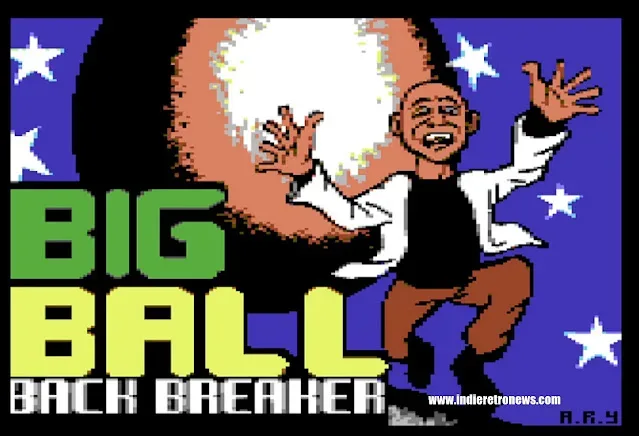
Richard Bayliss handled the programming, game design, graphics, sound effects and music, making this a notably author-driven C64 release. The package also includes a cartoon-style multicolour loading bitmap by Alf Yngve, an intro with graphics credited to Chesser/Blazon, and a tape-loading system credited to Martin Piper and Bayliss.
A score-chasing arcade setup with hazards on both sides of the decision
The central idea is less about a long narrative campaign than immediate reactive play. Bouncing balls create the survival pressure; items placed among that danger create the temptation. That combination matters because a collectable is not automatically a reward in this design. Some items provide power-ups, while others are harmful surprises. The player therefore has to make quick judgments instead of treating every object on screen as a safe objective.
That is a classic arcade tension, but Big Ball Back Breaker applies it to a clear platform-action vocabulary: movement, jumping, dodging and collecting. The stated 16-level structure gives the game a defined progression rather than an endlessly repeating score mode, while the high-score table keeps the focus on replaying and improving runs.
Power-up is the broad term for an item that temporarily or permanently helps the player, whether through stronger abilities, safer movement or another advantage. The specific effects of Big Ball Back Breaker’s pickups have not been detailed, so players should not assume a particular type of boost. What is clear is that helpful items are part of the game’s risk-and-reward loop.
Hazard, in this context, means an element that threatens a run rather than merely decorating the stage. Here, the bouncing balls are the prominent environmental danger, and the harmful items add another layer: danger may come from an object the player actively chooses to collect. That changes the rhythm from simple avoidance into identification and timing.
Sixteen levels, plus a reason to revisit them
A 16-level arcade game can live or die on whether players want another go after a failure or completion. Big Ball Back Breaker’s front end and competitive high-score table point firmly toward that replay-minded approach. A high-score table is more than a list of numbers: it gives each attempt a measurable outcome, whether the player is trying to outdo a previous personal run or compete with others using the same machine.
The disk edition goes a step further by including a functional high-score saver. In practical terms, that means scores can be retained rather than existing only for the current session. For players who enjoy revisiting C64 games over days or weeks, persistent score data is a meaningful feature. It lets the competition survive a reset and gives a good run a longer life than a single play period.
Related coverage includes Big Ball Back Breaker Brings 16 Levels of Arcade Chaos to Commodore 64.
The tape version, meanwhile, uses a retro-styled tape loader. Tape and disk are different physical software formats for the Commodore 64: tape releases load through cassette hardware, while disk releases use floppy-disk hardware. Big Ball Back Breaker’s split is notable because it recognizes both routes to playing on original hardware. The disk version’s score-saving feature is specifically identified; no equivalent persistent-score function is stated for the tape edition.
PAL and NTSC support explained
Big Ball Back Breaker supports both PAL and NTSC Commodore 64 systems. Those labels refer to regional television/video standards associated with different versions of vintage home computers and displays. For an action game driven by movement and timing, explicit compatibility is welcome: it signals that the release is intended to accommodate owners across both system types rather than being framed around only one regional setup.
No further technical details have been provided on how the game handles the differences between PAL and NTSC hardware, so it would be premature to claim identical timing, frame behavior or presentation across every display arrangement. The important confirmed point is straightforward: the game is built with both PAL and NTSC C64 users in mind.
This attention to formats fits the game’s broader presentation. Rather than treating the loading process as a disposable delay before the action, the release gives it visual personality through Alf Yngve’s bitmap art and, on tape, a dedicated loader system. On a machine where loaders, intros and title screens can be part of the ritual of starting a game, those pieces help form the complete release rather than sitting outside it.
A full production credit list, not just a name on the title screen
Bayliss’ credits span nearly every part of the actual game: programming, design, graphics, music and sound effects. That gives Big Ball Back Breaker a cohesive creative footprint, from the way its levels play to the sound that accompanies the action. The supplied description characterizes the music as uptempo, with custom sound effects also credited to Bayliss.
The additional credits distinguish the game itself from its surrounding presentation:
- Richard Bayliss: programming, game design, graphics, sound effects and music.
- Chesser/Blazon: intro graphics.
- Martin Piper and Richard Bayliss: tape loader system.
- Alf Yngve: multicolour loading bitmap artwork.
That division is useful for retro-game fans who value a release as a whole package. The playable program is only one component; the intro, load sequence, title presentation and saved-score functionality all influence how a game feels on original hardware.
What players should expect—and what remains unspecified
The available details support a clear picture of Big Ball Back Breaker as a brisk arcade challenge: 16 levels, a player character that runs and jumps, bouncing-ball hazards, items with mixed outcomes, music and effects, and score competition. It is not presented as a role-playing game, a sprawling adventure or a simulation. Its appeal is in pressing forward under pressure while learning when an apparent reward may be trouble.
Several specifics remain unstated. There is no supplied information on controls, the exact nature of the power-ups and traps, level themes, life systems, scoring rules, difficulty settings, file size, distribution price or digital availability. Those gaps are worth keeping in mind, particularly for players deciding between the tape and disk editions or preparing a particular C64 setup.
Still, the confirmed feature set is substantial for the game’s focused arcade premise. A defined 16-level run, dual PAL/NTSC compatibility, a disk high-score saver, tape-loader support and a bespoke audiovisual package all suggest a release intended to feel complete on the Commodore 64—not merely a brief technical exercise.
For a wider perspective on how games establish their identity through foundational design choices, see our look at why a first game’s worldbuilding can shape everything that follows. Big Ball Back Breaker works at a far smaller arcade scale, but its own identity is similarly rooted in the relationship between a simple premise and the systems surrounding it: movement, threats, uncertain pickups and the chase for a better score.