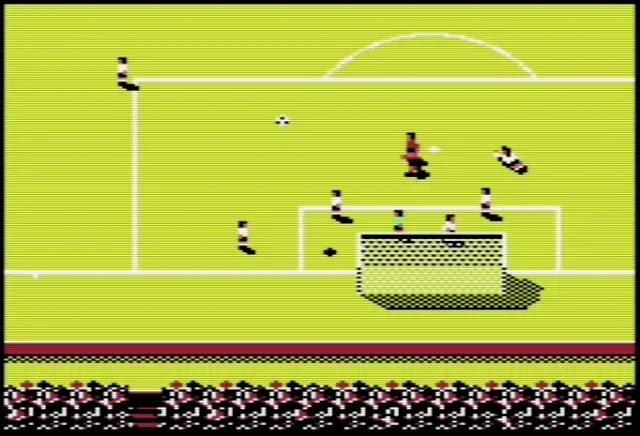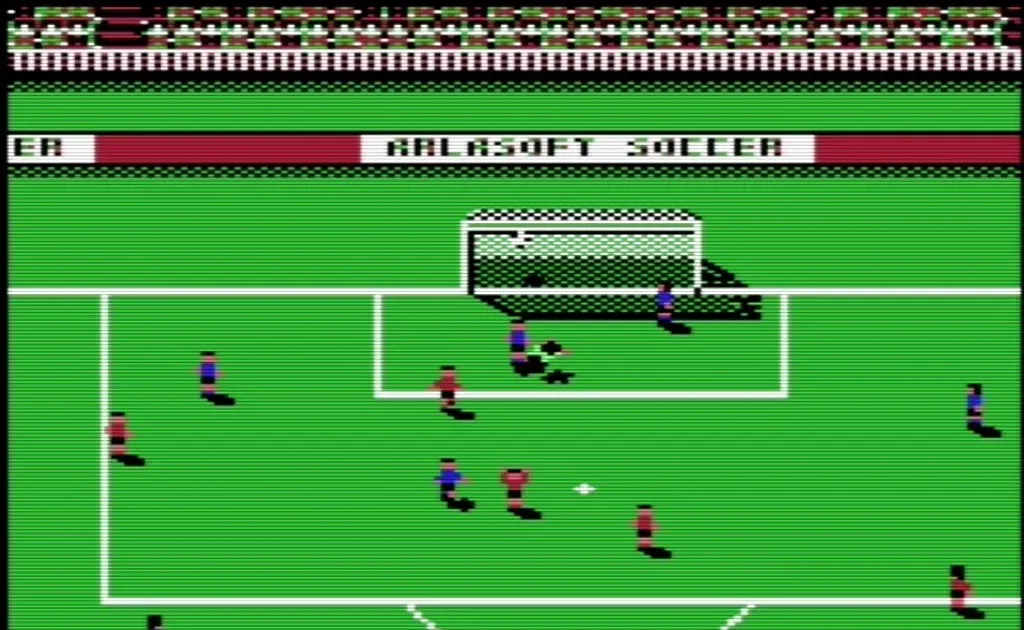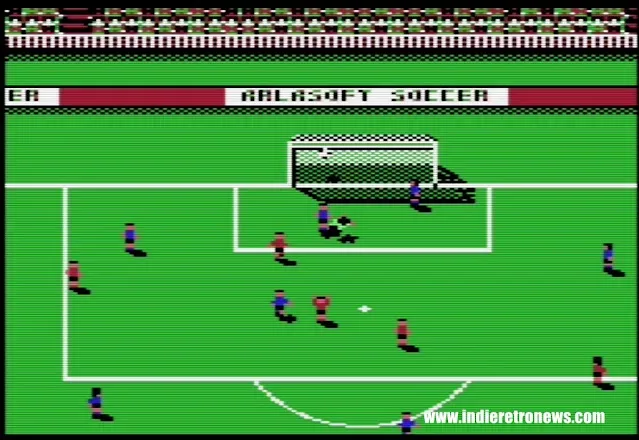
Arlasoft Soccer is a new, unofficial Commodore 64 football game built around the famously quick, readable Sensible-style approach to the sport. Its arrival is notable not simply because the game resembles a 16-bit favourite, but because it attempts to carry over the far more difficult part of that design: the relationship between player movement, ball behaviour and immediate control response.
The project follows five years of planning and technical work. The visual side of the conversion was comparatively manageable, but reproducing the particular movement and physics model required a clearer technical foundation. That foundation came from the team behind SWOS2020, which shared reverse-engineered C++ code and detailed systems documentation. Those materials provided a blueprint for recreating the relevant behaviour on radically less capable hardware.
That is the story behind why Arlasoft Soccer matters to retro players. It is not trying to turn a Commodore 64 into a more powerful machine, and it does not claim to retain every feature associated with later or larger versions of the formula. Instead, it is a focused attempt to preserve the on-pitch identity of a game style within the C64’s hard limits: a 1MHz 8-bit 6502 processor and 64KB of RAM.
The challenge was feel, not just football on screen
Sports games can look familiar long before they play familiarly. A top-down football pitch, small player sprites and a scrolling camera establish the surface-level presentation, but they do not automatically create a satisfying match. The decisive details are often harder to see: how quickly a player changes direction, how momentum carries through a turn, whether the ball appears attached to a dribbler or loose in space, and how reliably a pass behaves when the pitch is moving underneath the action.
Arlasoft Soccer’s development was therefore as much an exercise in reproducing a ruleset as recreating graphics. The reverse-engineered code and documentation were important because they helped identify the systems beneath the original feel rather than leaving the C64 version to approximate that feel only by eye. In practical terms, that can mean the difference between a game that is merely inspired by Sensible-style football and one whose movement has the recognizable rhythm players expect.
There is an important distinction here. The game pares back broader modes and data to fit its target machine, but the stated aim is to preserve the core “Sensi” match gameplay. That makes the port’s priorities clear: responsive football comes before a larger surrounding package.
How the C64 version makes the numbers work
The central technical problem is scale. The original code being translated was made for a 16-bit processor running at 7MHz; the C64 uses a 1MHz 8-bit 6502 and offers just 64KB of RAM. Those figures are not a simple, one-to-one performance comparison, but they illustrate why the team could not just move the original logic over unchanged.
Arlasoft’s solution is a set of targeted compromises and optimisations designed to protect the match flow. Mathematical lookup tables are one of the most important. A lookup table stores answers that a program expects to need repeatedly. Rather than spending processor time calculating multiplication or division during a busy match, the game can retrieve a prepared result. On hardware where every slice of processing time matters, that trade can be extremely valuable.
Another measure is to update player and ball movement on alternating frames. A frame is one individual screen refresh or display step. Restricting these updates to every other frame reduces the amount of work demanded from the processor, effectively halving that particular processing burden. It is a compromise, but one selected to leave enough time for the other jobs a scrolling football game must perform.
Some calculations also happen in tile space rather than pixel space. Pixel space deals in the individual dots that make up the display. Tile space instead works with larger grid units used to assemble areas of the screen. Using tiles can reduce the precision required for certain systems and, with it, the number of calculations the machine has to complete. The result is an engineering decision aimed at keeping the match moving, not a change made for its own sake.
The game also has to manage sprite multiplexing and screen scrolling at the same time. Sprite multiplexing is a classic technique in which available hardware sprites are reused at different points of the display as it is drawn, allowing a game to show more moving objects than a simple fixed sprite limit would otherwise allow. It is useful for representing a full football match, but it places extra demands on timing. Add a scrolling pitch, active players and a loose ball, and the available performance budget gets tight very quickly.
Slowdowns are possible in the busiest moments
Arlasoft Soccer can still experience minor slowdown when the goalmouth becomes especially crowded. That is an honest limitation of the workload involved, and it is presented as comparable to slowdowns possible in the Amiga 500 original. The relevant takeaway for prospective players is not that every match will struggle, but that the most congested attacking sequences remain the pressure point.
Commodore 128 owners have a potential advantage. The C128’s border raster speed boost can be used to achieve performance described as virtually flawless. “Raster” refers to the display being drawn line by line; work associated with the screen border can offer a useful timing opportunity on compatible hardware. The benefit is especially pertinent in a game that must synchronize movement, scrolling and many animated objects so carefully.
For the wider retro community, the project is a reminder that a port is often a series of decisions about what must be exact, what can be simplified, and where a machine’s unusual strengths can be exploited. The C64 version’s use of precomputed maths, alternating updates and tile-based calculations is not cosmetic technical trivia. Those choices are the reason an ambitious football game can fit and function at all within this hardware envelope.
What is included, and what had to be left behind
The 64KB memory ceiling meant some large-scale features could not make the transition. Arlasoft Soccer does not include career modes, substitutions or licensed player names. These are meaningful omissions for anyone looking for a deep season-management game or real-world roster presentation.
However, the release still offers a substantial set of match options:
- Human-versus-human and human-versus-CPU matches
- A 16-team cup mode
- Penalty shoot-outs
- Eight difficulty levels
- Six tactical formations
- Seven pitch types that change ball physics
The pitch selection is especially worth noting. It is not described as a visual-only choice: the seven pitch types actively affect how the ball behaves. That gives players a reason to consider surface conditions as part of their setup. A change in ball physics can influence passing, loose-ball recovery and the pace of a move, meaning the selected pitch can be part of the tactical identity of a match rather than just decoration around it.
The six formations supply another layer of adjustment without requiring the storage and simulation overhead of a full career structure. Likewise, eight difficulties offer a broad range for solo matches, while the cup and shoot-out modes keep the game focused on compact competitive scenarios. The feature set is best understood as deliberate concentration: fewer sprawling modes, more attention placed on repeatable matches and customizable conditions.
Compatibility across old hardware and modern setups
Arlasoft Soccer supports both PAL and NTSC formats. That matters because the Commodore 64 ecosystem spans regions that use different display standards, and timing-sensitive software can behave differently between them. Supporting both expands the range of original machines on which the game is intended to run.
The game is also listed as compatible with original C64 hardware, VICE, MISTer and modern clone consoles. VICE is an emulator, while MISTer is a hardware-based FPGA platform commonly used to recreate the behaviour of older systems. Clone consoles are modern machines designed around compatibility with the C64 environment. Together, those options mean the release is positioned for people who use an original computer as well as those who approach the platform through emulation or contemporary hardware.
There is one known caveat: a minor glitch affects C64 Ultimate turbo modes, and a patch is awaited. That wording matters. The issue is tied to turbo modes rather than being described as a general compatibility failure, and the expected patch indicates it is a known item rather than an unknown limitation. Players using that configuration should account for it rather than assuming every accelerated setting will currently behave identically.
The range of supported ways to play fits a larger retro-hardware landscape in which original systems, FPGA recreation and modern reproduction machines coexist. For another example of how current hardware continues to serve older game libraries, see our coverage of Analogue’s returning Super Nt+ and Mega Sg+ systems.
Why this port is more than a novelty
Analysis: Arlasoft Soccer’s most interesting achievement is its choice of target. The C64 is not receiving a generic football game shaped around the machine’s constraints from the outset; it is receiving an attempt to reproduce a distinctly responsive, fast-moving football formula that originated on considerably stronger hardware. The project’s success therefore depends on preserving priorities that are easy to underestimate: movement timing, ball response and visual clarity during active play.
That also explains why the cuts do not necessarily undermine its purpose. Career modes, substitutions and licensed names can expand a sports game’s scope, but they are separate from the moment-to-moment exchange of dribbling, passing, shooting and defending. By allocating limited memory and processing time toward the latter, Arlasoft Soccer makes a coherent argument about what belongs at the centre of this particular C64 adaptation.
The use of reverse-engineered technical material is significant in that context. It gave the developers a path toward understanding behaviour precisely, then translating it through C64-specific methods rather than guessing at the result. That is different from simply copying an aesthetic. It is preservation work directed at systems: how a game operates as much as how it appears.
For players, the practical expectation should be clear. Arlasoft Soccer offers a feature-rich compact football package built around its matches, with options for local human play, CPU opponents, cups, penalties, formations, difficulty and physics-changing pitches. It does so across PAL and NTSC machines and several modern routes into C64 software, while retaining a few hardware-specific caveats. Its ambitions are tightly defined, but within those boundaries, this is a technically inventive effort to put a demanding style of football on one of retro gaming’s most constrained and enduring platforms.
For additional coverage of the release, read the related report.