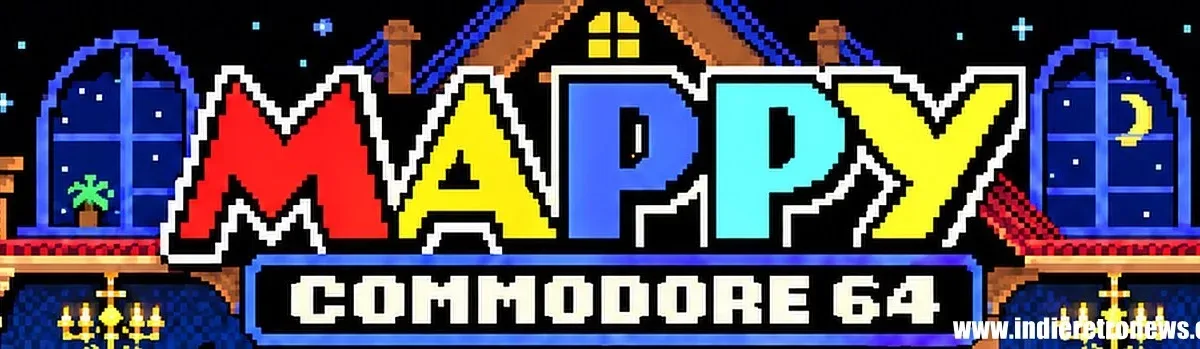
Mappy, Namco’s 1983 arcade game about a police mouse, has received a new Commodore 64 conversion from developer charger0277. The release is available in two familiar C64 formats: a .d64 disk image and a .crt cartridge image. Its key technical requirement is less familiar to casual C64 players, however: it needs a 1 MB RAM Expansion Unit, or REU.
That requirement is central to the port’s design rather than a minor optional enhancement. The C64 itself has 64 KB of memory for its program code, data, graphics and screen work. The conversion instead uses the additional memory in an REU to hold much of the material that cannot comfortably coexist in the machine’s standard memory while supporting the game’s scrolling presentation.
It is a notably focused approach to bringing an arcade design to an eight-bit computer. Rather than presenting the REU as a vague specification bump, the developer has outlined how the added memory is used: houses, music, screens, the bonus round and pieces of the program are stored there and brought in as needed. The result is a release aimed at C64 setups with expansion hardware, compatible devices such as Ultimate units, or an emulator configured with REU support.
A six-floor chase through a cat-filled mansion
The game retains the recognizable structure of the arcade original. Players guide Mappy through a multi-storey mansion, attempting to recover stolen treasure while avoiding a gang of cats. The mansion spans six floors, and Mappy’s principal route between them is a network of trampolines.
Those trampolines do more than provide vertical movement. They make navigation a persistent risk-management exercise: Mappy must use them to move among floors while the pursuing cats pressure his path. The house also contains standard doors and microwave doors. Opening them can stun nearby enemies, giving the player room to escape, reroute or reach an item that would otherwise be too dangerous to approach.
Treasure collection is tied to score strategy as well as progression. Matching pairs of items earn bonus points, so players are encouraged to think about collection order rather than treating every object as an isolated pickup. That keeps the game’s basic premise easy to understand—grab the stolen goods and evade cats—while giving score-focused runs an extra layer of planning.
The opposition includes Goro, the prominent red boss cat, alongside the smaller blue Meowky cats. Goro was originally known as Nyamco. Their presence maintains the familiar cat-versus-mouse identity of Mappy while the doors and trampoline routes give players tools to create a brief opening rather than simply outrunning every pursuer.
Why the 1 MB REU matters
An REU is an external memory expansion for the Commodore 64. In this case, the port calls for a 1 MB model. The practical purpose is capacity, but the technical benefit described for this release also involves speed: the REU can transfer memory independently at roughly ten times the rate of the C64’s processor.
Related coverage includes Mappy Arrives on Commodore 64 in a New 1 MB REU Arcade Conversion.
That distinction matters for scrolling. Smooth scrolling needs two screen buffers: one displayed to the player while another is prepared. Those two screens alone consume 22 KB. With the game program taking another 30 KB, the C64’s 64 KB total is already under severe pressure before accounting for the mansion layouts, audio, bonus material and other assets.
The REU supplies roughly 250 KB for that remaining content. Most importantly for the port’s presentation, the mansion can be drawn within the REU. When the screen scrolls, the newly needed rows can be transferred in ready for display. In plain terms, the expansion is doing much of the behind-the-scenes moving and staging of data that would otherwise compete for the C64’s limited memory and processor time.
That is why “1 MB REU required” should be read as a hardware baseline, not a label for a version with a few extras. A stock C64 does not meet the stated requirement. Anyone preparing to run the game on original hardware will need a compatible 1 MB expansion solution; those using emulation will need to ensure the emulator is set up with suitable REU support.
Disk image and cartridge image explained
The two supplied file types suit different C64 workflows. A .d64 is a disk-image format, representing a Commodore 64 disk. A .crt is a cartridge-image format, intended for cartridge-style loading on compatible hardware or software. The release therefore gives players a choice aligned with their preferred setup, while retaining the same REU requirement.
The unified release also automatically detects whether it has started on a European PAL machine or an American NTSC machine. PAL and NTSC refer to different television and video standards historically associated with different regions. For players, automatic detection means there is one file rather than a separate PAL and NTSC download to identify and choose at launch.
That compatibility decision is especially useful for a retro release intended to run across original hardware, modern C64-compatible devices and emulated environments. It does not remove the need for the 1 MB REU, but it does reduce one common point of regional setup friction.
An arcade conversion shaped by C64 constraints
The technical outline gives this Mappy port a clear identity. It is not attempting to pretend the C64 has unlimited space, nor is it framed as a stock-hardware conversion. Instead, it relies on an expansion device to solve a specific combination of issues: the memory cost of double-buffered scrolling, the size of the game’s assets and the need to move visual data quickly when the mansion view changes.
For retro players, that makes the release as much about configuration as it is about the game itself. Before launching it, the useful checklist is straightforward:
- Choose either the .d64 disk image or .crt cartridge image for the intended C64 setup.
- Confirm access to a 1 MB REU, whether through compatible real hardware, an Ultimate device or an emulator configuration.
- Allow the unified file to identify PAL or NTSC at startup.
- Learn the mansion’s trampoline routes and keep doors in reserve for moments when cats cut off an escape.
- Watch for matching treasure pairs when pursuing a stronger score.
The gameplay itself remains legible: climb through the mansion, retrieve the stolen items and use doors to turn pursuit into opportunity. Yet the conversion’s underlying design reveals how much planning sits beneath that simple arcade loop. The additional memory stores content that cannot all remain in the C64’s main 64 KB at once, while the REU’s transfer capability helps deliver fresh rows as the screen moves.
It is also a useful reminder that retro hardware projects can be deliberately specialized without becoming inaccessible in practice. The stated support for real expansions, Ultimate devices and emulation gives several paths to meeting the hardware requirement. Players do need to bring the right configuration, but the release is not limited to one single type of machine.
Charger0277’s Mappy conversion arrives amid continuing interest in projects that revisit classic games through modern retro-development techniques and upgraded period-appropriate hardware. For a different example of how current projects are engaging with legacy console design across regions, see Retro Remake’s SuperFPGA and regional SNES design plans.
The code for this Mappy release is described as AI-assisted. Beyond that designation, no further technical breakdown of the assistance is provided. What is clear is the port’s hardware strategy: use the 1 MB REU as both expanded storage and a rapid data-transfer partner, enabling a C64 adaptation built around the needs of Mappy’s scrolling, multi-floor mansion action.