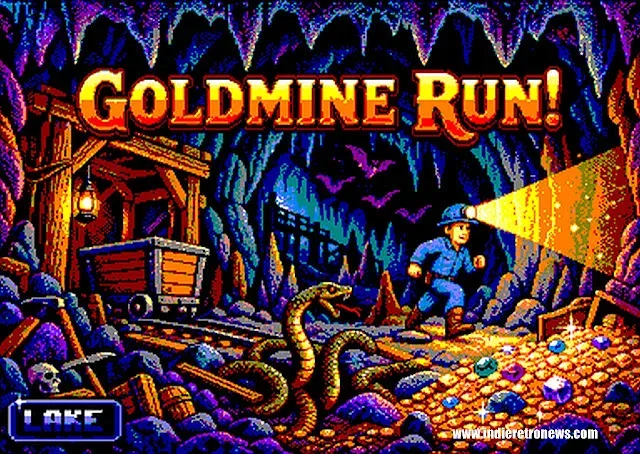
Gold Mine Run! is shaping up as a compact pressure-cooker for the Amstrad CPC 6128. The work-in-progress game from Asic28 sends players into underground caverns with one straightforward assignment: collect every bag of gold. The complication is that these tunnels are almost entirely dark, the player’s light is fading, and the mine is populated by skeletons, bats, snakes and hostile old miners.
That combination gives the project a more urgent identity than a conventional item-collection game. Success is not solely about reaching every gold bag. It is about choosing a route through limited visibility, finding supplies, dealing with locked paths and avoiding enemies before the torch gives out. A five-stage shareware demo offers the opening world in Easy, Normal and Hardcore difficulty settings, while the stated plan for the completed game is six worlds and 30 stages.
A mine where darkness is the clock
The key system in Gold Mine Run! is its shrinking pool of light. Rather than merely making caverns look atmospheric, illumination is presented as a resource that continually runs down. In practical terms, the visible area around the player acts as a clock: every detour matters because the darkness will eventually close in.
When the torch burns out entirely, the Time Monster appears and ends the attempt. That makes light management the defining constraint behind almost every decision. A player can see an uncollected gold bag, but cannot treat it as an isolated target. The useful questions become whether there is enough torch time to reach it, whether a key is required on the route, and whether searching for a replacement torch first is safer than pushing forward.
This is a familiar design principle expressed in a particularly direct way: a resource timer is any consumable value that limits how long a player can stay active or explore freely. Health can function this way, as can oxygen, fuel or a countdown. Gold Mine Run! makes the timer spatial as well as numerical. The player is not simply racing a displayed counter; the playable space itself becomes less readable as the available light contracts.
That distinction matters. Reduced light can make hazards harder to identify and routes harder to remember, so the penalty is not only eventual failure. It also increases uncertainty while the run is still alive. The named Hardcore mode is described as demanding that players learn layouts before darkness wins, suggesting that repeat runs and route knowledge will be central to mastering its tougher settings.
Gold is the goal, but supplies determine the route
Each cavern must be cleared of gold bags, establishing the immediate completion objective. Yet the mine contains more than treasure. Torches, pickaxes and keys are all part of the resource loop.
- Torches extend the period in which the player can see and survive before the Time Monster arrives.
- Pickaxes are navigation resources within the underground setting, though the available details do not specify exactly what obstacles they affect.
- Keys are used to navigate locked doors, placing access restrictions between the player and parts of a cavern.
Keys and locked doors create what game designers commonly call gating: progress is held behind a requirement, so players must locate the needed item or find a different route. In Gold Mine Run!, that structure is more consequential because the torch timer keeps running. A locked door is not just a puzzle to return to later; it can force a quick reassessment of the safest use of remaining light.
The result should be a chain of interdependent choices. A torch may be visible beyond a locked door. The key may lie on a longer branch of the cavern. An enemy patrol may turn the shortest route into the most dangerous one. The available material does not detail enemy behavior, combat options or the exact workings of the pickaxe, so those systems remain to be seen. Still, the basic ingredients indicate a game built around efficient movement and memory rather than leisurely scavenging.
Enemies add moving pressure to a fixed layout
Skeletons, bats, aggressive snakes and renegade old miners occupy the tunnels alongside the player. Their presence ensures the fading-torch mechanic is not the only source of stress. Even once a route has been learned, hostile creatures can make executing it difficult.
Static stage geometry and moving threats ask for different skills. A fixed door, item location or tunnel junction can be committed to memory over multiple attempts. A patrolling enemy introduces timing: knowing where to go is only half the problem if the player must identify a safe moment to pass. That is an especially meaningful complication in low visibility, where the useful information on screen is constrained by the radius of the torch.
The Hardcore description points toward a demanding relationship between those elements. Memorizing layouts can reduce the cost of being unable to see far ahead, but it does not automatically make a run safe. Players still need to conserve light, collect required items, negotiate locks and stay clear of threats. The three available difficulty choices should give the demo a useful range: Easy and Normal can introduce the stage structure, while Hardcore is positioned for players prepared to learn the mine’s layout under harsher pressure.
What the shareware demo includes
The current release is a shareware demo containing five stages from the first world. It supports Easy, Normal and Hardcore difficulties. This is a preview rather than the full intended game, and the planned scope is substantially larger: six distinct worlds comprising 30 action-focused stages.
That stated roadmap provides a clear reason to regard the demo as an introduction to the game’s systems instead of a complete representation of every intended setting. It establishes the core formula—dark caverns, gold collection, supplies, doors and enemy avoidance—while leaving the later worlds and remaining stages for the prospective final version.
The project was coded with C and Z80 assembly language. The Z80 is the processor family associated with the Amstrad CPC platform, while assembly language is a low-level programming approach that works closely with a machine’s instruction set. C is a higher-level language by comparison. A mixed C-and-assembly project can divide work across the two approaches, although no breakdown has been provided for which portions of Gold Mine Run! use either language.
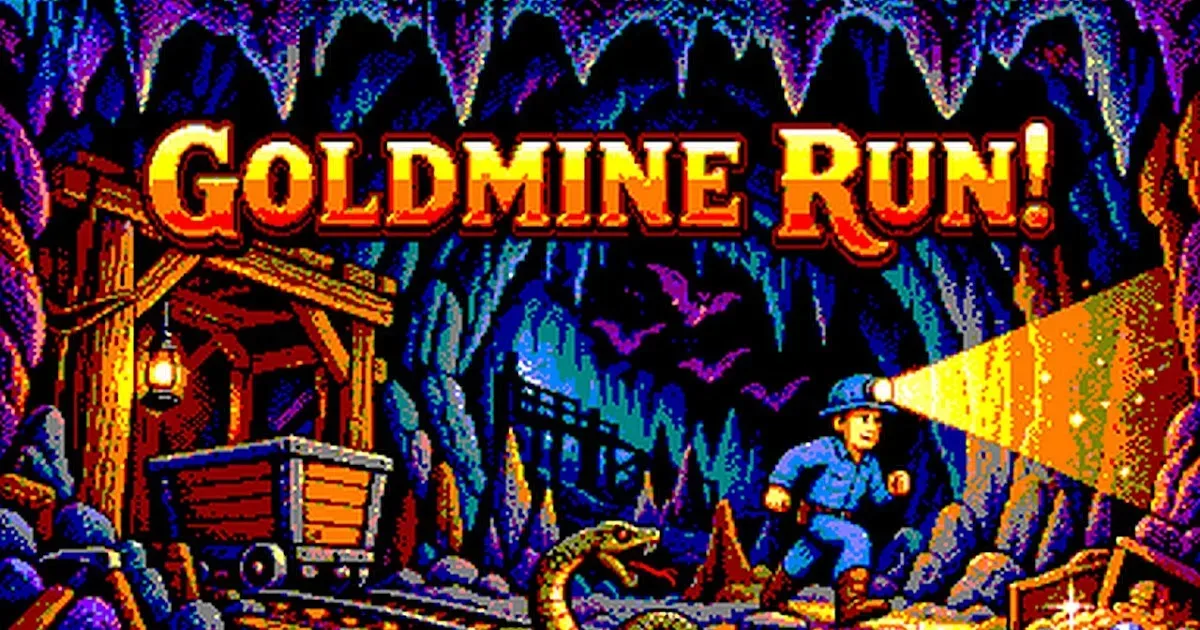
The preview also features an overscan title screen, custom music and sound effects. Overscan here refers to using display area beyond the standard visible picture boundaries normally assumed by a system’s regular screen presentation. It is a technical and visual touch that can make a title screen feel more expansive. The audio details are equally important to the premise: sound effects and bespoke music can reinforce an experience in which visibility is scarce and danger is always close, though the game’s exact sound design is not described.
An established idea adapted for the CPC
Gold Mine Run! is identified as being inspired by Gold Mine Run by Juan J. Martinez. The new project’s premise is therefore best understood as an adaptation of an existing game idea for the Amstrad CPC 6128 rather than an unrelated title that happens to share the same name.
What stands out from the available preview is the way its systems reinforce one another. Gold bags give every cavern a completion goal. The shrinking halo turns exploration into a race. Torches provide a way to extend that race, keys control access through locked doors, and enemies keep the chosen route from being a purely theoretical solution. The Time Monster supplies a decisive failure state when the central resource is exhausted.
For CPC players, the demo offers a focused chance to see how that tension plays on the hardware across five early stages and three difficulty modes. The full 30-stage, six-world plan remains a stated target rather than a finished feature set, but the current outline already presents a clear hook: treasure hunting where the real adversary may be the patch of darkness just beyond the torchlight.
For another look at how games build pressure through hostile environments, see our Gears of War: E-Day review.