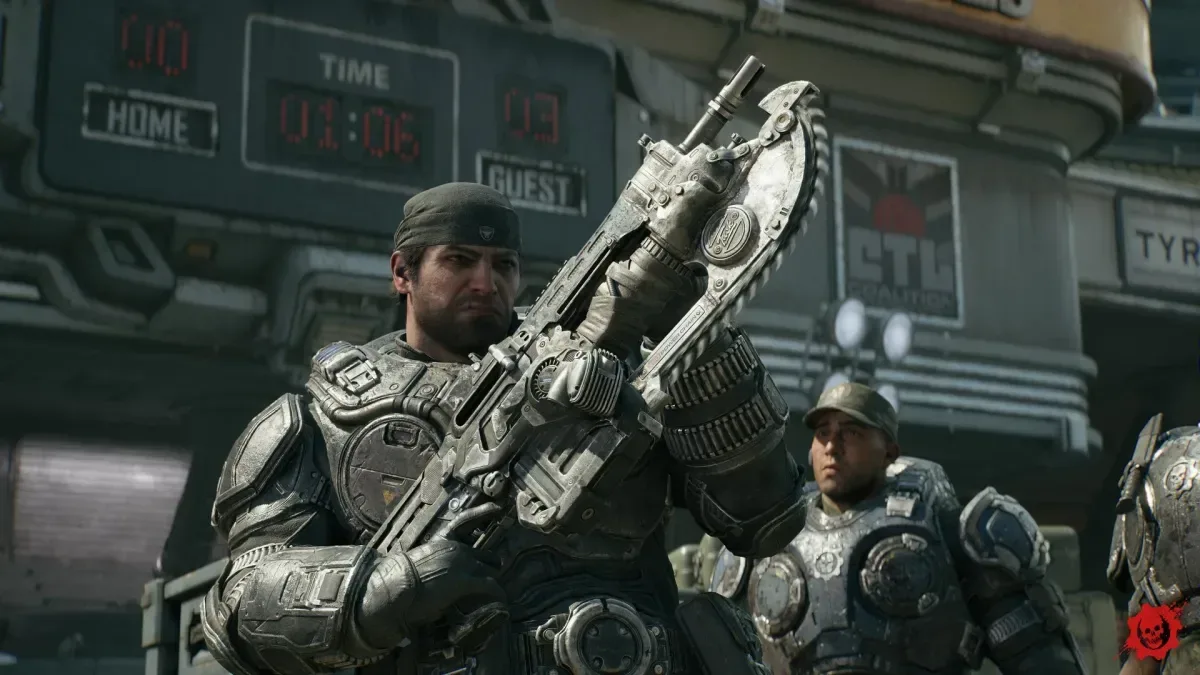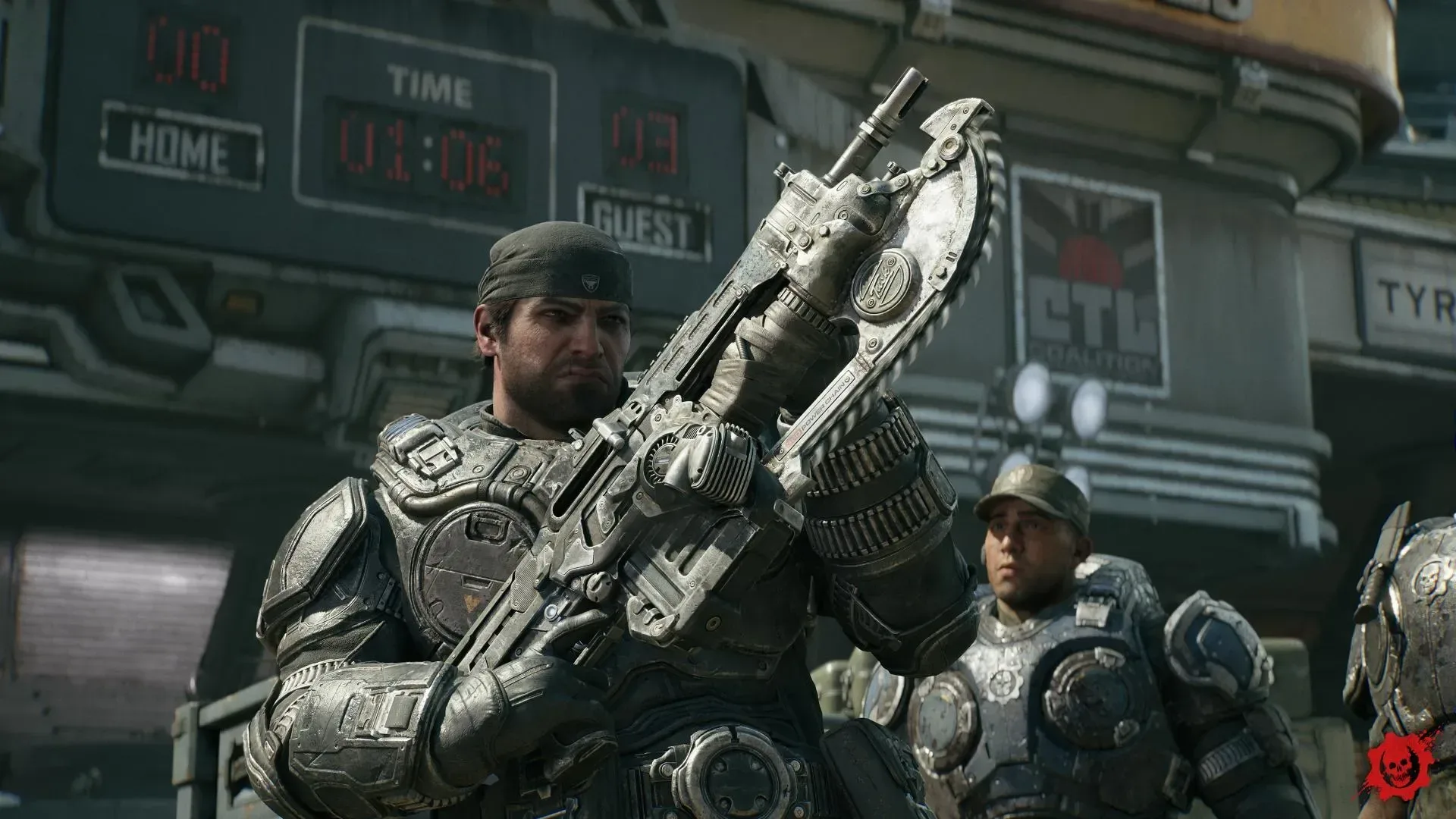
Gears of War: E-Day returns to an event that could easily have been treated as a lore checklist: Emergence Day, the sudden Locust attack that transforms Kalona from a city celebrating peace into the site of a devastating collapse. Instead, it frames that history as a focused disaster story. The result is a Gears game with the expected heavy weaponry and cover-based firefights, but also an unusually potent sense that the people holding those weapons are badly outmatched by the scale of what has begun.
Marcus and Dom arrive in Kalona to be honored for their roles in the recently concluded Pendulum Wars. The ceremony does not last long. Locust forces erupt from beneath the city, civilians are caught in the chaos, and the military response repeatedly proves inadequate. The campaign unfolds over three days, tracing humanity's desperate attempts to understand and contain an invasion it was not prepared to face.
That premise gives E-Day a sharper emotional angle than simple nostalgia. Marcus and Dom may be formidable soldiers, but Kalona is not a place they can rescue through sheer firepower. The city is falling, and the campaign’s effectiveness comes from making that outcome feel inescapable. A player can clear a battle space, survive another vicious encounter, and still feel the larger situation worsening around the squad. It is an appealing contradiction: a power fantasy with enough narrative pressure to make victory feel local, temporary, and costly.
A catastrophe before it becomes a war story
The opening stretch reportedly leans hard into horror, and that seems like the right register for an invasion defined by surprise and incomprehension. Monsters emerging from the ground and the immediate destruction of civilian life make the Locusts feel less like a routine opposing army than an overwhelming force of nature. The campaign does not merely state that Kalona is doomed; its three-day structure gives the collapse room to unfold as plans fail and the city’s options narrow.
That approach should be especially satisfying for players who want a campaign with momentum beyond a chain of isolated arenas. E-Day’s grim stakes do not erase the franchise’s muscular action identity, but they recontextualize it. Every successful defense can still carry dread because it cannot reverse the invasion’s broader course.
The returning leads have a meaningful personal thread as well. Marcus and Dom are dealing with the loss of Dom’s brother Carlos, while new squadmates Mags and Lucas broaden the group dynamic. Mags is a former soldier drawn reluctantly back into action, a role that suits the story’s theme of ordinary structures breaking down under extraordinary pressure. Lucas, the disciplined newcomer prone to supplying extraneous facts, appears to have a less even arc. His late-game material is said to land strongly, but the delayed payoff means he is underdeveloped for much of the campaign. It is a familiar pacing issue: a character can become compelling too late for the earlier scenes to gain much retroactive weight.
More reasons to search every ruined street
E-Day’s most substantial mechanical change is how it handles campaign space. Rather than relying solely on tightly linear shooting galleries or leaning fully into broad, open environments, Kalona is built from city streets with side routes, corners to explore, collectibles to find, upgrades to claim, and optional missions involving survivors. That middle ground sounds well judged. It preserves authored encounters while giving players practical reasons to look beyond the direct route.
The side content is not described as empty sightseeing. Hard cases can contain weapon modifications, and those modifications feed directly into combat choices. This makes exploration feel less like a scavenger hunt conducted out of habit and more like a route toward defining a preferred build. Players who enjoy checking alleys, shops, and damaged side streets for tangible progression should get more out of the campaign than those who want to move straight from objective marker to objective marker.
The build system reaches beyond guns. Weapon mods, armor mods, and tactical abilities can all be adjusted to suit a style of play. The examples point to a flexible but intelligible set of trade-offs: a Longshot mod can reload instantly after headshots, while an Incinerator shotgun mod narrows its spread to favor range and damage. Armor options can reward perfect reloads with extra damage or grant healing for close-range kills. Tactical abilities include support-oriented tools such as healing teammates and marking enemies.
These details suggest that E-Day does not mistake customization for clutter. Its systems appear connected to the moment-to-moment skills the series already values: accurate shots, active reload timing, positioning, and deciding when to fight up close. A sniper-oriented player can reinforce precision. An aggressive player can create more sustain at close range. A cooperative-minded player can contribute through healing and enemy marking. It is a promising way to add individuality without abandoning the franchise’s heavy, deliberate cover-shooter foundation.
For readers interested in a very different approach to purposeful exploration and environmental design, Joking Joystick’s Quern - Undying Thoughts PC Design Feature offers a puzzle-led contrast. E-Day’s spaces are about pressure, combat resources, and survivor-focused detours; their value lies in how they turn a war-torn city into more than a corridor between firefights.
Multiplayer with an intriguing split personality
The multiplayer suite aims to support both tradition and experimentation. Versus includes familiar-style team deathmatch and zone control modes alongside Crucible, a new power core-delivery mode. The available social playlists retain the chaotic competitive character associated with the series, but matchmaking is a notable concern. Matches can apparently place players against opponents with much higher player and class levels, producing lopsided encounters that blunt the appeal of jumping in casually.
That issue is important because social playlists are often where returning players reacclimate and new players learn the game’s rhythms. Even a strong ruleset can be frustrating if its early matches do not feel plausibly competitive. Ranked play and a larger player population may improve matters, but that is an expectation rather than a demonstrated resolution. Buyers mainly interested in versus competition should approach with the understanding that the current matchmaking experience may be uneven.
Horde Siege is the more adventurous proposition. This variation on Horde uses Kalona’s open streets for squad-based PvE objectives and takes cues from extraction shooters. Teams can head for their primary goal and extract, or stay out to complete side objectives and earn points for class upgrades. The presence of friendly squads in the same session creates the possibility that separate operations will overlap, giving cooperative play a more social and unpredictable shape than a strictly sealed-off wave defense match.
There is a trade-off. Players who favor the elaborate defensive planning of prior wave-based Horde formats may find Horde Siege less strategically intricate. E-Day does include a standard 10-wave Horde mode, which provides a more recognizable alternative, but it may not fully replace the deeper structure some veterans prefer. Still, the new mode’s blend of optional risk, class progression, and intersecting squad activity looks like a credible attempt to make cooperative play feel like a living response to the invasion rather than another set of disconnected survival rounds.
Who should answer the call?
E-Day appears best suited to players who want their third-person action to be both forceful and customizable. The campaign’s city-based exploration, upgrade hunt, and mod system give completion-minded players plenty of incentive to engage with its side paths, while its horror-inflected invasion story offers a clear dramatic reason for its escalating combat. Co-op players have a full campaign squad structure plus Horde Siege’s open-ended PvE missions to consider. Competitive specialists have substantial modes to sample, though the reported disparity in social matchmaking is a real caveat.
Most importantly, the game’s return to Marcus and Dom is not presented as an excuse to simply replay old rhythms. E-Day finds a more vulnerable context for familiar heroism, then supports it with expanded traversal, tactical abilities, build options, and city spaces that reward curiosity. Lucas’s late-developing characterization and the matchmaking imbalance are meaningful blemishes, but neither appears large enough to overwhelm a campaign and multiplayer package with this much variety and purpose.