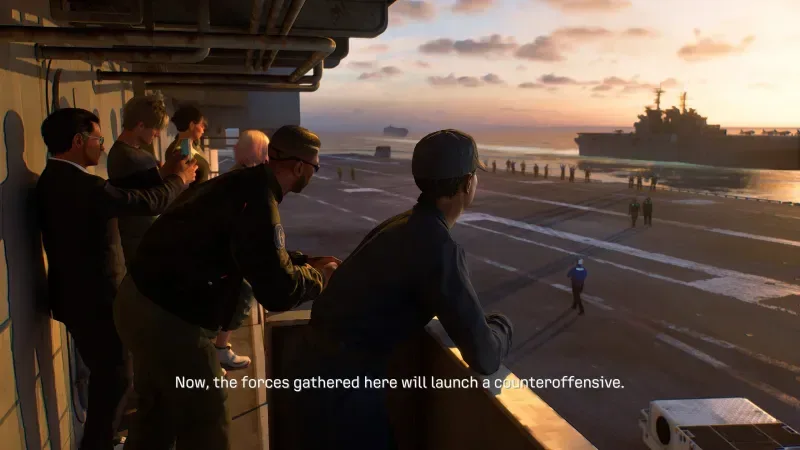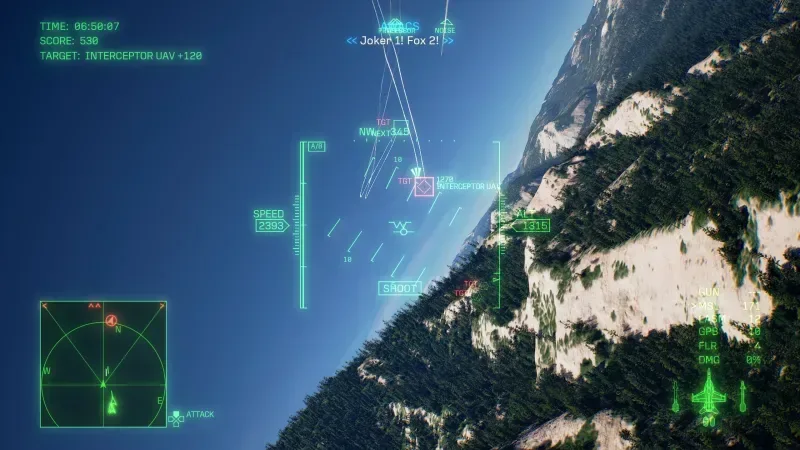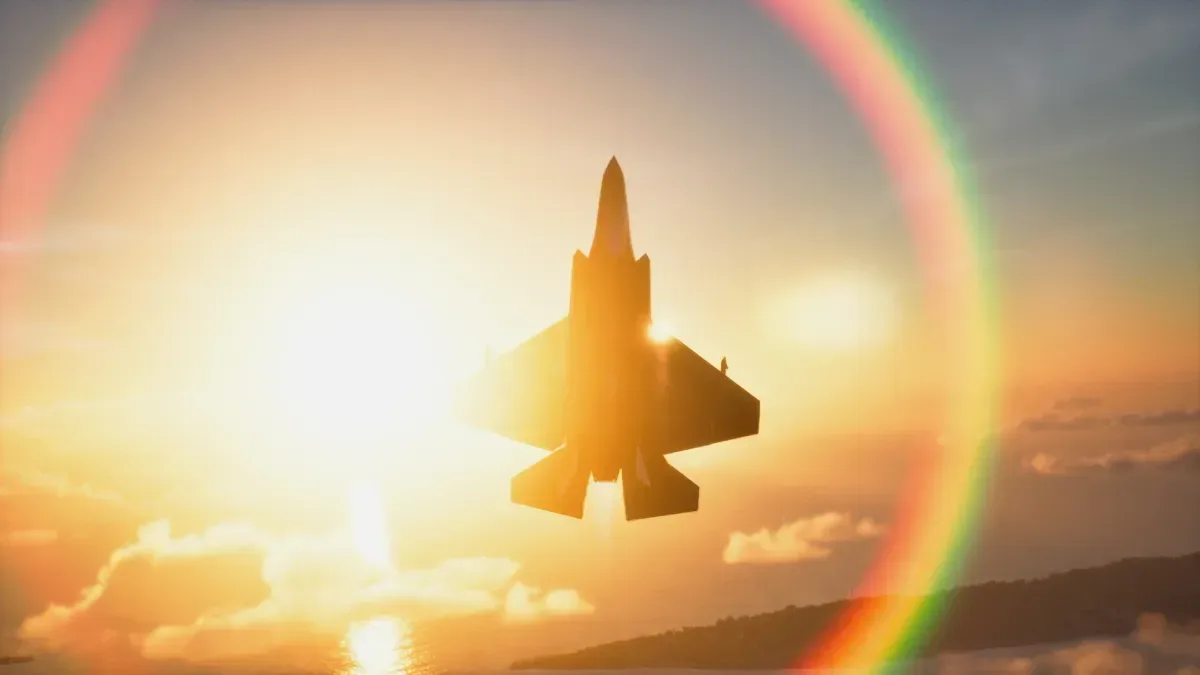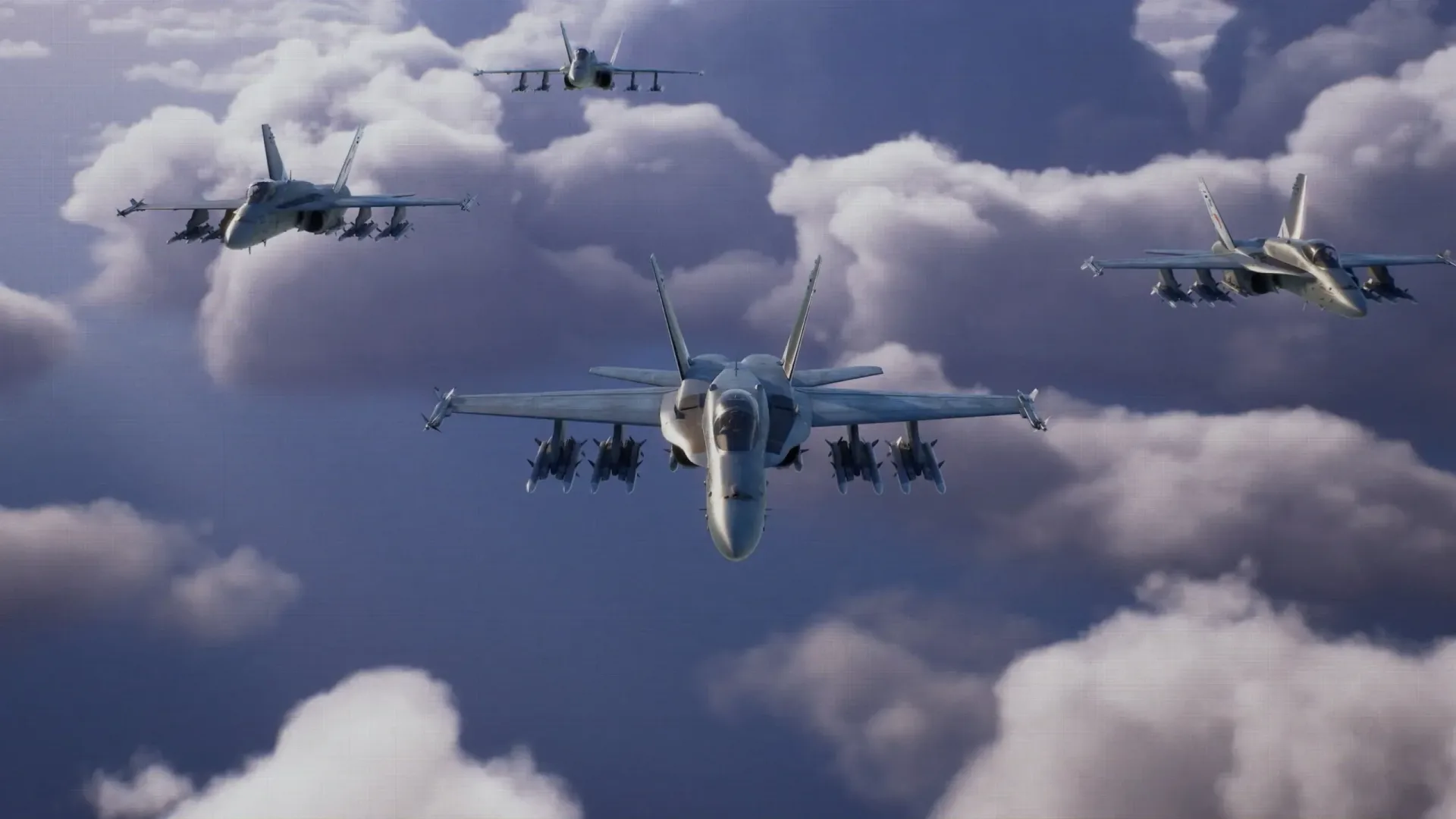
Ace Combat 8: Wings of Theve understands that aerial action is most exciting when speed, spectacle, and purpose converge. Its campaign casts the player as the successor to a fallen folk hero amid an invasion, but its strongest idea is smaller and more personal: a war story shaped by the people sharing the carrier Endurance and the skies around it. Across more than 30 missions, the game builds its drama through wingmen, squadron relationships, and dangerous assignments rather than treating every sortie as a detached score chase.
That focus gives Wings of Theve a persuasive sense of momentum. The conflict has familiar military and political stakes, yet the game grounds them in a surviving group of pilots and crew members trying to endure long enough to see an ending. Joker Squadron, Queen Squadron, the Endurance crew, and enemy aces all contribute to a crowded cast that is meant to stay in the mind. The premise—taking on the identity of the Wings of Theve after the original proves more legend than living symbol—also gives the campaign a useful tension between public myth and individual responsibility.
A campaign built for changing skies
The major achievement here is mission variety. Rather than relying on one uninterrupted cycle of airborne target destruction, Wings of Theve frames each operation as a compact field of objectives. One mission involves crossing a desert to dismantle an invasion force’s infrastructure by destroying power reserves, ammunition supplies, and aircraft hangars. Another asks for fast, low flying toward an island to stay beneath radar coverage. Later, radar jamming turns tracking cargo aircraft into an exercise in reading contrails. These scenarios retain the urgency expected of a flight-action game while giving individual sorties a distinct tactical identity.
This variety matters because it makes the campaign feel designed around situations, not merely locations. The player is repeatedly asked to judge altitude, positioning, targets, and timing under different conditions. The result is a game that appears especially well suited to players who want a directed, replayable single-player structure with changing objectives instead of a pure sandbox flight experience. Missions have enough internal tasks to encourage another run, whether the appeal is cleaner execution, better target selection, or simply revisiting a particularly dramatic setup.
Large mission areas support that replay value, but their importance is not only geographic. They create room for choices about approach and priorities, particularly when objectives involve whittling down resources instead of focusing solely on a single immediate threat. That structure can make success feel earned through situational awareness as much as reflexes. Wings of Theve seems interested in the fantasy of being a decisive pilot without reducing every encounter to a straightforward tunnel of missiles.
Weight, weapons, and pressure in the cockpit
The flight handling is presented as slightly heavier than the previous numbered entry, and that weight is a meaningful part of its identity. High-G turns feel like a struggle to force a huge machine through extreme speed and direction changes. This is not a claim of full simulation, nor does it need to be. The important quality is readable physicality: the aircraft are described as having enough mass to make sharp maneuvers feel forceful rather than frictionless.
A broad selection of aircraft and weapons gives that handling a practical outlet. Carrying two special weapons at once expands how a sortie can be approached and allows more specialization before takeoff. A dedicated section involving an A-10 provides a change of pace from the more frantic missile-focused engagements elsewhere. That is a welcome signal that the campaign is willing to alter its rhythm, even within a game built around supersonic dogfighting.
Ground opposition adds further pressure. Sotoa’s land battleships and other terra-naval units make surface forces more threatening than passive scenery, while rail-gun alerts demand attention amid aerial threats. The Lux Lunae, known as the Shadows, are positioned as the campaign’s standout adversaries: distinctive enemy aces with black aircraft, broadcast chants, and aggressive mid-air maneuvers. Their value is not just aesthetic. A recurring rival squadron gives improvement a face, turning each difficult encounter into a test of whether the player has learned to handle the game’s demands.
For readers drawn to action games that use a close perspective to intensify pressure, the cockpit-facing emphasis here has an interesting contrast with the first-person combat examined in Valor Mortis. The genres and pacing are different, but both point toward the value of perspective when a game wants danger to feel immediate rather than abstract.
A story that earns its biggest moments
Wings of Theve’s narrative ambition is strongest when it keeps attention on the people around the player. A first-person perspective brings the wingmen and Endurance crew closer, and that proximity is intended to make mission events land with greater force. Seeing pilots’ struggles before being asked to fight beside them helps the larger war feel connected to specific relationships. In a series often associated with enormous weapons and theatrical aerial battles, that more intimate framing is a smart complement to the spectacle.
It is not flawless storytelling. Some scenes require an arbitrary button press to continue, an interruption that can feel needlessly mechanical at moments when the drama should flow. The early use of Cope, the former Wings pilot, speaking from beyond also sounds overly emphatic. These are not small observations in a campaign so invested in atmosphere; presentation quirks can weaken material that otherwise aims for emotional weight. Still, the central character approach appears robust enough to carry the narrative through its occasional awkwardness.
Multiplayer potential meets avoidable friction
Multiplayer extends the focus on score competition and squadrons. Four-player teams can compete for points alongside or against an opposing squadron, offering an alternative to direct player-versus-player dogfights. Emergency sorties are the most compelling concept: periodically available special missions that send players against major superweapons such as the Arsenal Bird. They give the online component an event-like hook and a cooperative reason to return beyond ordinary matches.
The caveat is that this mode currently sounds more promising than fully frictionless. Frequent menu navigation, grinding for particular aircraft upgrades, and cosmetic monetization all slow the route between deciding to play and actually playing. None of those systems erase the appeal of coordinated aerial combat, but they matter to prospective buyers. Players mainly interested in a focused campaign can regard multiplayer as an extra rather than the foundation of the package. Those seeking a streamlined long-term online progression loop should expect some resistance from its surrounding systems.
Who should answer the call
Ace Combat 8: Wings of Theve is best suited to players who value handcrafted mission design, arcade-forward flight action with a sense of aircraft weight, and campaigns that attach grand conflicts to a dependable ensemble. Its apparent willingness to vary mission goals, aircraft roles, and enemy pressure is a major advantage. The Shadow squadron and heavy ground threats promise the kind of recurring opposition that makes a long campaign feel like an escalating contest rather than a sequence of disconnected victories.
Its limitations are equally clear. Storytelling occasionally stumbles in delivery, and the online side introduces progression and monetization hurdles that can dilute its momentum. But the campaign’s range, its emphasis on comrades aboard the Endurance, and its satisfying sense of high-speed aerial struggle give Wings of Theve a strong identity. It is a game that seems most convincing when it lets a dangerous objective, a trusted squadron, and a hostile sky speak for themselves.