Star Wars: Galactic Racer has the difficult job of making a well-worn setting feel less important than the game wrapped around it. Happily, it largely succeeds. This is a fast, demanding racing roguelite whose best idea is not a recognizable location or musical cue, but the way an evolving vehicle build changes the meaning of every event in a tournament run. The result is a racer with enough speed, friction, and experimentation to reward players who want more than a lap-by-lap tour of familiar scenery.
The campaign provides the central structure. The player enters the Galactic League in pursuit of champion Kestar Bool, whose past actions led to the protagonist's imprisonment. From there, the competition spans a multi-planetary tournament, with a story that has more room for rivalries and reversals than this genre usually receives. Character interactions at pitstops and mid-race communications give the event a welcome competitive personality, while strong voice work helps the allies and adversaries register as more than names attached to vehicles. The tone is willing to let competitors mock poor racing, which is a small but effective way to make failure feel part of an ongoing sporting drama.
That failure matters because the campaign uses roguelite stakes. Accumulating too many losses drops a racer from the tournament, meaning a bad stretch has consequences beyond one disappointing finish. It is a structure that gives upgrades, rival knowledge, and careful event choices genuine weight. It also makes Galactic Racer less immediately inviting than a conventional racer. The opening hours ask players to learn rapid, dense courses while accepting that an imperfect run may end before its build pays off. There is satisfaction in turning early disorientation into consistent placement, but the game does not appear especially generous in teaching that transition.
Speed with a learning curve
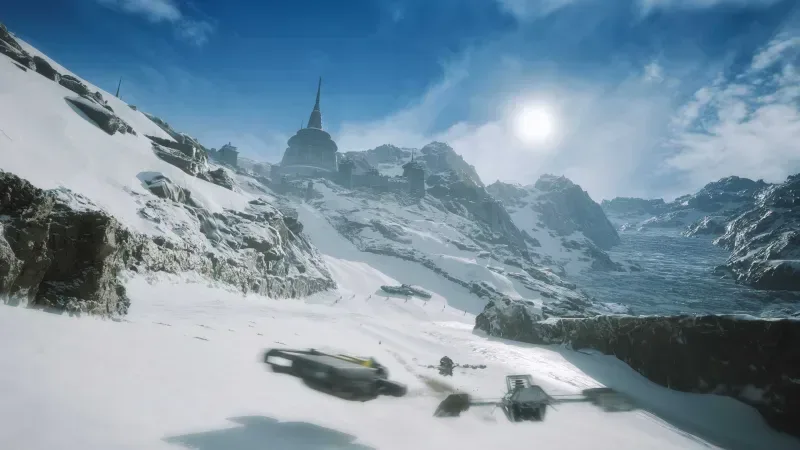
The tracks are designed to feel physically embedded in their settings rather than like cleanly separated racing arenas. Courses across planets including Jakku and Crait use environmental materials and terrain, with reverse versions extending the available route selection. At high speed, though, that immersive approach can create a readability problem. A wrecked structure might look like an obstacle, a route, or both until it is too late to decide. The absence of a minimap intensifies the issue, particularly for newcomers trying to maintain racing lines through narrow corridors and tight turns.
This is the review's largest reservation because legibility is not a cosmetic concern in a racing game; it is the basis for making skilled decisions. Memorization gradually turns confusion into confidence, and players who enjoy mastering a course through repetition may find that process deeply satisfying. Those looking for instant spatial clarity, however, may bounce off before the tracks become intelligible. Galactic Racer's visual commitment has character, but it occasionally asks the environment to communicate faster and more clearly than it does.
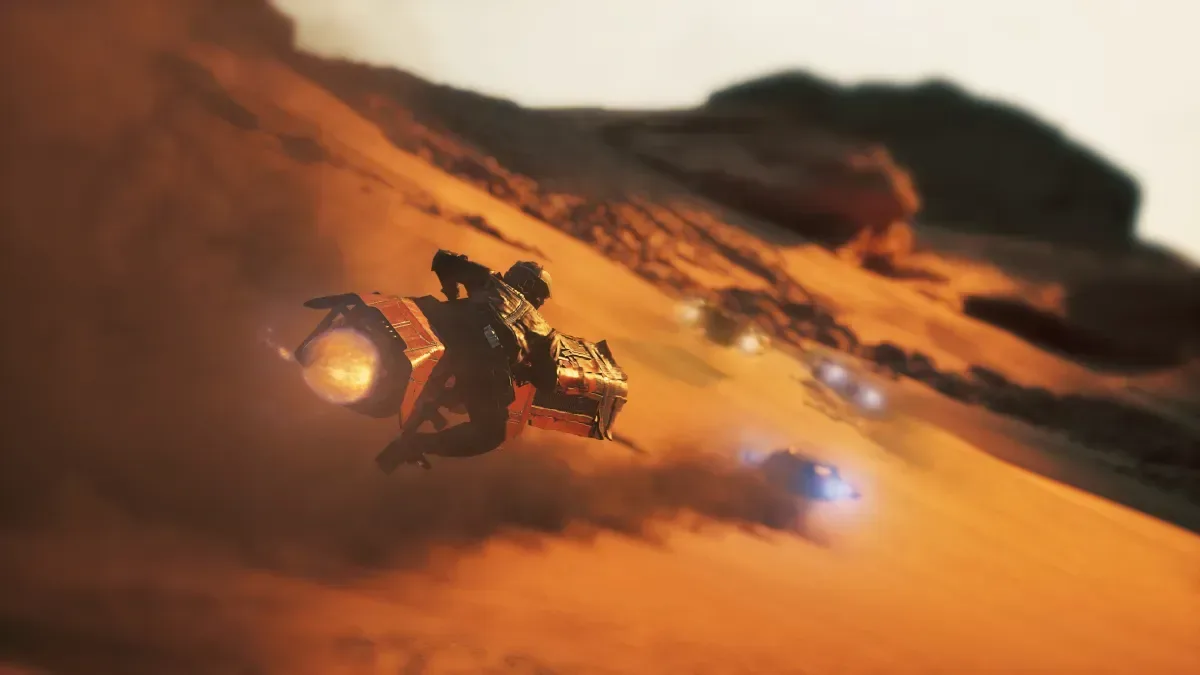
Once routes begin to settle into memory, the handling concepts offer meaningful variety. Landspeeders drift, speeder bikes can stop sharply before surging ahead, and skim speeders use a knife's-edge turning style to carve through corners. These are not merely visual categories: they invite different approaches to managing a course. The campaign may make landspeeders a comfortable place to start, but the alternate vehicles offer reasons to adjust habits rather than simply pursue a faster version of the same machine.
A tournament run built around choice
Between races, each planetary pitstop becomes a compact management space. Players can speak with characters, maintain damaged parts, buy abilities and components, upgrade their vehicle, and renew objective-based contracts. Rewards arrive through currency, race victories, upgrades, and new parts, supporting frequent experimentation rather than making every poor purchase feel terminal. Crucially, a new engine type can be crafted each run, which gives repeated tournaments a fresh mechanical identity.
The build system is Galactic Racer's strongest argument for its roguelite label. Improvements to afterburner performance, drifting, and battery capacity shape how a vehicle approaches races; battery capacity, for instance, determines how many abilities can be equipped. Abilities include auto-pilot for relief during difficult segments, plus offensive or disruptive tools such as lock-on ion blasts, corrosion vents, and shockwaves. A speed-oriented build can lean on a risky redlining ramjet, afterburner upgrades, and frequent use of Surge. Other builds can favor offensive maneuvering for elimination events or protection against hazards such as acid and ice.
That breadth makes the racing feel strategic without reducing it to menu arithmetic. The same roster of racers returns during a tournament, allowing players to learn who races defensively, who attacks, and which abilities a rival tends to bring. The game therefore encourages both mechanical execution and opponent awareness. A strong run is not just about having upgrades; it is about assembling a plan that suits the vehicle, the event type, the hazards, and the rivals on the circuit.
This is also where Galactic Racer distinguishes itself from a simple licensed racer. The Star Wars framing adds flavor, and familiar worlds may be a draw for fans, but the vehicle-building loop is the feature that gives repeat attempts their own stakes. Readers interested in other games examining how run-based systems create tension may also want to see this look at resource-led roguelite tension.
Podracers are thrilling, until they are compulsory
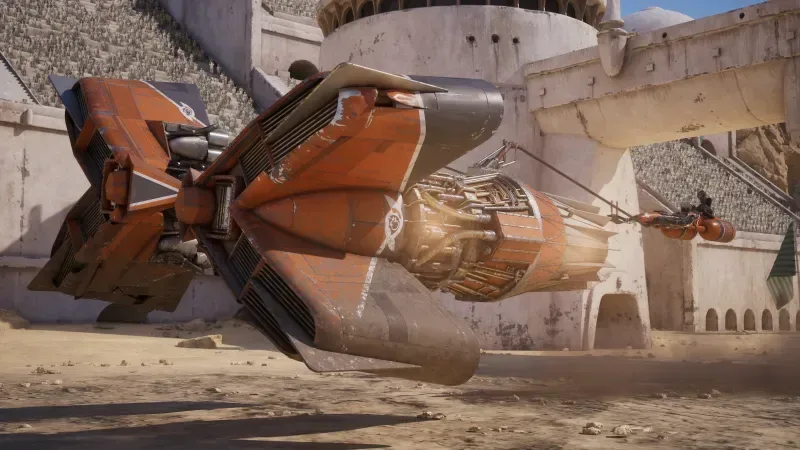
The major disruption comes from the fourth vehicle class: the podracer. These machines are framed as exceptionally fast and dangerous, and their speed and instability make their races unpredictable. That can be exciting when chosen voluntarily. Podracers are also available elsewhere, including multiplayer races made up exclusively of that class, where their unruliness can be treated as the main attraction.
In the campaign, however, certain events force their use. That requirement is especially awkward because it can arrive after five or six races spent developing familiarity with a personal vehicle and its build. Being asked to switch to a much less controllable machine while a tournament run is at risk feels less like a welcome change of pace than an interruption of the strategy the campaign has spent time encouraging. The issue is not that podracing lacks excitement; it is that compulsory high-chaos events conflict with a mode structured around long-term investment and earned consistency.
Players attracted specifically to volatile, high-speed racing may welcome these set pieces. Players who prefer deliberate buildcraft and steady mastery should know that the campaign occasionally takes that control away. Galactic Racer would be stronger if its most hazardous vehicle remained a more elective specialty rather than a required test with outsized consequences.
A substantial package beyond the campaign
The game does not rely on one mode to carry its replay value. Arcade includes time trials, advanced races, and additional challenges, while Scenario offers curated six-race campaigns using pre-built characters and vehicles. Both are useful complements to the main campaign because they push players out of a favored build or vehicle type and toward different forms of racing.
Multiplayer also retains much of the roguelite upgrade structure within quick six-race tournaments. Pre-race bets add another personal incentive, and the suite includes single quick races, XP progression, and cosmetic unlocks. Alongside leaderboards for time-trial competition, that selection suggests a racer designed to support both long-form campaign learning and shorter competitive sessions. The range will matter most to players who like refining runs, testing unfamiliar vehicles, and returning to improve times after the major campaign objective is complete.
Star Wars: Galactic Racer is best recommended to racers who enjoy learning difficult circuits and reshaping a vehicle over successive attempts. It has a real onboarding problem: track readability is inconsistent, the lack of a minimap can make early races disorienting, and mandatory podracer sequences can punish players for a mode switch they did not request. Yet its campaign structure, expressive upgrades, distinct vehicle handling, lively cast, and generous set of modes create a stronger foundation than its license alone could provide. This is a racer that earns repeat play through systems, not nostalgia.