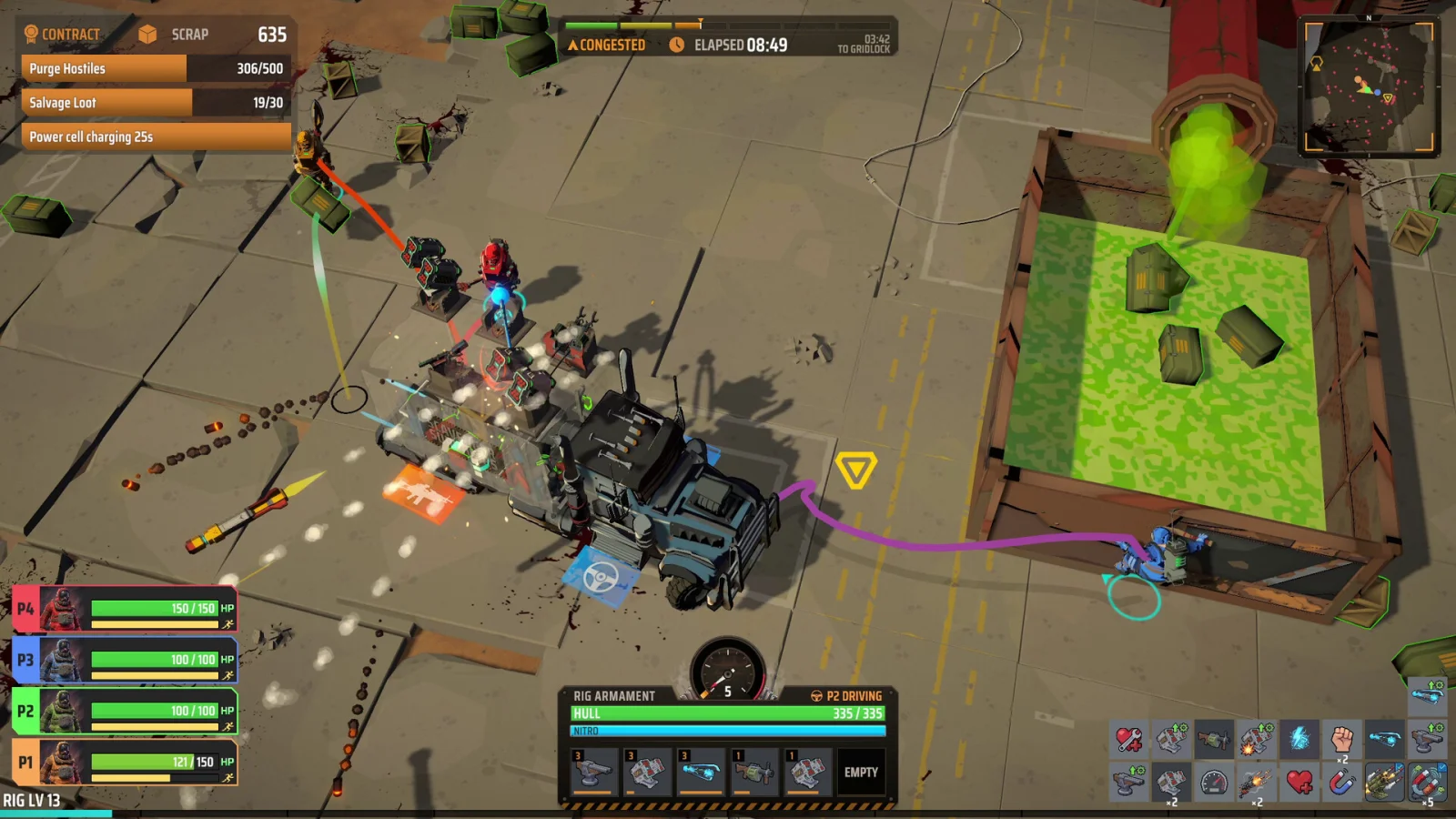
Scavenger Survivors is an upcoming PC game developed and published by Bad Goat Gaming. Its current release window is listed as To Be Announced, and open playtest registration is available. This is a factual preview of the announced game, not a hands-on assessment. There is no basis here to evaluate combat feel, balance, technical performance, co-op reliability, accessibility, or overall quality.
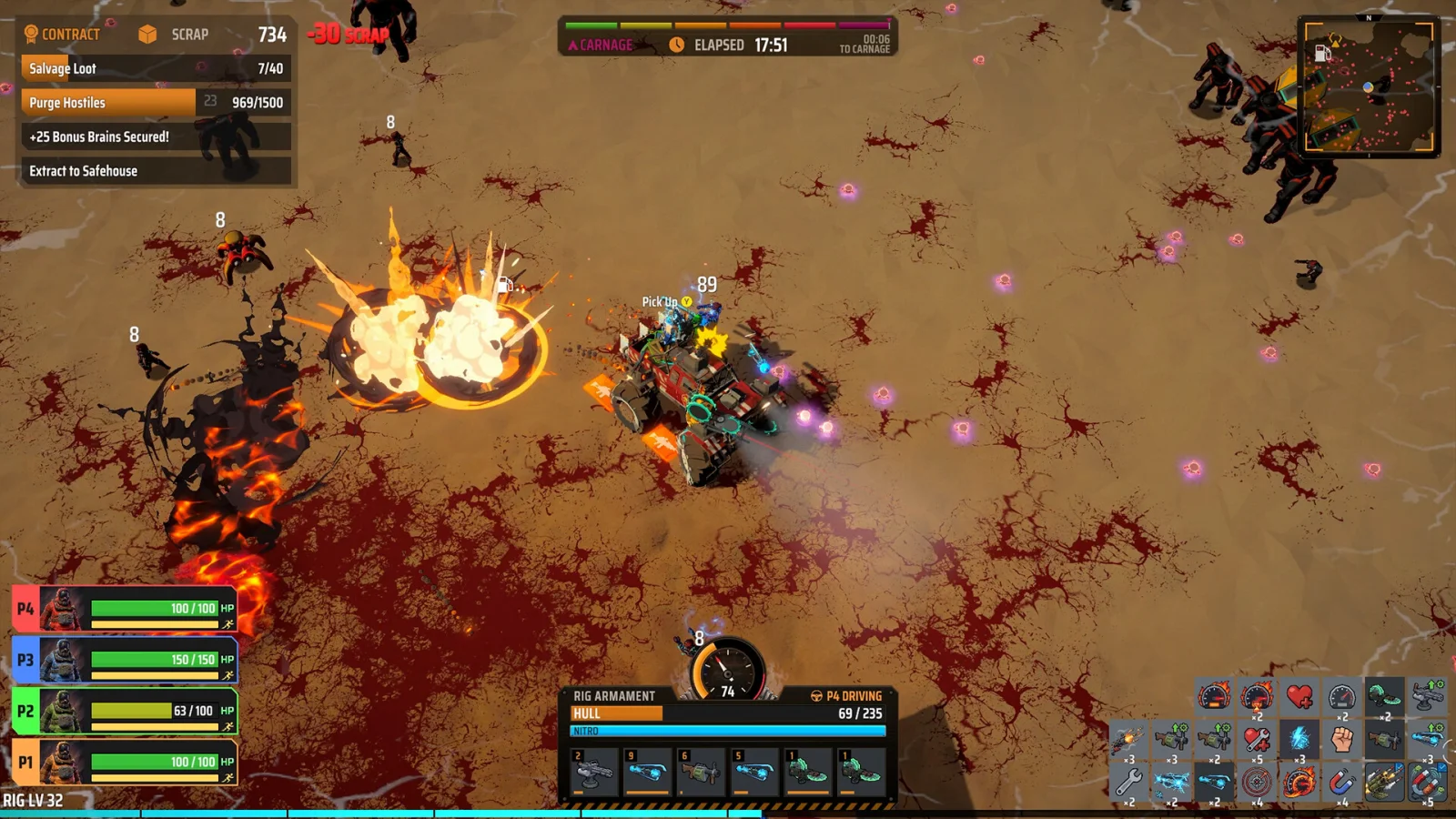
The advertised premise is a one-to-four-player, top-down, post-apocalyptic co-op roguelite/survivors hybrid. Players enter zones described as AI-infested with an armored mobile base called the RIG. They fight enemy swarms, retrieve salvage, bring that salvage back to the RIG, improve its defensive weapons, select roguelite boosts, and choose when to extract as danger rises. Single-player, shared/split-screen co-op, and Remote Play Together are currently listed among the planned PC features.
On paper, that combination gives the game a more defined objective than a simple survive-the-horde pitch. The advertised goal is not solely to remain alive or eliminate enemies: valuables must be recovered and returned to a shared vehicle. That stated delivery step could make distance, movement, and timing matter alongside combat. It also puts the RIG at the center of the premise, as both the group’s transport and the destination for whatever it retrieves.
A shared base could make cooperation more concrete
The RIG is the clearest organizing idea in Scavenger Survivors’ announced design. It is described as armored and mobile, and it is tied to several parts of the proposed loop: players travel with it into hostile areas, return salvage to it, improve defensive weapons, and ultimately use extraction as a decision point. Those are confirmed elements of the pitch. How they connect during an actual run is not yet established.
Still, the design implication is easy to see. A shared vehicle can give a group a visible common responsibility rather than leaving cooperation as a general instruction to fight near one another. If a team must bring material back to the RIG while managing swarms, players may have to decide who creates room, who handles the immediate objective, and when the group should regroup. These are possible coordination pressures suggested by the advertised structure, not confirmed player roles or proven tactics.
That distinction matters. A co-op game can list multiple players without making their decisions meaningfully interdependent. Scavenger Survivors’ premise potentially gives them a reason to care about the same location and the same haul. Whether that potential becomes satisfying teamwork will depend on information that has not been verified: how the game communicates threats, what players can do while moving salvage, how often the RIG is vulnerable, and whether a group has understandable choices when plans go wrong.
Physical salvage is the central unknown with the greatest design potential
The phrase “physically haul salvage” is especially notable because it suggests that recovered material is meant to be more than an automatically collected reward. The official description confirms the broad concept, but it does not explain carrying controls, object weight, collision behavior, dropping, enemy interference, movement penalties, or the distance and routes involved. None of those details should be assumed from the genre label alone.
If the eventual handling model makes cargo conspicuous and consequential, the salvage loop could create a clear difference between spotting something valuable and successfully securing it. A player carrying an object may need protection; teammates may need to clear a path; the group may need to abandon a find when the situation deteriorates. Conversely, if the handling is cumbersome or difficult to read, the same idea could interrupt the action rather than deepen it. These are conditional design outcomes, not claims about the current build.
Physical-object mechanics also place a premium on clarity. Players would need to understand what can be moved, where it needs to go, what threatens it, and whether a return trip remains worthwhile. That challenge becomes more important in a top-down game where enemies, teammates, cargo, defensive fire, and the RIG may all compete for attention. Strong communication of those priorities could support fast group decisions. The available information does not yet show how the game handles that communication.
Extraction pressure gives the announced loop its risk question
Scavenger Survivors is described as increasing danger over time and asking players to decide when to extract. That establishes an intended risk-versus-reward structure: leaving sooner may protect what has already been recovered, while staying out longer may expose the group to greater pressure in pursuit of additional salvage, upgrades, or stronger positioning. The specific escalation model, penalties, rewards, and extraction conditions have not been detailed.
For this structure to work as a cooperative decision rather than a routine button press, players would need enough readable information to weigh their options. They may need to know whether the group can make another trip, whether defenses are adequate, and whether the cost of remaining is rising in a comprehensible way. Those are useful questions for a future hands-on assessment, especially because the game’s premise links combat, cargo, and departure rather than treating them as isolated systems.
The RIG could make that risk calculation more legible than an abstract end-of-run menu. A vehicle that holds the team’s retrieved salvage and defensive investment is a tangible focal point for the decision to stay or leave. But the significance of that focal point remains conditional on implementation. Announced mechanics alone cannot show whether extracting feels tense, whether it provides meaningful alternatives, or whether it produces the intended sense of a difficult call.
Co-op support is listed, while practical use remains unverified
Current feature listings identify Scavenger Survivors as supporting one to four players, with single-player, shared/split-screen co-op, and Remote Play Together. The developer has also stated that one eventual owner is intended to be able to host and invite up to three other players through Remote Play Together. That is a stated plan for the final release and remains subject to the final game and the platform service’s functionality.
Shared/split-screen support is relevant to the game’s stated design because it may make the RIG and nearby salvage easier for local players to track as common reference points. It does not, however, confirm that the interface, camera behavior, visual effects, or communication demands will be comfortable in practice. Likewise, the single-player listing confirms that solo play is planned but does not explain how the game will adapt the RIG, swarm combat, hauling, or extraction decisions for one person.
Readers looking at another announced hybrid where clarity is central to the premise can also read this PC assessment of an RTS-action hybrid.
Boosts and defensive upgrades are announced, not yet defined
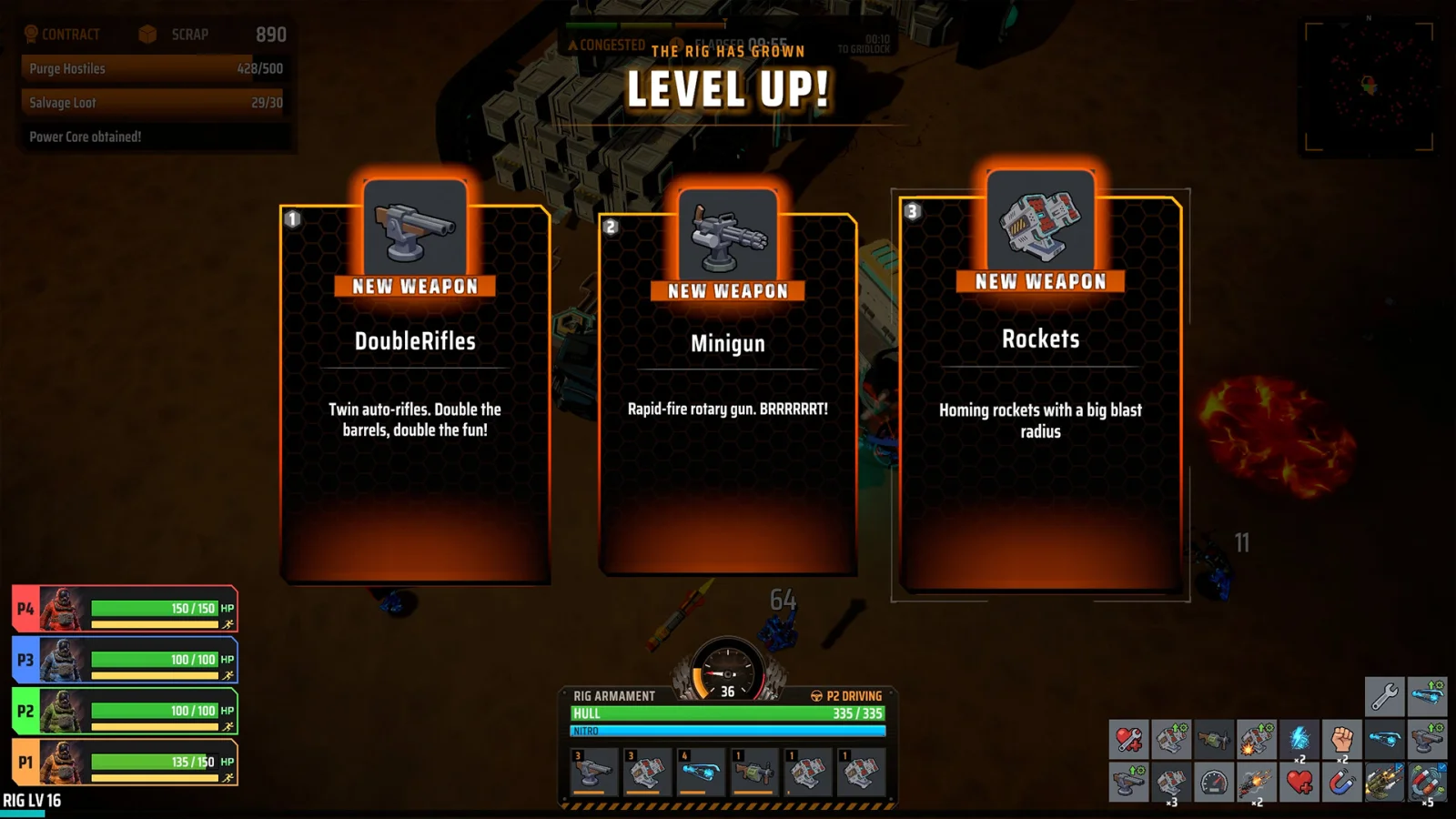
The game’s advertised run structure includes choosing roguelite boosts and upgrading the RIG’s defensive weapons. This confirms that runs are intended to develop through choices and improvements, but the available description does not identify particular upgrades, their acquisition rules, their duration, or how broadly they affect combat, the vehicle, salvage work, or extraction.
There is nevertheless a potentially interesting relationship between these two systems and the shared-base concept. Improvements to the RIG could, depending on their design, create benefits that matter to the entire group rather than only one player. Boost choices could also shape how confidently a team takes risks later in a run. Whether the options create meaningful trade-offs, straightforward power increases, or something else cannot be determined before playable evidence is available.
What is established now
The established picture is concise. Scavenger Survivors is an announced PC game from Bad Goat Gaming with no announced release date. It is described as a top-down, post-apocalyptic co-op roguelite/survivors hybrid for one to four players. Its stated loop involves entering AI-infested zones with the RIG, fighting swarms, physically returning salvage to that armored mobile base, improving defensive weapons, selecting roguelite boosts, and extracting as danger increases.
The decisive unanswered questions concern implementation rather than missing promises. Physical hauling, encounter readability, group coordination, RIG defense, upgrade choice, solo adaptation, and extraction pressure all need hands-on evidence before they can be judged. For now, Scavenger Survivors stands as an announced co-op design with a clear focal point: recovering material is only part of the job; getting it back to the shared vehicle is meant to matter too.