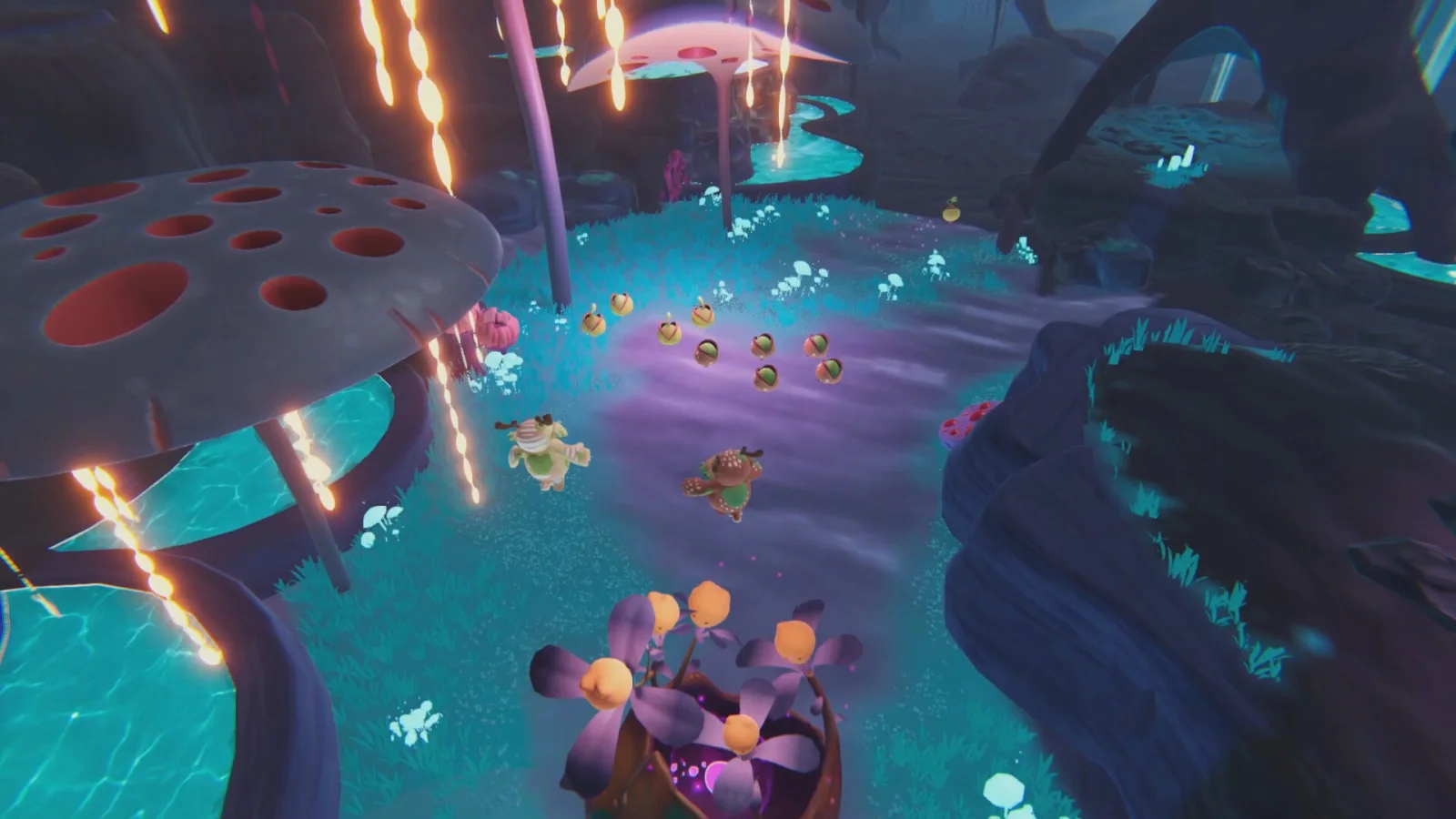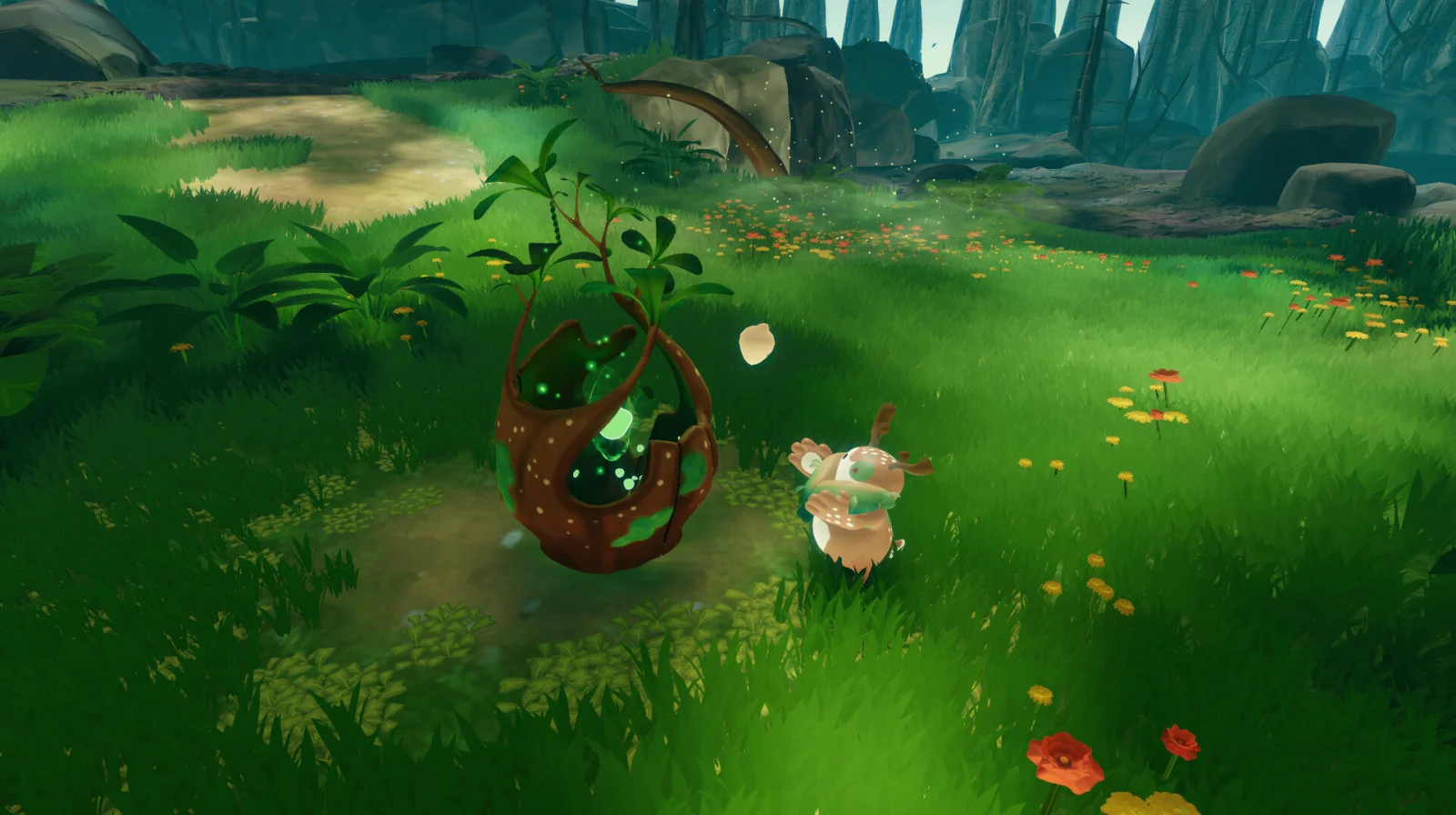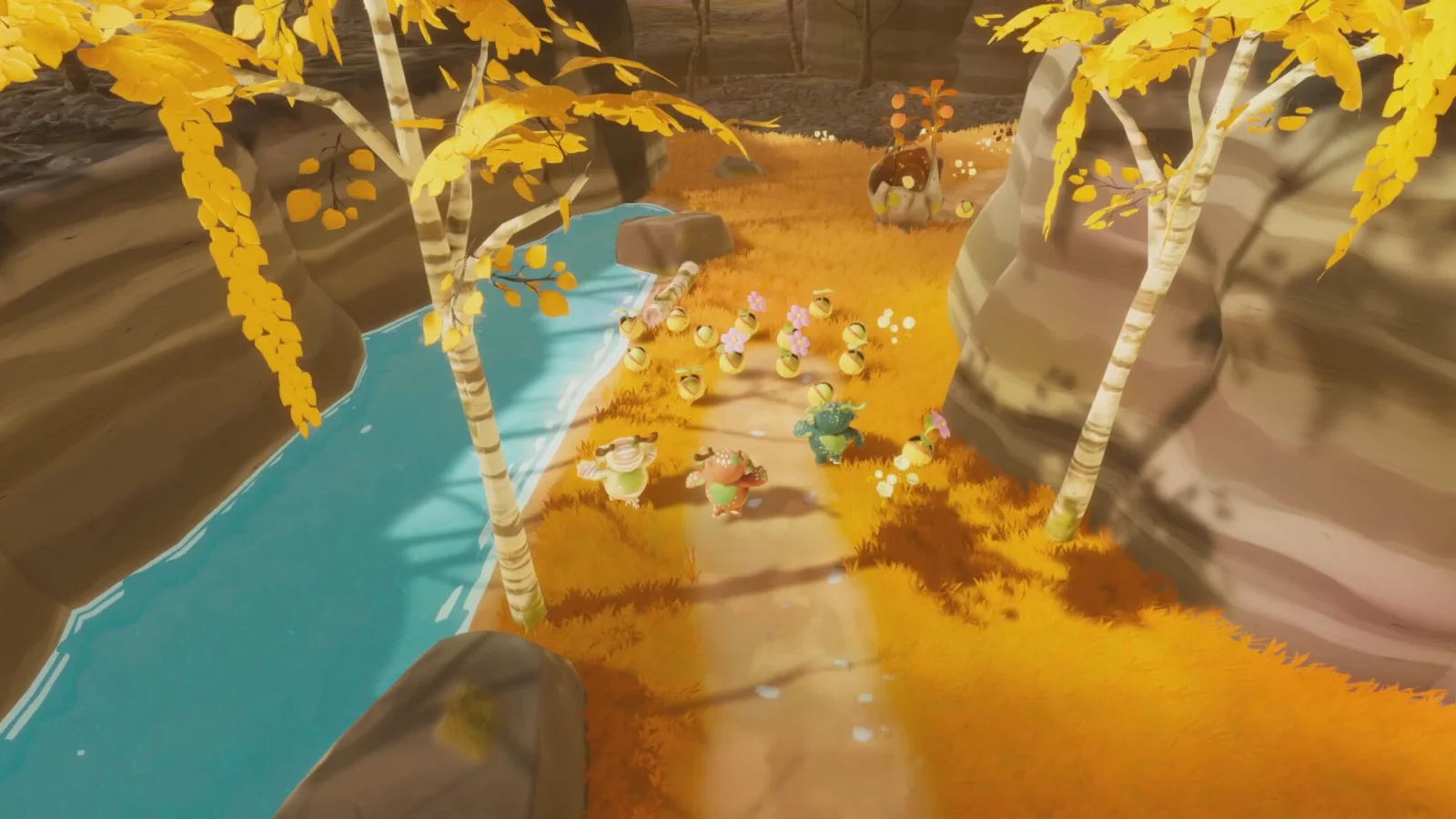
Bloomkeeper is an unscored assessment, not a scored review. Resonance Interactive’s game released for Windows on September 16, 2026, with solo play and online co-op for up to four people. Its official premise asks players to lead groups of Pouics through a world affected by spreading scorched zones and corrupted Malpouics, making real-time tactical decisions while protecting the flock and working toward restoration. That is a concise foundation with an immediately identifiable pressure point: the player is not merely solving a static environmental problem, but attempting to preserve and direct a group while that problem expands.
The available description does not establish every mechanical detail of how Bloomkeeper executes that premise, and it would be premature to supply those details by assumption. What can be said is that the game’s stated priorities—flock protection, hostile corruption, environmental recovery, and cooperative coordination—are closely related rather than decorative additions. They all point toward a design in which attention is contested. A player’s time spent growing or arranging a group may compete with time needed to contain danger. A move toward recovery may expose the flock. In co-op, the need to coordinate roles may make shared priorities as important as individual reactions.
That focus gives Bloomkeeper a potentially distinctive identity. Plenty of tactical games ask players to respond under pressure, and many games use recovery or restoration as a thematic goal. The particular interest here is the proposed collision of those ideas with crowd management. A flock is inherently a moving responsibility: its size, location, safety, and intelligibility can all become part of the same decision. Bloomkeeper’s success, therefore, may depend less on how many individual ideas it presents than on whether its central idea stays legible once several concerns demand action at once.
Established premise: restoration under active pressure
The official setup establishes a damaged world in which scorched areas spread and Malpouics are corrupted. The player’s goal is framed around restoring that world while guiding Pouics. This is valuable because it gives the tactical layer a consequence that is easy to understand in broad terms. The player is not simply defending a position for its own sake; protection and restoration are linked to the state of the world.
There is also a useful difference between a threat that exists and a threat described as spreading. Spread implies that delay matters, even though the official information does not define a timer, rate, or specific failure condition. As a design principle, that language creates the expectation of triage. If damaged territory can continue to worsen, then choosing what to address first becomes a meaningful question. If a flock needs protection at the same time, the game’s premise creates a natural push and pull between expansion, containment, and preservation.
One detailed critical account identifies this tension as Bloomkeeper’s strongest quality. Its observation is not evidence of universal agreement, but it is a useful lens through which to consider the announced design. It describes a challenge shaped by the need to balance flock growth and placement against the urgency of expanding scorched territory. That reading aligns with the official premise and highlights why the game’s systems may have more bite than a simple restoration theme suggests. The meaningful decision is not just whether to make progress; it is what kind of progress can be pursued without allowing another problem to become too costly.
For players who enjoy tactical games built around competing priorities, that structure is likely to be Bloomkeeper’s main attraction. The premise suggests that security cannot be treated as separate from advancement. Protecting the group may be part of advancing, while advancing the restoration effort may be necessary to keep the group safe. If those pressures are communicated cleanly, each choice can carry a worthwhile opportunity cost without requiring an excessively broad ruleset.
The promise of a deliberately narrow tactical identity
Bloomkeeper’s design pitch is appealing precisely because it is focused. Guiding Pouics, confronting corruption, and reversing scorched areas all belong to one thematic and tactical loop. The game does not need a long list of unrelated attractions to make that combination interesting. A coherent premise can make it easier for players to understand why a particular decision matters: the flock is worth protecting because it is central to restoration, and restoration matters because corruption is an active threat.
That coherence could also help distinguish the game for players fatigued by tactical experiences that bury a single good idea beneath disconnected progression layers or competing genre conventions. Nothing in the available information establishes Bloomkeeper’s broader structure, so it should not be credited with restraint it has not demonstrably shown. Still, its stated core is admirably direct. It identifies a group to care for, a damaged environment to address, and a hostile force that complicates both goals.
Focused design has a particular advantage in real-time tactics: it can make urgency intelligible. When threats, objectives, and units all speak to the same core problem, the player is more likely to see why the game is asking for a decision now. This does not mean simplicity. A narrow premise can produce difficult choices if each action affects the others. Deciding where a flock should be, how much risk it can absorb, and when a spreading hazard deserves immediate attention can generate sustained tension without needing to rely on sheer system count.
The inverse is also true. When a game’s appeal depends on several pressures being weighed at once, its feedback has to support that weighing. The player needs a fair chance to identify what is threatened, what has changed, and which response is likely to matter. Real-time tactical friction can be productive when it asks for prioritization. It becomes less persuasive when the obstacle is determining what the game is currently communicating.
Readability is not a minor presentation concern
The most important reservation in the available critical response concerns legibility as the flock becomes harder to read or direct. That is a specific concern, and it should not be inflated into a settled verdict on the entire game. It does, however, go directly to the heart of Bloomkeeper’s stated design. A game about managing a growing group under time pressure cannot treat visual and tactical clarity as merely cosmetic. Clear feedback is part of the challenge’s fairness.
In the most favorable case, a large flock creates satisfying pressure because the player can still interpret its situation and make meaningful tradeoffs. The mass of Pouics becomes evidence of responsibility: more to protect, more to position, and more at stake when corruption or scorched zones demand attention. In the less favorable case, that same mass can obscure relevant information or make intent difficult to translate into action. The result would not necessarily be demanding tactics; it could instead become uncertainty about the state of the field.
This distinction matters. Difficulty is not automatically a flaw, and Bloomkeeper’s premise should contain friction. The spread of hostile damage ought to create difficult choices if the game wants restoration to feel earned. But a player can only own a hard decision when the alternatives are sufficiently readable. If it is unclear where the flock is most vulnerable, what is immediately endangered, or how a response is being expressed, then the game risks turning decision pressure into information pressure.
That concern is especially relevant because the official description emphasizes real-time choices. A turn-based structure can give a player more opportunity to inspect a complicated situation; real-time pressure places greater weight on signals that can be understood at a glance. This is not a claim that Bloomkeeper lacks those signals. Rather, it identifies the principal design test suggested by the evidence. The game’s defining crowd-management idea will be strongest if scale adds stakes without depriving the player of dependable comprehension.
Readers interested in another assessment centered on the relationship between hectic play and clear information can see this assessment of readable chaos in PengPong. The comparison is limited to that shared editorial concern; the supplied information does not establish that the two games play alike.
Solo and co-op ask different questions of the same premise
Bloomkeeper officially supports solo play and online co-op for up to four players. The available information also says cooperation emphasizes coordinating roles. That is an appropriate fit for a game whose stated demands include flock protection, hostile corruption, and restoration. Multiple players potentially allow responsibility to be divided, but coordination also introduces a new layer of judgment: participants need a shared understanding of which problem deserves attention.
It would be unsupported to specify how roles are assigned or what any player can do within a session. The relevant analytical point is conditional. In a cooperative tactical design, division of responsibility can make a complicated situation more manageable when goals, signals, and priorities are mutually understood. A group may be able to respond to separate pressures without asking one person to resolve every conflict alone. Conversely, co-op can magnify unclear feedback when several participants interpret the same changing situation differently. Coordination cannot fully compensate for information that is difficult to parse.
Solo play frames the same issues differently. Without teammates, the player’s ability to prioritize is likely to stand entirely on the game’s own communication of danger, opportunity, and flock status. This does not make solo play inherently more or less difficult; the evidence does not establish comparative tuning or behavior. It does mean the solo offering is likely to appeal to people who value personally managing a set of concurrent tactical responsibilities, while co-op may appeal to groups interested in discussing and dividing those responsibilities in real time.
For either audience, the central question remains consistent. Does Bloomkeeper turn a growing set of obligations into satisfying tactical judgment? The official premise offers a strong reason to ask it, and the critical concern about legibility identifies where the answer may be decided. A clear co-op role framework can be valuable, but it is most compelling when the shared field of play makes those roles understandable. A rich solo challenge can be valuable, but it needs enough clarity for urgency to feel like a demand for skill rather than guesswork.
Who should take notice
Bloomkeeper looks most promising for players drawn to real-time tactical games with a protective or restorative objective rather than a purely destructive one. The appeal is not simply that it has a world to heal; it is that healing is presented alongside an expanding threat and the practical obligation of shepherding a group. Players who enjoy triage, positioning, and decisions where growth carries added responsibility may find the premise especially attractive.
It may also suit established groups looking for a cooperative game with an explicit coordination angle. Up to four-player online co-op is confirmed, and the official description makes role coordination part of its pitch. Prospective players should approach that promise for what it is: a design intention supported by the game’s stated features, not a guarantee of a particular social experience. The quality of coordination will depend on the game’s actual communication, the players involved, and the situations it presents.
Those who prefer tactical games in which every unit and threat remains immediately distinguishable may want to pay special attention to further evidence about late-stage readability. The available criticism does not prove that Bloomkeeper becomes unmanageable, but it identifies crowd clarity as a credible concern because the game’s core revolves around directing a flock amid escalating environmental pressure. That is not a peripheral preference issue; it is fundamental to whether the concept lands.
Unscored verdict
Bloomkeeper has a clear, cohesive proposition: guide Pouics, protect them from corruption, and restore a world whose scorched zones are presented as an active, spreading problem. Its solo and four-player online co-op support give that premise two distinct contexts, with the latter explicitly built around coordination. The most persuasive interpretation of the available evidence is that the game’s strengths and risks arise from the same source. Managing a growing flock while choosing when to address spreading danger can produce meaningful, memorable tactical tension. Yet that tension depends on the game remaining readable when pressure and crowd size rise together.
As an unscored assessment, the appropriate conclusion is cautious interest rather than a final recommendation. Bloomkeeper appears to have a more defined identity than a generic restoration game, and its central tradeoff has genuine potential. The decisive outstanding issue is whether its information design reliably lets players understand and direct the complex situation it creates. For players who welcome real-time prioritization and cooperative role discussion, that is a reason to watch closely. For players who need exceptionally crisp tactical legibility, it is the point that warrants the closest scrutiny.
A storefront snapshot dated September 22, 2026, showed 72% positive user reviews from 18 reviews. That is a small, changeable figure and not a broad measure of critical or player consensus.