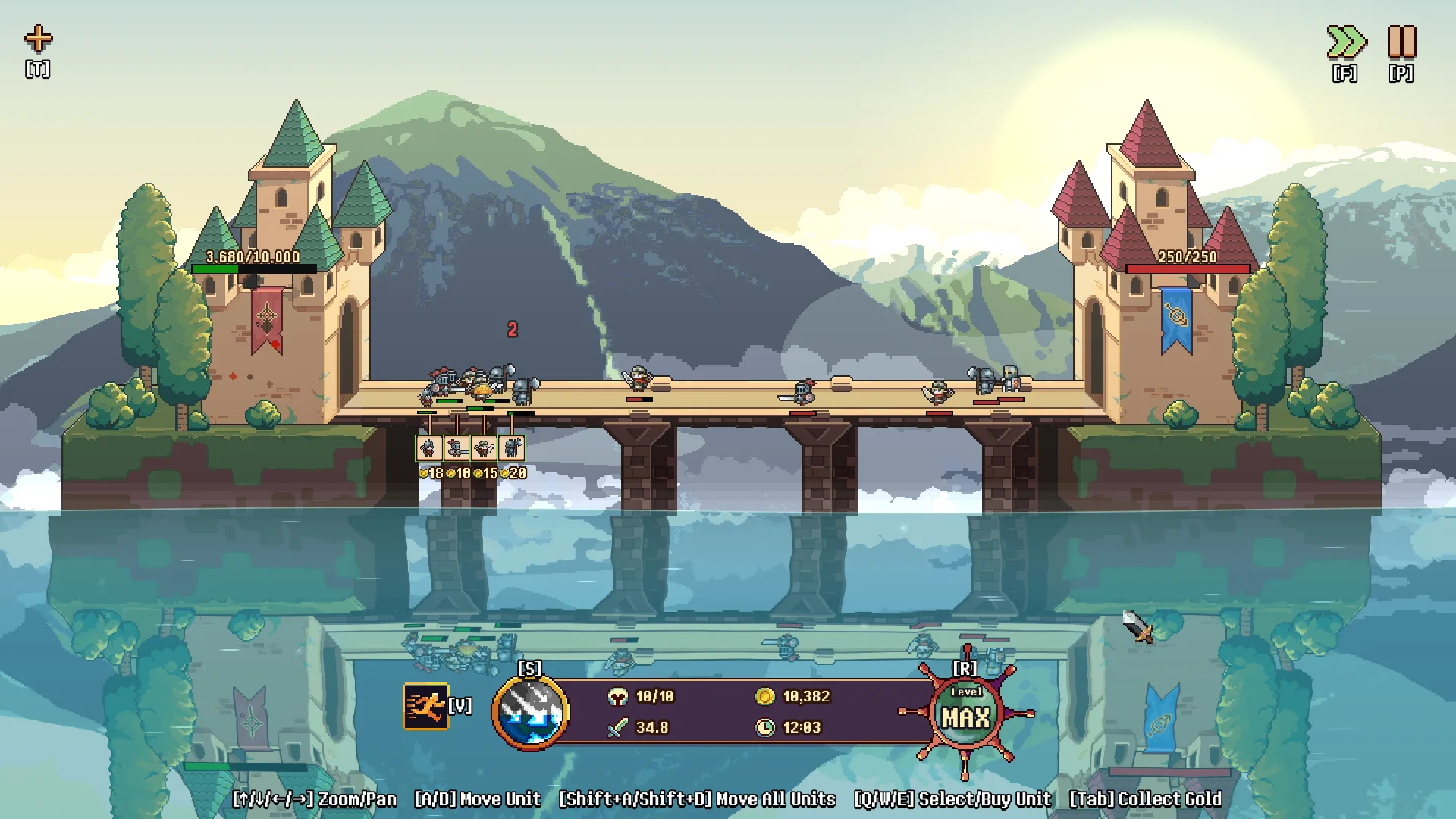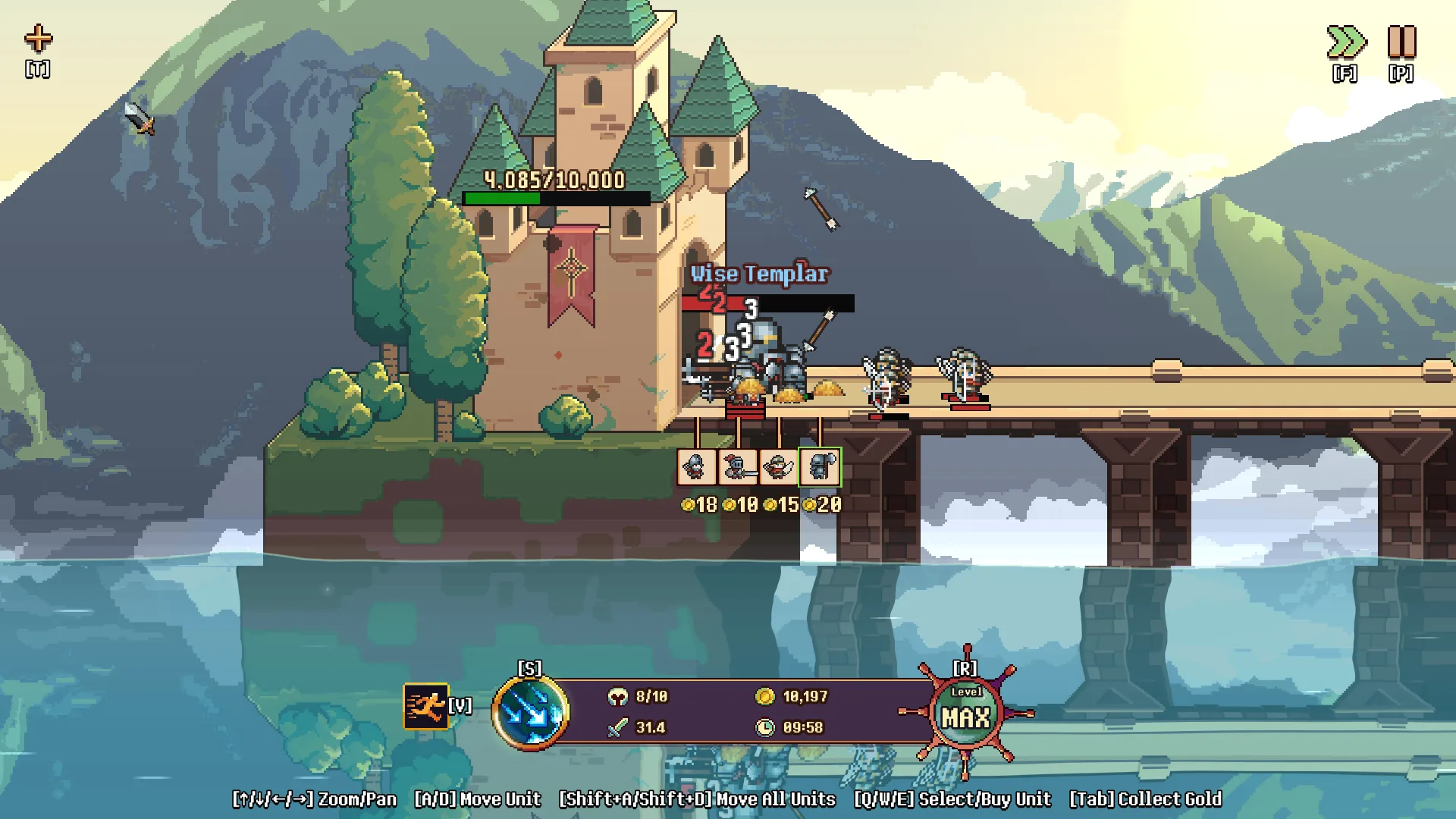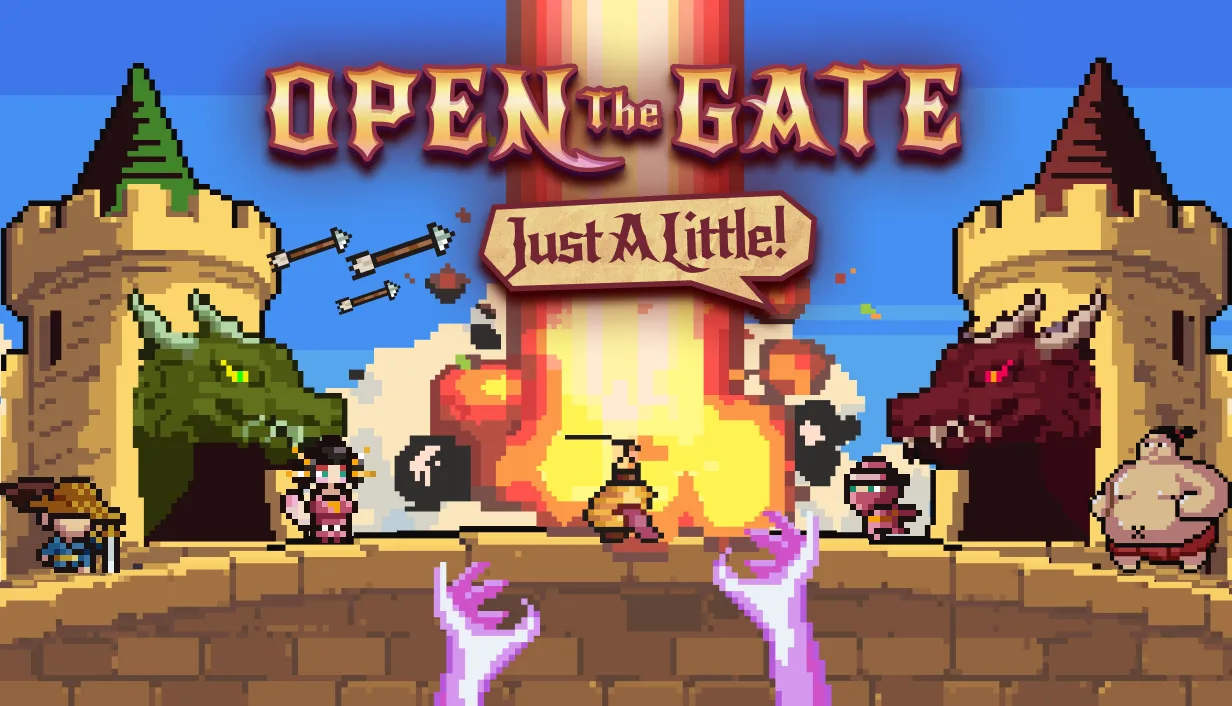
Open The Gate: Just A Little begins with a useful reversal of the usual tower-defense posture. Rather than defining success solely as surviving a procession of incoming enemies, its stated castle-versus-castle structure asks players to direct troops, capture towers, gather gold from fallen foes, train soldiers, and press toward an opposing stronghold. The result is a strategy premise in which defense has value because it may create an opening to advance.
Developed by Abubu Dance and published by The Bueno Interactive, the game released on Steam on August 13, 2026, for Windows and Mac. Its core battlefield is a narrow medieval-fantasy bridge. The developer describes arranging groups on that bridge, recruiting and promoting units, and pursuing the opposing castle. Four named legions—Crusader, Orc, Undead, and Dynasty—bring different armies and special skills, while a dragon is presented as a culminating threat.
Those facts establish a compact hybrid of tower-defense and real-time-strategy ideas, not its balance, technical performance, campaign scale, or the exact behavior of every encounter. Still, the announced systems fit together in a way that gives the game a distinct critical angle: it treats the frontline as a place to convert successful resistance into momentum.
An offensive answer to the tower-defense routine
Traditional tower defense often makes waiting meaningful. Players prepare a route, make spending decisions before or between waves, and then watch that planning withstand pressure. Open The Gate: Just A Little instead places the opposing castle at the far end of its conflict. That changes the implied question from “can this line survive?” to “when can this line move?”
That distinction matters even when the visible tools overlap with familiar genre language. Troop groups, towers, gold, and recruitment are not merely components of a defensive puzzle when the stated aim is to push through to a rival stronghold. A force that wins a clash but cannot capitalize on the result has not necessarily converted its advantage into progress. Conversely, advancing at the wrong moment could leave a player with insufficient strength to maintain pressure or respond to the next threat.
The bridge is a natural fit for this premise. A narrow lane may make the state of a confrontation easier to parse than a broad map packed with simultaneous routes. The player’s attention can remain on where groups are arranged, how close the conflict is to either castle, and whether the moment supports a push toward a tower. This is interpretation rather than a claim about the game’s exact controls or tactical depth, but it identifies why a restricted battlefield can be a strength: it makes position and timing legible without requiring sprawling terrain.
The constraint may also give every advance a clearer cost. When the fight is concentrated along one route, committing groups forward appears less like a detached order on a distant flank and more like a direct statement about the current battle. The available information does not establish tower ownership rules, recapture systems, or how territory changes after a capture. What it does establish is the importance of capturing towers on the route to the opposing castle, which is enough to frame the conflict as movement through a contested lane rather than passive endurance.
Fallen foes turn combat into an economy
Gold collected from fallen enemies is one of the design’s most consequential confirmed ideas. In many strategy games, income arrives on an independent schedule or from a separate economic layer. Here, the stated economy links currency to battlefield casualties. Defeating enemies is therefore not only about reducing opposing forces; it also contributes to the resources available for future decisions.
That connection gives the game’s offensive posture more weight. If combat success produces gold, and gold can train new soldiers, a favorable exchange can potentially become the start of another deployment. A clash is part of a chain: troops influence the encounter, the encounter produces or denies resources, resources shape recruitment, and recruitment affects the next attempt to take ground.
Independent criticism has highlighted a choice between spending gold on immediate units and improving production. It is a familiar strategy tension, but one that is particularly well suited to this format. Reinforcements can be attractive when the bridge is under pressure or a brief opening appears. A production upgrade may promise stronger future capacity, but only if the existing force can afford the delay. The important decision is not simply what is efficient on paper. It is whether the present state of the frontline permits patience.
This is where the tower-defense and RTS labels meaningfully meet. Defensive planning is still relevant because a player needs enough stability to make an investment. Real-time pressure is relevant because waiting for an upgrade may sacrifice an opportunity to advance. The design’s appeal rests on this interplay: economy is not distant bookkeeping, but an extension of what happens among the troop groups.
There are possible pitfalls to such a loop, though the evidence does not establish that they occur. An economy driven by fallen foes can become overly snowballing if an early lead compounds too easily. It can also feel stalled if neither side can generate sufficient resources to shift the confrontation. These are useful questions for prospective players, not confirmed defects. The known systems nevertheless suggest that Open The Gate: Just A Little wants each casualty to matter beyond the immediate exchange.
Legions provide a reason for victories to carry forward
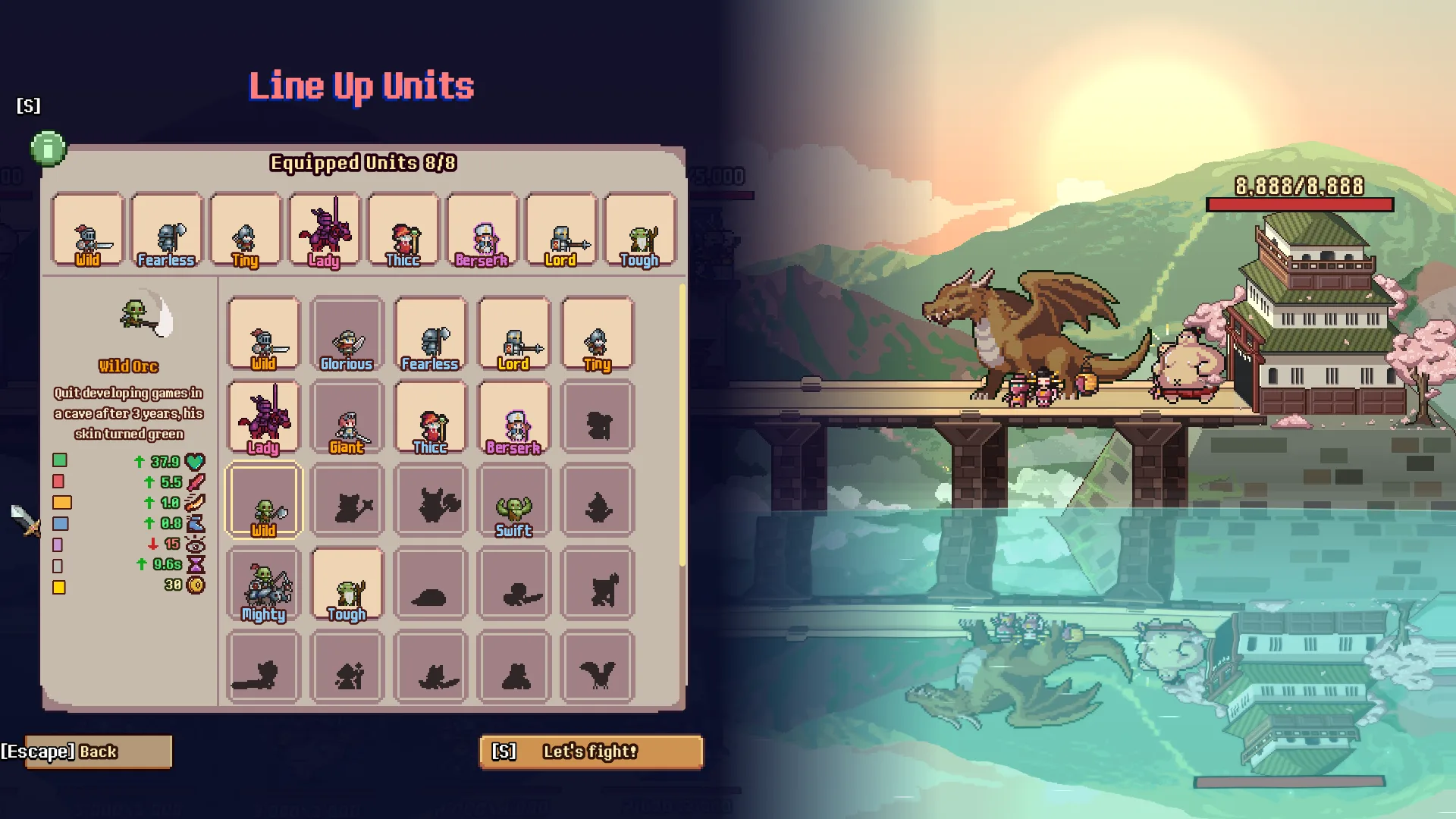
The Crusader, Orc, Undead, and Dynasty legions give the game its stated factional structure. Each is described as having different armies and special skills. More unusually, victory can grant skills associated with a defeated legion. That makes an encounter potentially additive: beating a faction is not only movement toward the enemy castle or a broader goal, but may also change the tools available afterward.
The promise of this system is variety through accumulation. If skills gained from defeated legions create meaningfully different tactical options, victories could influence later choices about troop arrangements, recruitment, and pressure. A player may be building a toolset rather than merely replacing losses. The available information does not specify the skills, their effects, or how they interact, so their depth should not be presumed. But the concept gives the four-legion structure more purpose than a sequence of cosmetic opponents.
The dragon should be read with similar restraint. It is presented as a culminating threat, establishing an escalation point within the game’s fantasy framing. Nothing supplied here confirms its encounter format, difficulty, position in a progression path, or relationship to the legions. Its value in the pitch is symbolic as much as mechanical: the castle conflict is designed to build toward something larger than a routine skirmish.
Persistent systems offer texture, but may test patience
Open The Gate: Just A Little extends its design beyond individual confrontations with randomized unit titles that affect statistics, rerolls, post-match XP, and an upgrade tree. These are confirmed systems, and together they indicate that unit management is meant to involve more than fielding an identical replacement whenever a soldier falls. Recruiting can include assessment of a unit’s title and stat effect, while rerolls offer a stated way to seek another result.
For players drawn to incremental strategy, this progression structure could make repeat attempts feel purposeful. Post-match XP means that progress is intended to persist beyond an individual match, and an upgrade tree suggests a longer-term layer of choices around the immediate bridge conflict. Promotions further support the idea that an army develops rather than simply resets between battles.
Randomness and persistence, however, create a real design trade-off. Randomized unit effects are most compelling when they ask players to adapt to what appears, rather than merely wait for a preferred roll. Upgrade systems are most satisfying when they broaden viable approaches rather than function as a numerical toll gate. Neither outcome can be established from the system list alone.
Later progression has drawn criticism for feeling slow and repetitive, with durable boss units and ranged archers identified as particular pressure points. That criticism is important because it speaks directly to the risk inside the game’s otherwise coherent repeat-attempt structure. If persistent XP, rerolls, and upgrades help players discover new responses, they can reinforce the pleasure of refinement. If advancement mainly asks for repeated accumulation before a difficult obstacle yields, the same systems may feel more like grind than growth.
This does not erase the potential value of the progression model. It clarifies the audience question. Players who enjoy iterative development, evaluating randomized modifiers, and carrying improvement across successive matches may see substantial appeal in the stated framework. Players who prefer entirely self-contained strategy matches, or who dislike progression tied to repeated attempts, may want to weigh that structure more carefully.
A focused proposition for compact-strategy players
On its confirmed design, Open The Gate: Just A Little appears best suited to players who value small-scale frontlines and visible tactical feedback. The bridge format focuses attention on a single advancing contest, while enemy-derived gold gives each successful exchange an economic consequence. Recruitment, promotions, skills, unit titles, rerolls, XP, and upgrades then place that short-term contest inside a larger development loop.
That makes it a different proposition from an expansive strategy game built around broad maps and many simultaneous fronts. The goal is not necessarily to simulate every dimension of warfare. It is to make a compressed sequence of decisions matter: place groups, respond to pressure, collect gold, choose between present reinforcement and future capacity, and try to turn a stable line into a captured route toward the enemy castle.
For a related look at how repeatable decisions can define a compact PC game, see this PC design assessment.
Unscored assessment
Open The Gate: Just A Little has a clear strategic identity on paper. Its most interesting idea is not simply that it contains tower-defense and RTS elements, but that it joins them through forward motion. Troop placement affects combat, combat yields gold from fallen foes, gold supports recruitment or production decisions, and those decisions shape the next push across the bridge.
The four legions, victory-linked skills, randomized unit titles, rerolls, post-match XP, promotions, and upgrade tree provide a defined persistent framework around that frontline. The major caution is whether that framework sustains variety over time, particularly in light of criticism around repetitive later progression and tough boss or ranged pressure. For players interested in concise strategy loops and incremental development, this is an unscored game worth considering for its offensive take on tower defense: holding the line matters because the line is meant to move.