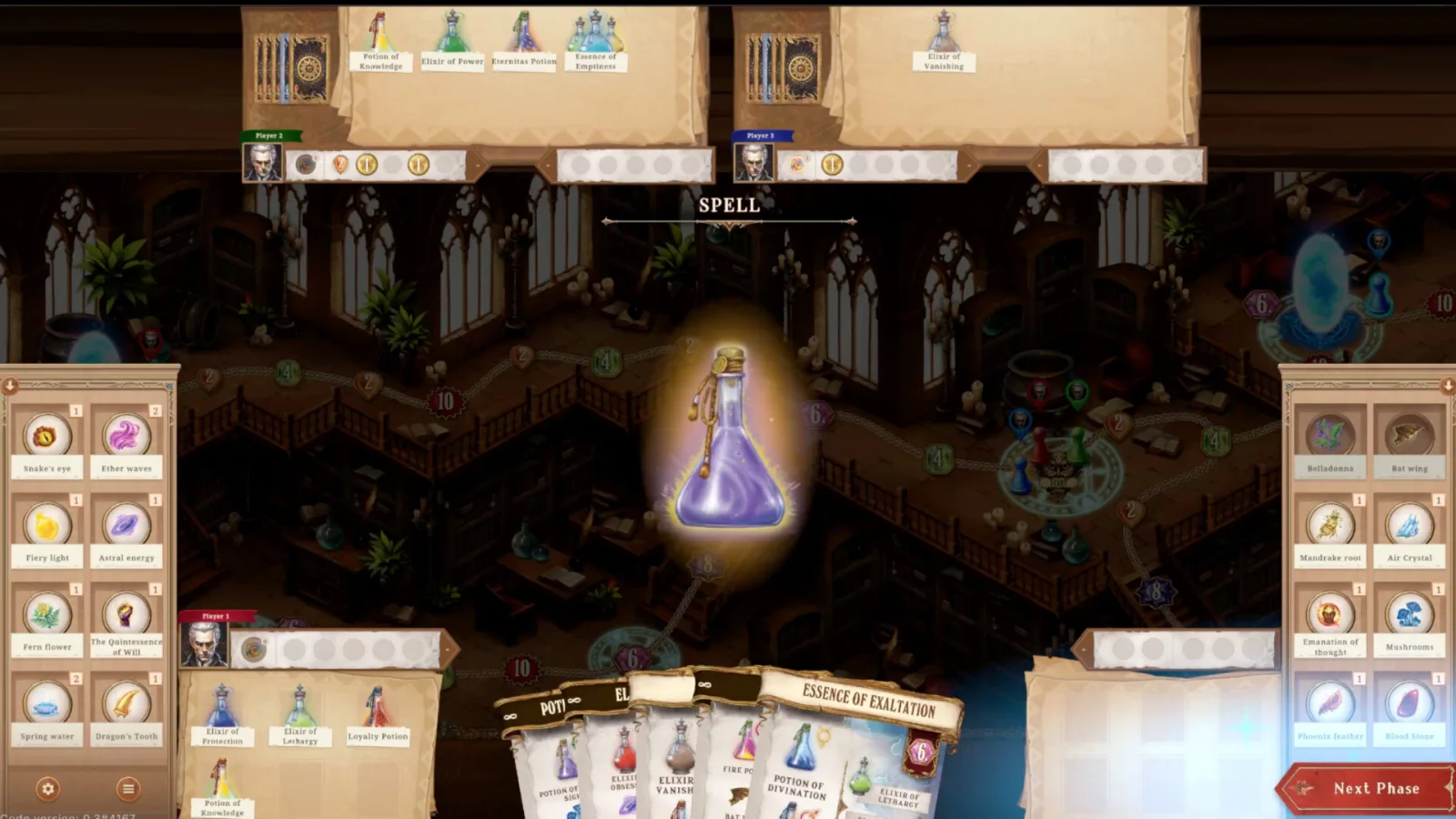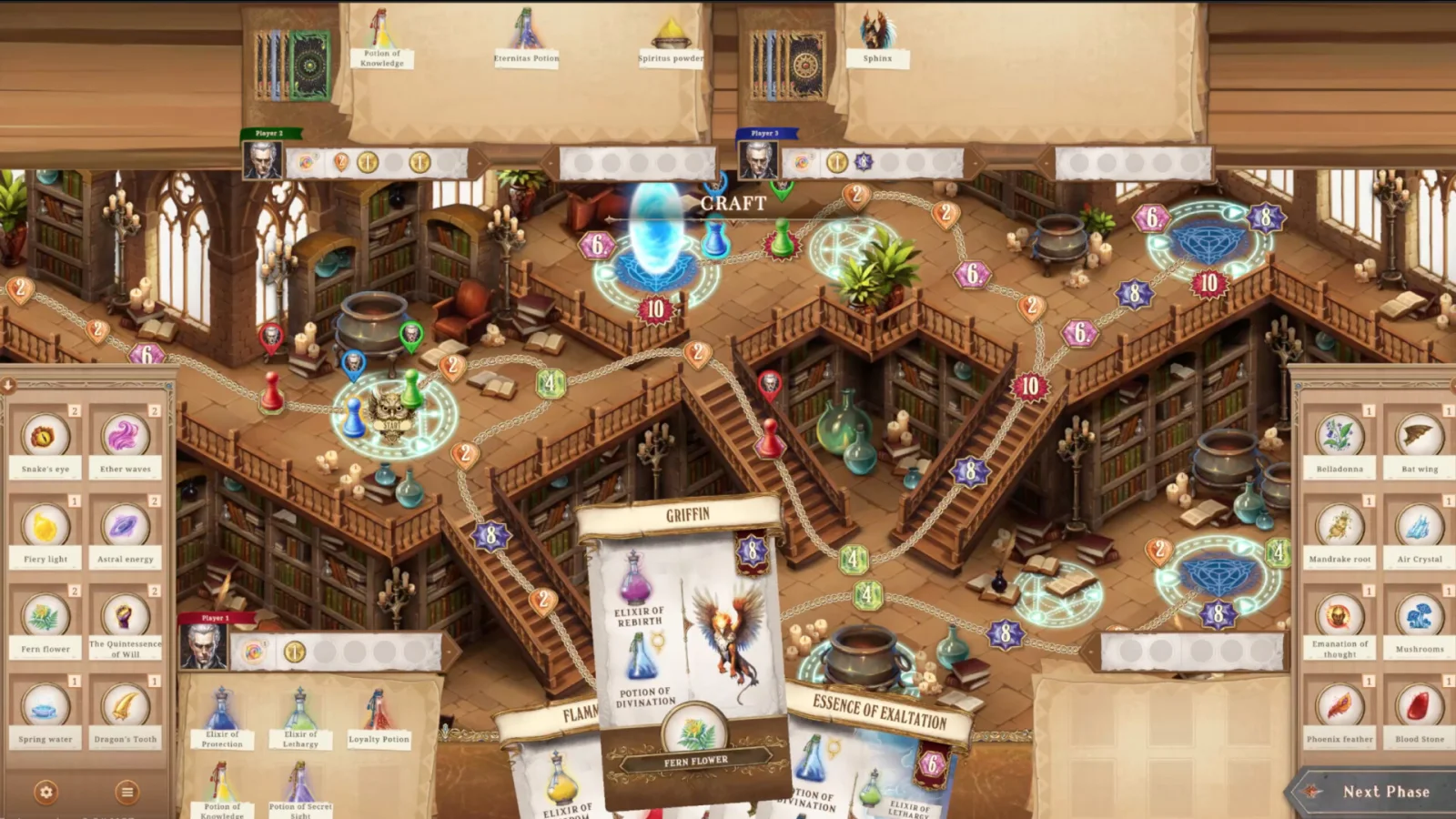
Potion-making: Path of the Alchemist is a PC strategy and board-game adaptation from Oduvan Games, with Beverlor listed as publisher on Steam. Its full release is currently planned for November 10, 2026, a date that should be treated as provisional until the game ships. Steam also currently lists a demo, while the title’s press materials identify a Beta key. There is no Steam user-review aggregate at present, and there is not a full-release critical record substantial enough to support a conventional scored verdict.
What is established is a compactly appealing premise. Master Fulcanelli’s forbidden spell has disrupted the First Tree, and competing alchemists are racing to reach three Places of Power. That race matters because it gives the potion-making theme a finish line. This is not presented as an endlessly expanding laboratory or a freeform crafting sandbox. The stated objective makes potion construction instrumental: recipes are valuable because they advance a competitor toward the Places of Power before rivals can do the same.
The official description lays out a system of gathering ingredients and combining them into increasingly complex recipes. It also says competitors may use opponents’ recipes, cast spells, wield talismans, and compete in single-player, online PvP, and LAN PvP. Those ingredients point toward a game whose central question may be less “what can I create?” than “which route through the recipe web is worth pursuing right now?” That distinction could give the adaptation a sharp tactical identity if its digital presentation makes each dependency and opportunity comprehensible.
What is established
Potion-making: Path of the Alchemist is explicitly a digital adaptation of a tabletop or board game. That origin is meaningful, but it should not be mistaken for a guarantee that every tabletop strength transfers automatically. Board-game systems can be exceptionally good at defining shared information, constrained decisions, and legible win conditions. A digital version, however, has to translate those virtues into screens, inputs, prompts, and visual hierarchies. The computer can handle bookkeeping, but it can also hide the board’s logic behind layers of interface.
The stated loop begins with ingredients and develops through more complex potions. In abstract design terms, that suggests a dependency structure: an early result may become a component for a later one, which may in turn unlock a still more demanding result. Rather than treating every potion as an isolated purchase, the game can make previous decisions matter as scaffolding. An ingredient selected now may have modest immediate value but become essential to a future branch. A tempting intermediate potion may either be a stepping stone or an expensive diversion.
The objective of reaching three Places of Power supplies a counterweight to purely maximalist crafting. If the system rewarded only complexity, the natural impulse would be to construct the grandest available recipe. A race objective can instead ask whether an elaborate route is actually efficient. A simpler sequence that reaches a Place of Power quickly may outrun a rival’s more impressive chain. Conversely, a player who spends time establishing a broader recipe base might find more options when a direct route is blocked. The design’s eventual character will depend on how often these competing instincts meaningfully collide.
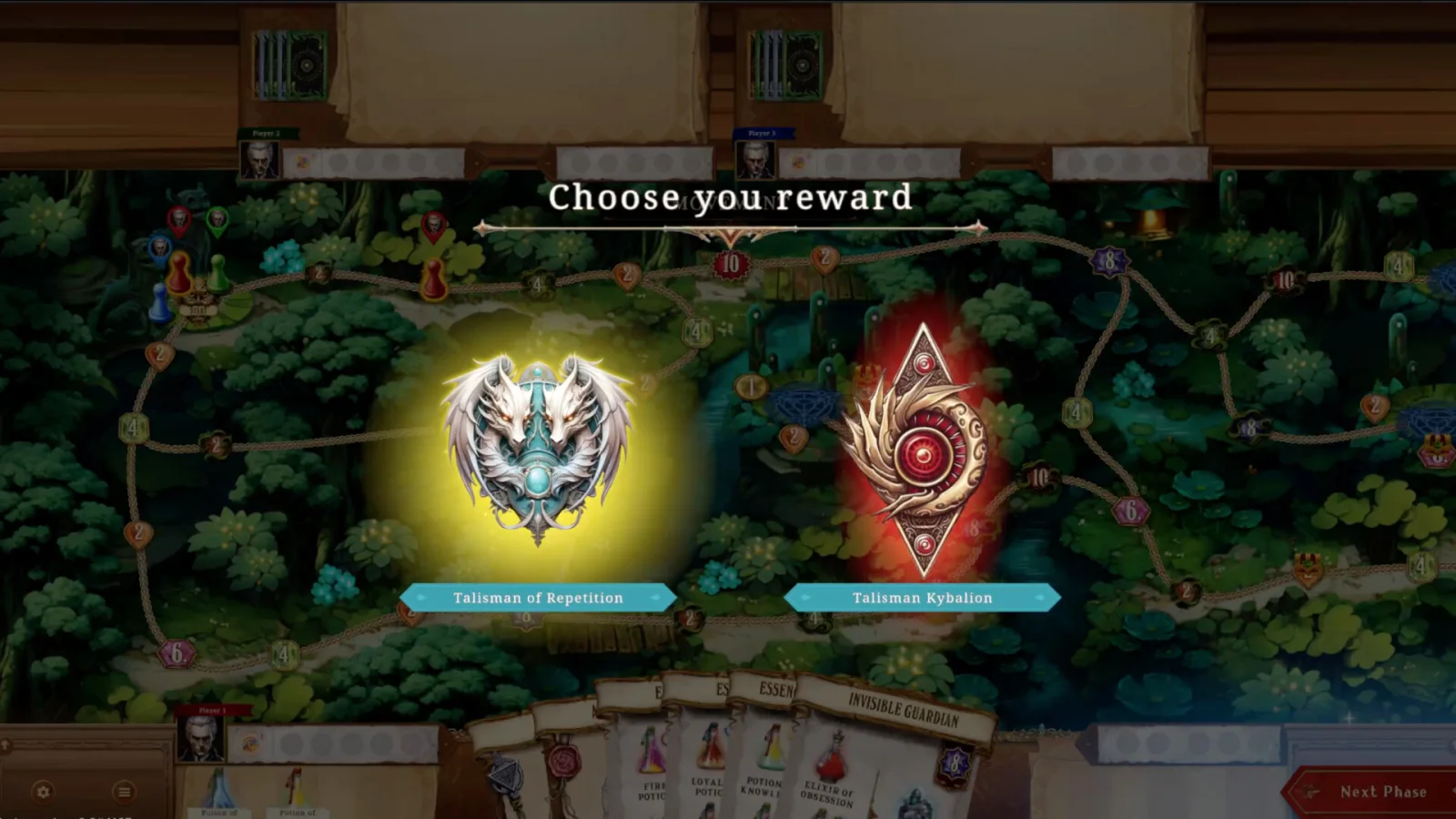
Spells and talismans are also part of the official outline. Their exact rules, availability, and impact are not established here, so it would be premature to assign them a particular tactical role. Still, their inclusion signals that ingredients alone are not intended to carry the whole contest. Depending on implementation, they could provide pivots, exceptions, acceleration, protection, disruption, or simply additional routes through the puzzle. The important unanswered question is whether they clarify strategic choices or merely add effects that are difficult to assess amid recipe management.
A crafting tree rather than a crafting pile
Recipe games often live or die by whether their combinations create planning rather than busywork. A system of intermediate potions can form a planning tree because one decision may lead to several later options while closing off others. In the strongest version of that model, a player does not merely collect items until a recipe turns green. They read several possible chains, decide which ingredients have flexible downstream uses, and judge whether committing to one line leaves enough room to react.
That is where the race to three Places of Power could make Potion-making: Path of the Alchemist more interesting than a relaxed alchemy catalogue. A fixed destination creates pressure to value tempo. If a complex recipe line consumes scarce ingredients or several turns of setup, its eventual payoff needs to justify the delay. If an opponent is visibly approaching a Place of Power, the best response might be to change plans, seize a useful recipe first, or find a shorter route. Such tension is a design possibility implied by the stated rules, not a claim about how individual matches currently play.
The risk is equally clear. A recipe tree becomes less strategic when its best route is always obvious, when an early setback leaves no credible recovery, or when the necessary information is too awkward to inspect. A satisfying network should make forward planning rewarding without requiring every player to memorize an opaque web. It should let someone understand the local decision—what this ingredient can become—while retaining enough depth for a longer-term plan to matter.
Automatic rule enforcement is one of the most persuasive reasons to adapt a tabletop recipe system to PC. If the software tracks legal combinations, prerequisites, available ingredients, and completed recipes clearly, it may remove setup and accounting friction that can slow a physical game. It may also allow attention to remain on choices rather than verification. That is an opportunity rather than a confirmed quality. Automation is helpful only when players can still see why an action is valid, why another is unavailable, and what a choice changes.
The shared-recipe question
The official description’s most intriguing competitive detail is that alchemists can use opponents’ recipes. That rule potentially turns a private optimization exercise into a shared tactical space. In a conventional engine-building structure, building a useful mechanism usually benefits its owner first. Here, a competitor’s progress may also create an asset other competitors can exploit. The result could be a productive tension between building efficiently and revealing a route that others can borrow.
That possibility raises several valuable design questions. Is a competitor rewarded enough for assembling a recipe before anyone else uses it? Can another alchemist immediately convert that recipe into a different chain? Does shared access create catch-up opportunities, or does the leading player remain so far ahead that copying is only a consolation? None of those answers should be assumed before the rules and final build make them clear. But the questions identify the part of the design with the greatest potential to generate interaction beyond a simple parallel race.
Shared systems can also create a useful form of table awareness. Instead of looking only at one’s own ingredients, a player may need to notice which recipes have entered circulation and which ingredients those recipes make more valuable. That can reward observation without requiring direct attack mechanics. It can also make timing matter: completing a recipe at one moment might open an opportunity for a rival, while delaying it could cost a crucial step toward a Place of Power.
For competitive players, the strength of this arrangement will likely rest on whether interaction feels deliberate and readable. A shared recipe should ideally create a decision: exploit it, race around it, deny a related ingredient if the rules allow, or build a response through one’s own line. If the shared layer is too weak, competitors may feel as though they are solving adjacent solo puzzles. If it is too dominant, personal recipe planning may feel temporary or futile. The final balance between ownership and reuse is one of the game’s central unknowns.
Solo and competitive play need different kinds of clarity
Steam lists single-player alongside online PvP and LAN PvP. Those labels establish available modes, but not their structure, objectives, opponent behavior, or balance. It would be unsafe to assume that single-player is a campaign, a sequence of bespoke challenges, an AI match mode, or any particular format. The beta’s existence should likewise not be treated as confirmation that all planned solo content is already available.
Conceptually, though, solo and competitive audiences will ask different things of the same recipe system. A solo player may value a clearly framed challenge, understandable opposition, and room to learn why one route outperforms another. A competitive player may place greater value on replayable uncertainty, interactive timing, and a fair opportunity to respond to emerging threats. A design can serve both, but it cannot simply assume that a puzzle which is engaging alone will automatically create satisfying player-versus-player drama.
The Places of Power objective may help unite those needs. A visible, finite target can give solo play a clean measure of progress and competitive sessions a readable race state. Yet it can only do so if the path toward each Place is communicated well. Players need to understand not just that a rival is ahead, but what the rival’s progress means and whether a response remains possible. This returns the discussion to interface design, the most important practical question surrounding the adaptation.
Legibility is not cosmetic
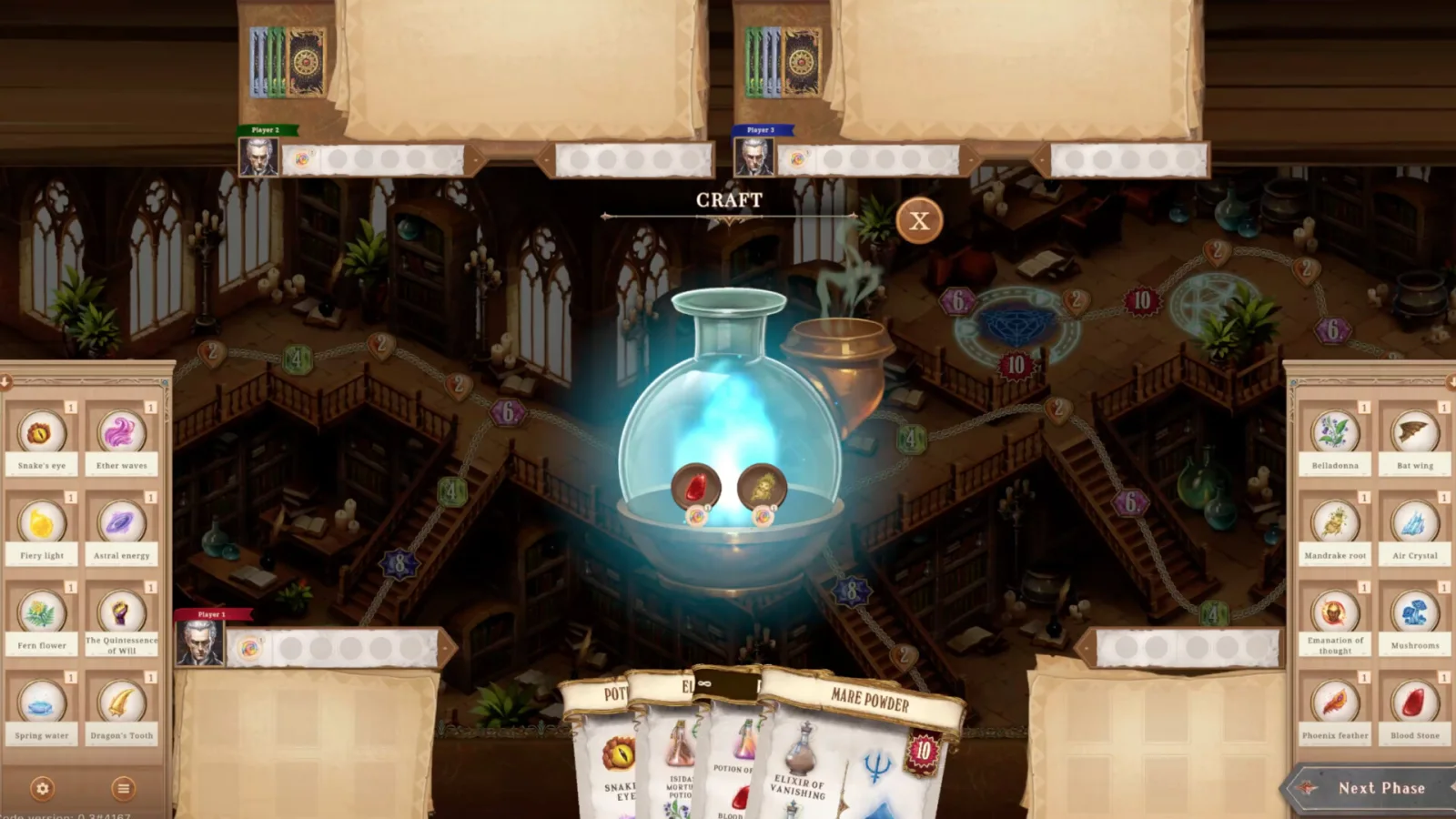
A digital card-and-recipe game depends on legibility at multiple scales. At the immediate level, players need to identify ingredients, potion requirements, spell effects, talisman effects, and legal actions. At the planning level, they need to inspect dependencies and compare routes without losing the context of the board. At the competitive level, they need to see what opponents have established, what is shared, and what threatens the race to three Places of Power.
Those requirements are not requests for visual extravagance. They are functional demands. Handmade art can establish a distinctive alchemical atmosphere, but atmospheric presentation should support information rather than obscure it. A beautiful ingredient icon that is hard to distinguish from a related component can slow decision-making. A recipe display that looks ornate but makes prerequisites difficult to trace can turn a strategic network into avoidable friction. Conversely, clear grouping, reliable symbols, readable tooltips, and easy route inspection could make a potentially dense system welcoming.
Pre-release feedback has identified interface clarity as an area still needing attention, which makes this more than a theoretical concern. That observation belongs to a beta period and does not establish the state of the planned release. It does, however, underline where polish matters most. This is not the kind of game where interface work merely makes menus nicer. It may determine whether the game’s intended planning depth is visible enough to be enjoyed.
Music and presentation merit the same measured approach. There have been positive impressions of the handmade visual direction, while the audio presentation has been described as restrained in beta. Neither point can settle the final game’s aesthetic impact. More importantly, neither substitutes for readability. The most successful presentation would make the alchemical setting memorable while keeping recipe chains, shared opportunities, and race progress easy to parse at a glance.
What remains to be seen before release
The core promise is intelligible: gather ingredients, make increasingly advanced potions, use a shared competitive space, and reach three Places of Power. The remaining questions are about execution and texture. How much meaningful choice exists in the early turns? How transparent are recipe dependencies? How disruptive or enabling are spells and talismans? How much agency does a player retain after another alchemist establishes a valuable recipe? How well do solo and PvP modes communicate their distinct goals?
There is also a broader adaptation question. Digital board games are often at their best when the software preserves the board game’s social readability while shedding its manual overhead. Potion-making: Path of the Alchemist has the right broad ingredients for that outcome: explicit competition, visible milestones, layered combinations, and potentially consequential use of opponents’ work. It will need to ensure that digital convenience does not become digital opacity.
Readers interested in how a PC game’s interface can become inseparable from its central rules can also see our Radiotext PC design feature. The games are not being presented as direct comparisons; the shared point is simply that systems built around interpreting information ask a great deal of their presentation.
Early outlook
Potion-making: Path of the Alchemist has a more focused proposition than its title alone may suggest. The stated destination is not potion collection for its own sake, but a contested route to three Places of Power. Intermediate recipes could turn ingredients into a genuinely interesting planning tree, while the ability to use opponents’ recipes could make the board feel shared rather than partitioned. Spells and talismans offer further potential for variation, although their practical role remains to be clarified.
For now, the most responsible reading is cautiously interested rather than conclusive. The demo offers a current avenue for players who want to inspect the game’s form, and the planned November 10, 2026 release gives the project a stated target rather than a guarantee. The final test will be whether its digital tools make recipe logic clearer, faster, and more tactically expressive than manual tracking would be—without flattening the decisions that make an alchemical race worth entering.