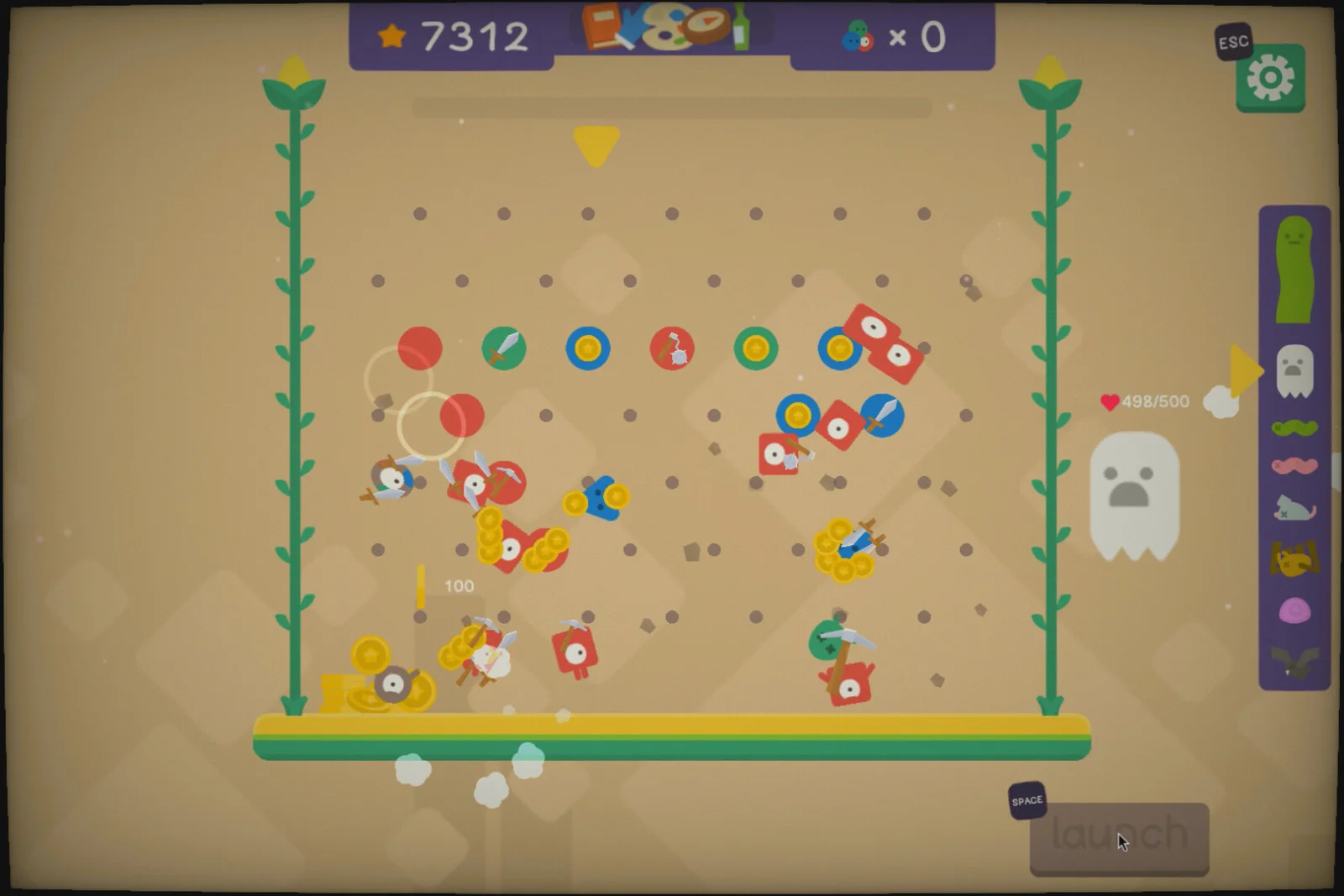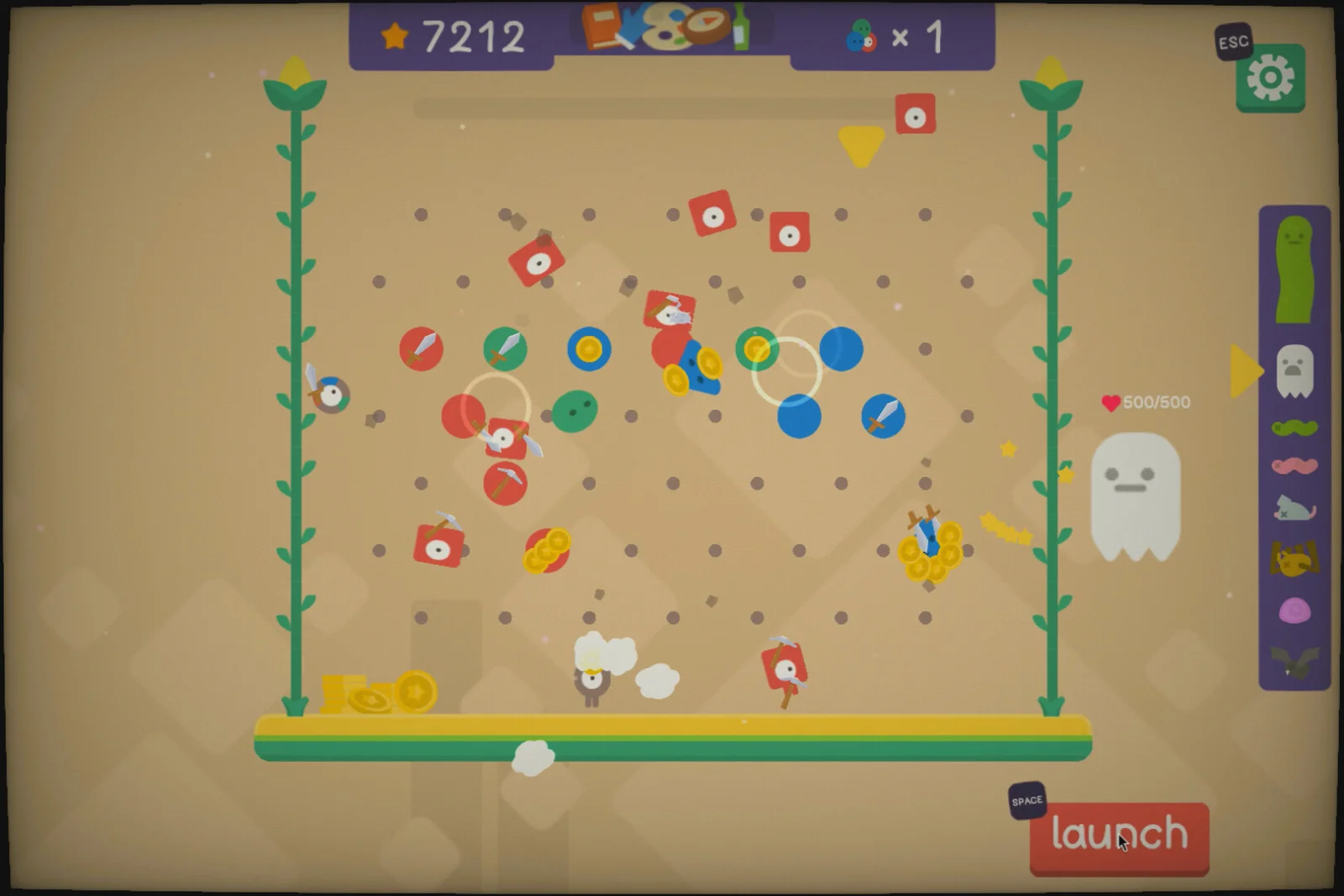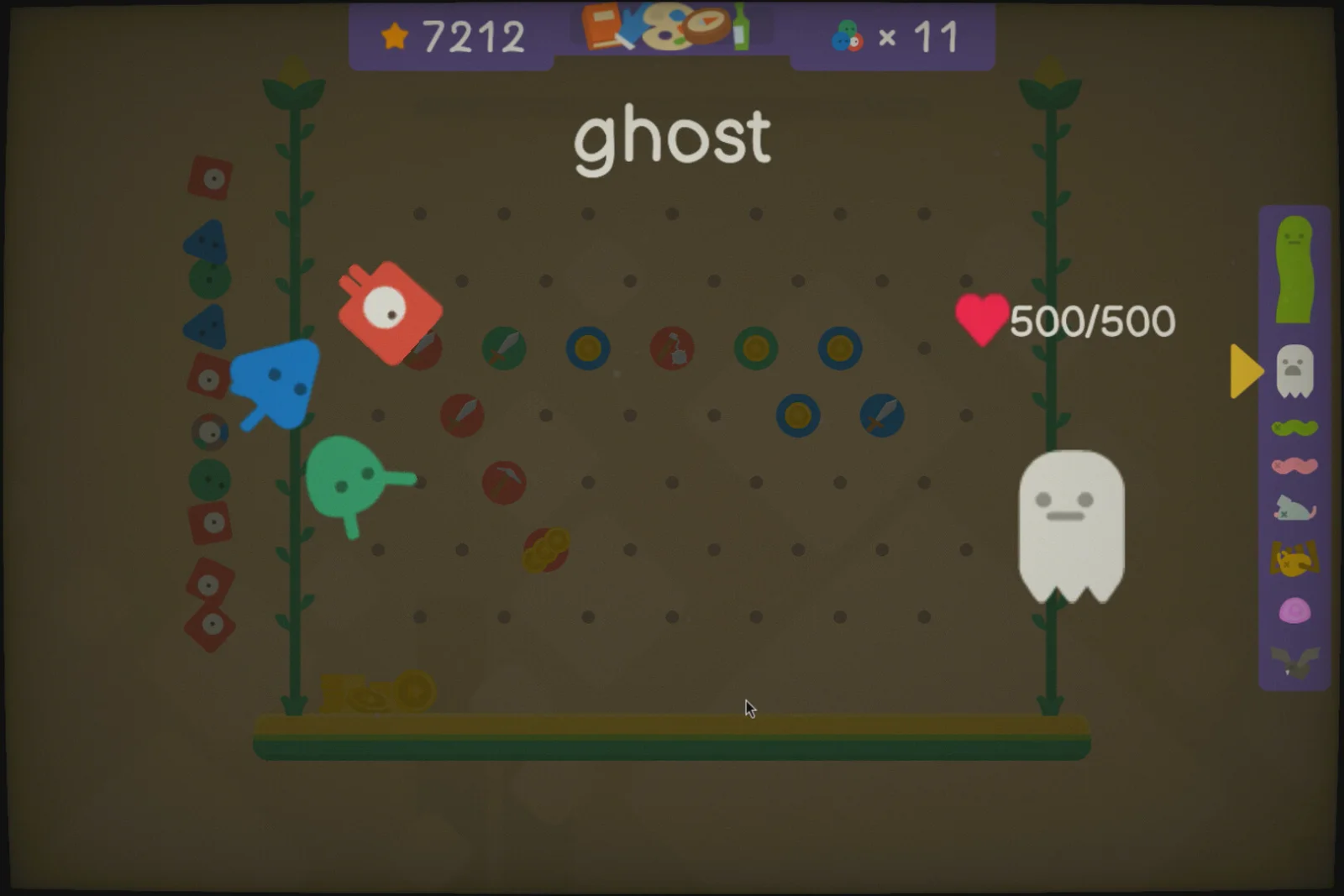
A Little Physics Roguelike is a PC game developed and published by berru, released on March 23, 2026. Its official description is concise: players grab equipment and build a board of items to defeat cute enemies. Steam categorizes it as a single-player Casual/Indie release and lists achievements, cloud saves, leaderboards, keyboard-only and mouse-only play options, custom volume controls, and Family Sharing.
This is an unscored assessment rather than a hands-on review. The available evidence points to a game with an immediately legible proposition: arrange tools, then watch a compact physics system convert placement into a cascade of contacts, movement, and damage. An independent critical assessment describes a blend of pachinko and coin-pusher ideas, with a board functioning in a deck-like role. It also identifies colorful equipment matching and randomized upgrades as central ingredients. That combination makes the game sound less interested in demanding constant mechanical execution than in making setup, anticipation, and visual payoff share the same small space.
There is a clear appeal in that framing. Physics games can turn a simple action into a miniature event because the player sees a chain form rather than merely receives a result. A collision that sends an object into another item, which triggers another favorable interaction, has a visible cause-and-effect texture. Board construction gives that spectacle a prelude: before the system starts moving, there is an opportunity to decide where equipment belongs and which possibilities are worth pursuing. Cute enemies and colorful equipment, as described in the available criticism, appear suited to that accessible, toybox-like presentation.
The complication is equally clear. A physics-driven game can make planning feel consequential without necessarily making it reliably decisive. The most important question for A Little Physics Roguelike is not simply whether chains look satisfying. It is whether board-building consistently gives players understandable ways to influence those chains, evaluate the result, and improve the next setup. That is where the distinction between a lively short-session diversion and a roguelike that rewards long-term return becomes especially important.
Verified outline: a board, equipment, and physics-driven combat
The established description does not promise a conventional action game. It promises equipment gathering, a board of items, and enemy defeat. The independent assessment further characterizes combat as passive, meaning the decisive moments occur through resolution rather than direct, continuous input. That does not automatically reduce the design to luck. Plenty of strategy games put their most meaningful choices before the simulation begins. The issue is how much information, control, and consistency the preparation phase supplies.
In the most favorable reading, the board is a tactical sentence written before the physics engine reads it aloud. Equipment position may determine what is likely to collide, what can be activated, or which sequence has the best chance of occurring. Color matching, if it materially links equipment choices and board outcomes in the way the criticism suggests, could make an otherwise abstract arrangement easier to parse. Players would not need advanced reflexes to participate; they would need an eye for placement and a willingness to learn which combinations produce useful results.
That low barrier to entry is one of the strongest documented virtues. The independent assessment praises the ease of getting started and the satisfaction of early physics chains. For players who find dense build systems tiring or high-speed execution uninviting, a game that communicates through objects bouncing, meeting, and setting one another in motion can be refreshingly direct. The listed keyboard-only and mouse-only options also establish that the game supports more than one input approach, although the available information does not establish the specific controls or how those options are implemented.
Officially listed cloud saves and achievements are practical additions for a game organized around repeatable sessions, while leaderboards indicate that some form of comparative score tracking is present. Their presence alone does not establish what is ranked, how leaderboards are structured, or whether competition is a major part of the experience. Still, they fit a design whose immediate appeal may lie in trying a board idea, watching the result, and looking for a cleaner or more dramatic outcome next time.
Agency versus spectacle is the central design test
The available critical assessment’s largest concern is that passive combat can make the game feel as though it is playing itself. This is a precise criticism for a physics roguelike, because spectacle is not the same as agency. A spectacular chain can be enjoyable even when it was difficult to predict. But if the player cannot tell why a favorable result happened, cannot make a sensible adjustment after an unfavorable one, or repeatedly arrives at the same broadly optimal setup, the animation risks becoming a substitute for decision-making rather than a payoff for it.
That concern should not be overstated into a claim that the board lacks strategy. The evidence supports no such absolute conclusion. Instead, it establishes a tension: equipment selection and placement may create planning opportunities, while the eventual resolution may constrain how strongly those plans can be expressed. For some players, that tension is the point. They may enjoy setting probabilities in motion and accepting that a small machine has a personality of its own. A favorable ricochet can feel more delightful precisely because it was not manually choreographed.
For other players, ownership matters more than surprise. Roguelike fans often value the feeling that a build has a readable identity: a choice leads to an interaction, the interaction produces a dependable advantage, and later choices develop that advantage. When randomness is perceived as overwhelming skill, as the independent criticism argues can happen here, defeat or success may feel less like a verdict on the build and more like a report from the physics table. That can blunt both pride and productive failure. A player can be entertained by chaos while still lacking a clear lesson to carry into the next attempt.
The difference is not philosophical trivia. It shapes whether replay becomes experimentation or repetition. A system does not need perfect predictability to support skill. It needs enough legibility that players can distinguish a sensible risk from an arbitrary one. Randomized upgrades can strengthen this loop by forcing adaptation: a new option may invite a revised layout instead of a familiar answer. Yet randomized upgrades can also dilute it if their availability matters more than the player’s ability to make good use of what appears. The available assessment raises precisely this latter possibility without establishing that every run suffers from it.
Board construction could be the game’s durable idea
The board-as-deck concept is the most promising part of the available description because it blends two kinds of anticipation. Deck-building language implies selection, combination, and the gradual formation of a build. Pachinko and coin-pusher language implies motion, uncertainty, and a physical payoff. Placing items on a board could potentially bridge those impulses: rather than merely collecting effects that trigger in a list, players might be assembling a spatial machine whose geography matters.
If that spatial element gives equipment distinct relationships, it could make planning meaningful even when combat itself is passive. Positioning can be a genuine decision layer when changing location changes likely routes, contacts, or interactions in a comprehensible way. In that ideal case, the passive phase is not an absence of play; it is a test of prior judgment. The pleasure comes from seeing a prepared structure behave as intended, or from revising it after it behaves unexpectedly.
However, the independent criticism argues that strategies can converge on stacking weapons and hoping for favorable physics. If that observation reflects the broader experience, it identifies a meaningful risk for the design: a board may offer the appearance of spatial variety while rewarding a narrower practical solution. Such convergence is especially damaging in a roguelike-adjacent structure because variety must do more than exist in a pool of upgrades. It needs to create materially different decisions and outcomes.
That criticism remains an observation, not a verified inventory of every viable approach. It nevertheless supplies a useful purchasing lens. Players interested chiefly in discovering expressive build paths may want evidence that varied equipment arrangements remain worthwhile beyond the first appealing combinations. Players who are content with a straightforward power fantasy may see less of a problem in weapon stacking, particularly if the immediate visual chain reaction is the reward they came for. The same trait can read as shallow to one audience and comfortably uncomplicated to another.
There is also a valuable distinction between “simple” and “thin.” The evidence supports the game’s low input barrier and early satisfying chains; it does not establish that simplicity itself is a defect. A compact ruleset can be excellent when its consequences are deep enough to learn over repeated sessions. The concern reported by the independent assessment is more specific: the loop may not evolve enough and runs may begin to blend together. That is a concern about sustained variation, not an argument that every accessible game needs more buttons, more menus, or a more elaborate control scheme.
Randomness changes the feeling of success
Randomness is unusually visible in a physics game. In many build-focused games, chance lives behind percentages, draws, or hidden calculations. Here, based on the available description, the uncertain part is likely expressed through physical motion. That can make chance more charming because it is animated and easy to watch. It can also make it more emotionally immediate. A near miss is not just a failed check; it is an object visibly taking the less helpful route.
Whether that feels thrilling or deflating depends on how players interpret the relationship between setup and outcome. A successful chain may feel deserved when it follows a clear arrangement, even if the exact sequence contains uncertainty. Conversely, a powerful arrangement that produces disappointing results for reasons players cannot meaningfully address may weaken confidence in the planning layer. The cited criticism’s claim that favorable physics can become the deciding hope suggests that this threshold may be crossed for at least one evaluator.
That does not make physics-driven variance inherently unsuitable for roguelike design. On the contrary, uncertainty can keep small boards from becoming solved diagrams. It can encourage resilient planning rather than brittle optimization, asking players to build for several possible paths rather than one perfect line. But that benefit depends on players having enough tools to respond intellectually to variance. Without that sense of response, randomness becomes something to endure rather than a condition to plan around.
Potential players should therefore approach A Little Physics Roguelike according to the type of ownership they seek. Those who enjoy arranging a contraption, releasing it, and accepting a degree of playful unpredictability may find the premise naturally appealing. Those who want every victory to feel tightly authored by a sequence of deliberate choices may be more sensitive to the reported passivity and volatility. Neither preference is more legitimate; they simply ask different things from the word “roguelike.”
A short-burst proposition, based on the current criticism
The independent assessment ultimately frames the game as an entertaining novelty for short bursts rather than a durable nightly roguelike. That conclusion should be treated as critical judgment, not an established fact about every player’s experience. Still, it coheres with the strengths and reservations described together. Immediate readability, colorful presentation, and satisfying early chain reactions are qualities well suited to brief sessions. Repetition, convergent strategies, and an insufficiently evolving loop are the kinds of concerns that become more visible over prolonged play.
Short-session appeal should not be treated as a consolation prize. Games built around a simple ritual can be valuable precisely because they do not demand a large mental commitment. A player may want the small drama of setting a board, watching it resolve, and moving on. The official single-player framing and available convenience features are compatible with that kind of personal, pick-up-and-play use, though they do not prove any particular session length or pacing.
At the same time, players seeking an enduring roguelike habit may reasonably place more weight on the reported lack of evolution. In that category, replayability is not just the ability to begin another run. It is the feeling that another run asks a newly interesting question. Are different upgrades changing priorities? Does placement create alternate solutions? Do losses clarify a different plan? The available criticism suggests uncertainty about those questions, particularly once the initial novelty of the physics interactions has passed.
For readers considering another game where planning is tested by a volatile system, JokingJoystick’s assessment of build planning amid a storm offers a relevant adjacent discussion. The comparison here is limited to that broad design question; the supplied evidence does not establish direct mechanical equivalence between the games.
Assessment
A Little Physics Roguelike has a coherent, inviting documented premise: build an item board, gather equipment, and let physics turn preparation into a bright, compact battle against cute enemies. The available criticism credits its presentation, low entry barrier, randomized upgrades, color-oriented equipment ideas, and early chain reactions. Those are substantial reasons for players who value playful spectacle and low-pressure experimentation to take interest.
The same evidence supplies a significant caution. Passive resolution may diminish the sense of direct involvement; randomness may sometimes obscure skill; and repeated runs may not develop enough distinction to support the long-lived roguelike routine some players expect. The crucial unknown for any individual player is tolerance for that trade. If unpredictability is a feature rather than a frustration, the board-and-physics blend may offer an enjoyable little ritual. If strong tactical ownership and consistently varied build expression are essential, the reservations deserve equal weight.
Accordingly, this is best viewed not as a verdict on unverified hands-on experience, but as an evidence-led assessment of a design caught between deliberate construction and cheerful mechanical disorder. Its strongest idea is also its hardest problem: the board needs to make players feel that they built the moment, not merely that they were lucky enough to watch it happen.