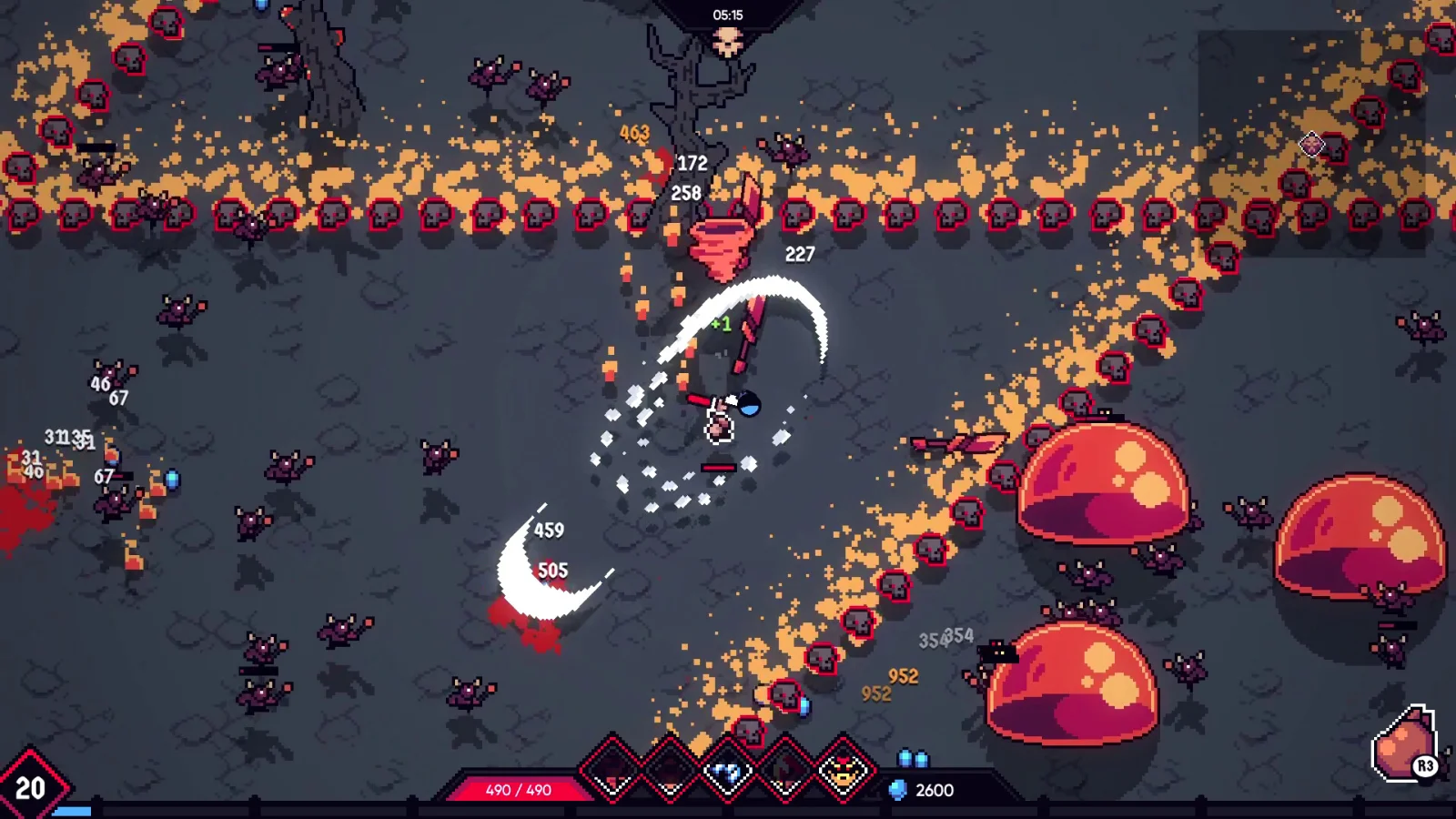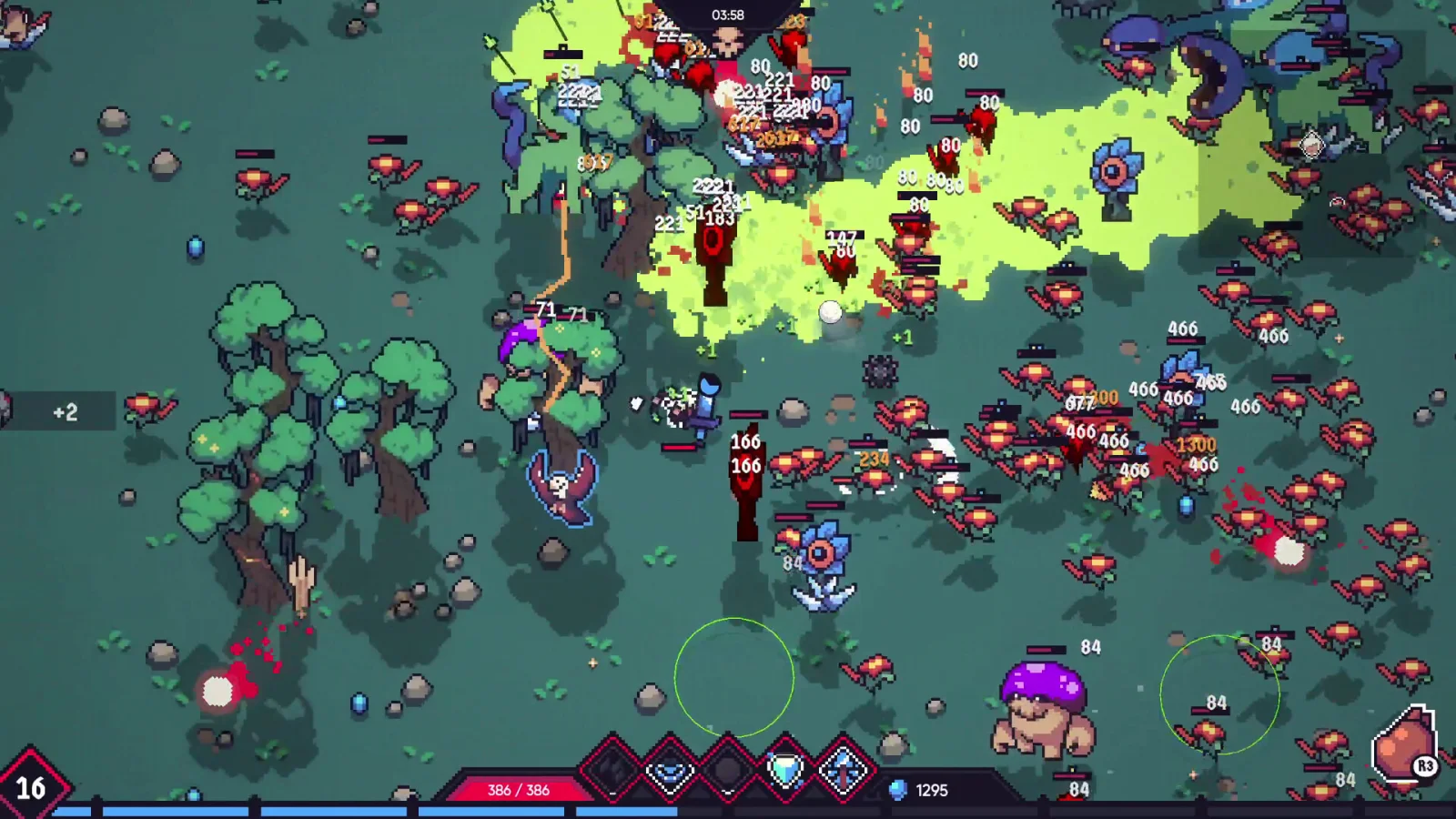
Asgard’s Fall — Viking Survivors arrives on PC as a single-player Norse-mythology action roguelite from Soulpotion, published by Assemble Entertainment and Sidekick Publishing. Its central loop is recognizably survivors-like: abilities trigger automatically, while the player’s meaningful moment-to-moment responsibilities are movement, positioning, collecting experience, and choosing how a build develops. Yet the official design outline points toward a more deliberate proposition than that shorthand can suggest. Distinct character skill trees, the branching Web of Wyrd, and the persistent Warpaint system all put planning alongside the genre’s familiar pressure of dense real-time combat.
This is an unscored assessment of the released PC version, not a first-hand review. There are no owner gameplay notes supporting a claim that Joking Joystick played, completed, or tested Asgard’s Fall, and a numerical score would imply a breadth of direct evaluation not available here. What can be assessed is the clarity of the announced and released design, the significance of its 1.0 additions, and the publicly documented launch-condition concerns that surround it. That distinction matters especially for a game whose long-term appeal may rest on whether its planning tools stay readable when the action becomes crowded.
Established design: automatic attacks, intentional movement
The established core is straightforward. Combat abilities activate automatically; the player directs movement and positioning, gathers experience, and makes build decisions. That setup changes the question a player is asked to answer. The challenge is not merely execution through manual attacks. It is about maintaining a safe or advantageous location while interpreting the state of a developing build and deciding which future benefits are worth pursuing.
Automatic abilities can make an action roguelite feel approachable at the input level without making it simple at the decision level. In Asgard’s Fall, that potential is strengthened by the stated role of positioning. If abilities fire on their own, placement can become the language through which players express immediate intent: staying mobile, collecting experience, or arranging encounters around the behavior of an existing build. This is a conditional reading of the design rather than a claim about the game’s exact combat feel, but it identifies a useful tension. The player may be spared some mechanical demands while still being asked to think continuously under pressure.
The Norse-mythology setting supplies the frame, but the more distinctive information is systemic. Characters have separate skill trees, meaning the game is structured to give different character choices their own developmental paths. The eventual quality of that distinction depends on variables not established here, including how strongly those trees alter priorities and how they combine with other systems. Still, distinct trees are a meaningful foundation for players who prefer to learn a game through contrasting planning problems rather than repeat the identical route with a different visual wrapper.
The Web of Wyrd is the clearest expression of the game’s ambition
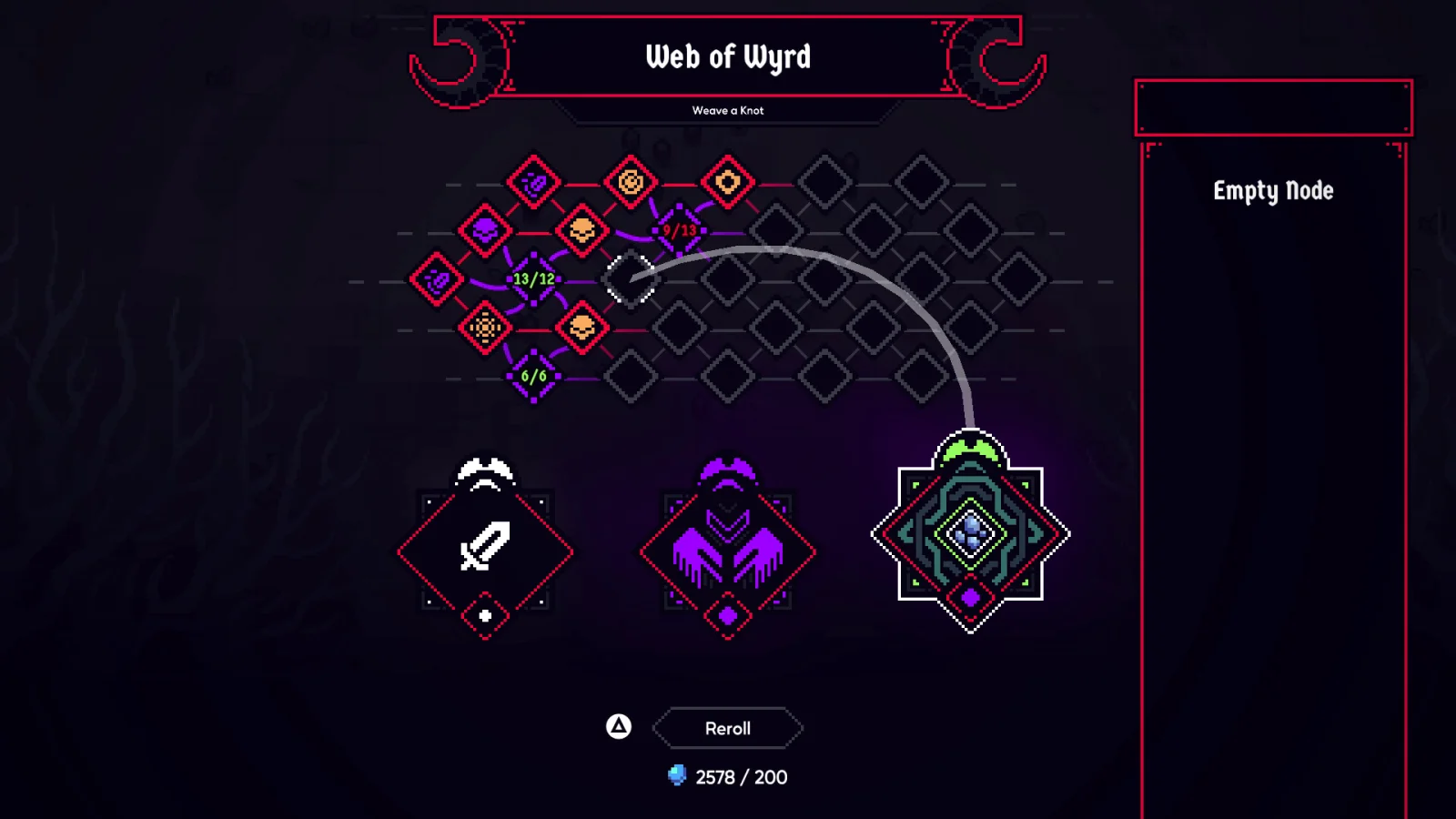
The Web of Wyrd is described as a branching build map using knots. That is the design element most likely to separate Asgard’s Fall from a progression model driven only by isolated level-up picks. A branching map makes a build legible as a route. Instead of asking only, “Which immediate upgrade is best?”, it can invite a second question: “What sequence am I committing to, and what will that route make possible later?”
That structure has an attractive theoretical advantage. Survivors-like games often make improvisation exciting because the player reacts to options as they appear. A branching map can preserve that uncertainty while adding authorship. The player is not necessarily choosing every result in advance, but is shaping an intention through connected decisions. Knots can make advancement feel like moving through a plan rather than collecting a pile of detached bonuses.
The risk is equally apparent. A route-planning layer only earns its complexity if its choices are understandable at the speed demanded by the surrounding action. Players need enough information to recognize meaningful forks, but not so much friction that each decision interrupts the momentum of a run. If the web clearly communicates what a path offers and why it matters, it could provide satisfying structure. If it becomes visually busy or hard to parse, the very mechanic meant to deepen strategy could make progression feel like administrative work.
A launch-period critical account described the web’s rune-and-knot planning as a particularly satisfying and distinctive part of the game. That is a useful reported perspective, not a universal verdict. It does, however, reinforce why the Web of Wyrd is worth treating as more than a thematic label. It appears to be the design’s strongest attempt to make advancement authored rather than purely random.
Warpaint makes permanent progression a spatial question
Warpaint is the other key system, and its description is unusually specific. It is a persistent meta-progression and inventory-placement structure in which runes modify abilities, occupy limited space, and can be found or crafted with pigments. Rather than framing permanent growth solely as a menu of flat unlocks, this makes it a layout problem. Space is limited, so the question is not simply whether a rune is desirable. It is whether it deserves room beside other runes and whether a given arrangement supports a player’s intended approach.
That can be a compelling source of long-term optimization. Inventory placement is one of those systems that asks players to weigh relationships rather than just rank individual items. A rune may look strong in isolation but become less attractive if it crowds out a different combination. Pigment crafting also signals a route toward intentional adjustment rather than pure dependence on discovery. The available facts do not establish how generous crafting is, how broad the rune pool becomes, or how much any arrangement changes play, so none of those outcomes should be assumed. The basic premise alone, though, gives persistent progression a more tactile identity than a conventional unlock track.
It also exposes the game to a severe usability test. Spatial systems must communicate limited room, item effects, and placement consequences cleanly. The player should be thinking about trade-offs, not wrestling with the means of expressing them. One launch-period critique specifically reported awkward Warpaint interface handling and judged the later meta-progression shallow. Those are reported experiences from that critic’s launch-version play, not established properties of every installation or every player’s campaign. They are nevertheless directly relevant to the system’s promise. A layout-based meta layer is only rewarding when its interface makes arranging and revising a build feel intelligible.
The 1.0 material says Warpaints were revised, while post-launch developer patch notes from September 10 and 11 documented fixes for Warpaint inventory problems. This establishes active attention to the system around release, not that every concern has been eliminated. Players considering the game chiefly for its persistent optimization should treat current patch condition as part of the evaluation rather than assume the original design description settles the matter.
Version 1.0 expands the framework, but not every question is answered
The full 1.0 release is listed for September 9, 2026, following an Early Access launch on April 9, 2025. Release material identifies several additions: a Druid, the final boss Hel, revised Warpaints, weapon skins, and ability compendium pages. The Druid adds a named character to a game with distinct character skill trees; the final boss establishes a stated endpoint within the release material; weapon skins offer a customization element; and compendium pages suggest a reference tool for abilities. It would be unsafe to infer their exact scope, unlock conditions, or effect on replayability beyond those facts.
One further launch-context detail is important for returning Early Access players: progress was reset for the clean-slate 1.0 release. That makes the release a fresh progression starting point rather than a simple continuation of prior accumulated progress. Whether that is welcome will vary. A reset can provide a common beginning for a changed progression economy, but it also asks previous players to revisit the path to permanent advancement. No broader judgment about the fairness or impact of that reset is warranted without direct player evidence.
There are 45 achievements listed and 13 listed interface languages. These are concrete release facts, but they should not be inflated into claims about content scale, localization quality, or accessibility. Achievement totals do not reveal their design, and interface-language support does not by itself establish complete translation coverage across every part of the game. They instead indicate that the PC release includes formal achievement tracking and a comparatively broad set of interface language options.
Launch condition is part of the assessment, not a footnote
For a game built around repeated runs and persistent planning, technical reliability has unusual importance. A disruption does not only affect one fight; it can interrupt an evolving build and undermine confidence in the progression attached to it. The developer documented several patches on September 10 and 11 addressing performance leaks, ability spawning, crashes, Warpaint inventory issues, and lost-progress recovery. Those notes are meaningful evidence that the team responded rapidly to identified launch problems. They are not evidence that all affected players are now problem-free, that every underlying issue is resolved, or that performance is identical across PC configurations.
A separate launch-period critique reported crashes, stuttering, frame drops, limited event and map variety, and shallow late meta-progression. Its account should be understood as a critic’s reported experience with the launch version, not a fixed description of the game after subsequent patches. Still, it identifies the exact areas that deserve scrutiny from prospective players: stability during a long session, clarity and behavior of ability effects, the usefulness of late persistent choices, and how much environmental or event variation supports repeated runs.
The crucial connection is philosophical as much as technical. Asgard’s Fall asks players to make layered decisions under real-time pressure, then to carry some optimization forward through Warpaint. That makes stability and interface clarity central to the intended fantasy. The Web of Wyrd can only feel like authored advancement if players can read it. Warpaint can only feel like a satisfying layout puzzle if its inventory interaction is dependable. Dense spectacle only supports thoughtful movement if technical behavior does not obscure what is happening. Rapid patches are encouraging as a sign of response; they should not replace checking the current state before treating launch concerns as historical.
Who the design may suit
Asgard’s Fall seems most naturally aimed at players who enjoy theory-crafting alongside dense real-time action. The appeal is not just surviving amid automatically triggered abilities. It is considering a path through a branching web, weighing character-specific skill development, and arranging persistent rune effects within a limited space. For players who like optimization to remain a recurring puzzle, Warpaint may be the system with the greatest potential. For players who want a run to have a visible strategic shape, the Web of Wyrd may be the stronger draw.
Players who mainly want immediate spectacle may still find the automatic-combat structure approachable, but the extra planning layers could be either welcome texture or unwelcome overhead. That will depend on their appetite for menus, routes, and revisions between or during the game’s action-driven decisions. Likewise, players especially sensitive to repetition should note the launch-period report of limited map and event variety, while remembering that it represents one critic’s account rather than a settled consensus.
Those concerned about rough releases have a clearer reason for caution. The developer’s own patch documentation acknowledges issues involving crashes, performance leaks, ability spawning, Warpaint inventory behavior, and lost-progress recovery. That does not dictate a single buying decision, but it makes a current-condition check prudent. A helpful related frame for assessing work still being tested against its own systems can be found in this Early Access overview.
Unscored conclusion
Asgard’s Fall — Viking Survivors has a coherent and potentially distinctive design argument. It takes the automatic-ability foundation of a survivors-like action roguelite and adds two forms of deliberation: a branching Web of Wyrd for run-level route planning and Warpaint for persistent spatial optimization. The strongest possibility is that these systems make advancement feel chosen and interconnected rather than merely accumulated.
That possibility is inseparable from execution. The launch-period record includes a critic’s concerns about variety, late progression, interface friction, and technical performance, alongside developer-documented post-release fixes for several concrete problems. The responsible conclusion is neither to dismiss the design’s promise nor to declare those concerns over. Players interested in theory-crafting, persistent layouts, and hectic positioning have clear systems to investigate. Players who require broad variation or a thoroughly settled launch should check the latest patch condition and current player feedback before deciding whether this particular Norse journey is ready for them.