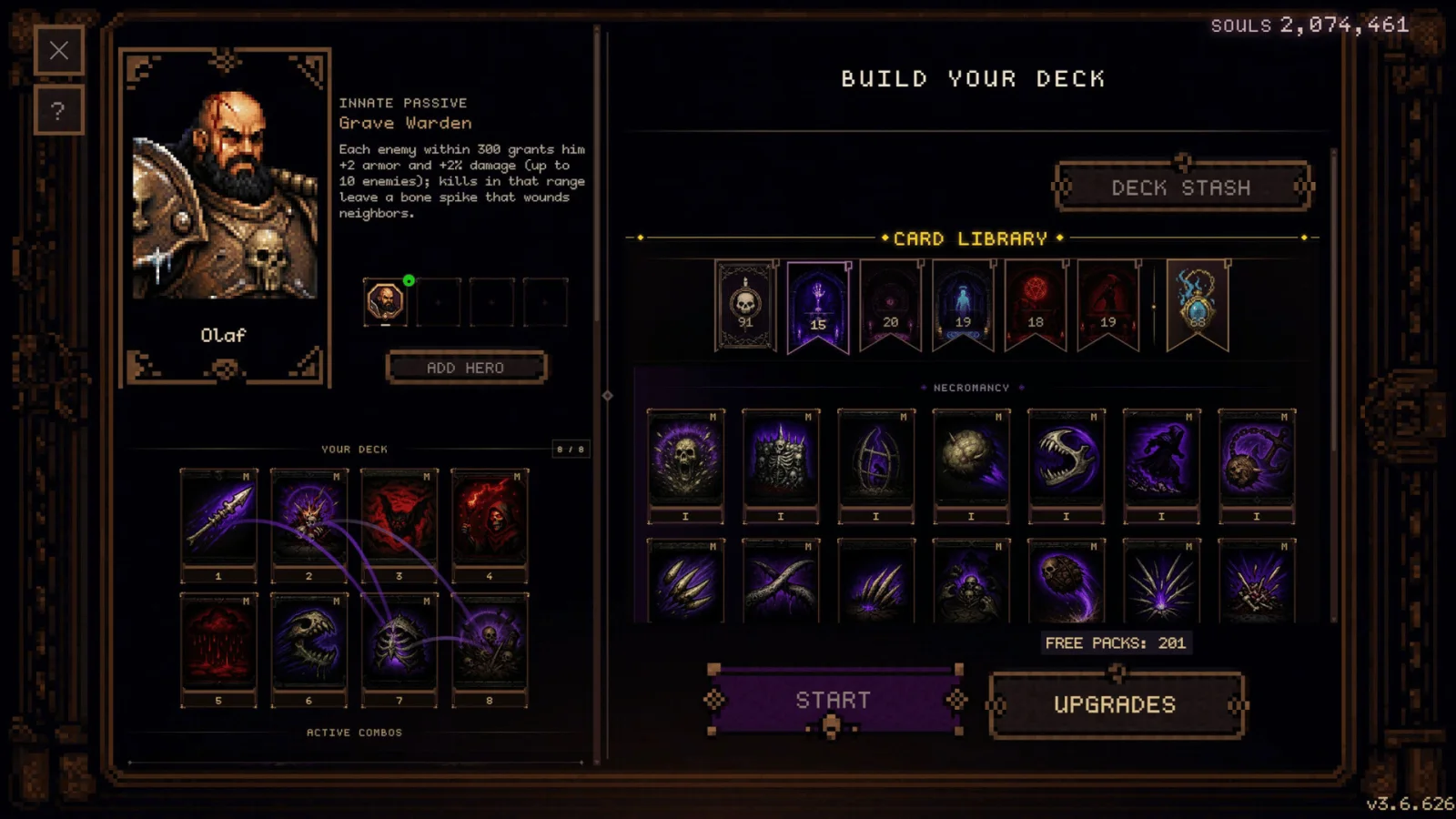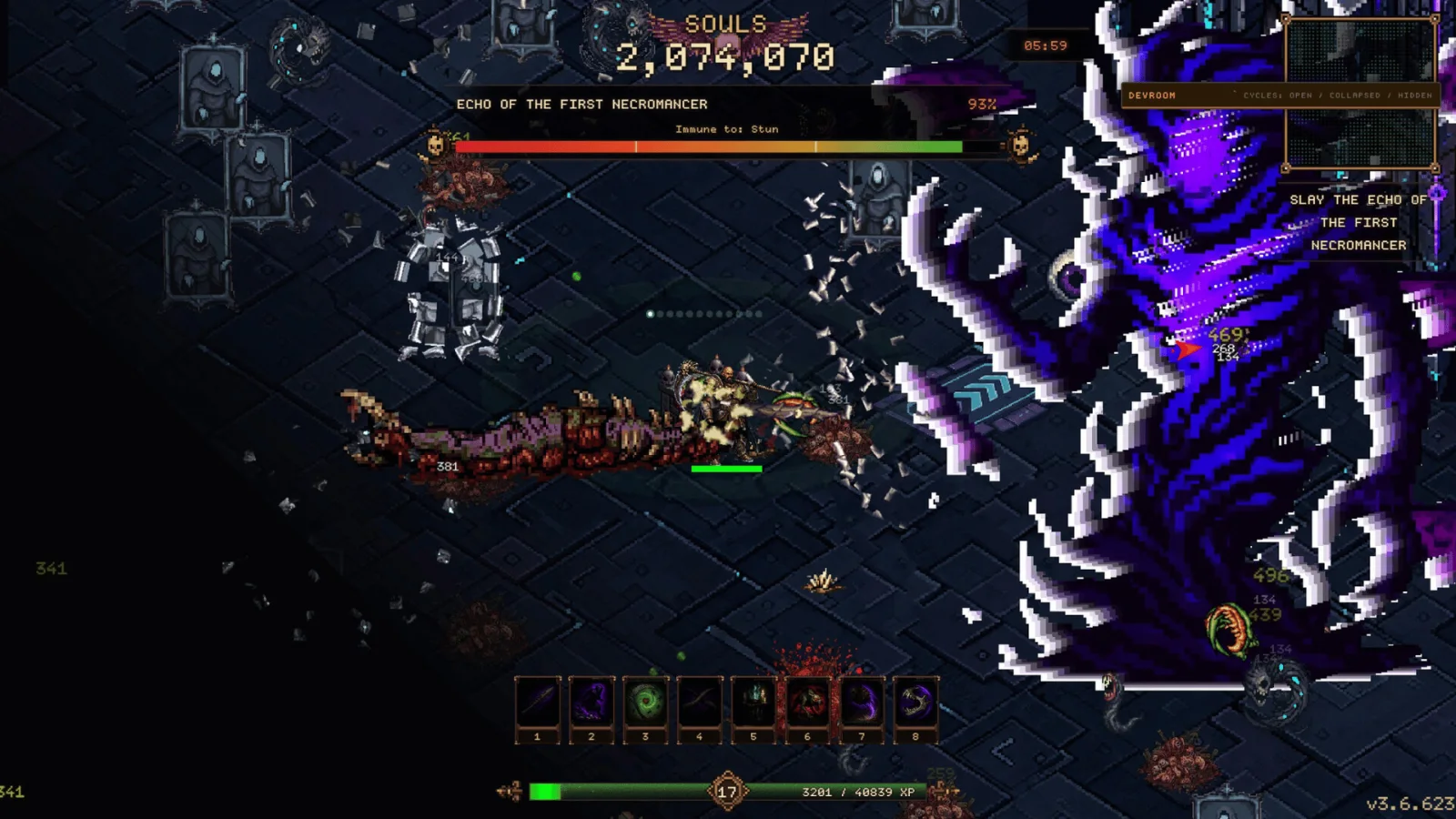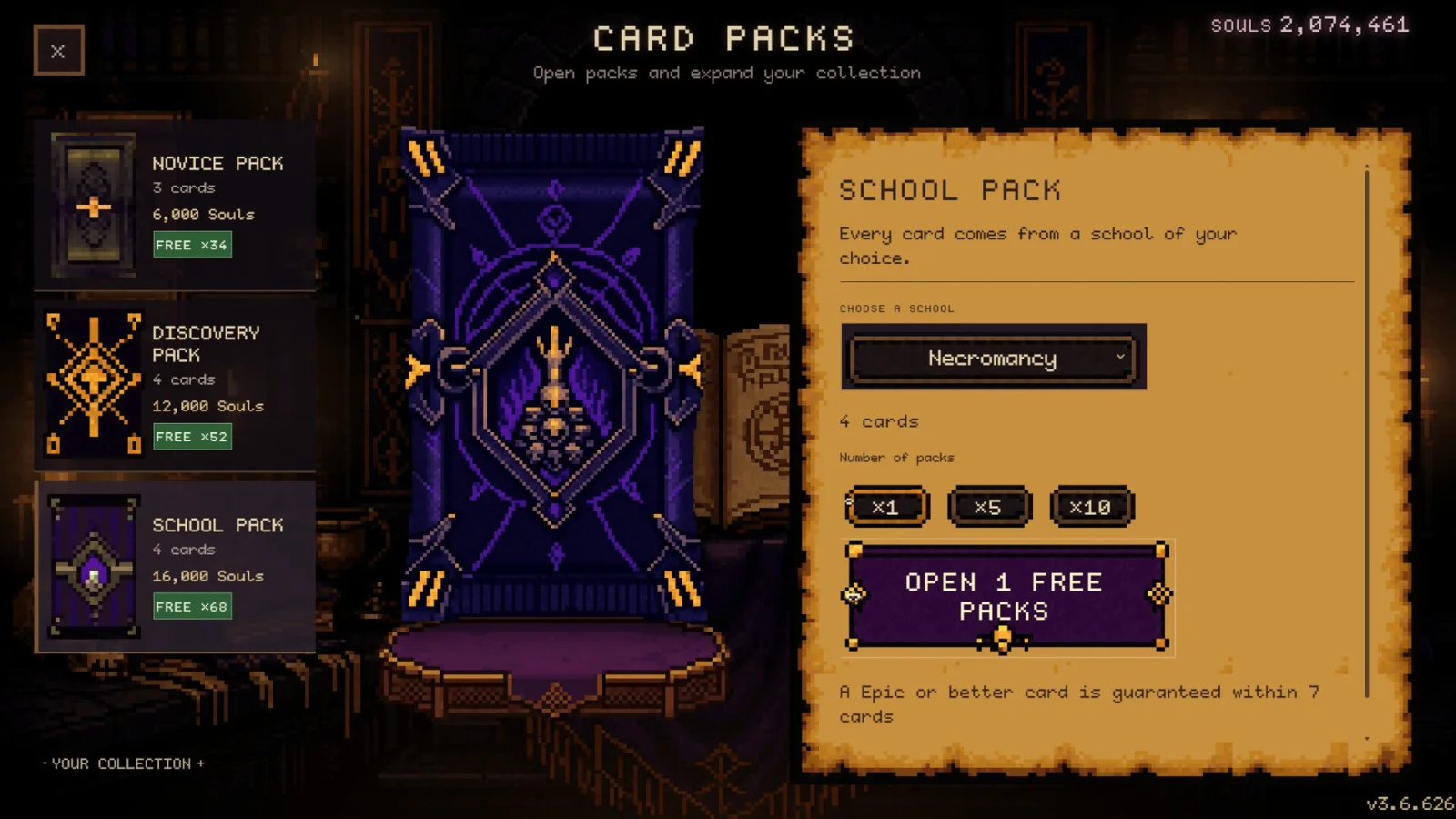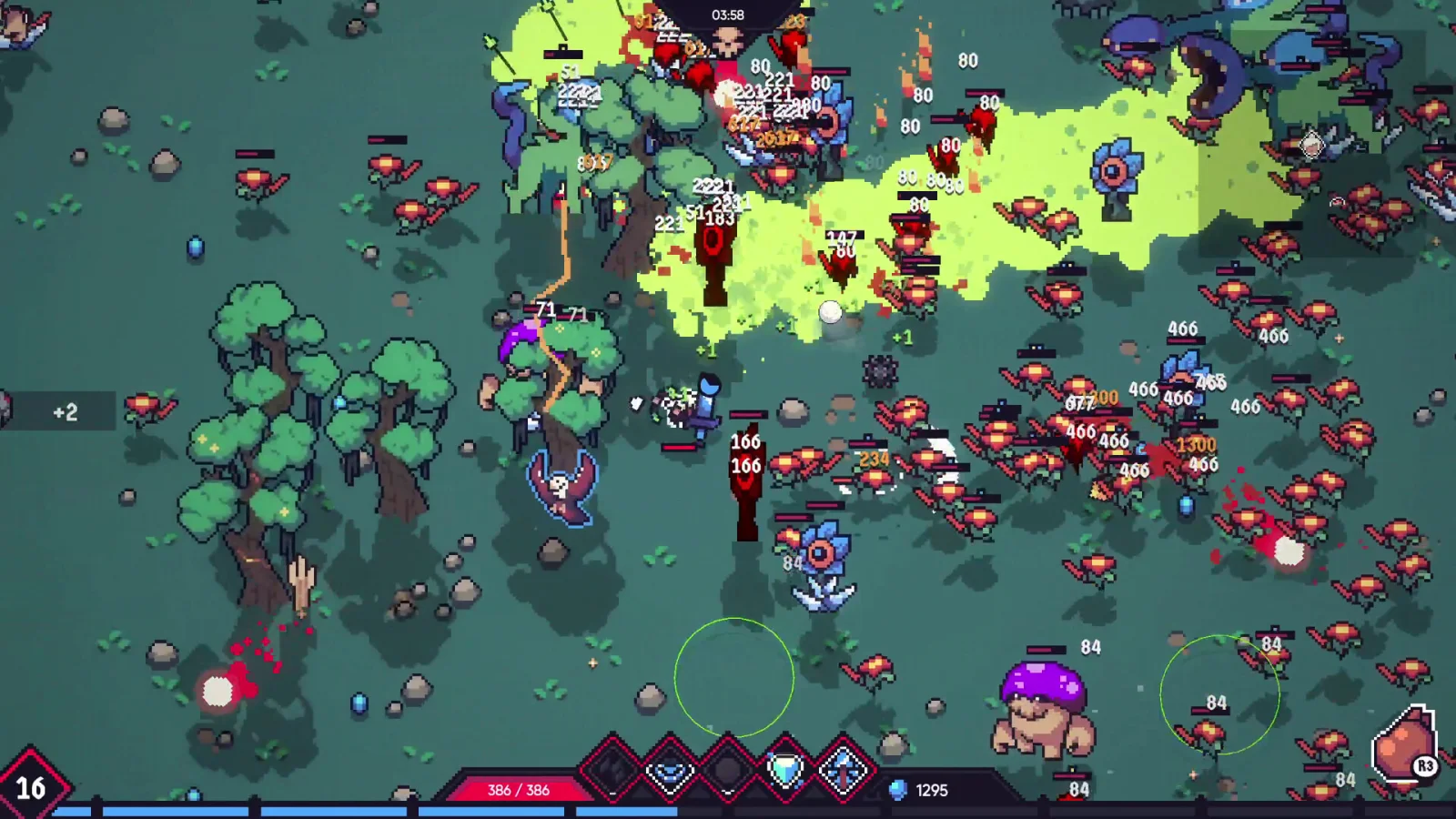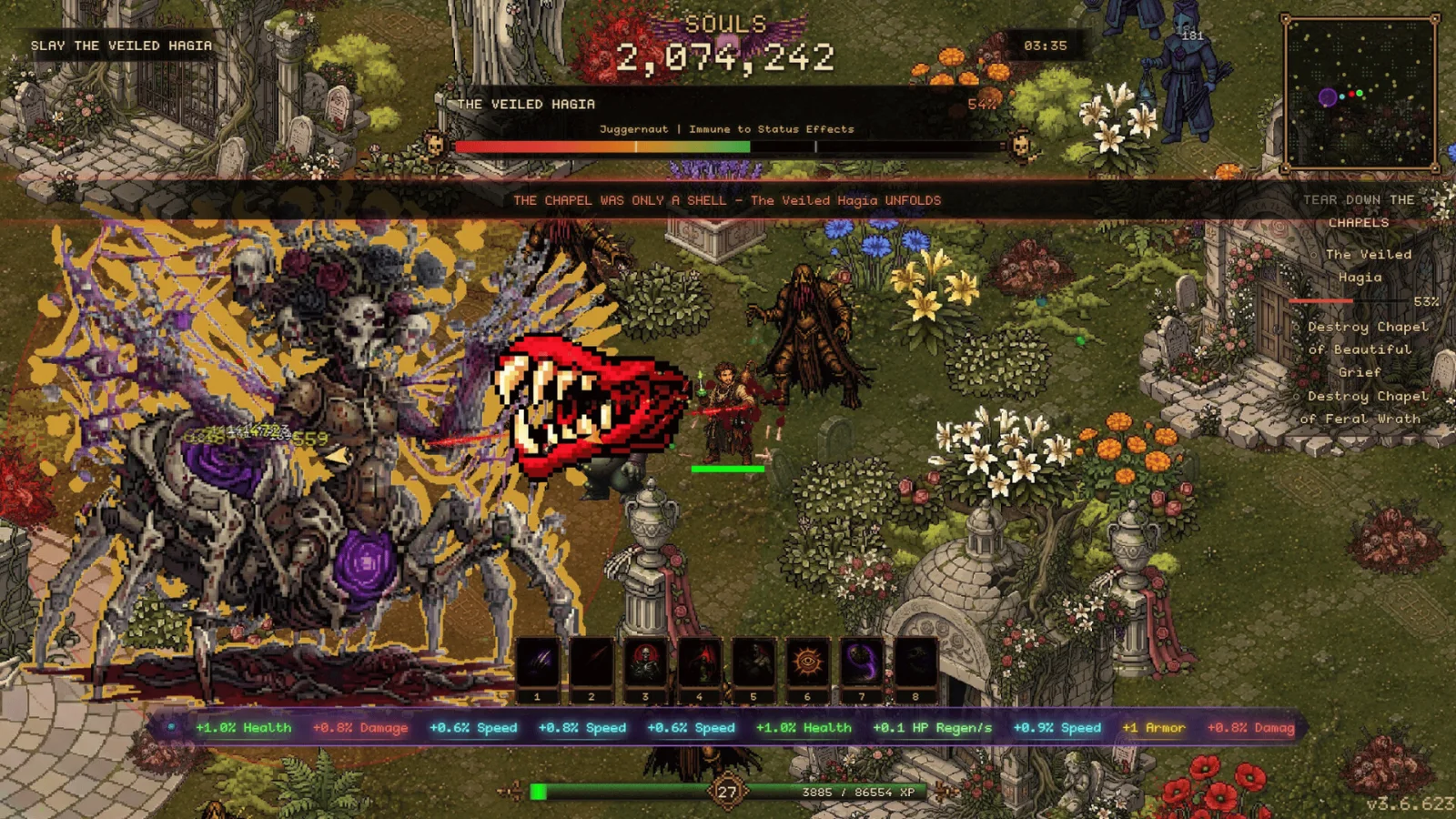
CODEX MORTIS is a necromancy-themed survivors-like and bullet-hell game from developer GROLAF and publisher CRUNCHFEST. Its version 1.0 launched on Steam for PC on September 24, 2026. That release matters because the game’s stated structure is no longer merely a compact survival loop with occult decoration: version 1.0 adds five schools of dark magic for a total of ten, expands the hero roster to 31, adds Apocrypha levels, shifts presentation to an isometric view, and introduces pre-run deck assembly with unlockable cards obtained from booster packs.
Those are substantial additions, but they are more interesting as a design argument than as a list of quantities. Survivors-like games commonly make their most meaningful choices during a run, when a random or semi-random selection of upgrades asks the player to improvise around immediate danger. CODEX MORTIS instead puts an explicit planning layer before that danger begins. Players prepare heroes, spells, and artifacts for runs, while the new deck system formalizes another part of that preparation. The central question is whether the game can make that advance planning feel like authorship rather than administration.
That question has become sharper with 1.0. Ten schools, 31 heroes, booster-pack cards, and Apocrypha levels suggest a game reaching for a broad build space. Broadness alone does not make a system deep. A useful build game needs players to recognize what an option does, why it relates to another option, what trade-off it carries, and where a different choice may be appropriate. If CODEX MORTIS makes those relationships readable, its pre-run construction could give the genre an unusually deliberate rhythm. If the relationships are obscured by terminology, overlapping effects, or unlocked options that do not change decisions, more content may become more homework rather than more possibility.
Building before the horde changes what randomness means
Deck assembly is not a cosmetic addition to a survival roguelite. It changes the role of chance. In a more spontaneous format, uncertainty is often the point: a player sees a choice, weighs an unfamiliar possibility against a dependable upgrade, and adjusts as enemies tighten around them. That can create vivid moments of rescue, compromise, and lucky discovery. It can also produce runs where a desired concept never becomes available in enough pieces to function.
Pre-run construction can narrow that uncertainty in productive ways. By deciding a pool before a run, a player may be able to pursue a particular magical identity with greater confidence. A deck can establish priorities, prevent incompatible selections from diluting the plan, and make later draws part of executing an intention rather than hoping a plan appears. The fantasy is especially suitable for a necromantic game. A necromancer preparing a repertoire of rites and relics before entering a hostile place has a stronger thematic logic than a hero who seems to discover their own powers one random menu at a time.
There is a cost to that control. Randomness is not only an obstacle; it is also a way of making familiar systems surprise their players. When deck restrictions are too firm, a run can become a routine sequence of obtaining the same pieces in the same order. When construction has too little influence, the deck becomes ceremonial, with the meaningful choices still determined by uncontrolled rewards. The most compelling middle ground would let preparation shape the odds and the available lines of play without reducing each run to a solved shopping list.
This is why card design, draw logic, and encounter demands are inseparable even when they are presented in different menus. A card is meaningful when it opens a tactic, protects against a weakness, supports a difficult commitment, or offers a tempting alternative to an established plan. It is less meaningful when it is simply the numerically correct inclusion for every deck that can accommodate it. CODEX MORTIS does not need every card to be universally powerful. It needs the reasons for choosing among cards to be understandable.
Booster packs can make discovery tangible, or make understanding harder
The unlockable-card booster-pack framework gives progression an immediately recognizable container. Packs can make collection feel concrete: there is a new object to open, a new possibility to consider, and a visible enlargement of the player’s toolset. In a game built around assembling a deck, that kind of acquisition can turn long-term advancement into a conversation about future strategies rather than a mere rise in raw values.
Yet collection-based progression brings a comprehension burden. Every additional card asks for readable text, a comprehensible function, and a place within the game’s larger vocabulary. If a player cannot tell whether a new card changes a deck’s direction, improves an existing role, or simply repeats a prior function with different dressing, unlocking can create noise. The burden rises further when a game also has heroes, spells, artifacts, ten schools of magic, and passive systems described as Fundamentals. None of these layers is automatically excessive; their usefulness depends on whether each layer answers a distinct question.
Heroes might establish a starting identity. Magic schools might describe a language of effects and synergies. Spells might supply active or automated expression of that language. Artifacts might provide unusual rule changes or durable support. Fundamentals might offer persistent, lower-level adjustments that bind a build together. Cards might determine which possibilities can enter a run. This division is only a potential model, not a confirmed account of every interaction in CODEX MORTIS. But it illustrates the clarity test facing the finished game: a player should be able to explain why a decision belongs in one layer rather than another.
The best collection systems make new information manageable by giving players stable reference points. Clear school identities, consistent iconography, concise effect language, and visible relationships between a card and its likely partners can make a large catalog inviting. Search, sorting, comparison, and sensible introductory deck templates could also matter greatly, though their presence should not be assumed. Without a strong explanatory structure, a growing card pool can privilege outside study or repeated trial over tactical judgment. With one, it can make experimentation feel like a reward in itself.
Ten schools are a promise, not yet proof, of variety
Five new schools bring CODEX MORTIS to ten, and the official premise includes combining magic-school effects while raising undead and fighting waves. That gives the game a potentially distinctive intersection: magical combination is not an abstract elemental puzzle, but part of a dark-fantasy survival framework where summons and hostile crowds occupy the same combat space.
Combinatorial possibility is easy to overstate. Ten schools can yield many pairings on paper while still producing only a few practically sensible choices. Meaningful variety requires schools to ask different questions. One may favor position and area control; another may alter enemy behavior; another may lean into summoned pressure; another may convert a defensive condition into offensive value. These are examples of design roles, not claims about the specific schools in CODEX MORTIS. The important principle is that variety appears when changing a school changes priorities, timing, spatial judgment, or acceptable risks.
Counterplay and stage demands matter just as much. If every level rewards the same broad damage pattern, the game’s wide magical vocabulary risks collapsing into a narrow answer. If distinct enemy groups, terrain arrangements, objectives, or wave patterns ask for different strengths, then choices made in deck construction have a chance to become situational rather than ornamental. The newly added Apocrypha levels may be an important part of this equation, but their exact demands should not be presumed. Their design will determine whether they create new reasons to revisit the toolset or simply more places to use familiar solutions.
Earlier pre-release discussion around the game’s build planning raised a useful concern for the 1.0 version: strategic theory must be matched by dependable execution and appropriately tuned challenges. The expanded release should be judged by whether it answers that concern, not by treating an earlier balance impression as a permanent verdict. More heroes and more schools make balance harder, because each new option can alter the value of older ones. That is not a reason to prefer a smaller roster. It is a reason to value visible rules, understandable counters, and encounters that reveal why a build succeeds or fails.
Isometric combat needs to protect the player’s ability to read danger
Version 1.0 rebuilds the presentation as isometric. For a game about waves, projectiles, undead, effects, and layered magical combinations, perspective is not a superficial matter. An isometric view can potentially improve spatial comprehension by giving locations and movement lanes a more structured relationship than a flatter presentation. It can make the battlefield feel like a place with direction, distance, and shape rather than a neutral backdrop for effects.
It also creates fresh hazards for a bullet-heavy game. Isometric depth can complicate judgments about where an attack will land, whether a route is actually open, or how close an enemy truly is. Tall scenery, dense spell effects, friendly summons, and enemy swarms can all compete for attention. A game centered on sustained combat needs its most urgent information to remain visible: dangerous projectiles, enemy silhouettes, player position, pickup locations where relevant, and the limits of an effect’s reach.
Readable combat does not demand visual austerity. Necromancy and dark magic invite spectacle. The stronger standard is hierarchy. A dramatic spell can fill a scene with atmosphere while still making imminent threats stand apart through contrast, motion, sound, outlines, or timing. Similarly, an undead army can sell the fantasy without becoming a visual curtain over the player’s own decision-making. If the isometric rebuild serves that hierarchy, it could reinforce the game’s tactical ambitions. If it obscures the reasons for defeat or success, it would weaken the value of careful pre-run construction.
Local co-op could turn individual decks into a shared plan
CODEX MORTIS lists local co-op among its known mechanics. Cooperative survival games can change buildcraft because each player’s choices acquire a second audience. A group may seek complementary roles, divide responsibility for different kinds of pressure, or deliberately overlap strengths to create reliable shared answers. In a deck-focused structure, co-op could therefore extend preparation from individual optimization into negotiation: which magical approaches should the group cover, and which risks are acceptable because a partner brings another tool?
That possibility is not a guarantee of satisfying coordination. It depends on how much build information is communicated, how tightly players must remain together, how rewards are handled, and whether the action makes each participant’s contributions intelligible. None of those implementation details should be inferred here. Still, local co-op fits the premise better than it might in a purely reactive survivors-like, because planning creates something substantial to discuss before the first wave. Players who enjoy comparing roles and arranging complementary strategies may find that prospect appealing; players who prefer solitary, low-commitment improvisation may regard the same preparation as friction.
Players looking for a fast, spontaneous genre entry should therefore approach CODEX MORTIS with the right expectation. Its stated systems point toward a game that wants choices before the run to matter during the run. That may be a strength for players who enjoy studying interactions, building toward an intended identity, and revising a plan after a failed attempt. It may be less attractive to those who chiefly want the pleasure of accepting whatever upgrades arrive and rapidly making do.
AI-assisted production is not a substitute for design criticism
GROLAF has made an AI-assisted production claim. That statement is relevant to how the game was made, but it does not by itself establish the quality, originality, readability, or balance of the resulting design. Those questions remain questions about the game’s actual systems and presentation. Treating a production method as an automatic verdict would avoid the more useful critical work: asking whether the rules communicate clearly, whether the visual field supports decisions, and whether the game’s many unlocks create meaningful new play.
The relevant design standard remains the same regardless of production process. CODEX MORTIS should be strongest when its necromantic theme, deck assembly, school combinations, and survival pressure reinforce one another. Its 1.0 additions give it more opportunities to do that, but also more concepts that must be introduced, differentiated, and balanced.
Conclusion: the interesting part is the intention
CODEX MORTIS arrives at 1.0 with an unusually clear ambition for its genre: make the player’s build a commitment formed before combat, not only a trail of upgrades accumulated within it. The 31-hero roster, ten schools of dark magic, decks, booster-pack unlocks, Apocrypha levels, isometric presentation, and local co-op create a sizable framework for that ambition. The framework’s success will rest less on how many combinations it can advertise than on whether players can read those combinations, test them against distinct pressures, and understand how a different choice might have changed the outcome.
For another look at how a different survival game might make meta-level structure matter, see Joking Joystick’s Reap and Rush PC critical-design feature.