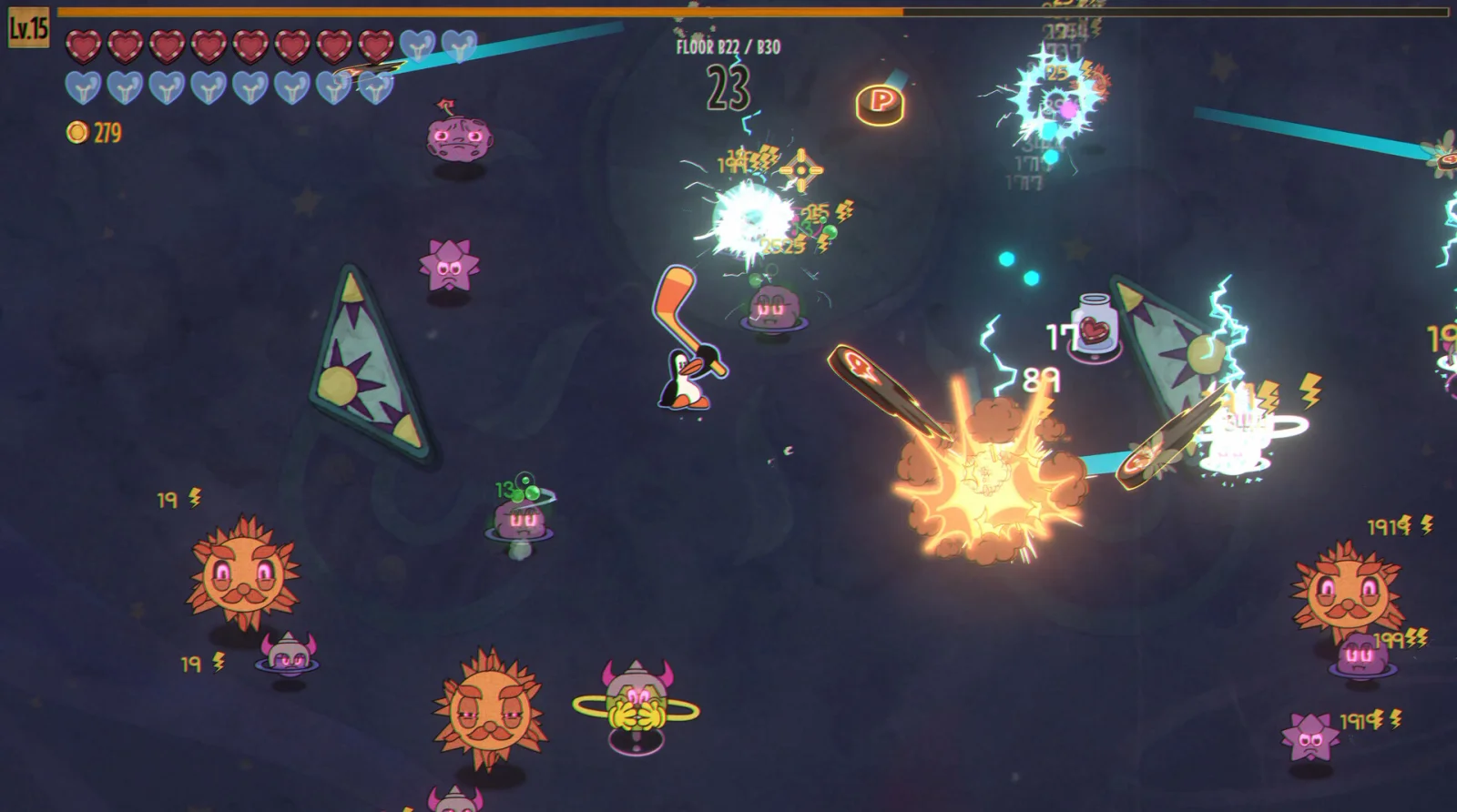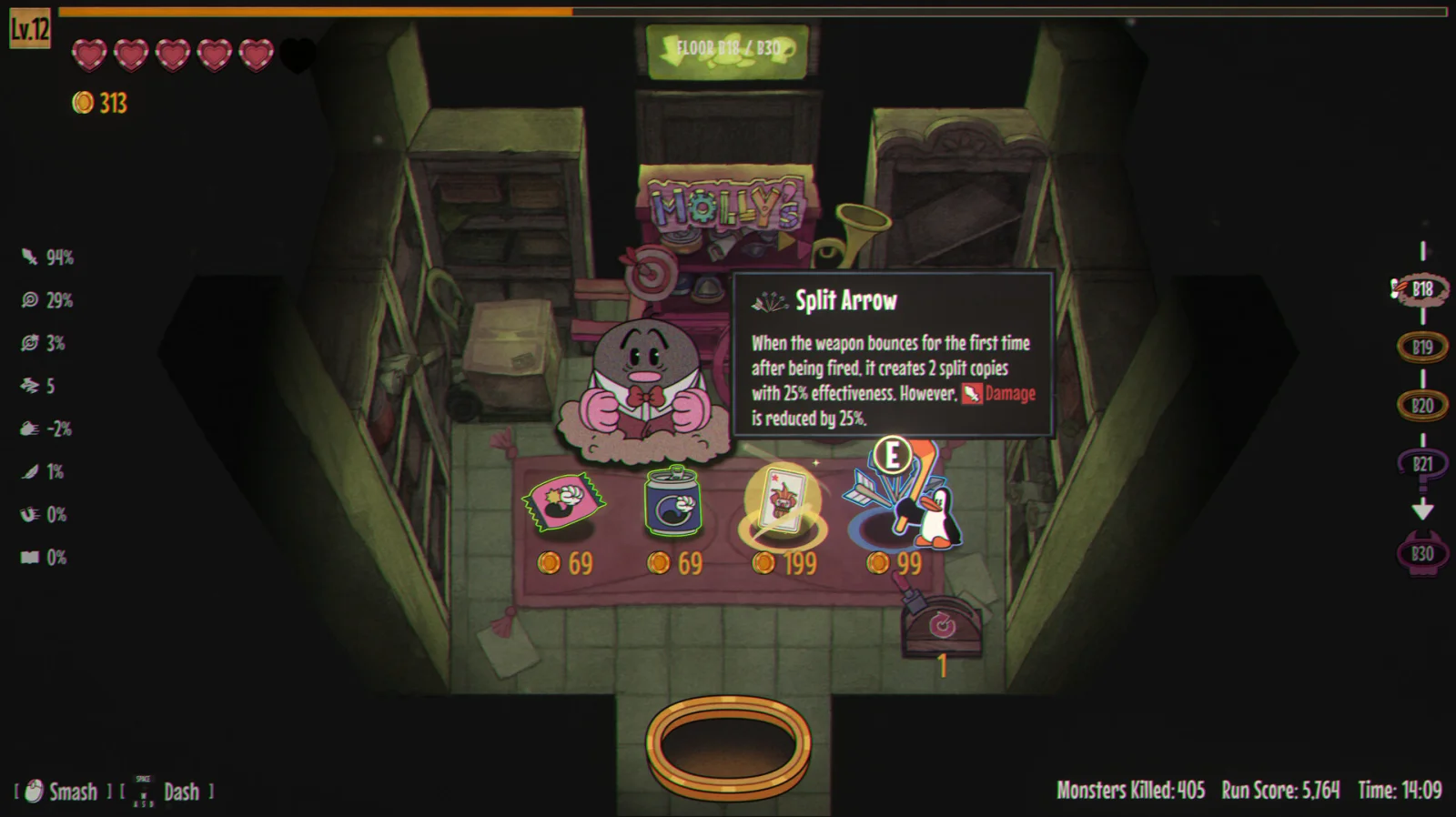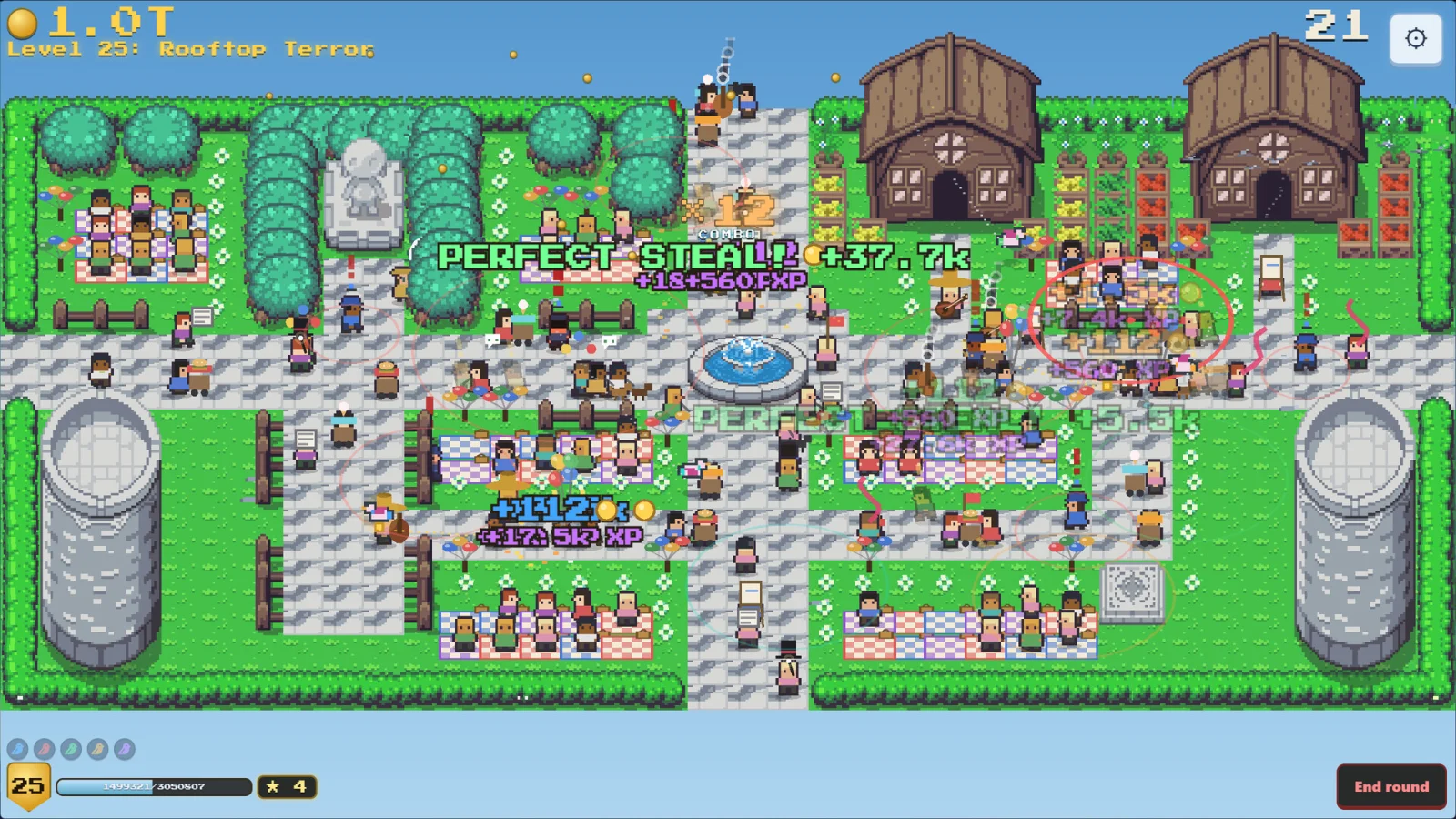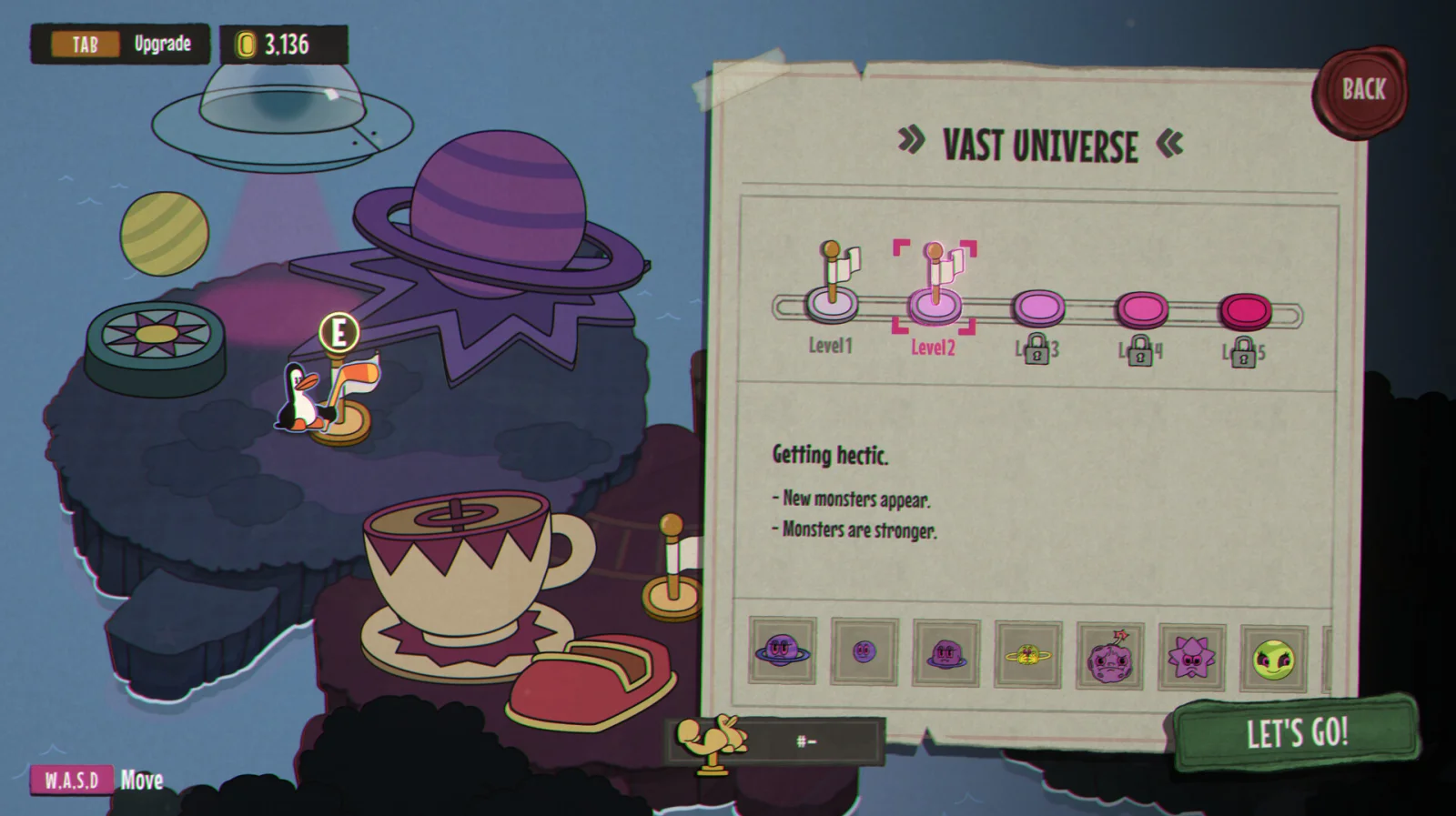
PengPong has a premise compact enough to explain quickly and strange enough to invite a closer look. Developed by Sandy Floor and published by Sandy Floor with Gamirror Games, it released for PC on August 20, 2026. Its published description identifies it as a single-player action roguelike: a bullet-hell game in which pinball meets gambling. Independent critical descriptions add a particularly useful image to that pitch: a penguin carrying a hockey stick and redirecting attacks amid roguelite-style chaos.
That combination does not automatically establish the depth, polish, or long-term shape of PengPong. It does, however, establish an intriguing design question. Bullet hells traditionally ask players to read incoming patterns, preserve a small safe space, and decide when movement is worth the risk. A ricochet-centered action layer potentially changes that relationship. Rather than treating projectiles solely as hazards to avoid, a player may be asked to judge their angle, timing, speed, and onward path. The most appealing version of PengPong is therefore not merely a familiar survival exercise with a novelty character. It is a game in which danger can become material for an improvised counterattack.
This is an unscored assessment rather than a hands-on review. The evidence supports discussion of PengPong’s announced structure, its published product features, and the implications of the design described by outside critics. It does not establish exact controls, enemy behavior, build systems, difficulty tuning, performance, accessibility quality, or the full amount of content. Those distinctions matter especially for a physics-led action game, where the difference between an exciting idea and a durable game is often found in details that a premise cannot communicate.
Established facts: a single-player action roguelike with an unusual hook
At the most concrete level, PengPong is presented as a single-player action roguelike and bullet hell. The official framing joins pinball and gambling rather than treating either word as incidental decoration. Published product information also lists achievements, adjustable difficulty, save-anytime support, controller support, cloud saves, stats, and leaderboards. These are meaningful pieces of product information, but they should be understood precisely. Their listing verifies that these options or systems are advertised; it does not establish how broad their settings are, how controller support feels, what the statistics record, how leaderboards are organized, or how each feature is implemented.
Still, these listed supports are relevant to the kind of game PengPong appears to be. Action roguelikes and bullet hells often invite repeated attempts, short-term experimentation, and performance comparison. Save-anytime support and cloud saves may make that commitment easier to fit around real life, while adjustable difficulty may give more people a route into a demanding-looking concept. Achievements, stats, and leaderboards may provide optional records of progress or performance. None of those labels prove that the game meets every player’s needs, and they are not substitutes for specific accessibility documentation. They do indicate that PengPong is presented as something intended for revisiting rather than as a one-pass action curiosity.
The underlying image is memorable because its components point in the same direction. Pinball suggests angles, rebounds, momentum, and contingency. Gambling suggests stakes, uncertainty, and decisions made before outcomes are fully known. Bullet hell suggests a crowded screen in which reading space is as important as raw reflex. The hockey-stick detail reported by an independent critic gives those abstractions a physical focal point: an instrument associated with striking, aiming, and redirecting. A penguin makes the concept playful at a glance, but the mechanical significance lies in the proposed relationship between contact and consequence.
Ricochet can change what positioning means
In a conventional avoidance-focused bullet hell, movement is usually defensive first. A player looks for lanes, circles patterns, shifts through openings, and tries to avoid turning a manageable formation into an unavoidable trap. Offensive decisions may coexist with that work, but the hostile projectile remains a boundary: it marks where the player cannot safely be. A ricochet mechanic can complicate that simple division. If attacks can be redirected as described, an incoming object may simultaneously be a threat, a possible tool, and a timing test.
That possibility has interesting consequences for positioning. The best location may not always be the furthest point from danger. It may be a place where a projectile can be met at a useful angle, sent toward a target, or turned away from a worse future line. The player’s spatial problem becomes less like finding empty floor and more like arranging an encounter between trajectories. That is a richer proposition than simply adding a bat-like animation to a bullet hell. It could make a screen full of hazards feel like a field of potential interactions.
The qualifier is crucial: it could. For this sort of system to work, players need to understand why an attempt succeeded or failed. If a redirected attack travels where the player expects, a narrow save can feel earned. If its path appears inconsistent, if the timing window is difficult to parse, or if visual clutter prevents a clear reading of contact, then the same feature can make defeat feel arbitrary. Physics language is attractive because it promises tangible cause and effect. It also raises the standard for communication. A game built around ricochets needs readable vectors, legible impact feedback, and enough visual distinction that players can interpret a busy scene under pressure.
Readability is not merely a matter of making the image cleaner. It governs learning. Players can improve at difficult games when they can identify a mistake, form a new expectation, and test it on the next attempt. In PengPong’s proposed space, the useful lesson might concern where a projectile was met, when it was struck, what it rebounded from, or what risk was accepted to create an opening. Without dependable feedback, a player may only learn that chaos happened. The latter can be funny once; the former is what gives repeatable chaos a chance to become a compelling skill language.
Outside commentary has been positive about this core premise. One critic awarded PengPong four out of five, emphasizing the appeal of the ricochet foundation and treating repeated chaos as central to its draw. Another praised the combination of penguin, hockey stick, physics, and varied weapons. These observations are encouraging, but they are not comprehensive evidence for every element of the release. What they do support is a measured conclusion: more than one critic found the central interaction distinctive enough to carry real interest.
Gambling language should make risk legible, not merely louder
The phrase “pinball meets gambling” carries an additional design promise. Gambling in game language can mean many things, from chance-driven rewards to wagers, uncertain upgrades, multipliers, or choices that exchange safety for a potentially stronger result. PengPong’s public description does not specify which of those structures it uses. It would be inaccurate to assign it a particular currency, betting interface, reward schedule, or run economy.
Even so, the label provides a useful analytical lens. If gambling is integrated into the action rather than pasted onto it, the strongest version would make risk decisions intelligible before the outcome arrives. A player might understand that a more aggressive ricochet line is dangerous because it requires standing in a tighter space, or that a choice trades a stable result for a volatile one. The tension comes from knowingly choosing exposure, not from being denied the information needed to make a judgment.
That principle matters because randomness and physics are already potent sources of uncertainty. Roguelikes frequently use unpredictable offerings to create variety between attempts. Ricochet systems can create surprising results because small angle differences have large downstream effects. Combining both can be exhilarating, but it can also overload the player’s ability to understand what mattered. The goal is not necessarily to remove surprises. It is to ensure surprise retains a relationship to a decision. A spectacular rebound is more satisfying when the player can see the opening that enabled it; an unlucky result is easier to accept when its odds or conditions were meaningfully telegraphed.
The pinball comparison is helpful here. Pinball is exciting in part because a ball can escape complete control while remaining visibly governed by surfaces, contact, and momentum. The player cannot dictate every result, yet the table’s architecture makes outcomes feel connected to action. PengPong’s published concept has a similar opportunity. If its gambling dimension supplies stakes and its ricochet dimension supplies understandable physical cause, uncertainty can become drama rather than noise. If either side obscures the other, the result risks becoming a series of events that are lively but difficult to own.
An inventive center still needs surrounding depth
The most substantive caution in the available criticism is also the most useful one: one positive assessment warned that the surrounding game can feel unfinished. This is not a basis for declaring PengPong unfinished as an established fact, nor does it identify a specific absent feature. It is instead a warning about the gap that can exist between a brilliant action verb and the wider structure that supports it.
That gap is familiar in systems-first games. A remarkable core interaction can command attention immediately because it offers a sensation that competing games do not: here, the prospect of turning hostile fire into a moving, rebound-driven tool. But a core mechanic needs contexts that keep revealing its possibilities. The available independent commentary mentions varied weapons, which may indicate one avenue for expansion, though it does not establish the scope, progression, or balance of that variety. The important question is broader than quantity. Do different situations make players reinterpret timing, angle, danger, and reward? Do later decisions preserve the clarity of the original idea while asking for a deeper understanding of it? The supplied evidence does not resolve those questions.
Story is a useful example of the difference between a necessary support and a universal requirement. A third positive essay regarded PengPong’s limited story as acceptable for a systems-first game and felt its trailer communicated the basic concept effectively. That is a defensible perspective. A compact narrative need not be a flaw if repeated decisions, escalating pressures, and evolving interactions provide the primary reason to continue. Conversely, a larger story would not repair an action loop that stops producing new thought. The appropriate standard is not narrative volume; it is whether the whole package gives the central mechanic enough meaningful work to do.
Players interested in unconventional physics design may also find a useful parallel in this physics-puzzler assessment. The games should not be treated as direct equivalents: their published genres and goals differ. The relevant connection is narrower. Physics-centered games benefit when outcomes can be read, anticipated, and creatively manipulated rather than merely endured.
Difficulty options are welcome, but their quality remains unverified
The listed adjustable difficulty is a concrete point of interest for a game framed around bullet-hell pressure. It may give players a way to approach an intimidating premise on terms that better suit them, and it is reasonable to view the presence of a difficulty setting as a potentially helpful inclusion. Save-anytime support may likewise reduce practical friction for people who cannot dedicate long uninterrupted sessions to repeated runs. Controller support can expand the available ways to play. These are practical considerations rather than decorative bullet points.
At the same time, none should be overstated. Adjustable difficulty does not reveal what is adjusted, whether it changes the central feel of play, or whether every option is equally well tuned. Controller support does not disclose button layouts, remapping, vibration, or input behavior. Save-anytime and cloud saves do not describe the precise boundaries of saving or synchronization. There is no supplied evidence concerning text options, color accommodations, audio cues, remapping, motion settings, or other accessibility measures. A responsible assessment can recognize the listed features without converting them into promises the public information does not make.
The same restraint applies to leaderboards and stats. Their presence may appeal to players who enjoy tracking results or comparing performance, particularly in a game whose premise implies precision and repeat attempts. Yet a leaderboard can mean many things, and the information available does not establish categories, seasons, anti-cheat policies, ranking format, or community activity. The sensible takeaway is modest: PengPong advertises tools that may support self-measurement and competition, while the exact social and technical experience remains unverified.
What a durable PengPong would need to prove
The critical question is not whether PengPong has an identifiable hook. It clearly does. The question is whether its design gives that hook enough room to develop from a clever first impression into a language players can speak fluently. A durable ricochet game would ideally create moments where a player gradually sees a dangerous pattern not as a wall, but as a possible resource. It would allow a previously intimidating screen to become comprehensible in terms of angles, contact points, and selectively accepted risk.
That possibility should not be confused with a demand for total predictability. Pinball is compelling partly because it permits the unexpected, and bullet hells need pressure that cannot be reduced to rote certainty. The balance lies in giving players a stable basis for interpretation. An attempted deflection can go badly without feeling meaningless if its direction, timing, and immediate consequences remain understandable. A system that lets players recognize their own increasingly informed gambles can make failure productive rather than simply frustrating.
It is also where the wider roguelike framing becomes important. A repeated-run structure can be an ideal home for a mechanic that rewards learning. It gives players opportunities to revisit a confusing scenario with a revised hypothesis and see whether the new approach holds. But roguelike structure alone does not guarantee that outcome. The intervening decisions, available variety, and encounter contexts must make learning feel cumulative instead of repetitive. The critical concern about the surrounding package therefore deserves attention precisely because PengPong’s premise seems strong enough to invite high expectations.
Published feature listings may soften some of the practical demands of such a loop. Difficulty options, saving support, and cloud saves may help different players establish a rhythm around experimentation and repeat attempts. That remains a conditional benefit rather than proof of broad accessibility or polished implementation. A demanding game can be thoughtfully designed at every difficulty level, or it can simply expose different numerical pressures; the supplied information cannot distinguish between those possibilities. Likewise, the existence of controller support says nothing on its own about comfort, customisation, or responsiveness.
Verdict: a concept worth examining closely
PengPong’s strongest established asset is conceptual coherence. “Bullet hell where pinball meets gambling” is not a generic genre collage once paired with the independently described act of redirecting attacks using a hockey stick. It suggests a potentially active reinterpretation of bullet-hell positioning, one where safety, offense, and risk could meet in the same split-second decision. Independent critics have found that foundation fresh and entertaining, while the published listings point to difficulty, saving, controller, cloud-save, stat, achievement, and leaderboard support that may reduce practical friction for some players.
The caution is equally clear. A memorable central mechanic is not proof of content depth, consistency, or finish across the entire experience. One critic’s concern that the surrounding game can feel unfinished should encourage prospective players to look beyond the instantly communicative trailer concept and ask whether the released structure continues to develop it. For players drawn to systems in which hostile space can become an opportunity, PengPong appears to be a distinctive PC release to investigate. Whether its inventive ricochet language sustains a full roguelike remains a question best answered by more direct, detailed evidence than is presently available.