Shoe it All! is assessed here without a score and without a claim of hands-on play. Amberbite developed and published the PC game with Bright Gambit, and its official release date is September 3, 2026. The Steam version casts the player as Lace, a rebellious teenager who uses a swing and thrown shoes to solve physics puzzles while pushing back against rule-bound adults. That is a deliberately compact premise, but it points toward an appealing puzzle-game question: can one action remain interesting when a level asks the player to understand it more deeply rather than merely perform it more often?
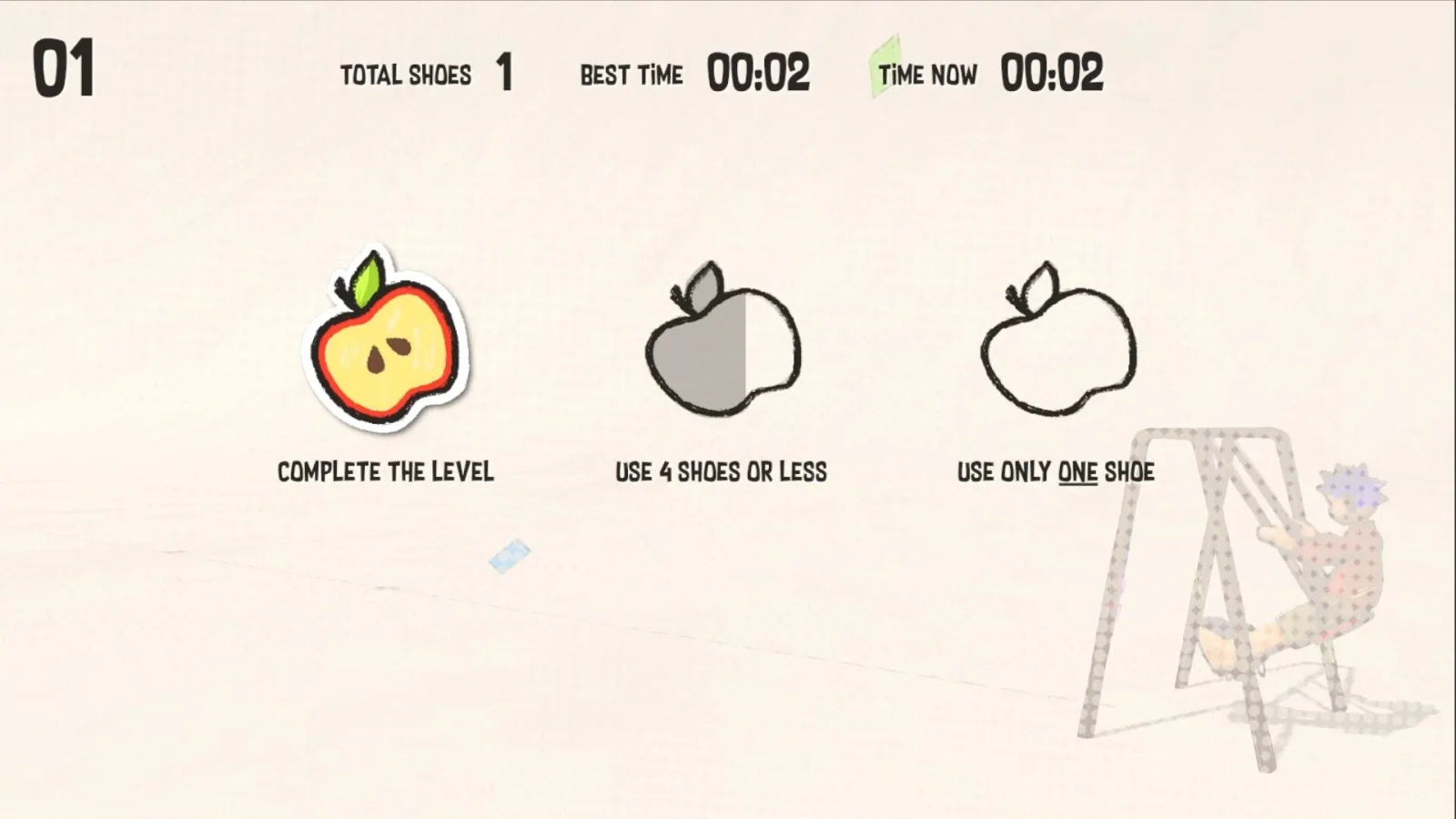
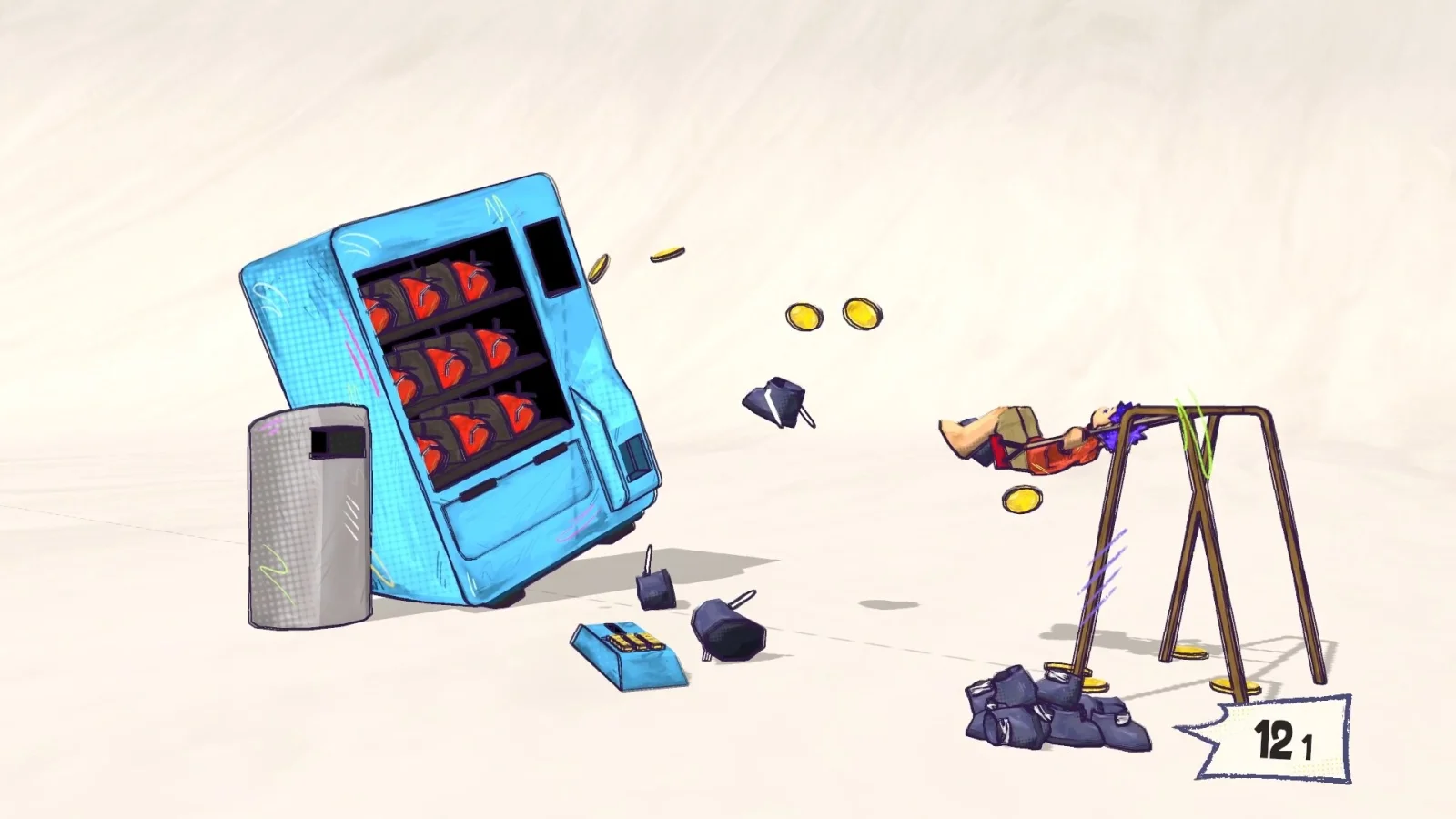
Official material says the central loop is to build momentum on a swing, choose a release moment, and launch a shoe at an objective. It also promises more than 65 handcrafted puzzles, multiple solutions, nearly 200 collectible stickers, optional trick-shot and efficiency goals, chain reactions, hidden bonus levels, bosses, a dedicated Speedrun Mode, and a punk soundtrack. Those are established design claims, not proof of how the PC version feels in practice. Still, they give enough shape to examine the design promise: Shoe it All! appears to be aiming for a puzzle campaign that teaches a comprehensible physical gesture, then turns accuracy, routing, and curiosity into separate reasons to revisit it.
A readable action can support demanding puzzles
Physics puzzlers often live or die by the distance between understanding an action and mastering it. “Swing, release, throw” is immediately legible at a conceptual level. A player can presumably see the broad relationship between swing momentum, release timing, trajectory, and a target. That clarity matters. When the input-to-outcome relationship is easy to describe, failed attempts can become information rather than opaque punishment: the release was too early, too late, or aimed at the wrong part of a sequence.
The more interesting question is whether the official puzzle count and stated multiple-solution structure make room for more than a series of isolated target hits. If a stage admits distinct approaches, the obvious first solution can serve as an introduction while an alternate route tests insight. The player is not only asking whether a shoe can reach something; they may be asking what can be reached first, what may be left untouched, and whether a setup produces a useful cascade. That is a strong foundation for a game whose basic action could otherwise become repetitive.
An independent PC report describes the controls as simple, retries as forgiving, the difficulty curve as steady, and the presentation as colorful and low-poly. It also notes that precision requirements can occasionally frustrate. Those observations are useful but limited to that report; they are not a substitute for direct PC testing here. Even so, the combination it describes aligns with the genre’s core need. A precision-driven puzzle benefits greatly when a failed attempt can be rapidly reframed as another experiment. The challenge then lies in reading timing and consequence, not in recovering from a long interruption.
Forgiving retries, if consistently implemented as reported, are especially important because timing challenges create inevitable near-misses. A game can reasonably demand a narrow release window when players can quickly observe the result, adjust, and try again. By contrast, a precision task becomes draining when the reset process is cumbersome or when its feedback cannot explain what changed. Shoe it All!’s design ambition therefore rests less on the sheer fact that it uses physics than on whether every throw communicates enough for the next throw to be a decision.
Stickers and goals could turn completion into mastery
The announced sticker collection and optional goals are potentially more significant than they first sound. Nearly 200 collectible stickers offer a broad set of reasons to inspect levels beyond their most direct solution. Optional trick-shot and efficiency objectives, meanwhile, can distinguish simply clearing a puzzle from understanding its possibilities. A player who reaches an objective with several throws may later discover a more elegant route, a shortcut, or a way to arrange the same interactions into a trick shot.
This is a sensible way to layer difficulty without assuming every player wants the same demand. The primary path can prioritize comprehension and forward motion. Optional conditions can ask for tighter timing, fewer throws, or a more inventive setup. Official information specifically says levels can reward experimentation, shortcuts, and fewer throws, which suggests an intended spectrum between casual success and deliberate optimization. If those incentives are integrated meaningfully across the level set, they could give the game a sturdy completionist identity.
There is also a valuable difference between a collectible that merely occupies a hidden corner and one that directs players back toward the system. Stickers tied to alternate routes, better efficiency, or inventive interactions would encourage renewed engagement with the swing-and-throw mechanic itself. The important conditional is that objectives need to reveal new decisions rather than only demand stricter execution of old ones. A lower throw count can be compelling when it uncovers a shortcut or changes the order of events; it is less compelling when it simply requires repeating an already-solved action with less margin for error.
The dedicated Speedrun Mode announced by the developer makes this tension more explicit. Speedrunning can turn a short, readable physics puzzle into a rich routing problem, but only when players have meaningful choices to optimize: alternate solutions, reliable shortcuts, setup decisions, and routes that trade safety for speed. Shoe it All!’s stated focus on multiple solutions and efficiency has the right vocabulary for that audience. Whether the mode provides satisfying long-term depth cannot be established from the available information, but the underlying design is at least aimed in a direction speedrunners can evaluate on its own terms.
For another example of an assessment centered on how compact systems and repeat attempts can shape a game’s appeal, see this related examination of clean resets.
Chain reactions need to make cause and effect visible
Chain reactions are among the most promising announced features because they can transform a throw from a single-target test into a small piece of stage-wide planning. A shoe that triggers one event, which changes another element, which then opens a route or reaches an objective, gives the player an intelligible before-and-after structure. That legibility is central to satisfying puzzle feedback. The player should be able to connect an action to a consequence, then use that understanding to form the next hypothesis.
An independent console report praises the immediate cause-and-effect feedback and accessibility, while also raising concerns about variety, overall scope, story framing, and occasional collision issues. Its technical observations came from a PS5 Pro test and cannot be projected onto PC. The comments about feedback and scope are still useful as perspective on the announced design, not as universal verdicts. In particular, immediate feedback would complement the game’s destructive chain-reaction premise: spectacle has puzzle value when it also clarifies why a plan worked.
“Destructive” is not automatically synonymous with “deep.” A chain reaction becomes strategically interesting when it creates ordering questions, alternative setups, or consequences that can be redirected. If it only supplies visual punctuation after an obvious hit, it may be enjoyable without meaningfully extending the puzzle. The official promise of handcrafted puzzles, hidden bonus levels, and bosses suggests opportunities for changing contexts, but it does not establish how often the game transforms its central verb. That distinction should remain at the center of any purchase decision.
The danger of a good gimmick staying a gimmick
Every single-action puzzler confronts the same risk: a delightfully clear idea can exhaust itself before the campaign has fully used its supporting systems. Shoe it All! has announced several counterweights—multiple solutions, optional goals, chain reactions, bonus levels, bosses, and Speedrun Mode—but lists of features do not automatically guarantee variety. The crucial measure is whether later challenges alter the questions being asked of the player. Does a stage reward a new way of reading momentum? Does it make a shortcut worth discovering? Does a chain reaction reframe the best release point? Do optional goals produce a substantially different route?
Another independent report, based on Xbox, praised the central mechanic and creative solutions but cautioned that content volume and long-term replay may be limited. That is not PC-specific performance evidence, and it does not settle how any individual player will value the available content. It does, however, identify a sensible audience consideration. A concise game can be an advantage for players seeking a focused set of puzzles, while people looking for a long campaign or an endlessly renewable system should look closely at their expectations for breadth and replay before committing.
This makes the optional layers particularly important. A player satisfied by one clean solve may view the game through the campaign’s core puzzle count. A completionist may find considerably more value in stickers, hidden levels, trick shots, and efficient clears. A speedrunner may care most about route choice and the ability to repeat challenges cleanly. Those are different value propositions, not interchangeable claims about replayability. Shoe it All! may appeal strongly to one of those groups while feeling limited to another.
Attitude can frame the puzzles without carrying the whole game
Lace’s rebellious stance and the opposition to rule-bound adults give the game a comic anti-authority identity. The punk soundtrack announced by the developer appears designed to reinforce that posture. This framing can be effective even if the game’s real center is physical problem-solving: it gives a shoe throw a small note of defiance rather than presenting it as abstract mechanical labor.
At the same time, the available information does not establish a deeply developed narrative. The console report mentioned weak story framing, but that remains one report’s perspective and does not authorize invented plot details or conclusions about Lace’s arc. The safer design reading is that players seeking a substantial story should treat the premise as a tonal hook rather than assume it will provide elaborate narrative payoff. A light frame is not inherently a flaw; it simply asks the levels, objectives, and playful feedback to do more of the work.
Precision and technical reliability are different questions
It is important not to collapse intended precision into a claim of technical defect. A puzzle can deliberately ask for careful release timing, aim, and sequencing. Some players may enjoy that skill demand, while others may find it frustrating, particularly when an optional objective raises the stakes. That is a matter of challenge preference and level design.
Collision problems, by contrast, would concern whether the game behaves reliably relative to its own rules. The independent PS5 Pro report mentioned occasional collision issues, but that observation cannot be treated as a finding about the PC version. There is no provided PC technical evidence supporting claims about collision behavior, performance, input latency, or stability. Prospective PC players should therefore keep the two questions separate: are they interested in timing-focused puzzle goals, and do current PC-specific reports establish dependable technical behavior? This assessment can answer the first only conditionally and cannot verify the second.
Unscored verdict
Shoe it All! has an appealingly legible premise and a thoughtfully announced set of mastery layers. Momentum, release timing, and shoe throws are simple enough to explain in one sentence; alternate solutions, stickers, trick shots, throw-efficiency goals, chain reactions, and a Speedrun Mode could ensure that the game asks more of the same action over time. Its most compelling possibility is a campaign where failure is quick, informative experimentation and where a clean solution is only the starting point for a cleverer one.
That promise comes with meaningful cautions. The available independent reporting raises concerns about precision frustration and potentially limited breadth or long-term replay, while its PS5 Pro collision observation must not be applied to PC. Players who want a deep story or a long campaign should weigh the reported scope carefully. Players who enjoy short-session physics puzzles, optional completion goals, route hunting, and speedrun-minded refinement are the clearest conditional audience—provided the PC version’s current technical reputation meets their standards.
Without hands-on PC evidence from Joking Joystick, Shoe it All! remains an unscored assessment rather than a scored review. Its design is easy to see the appeal in; the unanswered question is how consistently its levels evolve the shoe throw from a charming hook into a lasting puzzle language.