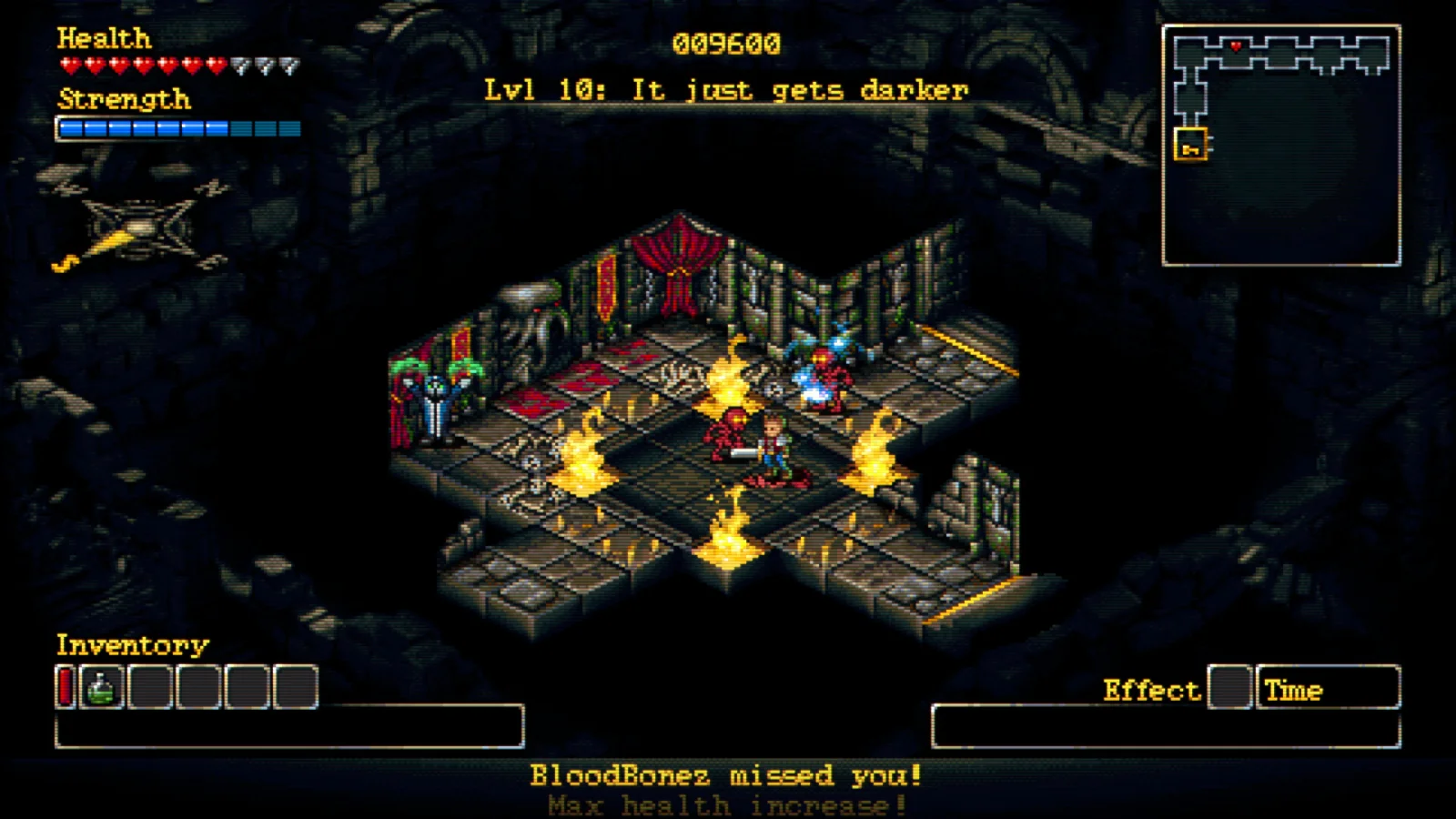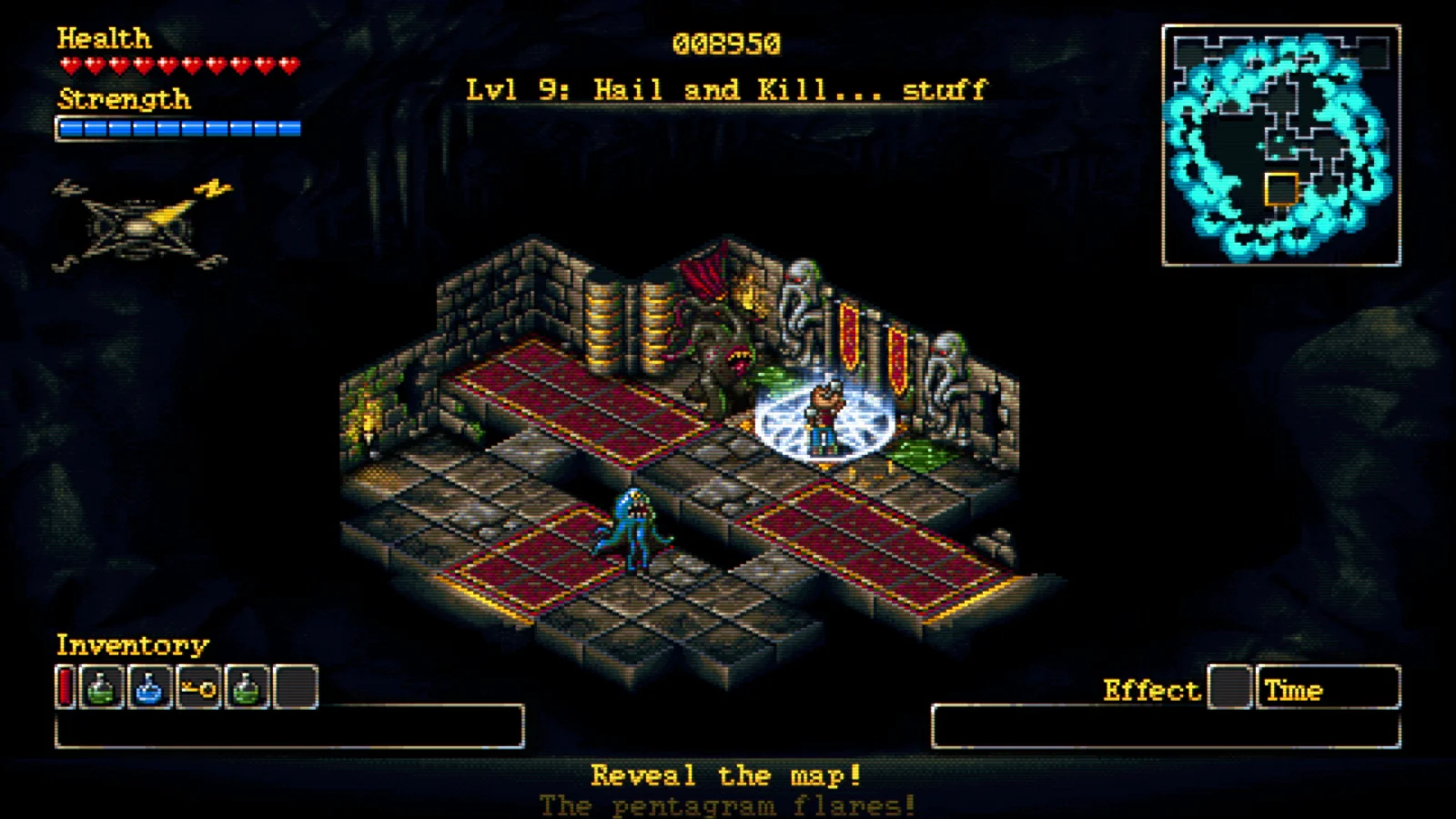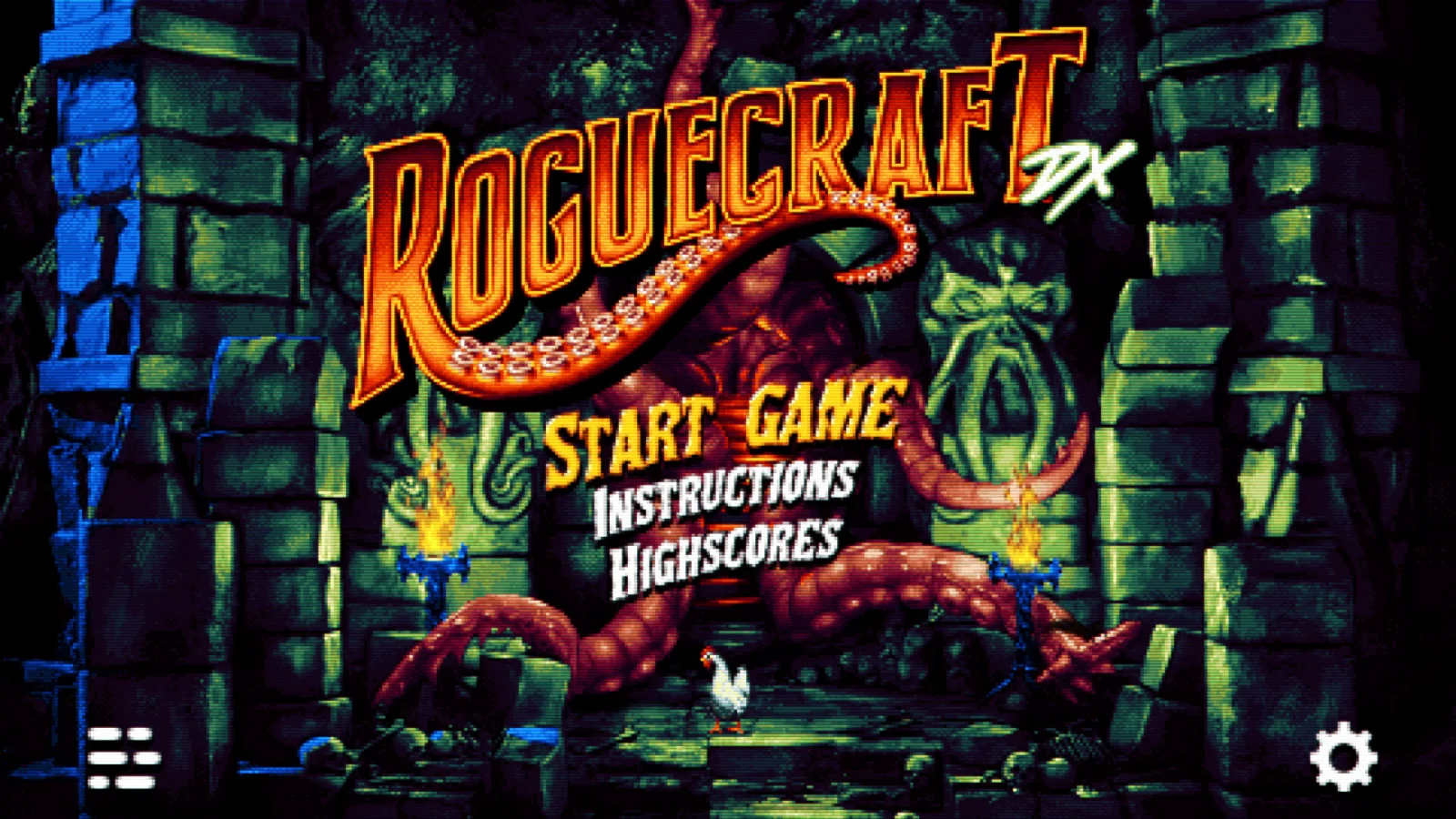
Roguecraft DX is a PC revival of a modern Amiga game, developed by Badger Punch Games and published by Thalamus Digital. Its premise is deliberately lean: choose one of three heroes, enter a procedurally generated isometric dungeon, and attempt to survive a run in which death means starting again. The advertised 30-to-40-minute run target places it in a useful middle ground for players who want a complete tactical attempt in an evening, rather than a campaign that expects a long-term commitment.
That apparent simplicity is not the same thing as a promise of easy play. A smaller decision vocabulary can make a game quicker to understand, but roguelikes often derive their pressure from how those few decisions compound. In Roguecraft DX, route choices, immediate danger, unidentified potions, discoveries such as secret rooms, and the timing of temporary familiars all potentially matter because a failed run is not softened by a permanent safety net. The defining question for a prospective player is therefore less “how much is there to learn?” than “do I enjoy learning through resets?”
Three heroes establish the game’s tactical vocabulary
The Warrior, Rogue and Wizard give Roguecraft DX a clear opening choice. The Warrior is positioned as the stronger melee option. The Rogue has teleport and backstab tools. The Wizard uses magic missiles but is fragile. These are meaningful distinctions because they change the relationship between risk and space before a run even begins. A melee-focused character can invite a more direct approach; a fragile ranged spellcaster suggests that preserving distance is more urgent; and teleportation can turn position into a resource rather than a fixed constraint.
Still, character distinction should not be mistaken for demonstrated balance. A roster of three can make each role legible and can encourage players to sample multiple approaches, but it does not establish that every hero is equally forgiving, equally powerful, or equally satisfying for every player. The Rogue’s teleportation in particular is described by one critical account as not always fully controllable. That is an important caveat for anyone drawn to mobility as a means of precise planning: a movement tool can create dramatic opportunities while also introducing uncertainty at the exact moment a player expects control.
The more generous reading is that Roguecraft DX appears to value sharp identities over broad character-building complexity. For newcomers to turn-based dungeon games, that may reduce the burden of decoding a large skill tree or a long equipment taxonomy. For veterans who expect deeply customizable builds, the same compactness may feel restrictive. The available facts support the former design direction, not an assurance that the latter audience will find endless strategic expression.
Resets put mastery ahead of accumulation
There are no persistent stats or equipment unlocks between runs. That choice is central to how Roguecraft DX should be approached. Without metaprogression to incrementally increase baseline strength, a restart asks the player to bring back knowledge, priorities and better judgment instead. Which risks are worth taking? When is a mystery potion worth identifying? How much should a hero rely on a temporary familiar? What does this particular character need to preserve before the next floor?
This model has an appealing clarity. A successful run can feel tied to decisions made within that attempt rather than to hours spent accumulating permanent advantages. It also keeps early runs from becoming obsolete simply because the profile has advanced. Players who dislike being told to repeat content until numerical progression makes a challenge manageable may find that refreshing.
But clean resets have a cost. They provide little consolation to players who enjoy a roguelite’s long-term arc: opening new options, investing in a favorite style, or feeling that even a losing attempt advanced an account. Roguecraft DX instead asks whether the run itself, and the understanding it builds, are sufficient rewards. That is a strong philosophy rather than a universal virtue. Players seeking a persistent collection loop should treat the absence of unlocks as a decisive buying consideration, not a minor footnote.
For another take on how progression structures alter repeat play, see our Star Conflict: Burrownauts preview.
Chance makes planning valuable, not absolute
Turn-based pacing is naturally suited to thoughtful play because it gives a player time to assess a board state before acting. That can make a compact dungeon format feel more deliberate than its brief runs suggest. Yet Roguecraft DX also includes uncertainty: potions begin unidentified, floors are procedural, and one published critique flags chance-based misses as a frustration. Randomness can create suspense and force adaptation, especially in a run-based game where identical solutions would quickly lose their interest. It can make information a prize rather than a default.
At the same time, chance necessarily puts limits on player control. The issue is not that randomness is inherently flawed; it is whether the game supplies enough ways to respond to uncertainty that losses remain interpretable. The supplied information cannot settle that question. It does, however, make Roguecraft DX a less obvious match for players who want every failed turn to have a clear, controllable answer. Its turn-based structure may allow time for planning, but planning cannot wholly remove variance.
The unidentified-potion system is a concise example of this tradeoff. It creates a decision under incomplete information, which can be exciting for players who like calculated gambles. It can also feel punitive to those who prefer tools to be clearly defined before committing to them. Neither response is unreasonable; the key is recognizing that discovery is part of the tension rather than merely a collectible layer.
Temporary help and alternate modes broaden the frame
Temporary animal familiars can fight and fetch loot, but their duration is limited. That limit is more consequential than it may first appear. A companion that lasts indefinitely would primarily function as a standing advantage. A companion with an expiry instead introduces a timing problem: use its help now to stabilize an immediate threat, leverage it to gather resources, or preserve that window for an uncertain situation later. This is a compact form of resource management, and it fits a game that appears to prefer situational priorities over permanent upgrades.
Secret rooms point in a similar direction. Their inclusion suggests that attention and exploration can be rewarded, though it would be a mistake to promise consistent value from them. One critical response specifically found secret rewards and enemy threats uneven. That does not prove a universal problem, but it does warn against assuming each discovery will reliably justify the risk or time spent pursuing it. In a roguelike, inconsistency may be intentional texture; it can also make a reward structure feel arbitrary. The difference depends on context not established here.
Roguecraft DX offers a 15-floor Classic mode, Endless Dungeon and Chicken Run. These modes give the game more than one stated structure: Classic supplies a defined 15-floor objective, while Endless Dungeon changes the horizon away from a fixed endpoint. Chicken Run is listed as a distinct option, but its rules have not been detailed, so it should not be oversold as a guaranteed third major campaign. Multiple modes can reshape goals and encourage players to revisit the core systems, yet they do not automatically prove limitless variety. Their value will depend on whether a player already enjoys the basic cycle of moving through uncertain floors and making tactical tradeoffs.
Presentation can attract, but systems should decide the purchase
Published criticism has been positive about Roguecraft DX’s presentation and audio, and its Amiga lineage is plainly part of its identity. That makes the game a potentially appealing proposition for players interested in a modern PC version of a retro-rooted dungeon roguelike. However, nostalgic aesthetics and practical visual clarity are separate issues. An isometric view can be attractive while still requiring careful evaluation of how readily players can parse positions, threats and interactable details. There is no basis here to claim that the game succeeds or fails at that screen-readability test.
The practical recommendation is conditional. Roguecraft DX looks best suited to players who want short, turn-based dungeon attempts; enjoy testing a focused set of character identities; and see starting from zero as part of the challenge. The Warrior, Rogue and Wizard offer immediately understandable reasons to replay, while procedural floors, secrets, potions and expiring familiars can keep individual runs from becoming purely routine.
Players who prioritize permanent progress, highly deterministic tactical outcomes, or expansive build construction should approach more cautiously. The game’s strongest stated traits are concentration and replay through changing runs, not accumulation or maximal systemic breadth. Its September 10, 2026 PC release makes it one for the shortlist if that compact, restart-driven model sounds inviting. Its limitations are not hidden by the premise; they are part of the same disciplined design that may make it click for the right audience.