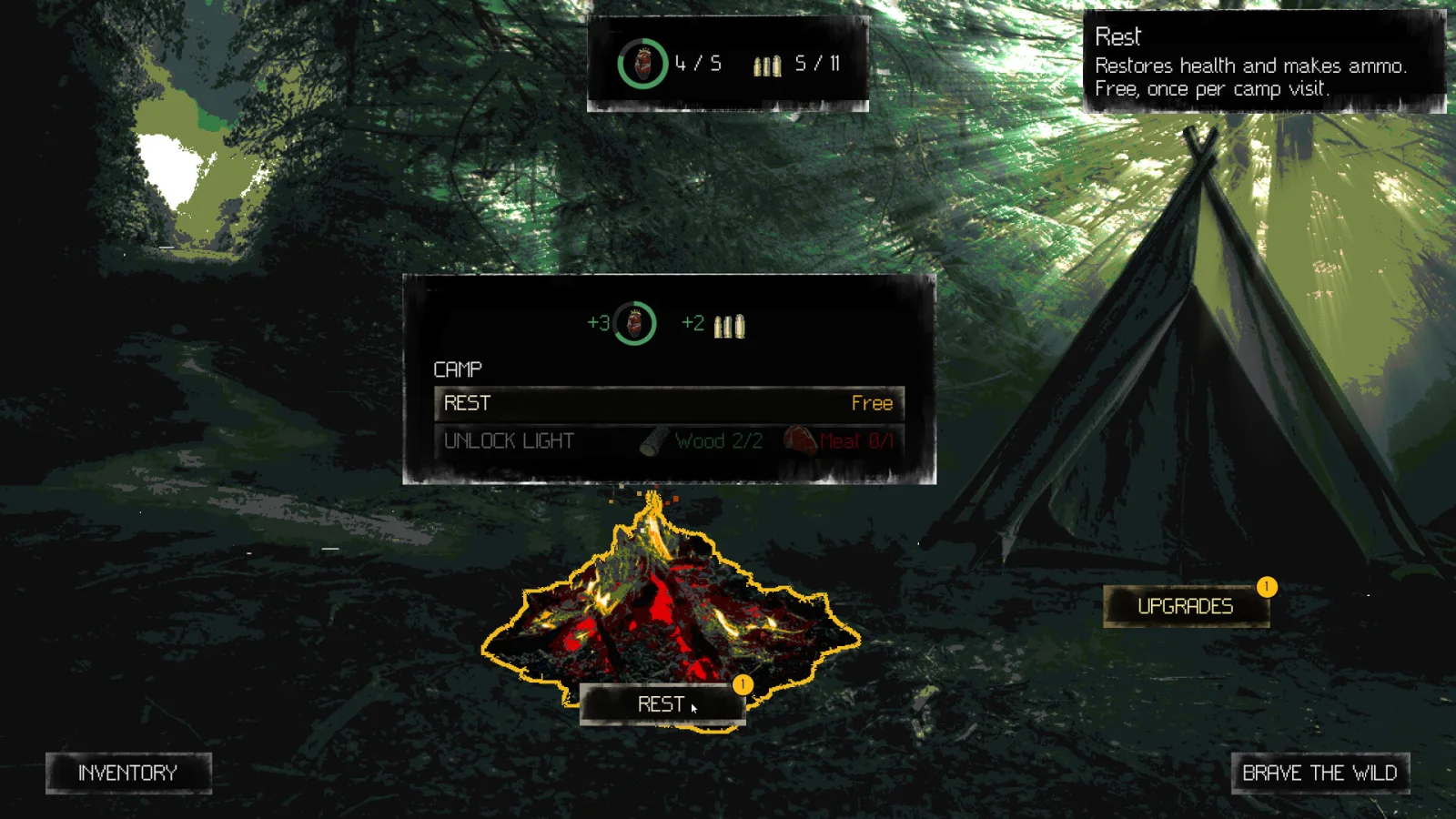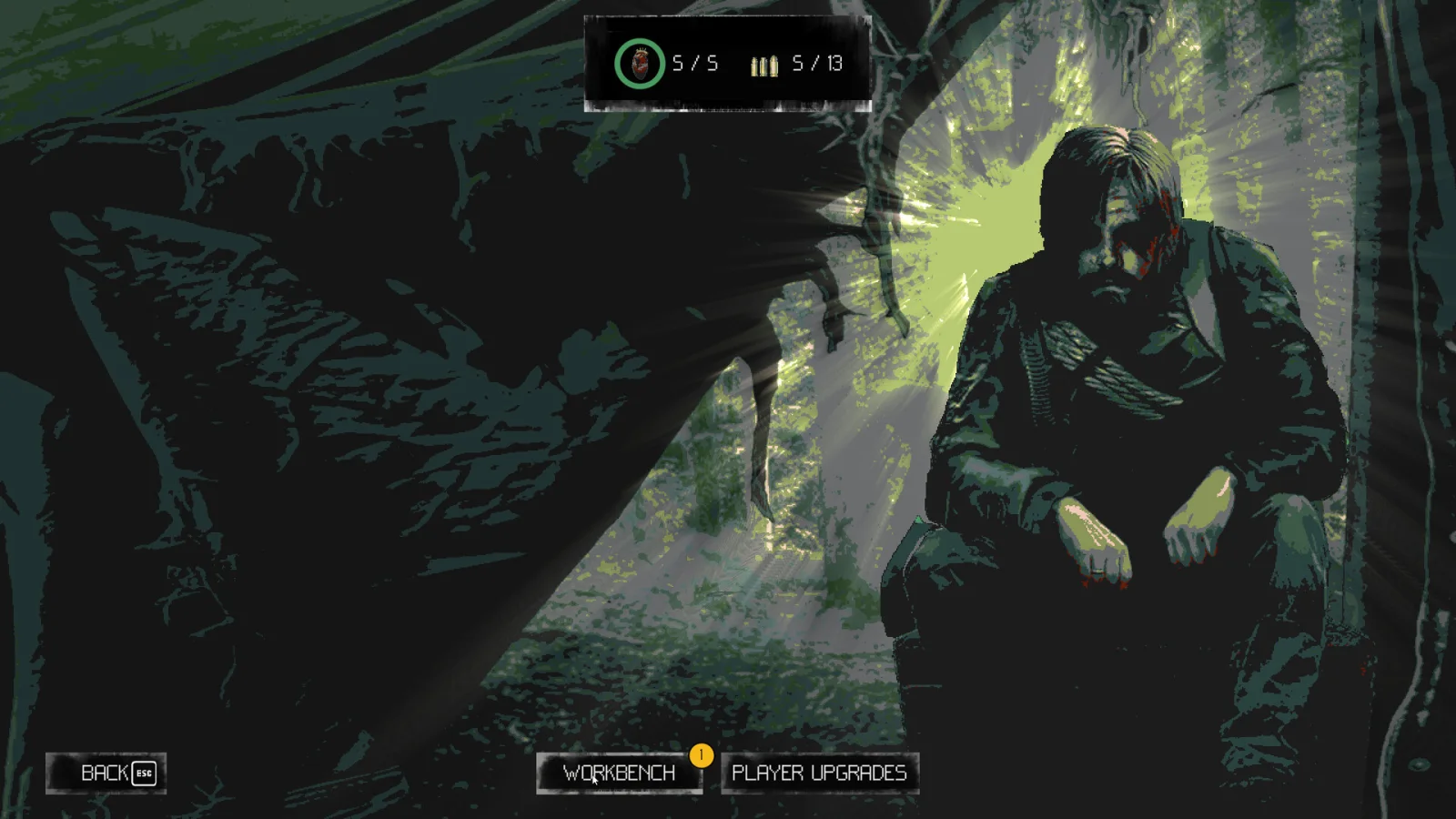
Medium Rare is not yet a released game. Developers Payne Robinson, Peter Tinaglia, and Giovanni Fim, alongside publisher ExeCo, have announced the PC game for a 2027 full release. A public Steam demo is planned for October 9, 2026; as of October 3, 2026, it is not publicly available. Its announced systems raise a series of intriguing questions about risk, resources, and the decision to leave a dungeon floor.
The official pitch places a turn-based survival dungeon crawler inside a world of industrialized cannibalism. Its protagonist is trying to rescue his kidnapped wife, while the announced play structure centers on grid-based floors, scavenging, dice-based gunfights, ammunition conservation, parts and upgrades, and the choice between extracting with resources or pushing farther into danger. The pixel-art presentation is also described as violent. That is a forceful combination of thematic premise and mechanical vocabulary, but its promise rests less on any one ingredient than on whether those ingredients continually sharpen one another.
Extraction is the most important announced idea to watch. In a dungeon game, deciding whether to leave can be more interesting than merely deciding where to move next. A floor can offer resources, upgrades, or another chance at progress, but the value of continuing is only meaningful if banking what has already been found carries a credible benefit. Conversely, the threat of continuing only matters if failure, depletion, or mounting danger gives the decision real weight. Medium Rare’s stated structure could turn a simple exit into a recurring question: is the current haul sufficient, or is the possible value beyond the next stretch worth risking it?
That choice has room to create a useful opportunity-cost dimension around every encounter. Fighting may consume ammunition. Looting may occupy limited inventory space. Exploring could reveal parts or upgrades, yet may also ask the player to spend turns and resources. If these pressures are legible and connected, an encounter is not simply a barrier between the player and a reward. It becomes a calculation about what to preserve, what to gamble, and what can be afforded before leaving.
There is a major distinction, however, between an extraction decision that produces tension and one that merely repeats a routine. If leaving is usually obvious, then the system may function as housekeeping rather than strategy. If pushing onward is usually mandatory for practical advancement, the supposed decision can collapse in the other direction. The announced design will need enough variation in resource states, loot value, and immediate threat that neither answer settles into a universally safe rule. The interesting version of the loop is not one where players always leave as soon as they have something worth protecting, or always continue until forced out. It is one where each choice answers a changing situation.
An economy built around restraint
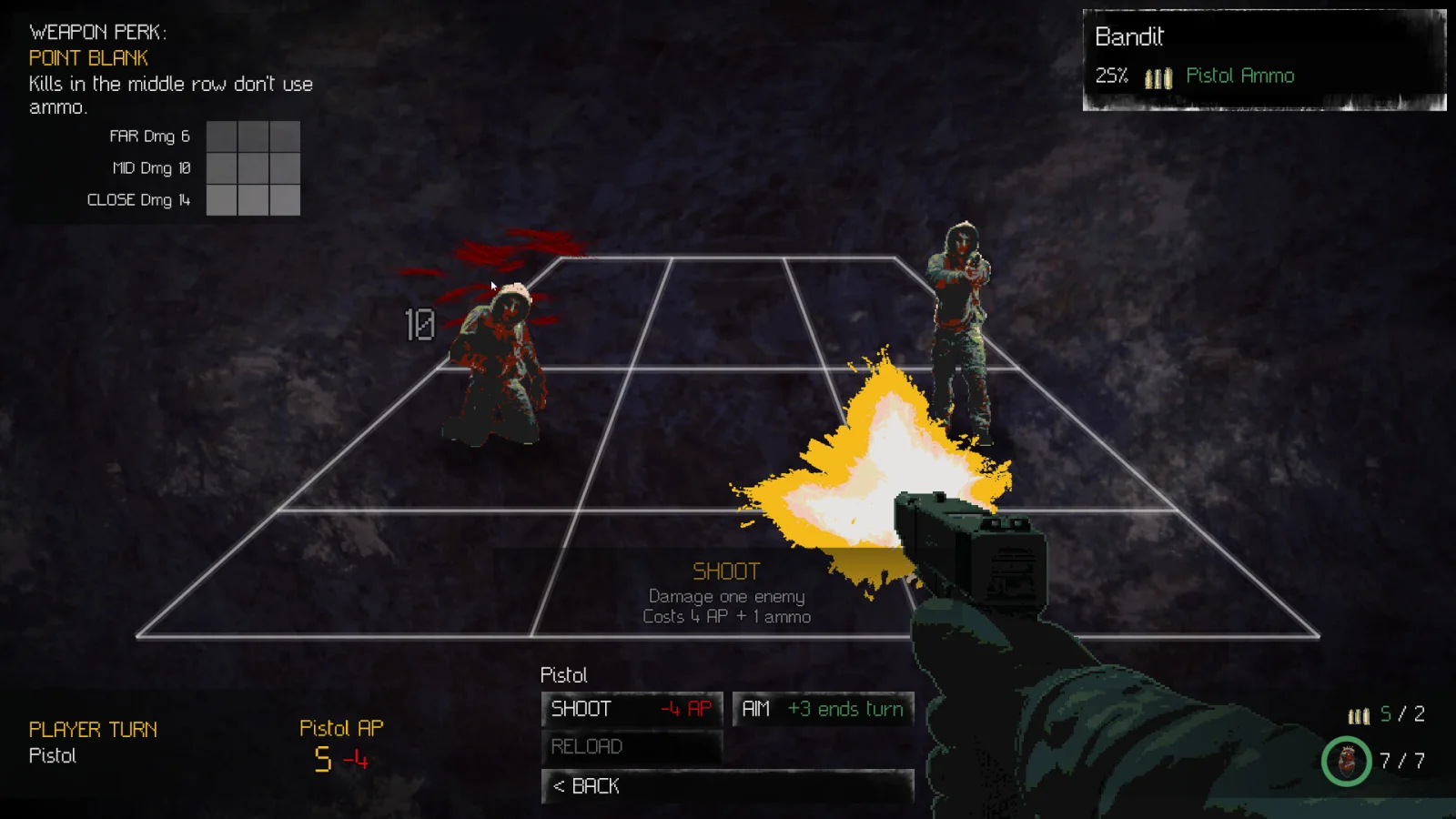
Medium Rare officially describes ammunition conservation as a central concern, and that can substantially alter how a turn-based crawler reads. Limited ammunition does not automatically make combat strategic; it can simply make it restrictive. But paired with a grid-based floor structure, it has the potential to make positioning, target priority, retreat, and the decision to avoid a confrontation matter before a shot is fired. The crucial word is potential. The supplied information does not establish exactly how movement, attacks, opposing characters, reloading, or ammunition acquisition work, so those details should not be assumed.
What can be said from the announced design is that scarce ammunition could make guns feel like commitments instead of default actions. A player who believes every round may matter later is encouraged to ask what a fight is worth. That can support a survival tone particularly well when extraction is also central: firing now may make the current route safer while diminishing confidence in going deeper, or it may protect a haul that is already valuable enough to extract. In that sense, ammunition could be the thread tying immediate decisions to the larger question of when to leave.
The risk is opacity. Conservation is compelling when a player can understand why supplies ran low and can identify choices that might have produced a different outcome. It is much less persuasive when scarcity feels detached from decisions or when recovery opportunities are too hard to read. The public demo, once available, should offer a first practical look at whether Medium Rare communicates its resource economy clearly enough for caution to feel intentional rather than merely anxious.
Dice-based gunfights introduce another source of uncertainty. Dice can produce drama because they make chance visible: an action can have a probability, a result, and a consequence that are easy to recognize. They can also create frustration if the player has little influence over the stakes, the odds, or the aftermath. Medium Rare’s official description establishes dice-based gunfights, but it does not establish the exact dice rules, the range of outcomes, or the forms of player control around those outcomes. It would be premature to call the system tactical, random, fair, punitive, or any combination of those terms.
Still, the design question is precise. Do dice outcomes leave room for meaningful agency? That agency might come from choices made before a roll, choices over which risk to accept, or choices in how a player adapts once an outcome is known. The specific form is not announced. The principle is that uncertainty works best when it does not erase responsibility. If an unfavorable result can be understood within a decision the player knowingly made, tension may remain productive. If results regularly seem to overrule all relevant planning, chance may obscure the resource and extraction decisions the broader design appears to prioritize.
Inventory as a second map
The official description uses the familiar phrase inventory Tetris for Medium Rare’s item organization. Spatial inventory systems can make loot more than an abstract numerical gain. An item is not only useful; it occupies a shape and therefore displaces some other possible future. That means the player may have to decide whether a newly found object is worth rearranging for, whether a part should be kept over ammunition, or whether a promising upgrade merits carrying at the cost of flexibility. In a game already structured around gathering resources and choosing when to extract, this is a logical pressure to add.
Spatial limits could make inventory management an extension of survival play rather than an interruption from it. A well-paced system can produce small but consequential decisions: keeping a resource because it supports a plan, discarding an item because the route out matters more, or reorganizing because a newly found object changes the value of what is already carried. None of those are verified descriptions of Medium Rare’s exact interactions; they are strategic possibilities suggested by combining its announced inventory organization with its announced extraction loop.
The pacing of that friction is especially important. Too little capacity pressure can make the system decorative. Too much friction can make every find feel like clerical work, particularly if rearrangement is frequent without creating an interesting decision. The central question is not whether the game has spatial organization, which its official description indicates, but whether items have sufficiently distinct roles that choosing between them says something about a player’s plan. The public demo may clarify how often organization is required, how much information the player receives, and whether parts, ammunition, and upgrades compete in compelling ways.
Upgrades are another announced element that needs to do more than raise a value. Distinct upgrade choices could help preserve variety by changing what kinds of risks feel acceptable. An upgrade might, in principle, make a player more willing to explore, make supplies easier to protect, or alter the value of extracting early. These are examples of possible design relationships, not confirmed Medium Rare upgrade effects. The available evidence only confirms that parts and upgrades can be gathered. Whether the resulting choices are broad, narrow, temporary, persistent, mutually exclusive, or otherwise structured remains unanswered.
That uncertainty matters because upgrades can either reinforce the game’s central decision or flatten it. If every improvement simply makes continuing farther safer, progression may steadily reduce the force of the extraction question. If upgrades instead create different priorities, they could deepen it. The design does not need every enhancement to be equally dramatic, but it needs enough identity that collecting parts feels connected to a changing approach rather than to an automatic checklist.
A premise that needs tonal precision
Medium Rare’s premise of industrialized cannibalism is deliberately abrasive, and the announced protagonist’s effort to rescue his kidnapped wife gives the setting an immediate personal objective. The pixel-art violence and survival framing suggest a game willing to use disturbing material, but official descriptions alone cannot show how the narrative handles that material. It would be inappropriate to presume a particular tone, degree of satire, emotional depth, narrative structure, or treatment of its characters.
The important editorial question is whether the premise and the mechanical loop ultimately speak the same language. A system about gathering, carrying, spending, and extracting resources can support a setting concerned with commodification and survival, but it can also sit beside its fiction without meaningful connection. The eventual game will need to establish its own answer. A serious or grotesque premise does not become effective merely through escalation, nor does pixel art predetermine how violence will land. Context, framing, and consistency will matter far more than the broad subject matter alone.
There is also a balance to strike between a clear personal goal and the repeatable logic implied by an extraction-focused dungeon crawler. The supplied information confirms both the rescue premise and the systemic features, but not how they are joined over the course of the game. That connection is one of the larger unknowns awaiting the demo and, later, the full release.
What the upcoming demo can meaningfully answer
The public demo planned for October 9, 2026 should be treated as a limited opportunity to assess the announced foundations, not as evidence of the finished 2027 game. A demo can represent a narrow slice, and no assumption should be made about how much of Medium Rare’s broader progression or narrative it will contain. Even so, a playable slice can answer practical questions that a feature list cannot.
- How quickly does the extraction loop refresh? The demo may reveal whether the leave-or-push decision arises often enough to shape play without becoming repetitive.
- What agency exists around dice? It may show how outcomes are communicated and whether players can make informed choices around risk.
- How is inventory friction paced? It may clarify whether spatial organization produces meaningful trade-offs or frequent administrative pauses.
- Do upgrades create distinct priorities? It may indicate whether gathered parts encourage different approaches or primarily offer straightforward improvement.
- How is the premise framed? It may provide initial context for the violent industrialized-cannibalism setting and rescue objective, without necessarily representing the full narrative.
For a related look at a different card-driven design, see this PC design assessment of pre-run deckbuilding. Medium Rare’s announced identity is different, but the editorial standard is the same: locate the choices a design says it wants players to make, then wait for playable evidence before treating those choices as successful.
At present, Medium Rare has a potentially coherent set of announced pressures. Grid-based traversal could make space and pathing intelligible. Ammunition conservation could make combat expenditure meaningful. Dice-based gunfights could make uncertainty explicit. Inventory Tetris could turn loot into a capacity problem. Extraction could give all of those systems a shared endpoint. The compelling version is a game in which those pressures compound rather than compete for attention.
But the announced design remains a proposition, not a demonstrated achievement. The October 9 public demo is the next opportunity to evaluate how the risk calculations feel, whether the dice outcomes are readable, and how effectively the premise is handled. Until then, Medium Rare is most interesting as a carefully interlocked idea: a survival crawler where the most important decision may not be how to win the next fight, but whether the resources already earned are enough to justify walking away.