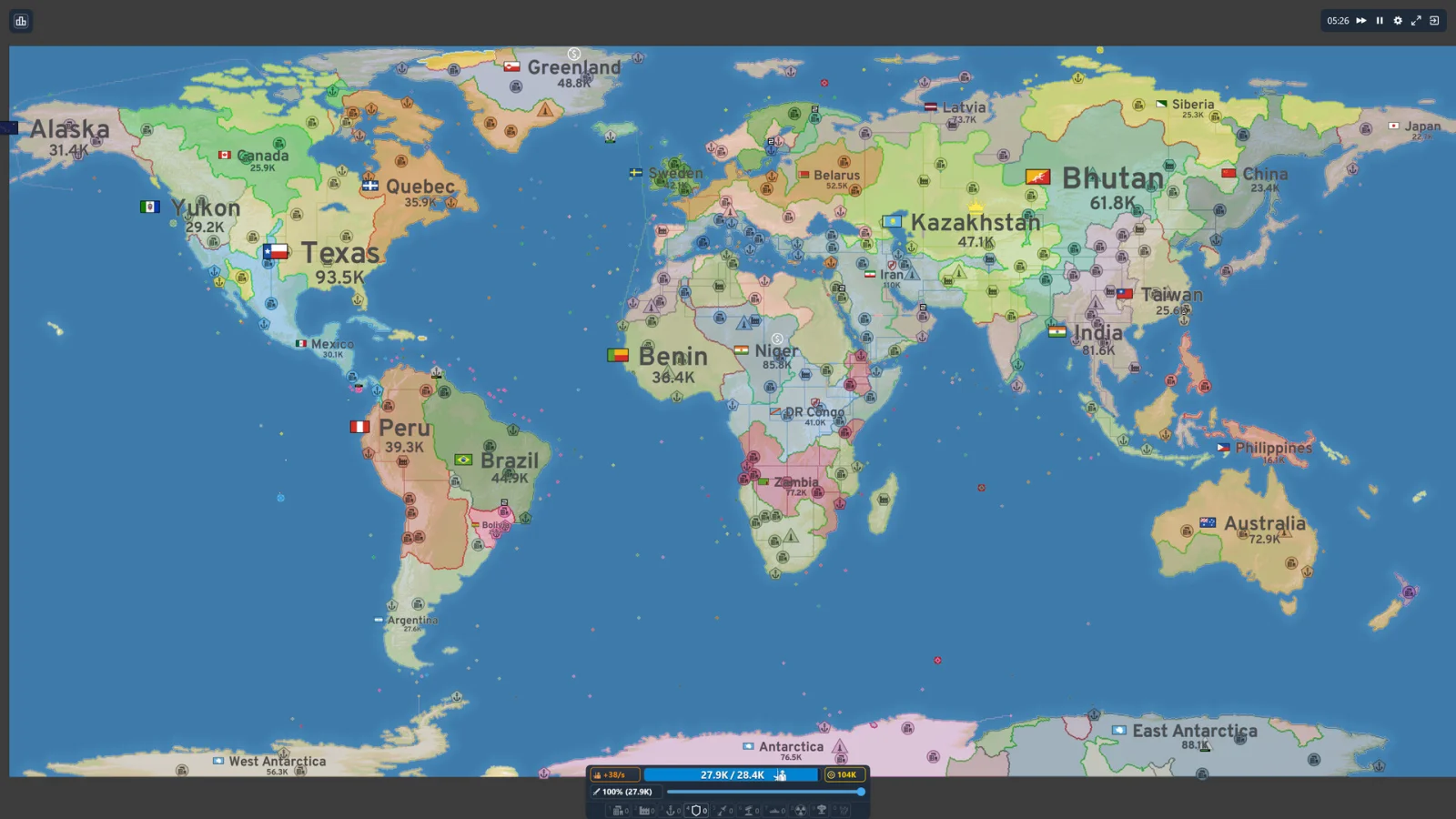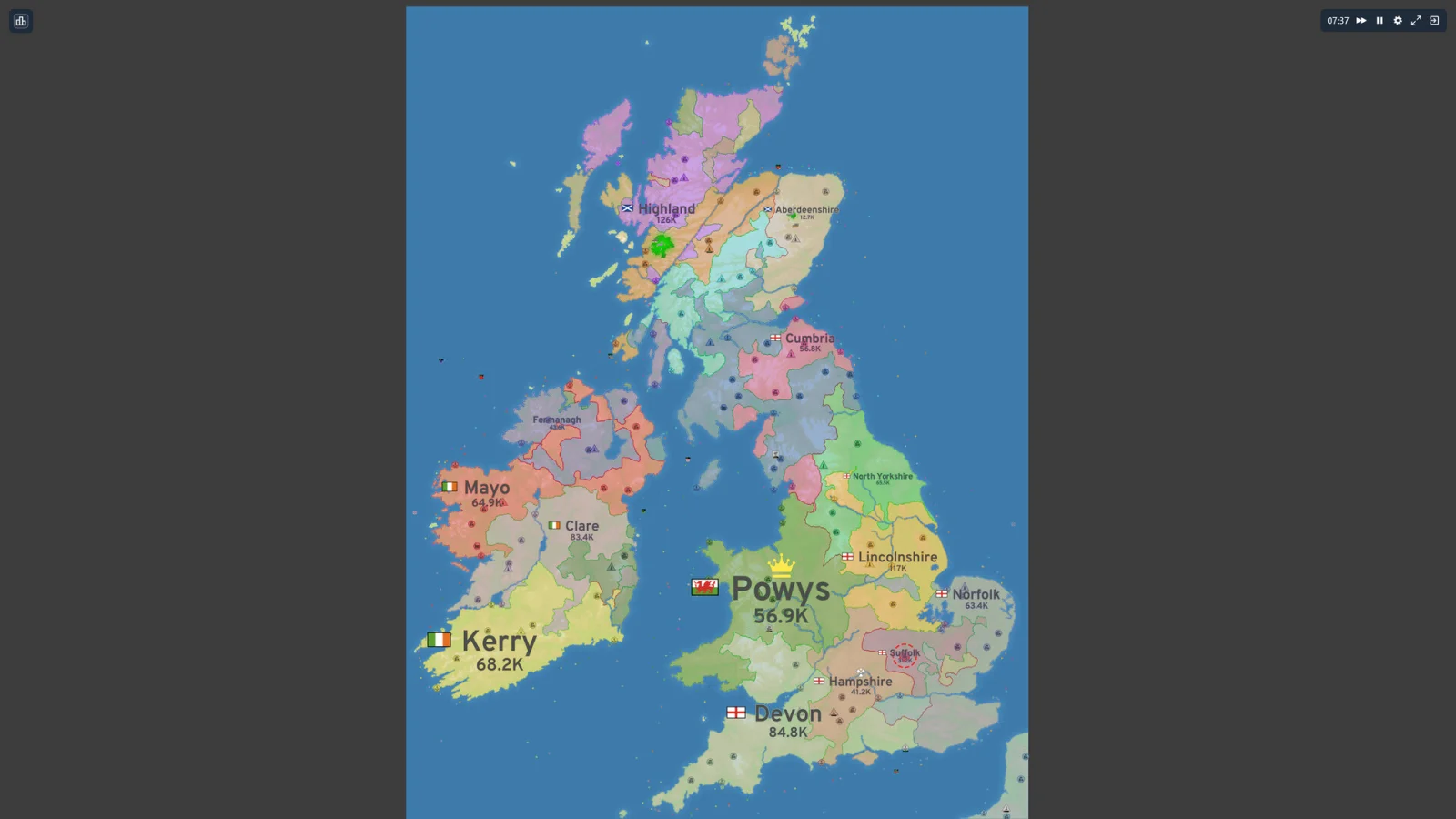
OpenFront entered Steam Early Access on September 17, 2026. OpenFrontInc is listed as both developer and publisher. The game’s stated premise is a real-time strategy experience played on a shared world map, with hundreds of players advertised as participating in the wider space. Players are described as beginning with a small territory, then expanding while building a gold economy and military strength.
This is an unscored Early Access overview based on the available design information, not firsthand play. As a result, it cannot establish whether OpenFront is balanced, readable, stable in networked play, or satisfying over extended sessions. It also cannot confirm how the advertised systems behave when many players are contesting the same map. What it can do is identify the strategic questions raised by the game’s stated direction.
OpenFront advertises cities, ports, missile defenses, alliance requests, truces, a naval front, nuclear strikes, multiple maps, and territory cosmetics. It also advertises shared servers and cross-platform support. Those are the declared elements of the current proposition. The Early Access roadmap separately identifies mobile applications, expanded clans and leaderboards, additional maps and modes, and Steam Deck optimization as intended future work. That distinction matters: advertised cross-platform support should not be confused with a roadmap item, while the roadmap itself should not be treated as a promise of delivery.
Established details: expansion on a populated strategic map
OpenFront’s central advertised loop is straightforward enough to understand. A player starts with limited territory, expands, develops a gold economy, and builds military strength. The potentially unusual part is the shared-map setting. In a conventional strategy premise, acquiring land is primarily a mechanical act: gain room, gain resources, gain position. In a world occupied by many other players, the same act may also carry a social meaning.
A newly claimed border could be read as ordinary growth, an attempt to secure a chokepoint, an invitation to cooperate, or an alarming approach toward somebody else’s plans. That possibility does not prove that OpenFront’s diplomacy will be deep or that its community interactions will be constructive. It does explain why alliance requests and truces are potentially important rather than incidental. The game’s pitch is not only about moving outward; it is about moving outward where other people can interpret the move.
That shared-world scale could give routine RTS priorities a more unsettled character. A player might have to judge whether nearby territory is worth the attention it attracts. A neighbor might be weak today but aligned with stronger players tomorrow. A truce might buy useful time, or simply delay an eventual disagreement. These are conditional design possibilities, not confirmed outcomes, but they arise naturally from an RTS that presents territorial expansion alongside player-facing diplomatic tools.
The core question is whether growth creates responsibility
Gold is explicitly described as a resource, while military strength is part of the stated strategic foundation. The precise relationship between gold, defenses, cities, ports, and military development has not been established. There is no basis here to assume particular costs, production rules, upkeep systems, unit types, or resource formulas. Still, the announced combination raises a useful question for Early Access: does more territory create meaningful choices, or merely provide a reliable route to greater power?
The strongest version of OpenFront’s premise would make expansion attractive without making it automatic. More territory could create opportunity, but also extend the area that needs attention. A larger position may expose more borders, put more strategic sites into contention, or make diplomatic relationships harder to maintain. If this general tension is reflected in the game’s actual systems, expansion could become a calculation about timing and exposure rather than a simple instruction to take as much land as possible.
That would give gold an especially important strategic role. An economy can be interesting not because a number grows, but because spending it means choosing among competing priorities. OpenFront has not detailed what those choices are. However, its advertised mix of territorial growth, cities, ports, missile defenses, and military strength gives it room to make investment decisions matter. Consolidation, outward expansion, deterrence, and cooperation could potentially pull in different directions. If every investment instead serves one clearly superior path, the shared-map premise may become less varied than its feature list suggests.
Early Access is where that distinction needs evidence. The listed ideas are enough to establish an ambition, but not enough to show whether the ambition produces varied strategies or a dominant early advantage. No conclusion about balance should be drawn before the game’s actual play conditions can support one.
Diplomacy may be the design’s most unpredictable layer
Alliance requests and truces are among OpenFront’s most consequential advertised features because they introduce human uncertainty into a game about borders. A diplomatic agreement can change what a player thinks is safe, what territory appears available, and which conflict deserves immediate attention. It can make military strength a bargaining factor rather than only an instrument of attack.
In conditional terms, a truce could enable two vulnerable neighbors to focus on a larger threat. An alliance could let players coordinate their interests across a map. It could also become temporary when those interests diverge, because diplomacy in multiplayer strategy is rarely a permanent cure for ambition. The map may be shared, but everyone is still likely to have their own idea of where the furniture should go.
This potential social layer may be compelling for players who enjoy negotiation, suspicion, and adapting to other people’s decisions. It may be less appealing for those who prefer a strategy game where every relevant variable is clearly represented by the rules rather than by another player’s changing priorities. Neither audience response can be assumed in advance. The point is that OpenFront’s stated multiplayer structure makes diplomacy part of the strategic proposition, not merely a decorative button beside the warfare systems.
The practical quality of that proposition remains unknown. The available information does not establish how alliance requests or truces are presented, enforced, limited, or communicated. It does not establish whether players can understand the state of a crowded map at a glance. It does not establish whether the game’s social tools reduce confusion or amplify it. Those are material questions for a shared-world RTS, and they cannot be answered by an announcement alone.
Ports and naval play could give geography a real role
Ports and a naval front are advertised, which suggests that coastlines may matter to OpenFront’s strategic picture. Their exact functions are not specified. Ports should not be assumed to enable trade, transport, resource extraction, particular construction options, or any other unconfirmed mechanic. Yet their presence alongside naval play makes it reasonable to see geography as a major design opportunity.
If water meaningfully changes how players approach one another, a coastline could be both an opening and an obligation. It might connect distant territories that would otherwise seem strategically separate. It might create another direction from which pressure can arrive. It might make a coastal position desirable while requiring different defensive thinking than a landlocked one. These are possibilities rather than verified mechanics, but they are the sort of tradeoffs that can make a map feel consequential instead of functioning as a flat board for expansion.
Multiple maps are also advertised. Their number, layouts, rotation, and availability have not been confirmed in the supplied information. Even so, map variety could be important to the game’s long-term identity if different geographical arrangements alter the value of territory, ports, defenses, and diplomatic relationships. A shared-world RTS benefits when location changes the questions players ask, rather than merely changing the colors around the same familiar answers.
Defense and escalation need to preserve agency
Missile defenses and nuclear strikes give OpenFront’s public description a deliberately high-stakes vocabulary. In fictional strategy design, nuclear escalation can function as a threat that changes how players judge danger, negotiate, and prepare their territory. Its strategic value would not rest on spectacle alone. Ideally, it would create difficult choices around deterrence, vulnerability, and the consequences of letting a conflict intensify.
That is only an analytical ideal, not a claim about OpenFront’s current implementation. The available description does not explain how nuclear strikes work, when they are available, what missile defenses do, or how either system interacts with the rest of the game. It therefore cannot support claims about endgame pacing, counterplay, fairness, or destructive scale. What can be said is that these advertised systems place a burden on the wider design: escalation should sharpen decisions, not make prior planning irrelevant.
Cities raise a similar question. Their presence establishes that OpenFront includes them among its advertised elements, but not their specific role. The most promising broad structure would be one in which cities, ports, defenses, territorial growth, diplomacy, and military development create competing priorities. The less interesting structure would be one where every element exists solely to increase force along a single obvious route. Early Access play, rather than design language, will determine where OpenFront lands.
Current support claims and future plans should remain separate
OpenFront’s browser origins are part of its stated background, and its shared servers and cross-platform support are currently advertised features. In principle, that approach suits a game whose identity depends on a communal strategic space: broader access could help make a map feel active and politically fluid. But there is no hands-on evidence here regarding server behavior, control clarity across platforms, population patterns, or the practical experience of participating in a large shared match.
The roadmap is more clearly provisional. Mobile applications, expanded clans and leaderboards, additional maps and modes, and Steam Deck optimization are identified as directions the project intends to pursue. They are useful signals of developer priorities, particularly because clan and leaderboard features could eventually add another layer of organization to a shared map. They are not current features by default, and they are not guarantees.
For another unscored look at an early-stage game through the lens of its announced direction, read our Star Conflict: Burrownauts preview.
Unscored outlook
OpenFront has a coherent announced hook: combine familiar RTS expansion with a shared map where territory can carry economic, military, geographic, and social consequences. Gold, cities, ports, missile defenses, alliance requests, truces, naval play, and nuclear strikes are not proof of a successful strategy game by themselves. They do, however, describe a framework capable of producing interesting pressure if the systems give players readable alternatives and meaningful reasons to adapt.
The unanswered questions are substantial. Can growth remain rewarding without becoming runaway momentum? Can diplomacy be useful without becoming opaque? Can ports and coastlines create distinct strategic exposure? Can defenses and escalation raise tension while leaving players with agency? Can the shared-map concept remain understandable at its advertised scale? OpenFront is already in Early Access, but its feature description cannot resolve those questions. It establishes a strategically ambitious proposal; hands-on evidence will have to establish the results.