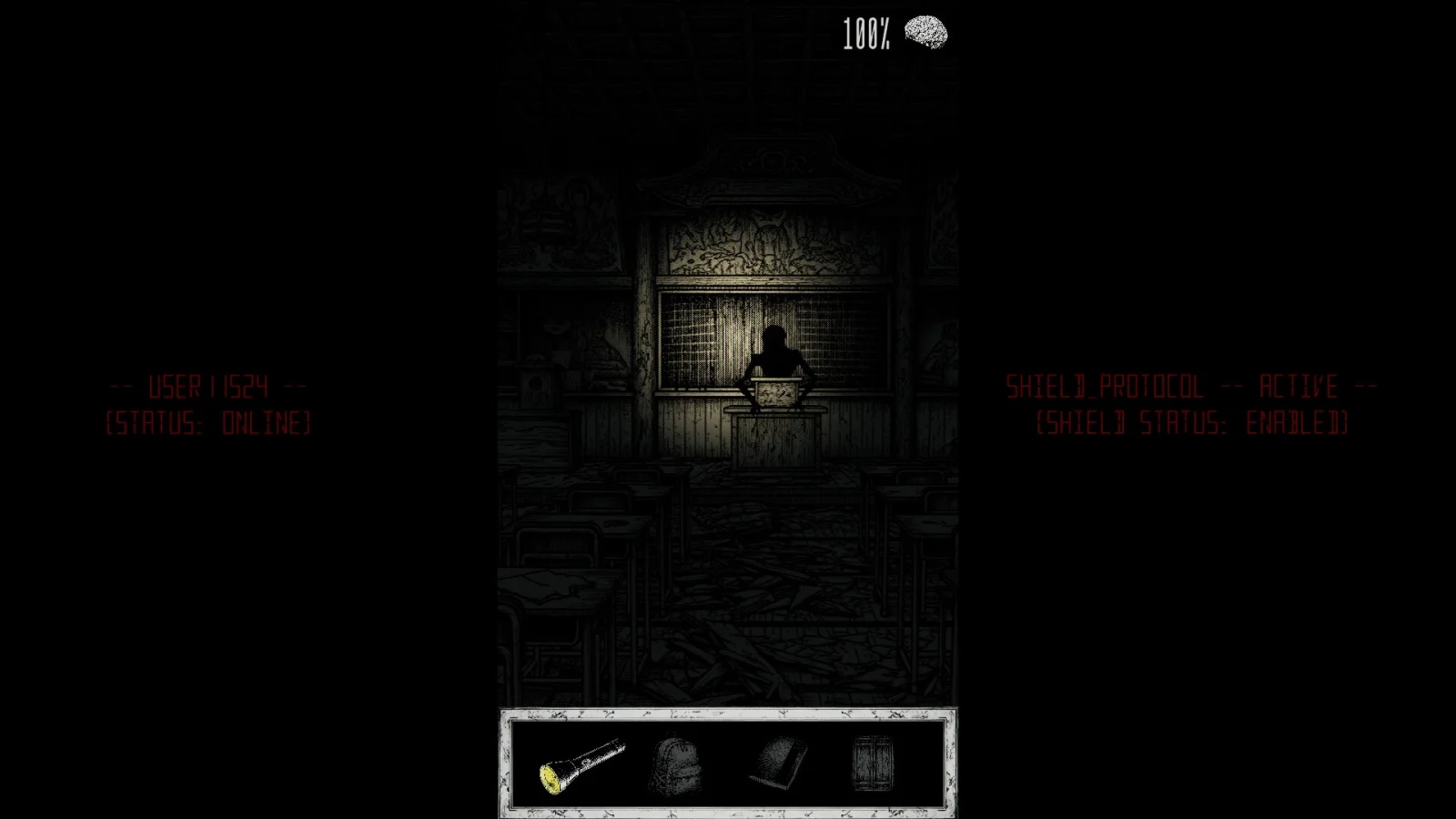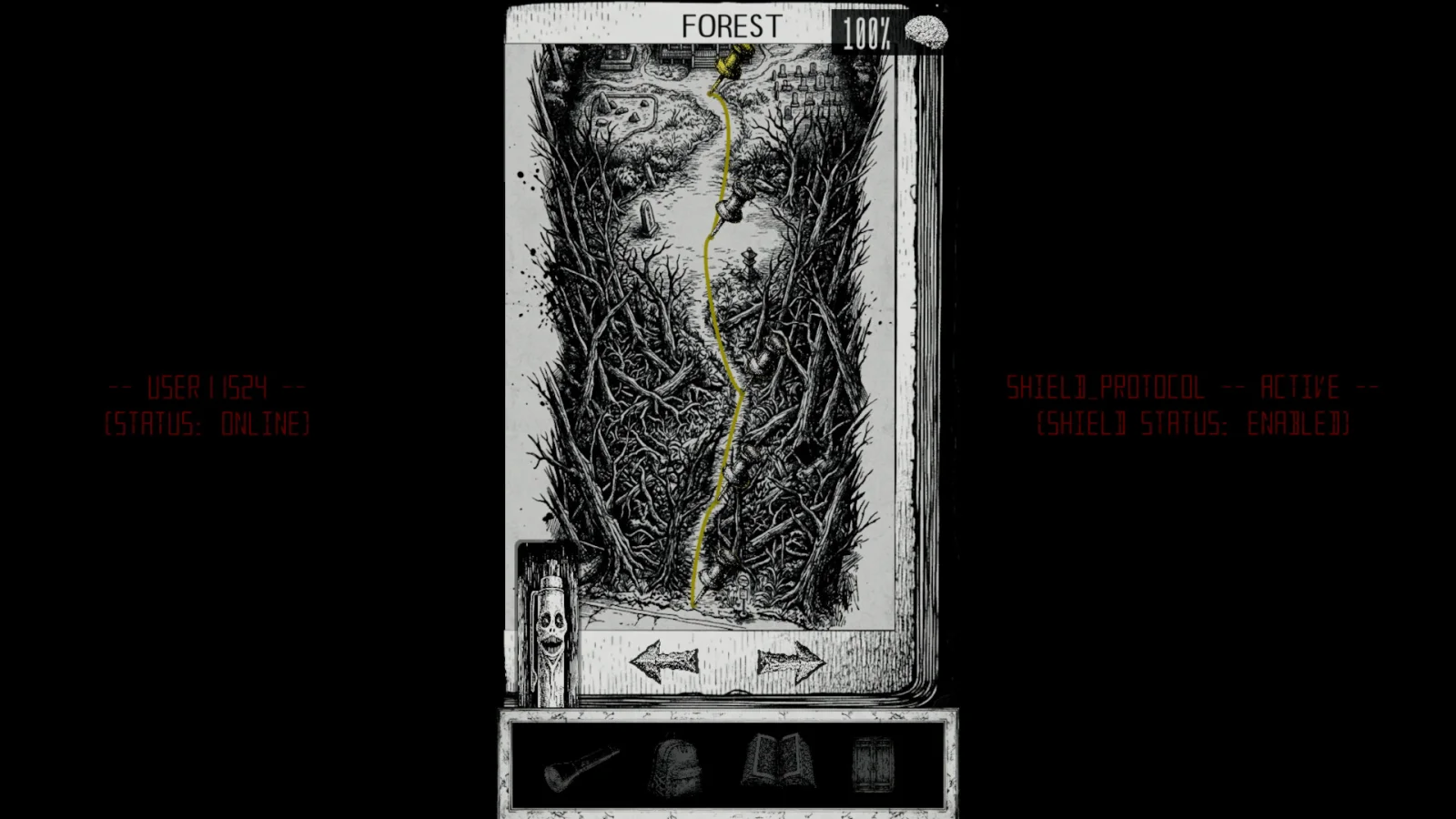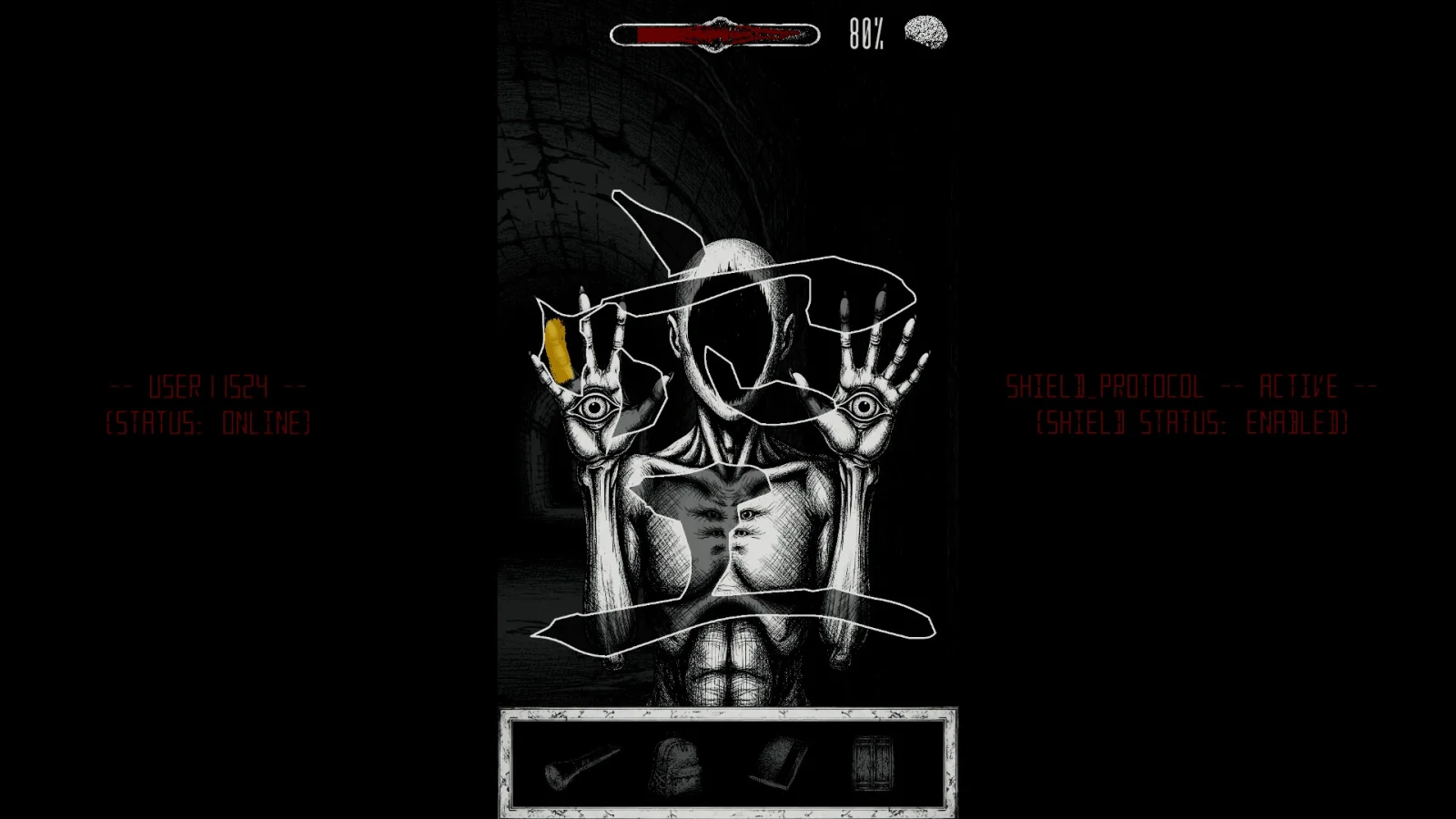
VOS: First Faiths is a released PC psychological-horror game from developer and publisher Digital HOR. Its premise places the player on an assignment from Veil Obscura Services, navigating a temple or labyrinth across repeated runs. Official materials describe a single-player point-and-click structure built around exploration, maps and notes, resource management, a VOS shop, narrative decisions with branching consequences, multiple possible endings, and hostile encounters answered by drawing protective sigils in real time.
That is an intriguing collection of responsibilities for a horror game. Rather than making fear solely a matter of a threat appearing at the right moment, the stated design asks the player to collect and preserve information, allocate resources, orient themselves within an uncertain space, and then respond during danger. Whether all of those parts combine elegantly depends on their implementation. Yet the basic proposition is strong enough to deserve attention: investigative horror can turn uncertainty into a meaningful activity when uncertainty has records, routes, costs, and decisions attached to it.
VOS: First Faiths is therefore not built around one isolated hook. Its point-and-click exploration, resource management, shop, maps, notes, branching decisions, repeated temple runs, and sigil tracing are presented as interlocking parts of the same journey. The appeal of that arrangement is not simply that it offers several systems. It is that each system could give the others a reason to matter. A note is more significant if it changes a route. A route is more tense if resources make detours costly. A decision carries more weight if prior investigation changes how its consequences are understood.
An investigation designed to make note-taking matter
The official inclusion of maps and notes is not just a checklist detail. In a labyrinthine horror setting, those tools can establish a productive relationship between the player and the unknown. A map can make location legible without making it safe. Notes can preserve discoveries without automatically explaining them. Put together with repeat runs, they suggest a format in which a player may return to an oppressive place with greater knowledge but not necessarily greater certainty.
That distinction matters. Horror becomes less interesting if information only erases danger. The more promising possibility is that information changes the kind of danger being faced. A discovered route might make a choice clearer while revealing a new cost. A note might identify a threat but leave the player to decide whether spending resources on preparation is worthwhile. An acquired understanding from one run could reshape priorities on another without turning the temple into a fully solved diagram.
There is also a thematic fit between an employer called Veil Obscura Services and a structure built around records, assignments, and supply decisions. The fiction could make administrative objects feel ominous rather than inert. A shop is often a plainly mechanical convenience; in psychological horror, its role may feel more coherent if it reinforces the sensation that survival has been processed into procedure. That is an analytical possibility rather than a claim about individual scenes or the narrative’s tone. Still, the announced structure gives bureaucracy, investigation, and ritual room to intersect.
Players who enjoy exploratory horror may find that combination more appealing than a design centered exclusively on reflexes. The point-and-click format can direct attention toward spaces, objects, clues, and decisions, making inspection feel deliberate. But point-and-click structure alone cannot guarantee clear visual communication or satisfying deduction. The consequential question is whether maps, notes, and interactable information build a chain of reasoning that players can follow, challenge, and revisit.
Repeated runs could also give note-taking a purpose beyond completionism. Returning to a place with accumulated knowledge has long been a useful foundation for horror: familiarity can make an environment more threatening, not less, when the player realizes that a previously overlooked detail now has consequences. VOS: First Faiths does not need every mystery to become a clean answer for that structure to work. It needs discoveries to create meaningful new questions, priorities, or decisions.
The sigil is the pressure point
The most distinctive official mechanic is real-time drawing of protective sigils during hostile encounters. The idea has immediate dramatic logic: an act normally associated with patient ritual is converted into an urgent physical task. Real-time sigil drawing during hostile encounters could shift the experience from deliberation to urgency. That interruption could be exactly what gives the horror loop its pulse.
It could also be divisive. One independent July critique praised the monochrome atmosphere and distinctive art while raising a specific concern that kanji or sigil tracing felt awkward with a mouse or trackpad, particularly because the action is central to survival. This should not be inflated into a general verdict. The critique discussed the game on an AYN Thor handheld, which does not establish official support for that device or settle how every player will respond using other hardware.
The broader design issue is easy to state. Real-time tracing creates suspense when the player feels that the result reflects a demanding but understandable action. If recognition is readable and the task suits the available input, a protective mark can feel like a desperate ritual completed at the edge of failure. If the gesture feels opaque or physically awkward, the same sequence may pull attention away from the horror fiction and toward interface friction. That does not make drawing-based defense a bad idea. It means VOS: First Faiths places unusual weight on a small interaction that must carry both atmosphere and usability.
Prospective players should take their preferred input method seriously. Those attracted to games that ask for active drawing under stress may regard the mechanic as the title’s central appeal. Players who dislike precision gestures with a mouse or trackpad may want to consider current player impressions, footage, and developer information before purchasing. The official details supplied here do not describe control customization or alternate input arrangements, so those should not be assumed.
There is a productive contradiction at the center of the concept. Investigation encourages thoughtfulness: inspecting, recording, comparing, and deciding. Hostile encounters that require real-time sigil drawing interrupt that deliberation with urgency. If handled clearly, the contrast could make both halves stronger. Slow exploration would give the player something to lose, while sudden tracing would force a response before analysis can become comfort. If the transition between those modes is unclear, however, the interruption could feel arbitrary rather than frightening. The success of the game’s central tension may rest on how well it makes contemplation and panic feel like parts of the same ritual.
Choices and repetition need to illuminate one another
Digital HOR describes meaningful decisions that affect narrative branches, alongside multiple possible endings and repeated trips through the temple. Those systems have a natural opportunity to reinforce one another. Repetition can become purposeful when a later run is not simply a demand to revisit material, but a chance to reconsider an earlier decision with more context. Branching can become more compelling when choices arise from knowledge gathered in the labyrinth rather than appearing as detached selections with little relationship to exploration.
There are several ways this relationship could succeed. Choices may lead players to protect different resources, prioritize distinct leads, or interpret notes differently. A run could acquire narrative weight when its outcome changes the questions a player brings to another route. Multiple endings are most valuable not as a numerical promise, but as an invitation to consider what was understood, sacrificed, or overlooked on the way there.
Conversely, repeat-run structures can feel thin if decisions are difficult to read or if accumulated knowledge does not meaningfully alter player thinking. The official feature list does not resolve where VOS: First Faiths falls on that spectrum. Its stated ingredients do indicate that clarity will be particularly important. Horror benefits from mystery; a branching game benefits from players understanding enough about cause and consequence to make decisions feel like their own. The ideal balance leaves the temple unsettling while allowing a player to recognize why they chose a particular course of action.
This makes the game a potentially good fit for people who enjoy revisiting a threatening setting to form a fuller picture, rather than treating one ending as the only relevant destination. It may be less naturally suited to anyone seeking a completely frictionless horror tour. Resource management, branching decisions, spatial records, and hand-drawn defenses all point toward participation beyond simply moving forward. The potential payoff, if the systems communicate well, is apprehension born as much from responsibility as from surprise.
Monochrome style has to carry both mood and information
The independent critique described the game’s monochrome atmosphere and artwork as distinctive. That is a useful observation about visual identity, especially for a project whose investigative elements depend on players looking closely. It also identifies a central tension worth considering rather than a settled quality judgment. A stark visual approach can make a temple feel symbolic, haunted, or archival. It can emphasize the sensation of moving through a place governed by signs rather than ordinary logic. At the same time, an investigation game needs clues, paths, and important objects to remain intelligible.
Stylistic cohesion is therefore more than decoration here. If visual language supports the maps, notes, objects, and sigils, mood and readability can strengthen one another. If the presentation asks the eye to work harder than the information design can support, ambiguity can become an obstacle rather than a source of dread. The key question for this particular aesthetic and design combination is whether its atmosphere helps players understand what deserves attention without making the temple feel ordinary.
Monochrome presentation can be especially effective in horror because it narrows the visual field and gives shape, contrast, texture, and motion more responsibility. That can make a discovered symbol, marked path, or strange object feel unusually important. It can also require careful visual hierarchy. VOS: First Faiths has announced maps and notes as part of its investigative toolkit, so any successful relationship between style and readability could allow those tools to feel like extensions of the same world rather than compensations for it.
For another Joking Joystick discussion of horror design built around a demanding central interaction, see Control Resonant Review: A Weird, Welcoming World With a Punishing Pulse.
A material disclosure for prospective buyers
Digital HOR discloses that generative AI served as a foundation for initial visual and audio assets, followed by systematic manual editing and refinement. This is a material production choice, and readers who make purchasing decisions partly on how art and audio are produced will reasonably want it stated plainly. The disclosure does not provide an asset-by-asset account, so it would be inappropriate to infer the proportion of material involved, the tools used, or the precise nature of later edits.
It also should not be used as a shortcut to claims about artistic quality. The relevant facts are narrower: the developer says generative AI was foundational to initial visual and audio assets, and says those assets received systematic manual editing and refinement. Players can weigh that disclosure according to their own standards while considering the game’s atmosphere, readability, and system design on their own merits.
What VOS: First Faiths offers
VOS: First Faiths has a coherent official identity. It is a single-player, point-and-click psychological-horror game in which a player returns to a temple labyrinth, records discoveries, manages resources, makes branching decisions, and draws defensive sigils in real time. Steam lists 12 achievements, six interface languages, English full audio, and an official soundtrack included with purchase. These are concrete release details, though they do not by themselves determine how the game’s pacing, narrative branches, or core gesture mechanic will suit an individual player.
The most promising reading of the design is a horror game that makes uncertainty productive: not merely an absence of answers, but a reason to inspect, annotate, budget, choose, and try again. Its clearest point of caution is equally apparent. Real-time tracing is not a peripheral flourish; it is an official response to hostile encounters, and the available independent critique suggests that mouse or trackpad comfort may be decisive for some players. For the right audience, that physical ritual may be the feature that makes VOS: First Faiths memorable. For another, it may be the dividing line.
Players drawn to exploratory psychological horror, repeat-run discovery, branching outcomes, and drawing-based defensive actions have a specific and unusual proposition to consider. Players for whom input comfort, transparent AI-asset practices, or highly legible investigative design are decisive may want to weigh those priorities closely. VOS: First Faiths makes an appealing argument that fear can emerge from keeping records while lost in the dark; whether its signs feel satisfying to draw is a personal and consequential question.