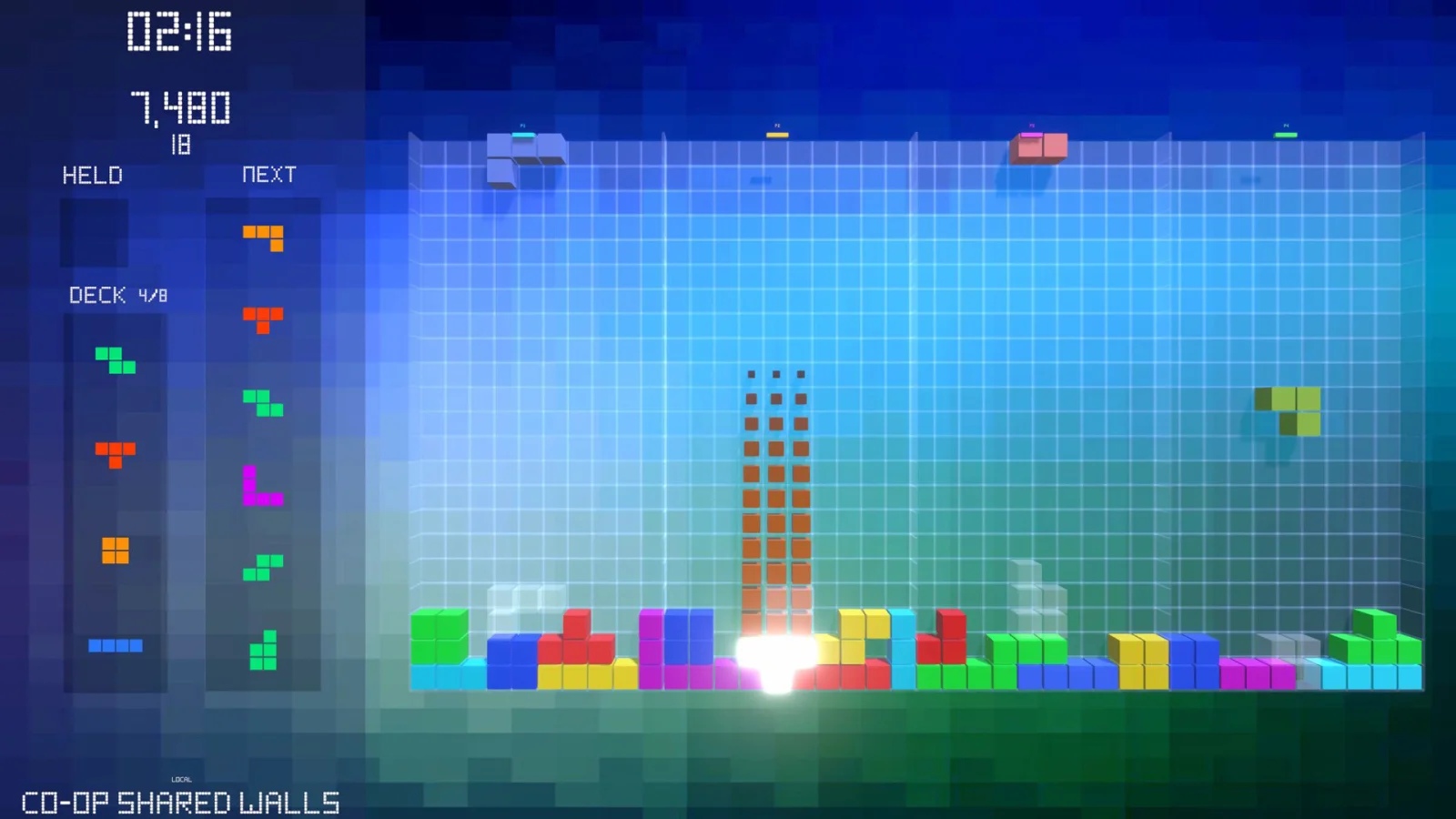
GLUE BLOCKS is a pre-release falling-block puzzle game from Figmenthol, which is both developing and publishing it for Windows PC. Its announced release date is September 25, 2026. The central proposition is concise but potentially far-reaching: adjacent blocks can be glued together into larger custom pieces, and those pieces enter a deck for later use. The resulting decision is not simply whether a shape fits right now. It is whether turning several manageable blocks into one stronger object is worth accepting a future draw that may be much harder to place.
That is a promising way to put pressure on a familiar puzzle vocabulary. Conventional falling-block play often rewards keeping the board tidy while reserving room for a known set of shapes. GLUE BLOCKS appears to complicate that discipline by asking players to manufacture part of the shape pool themselves. A glued piece may create a higher-scoring opportunity, according to the announced design, but it also commits the player to its silhouette. The same construction that looks efficient while the well is open could become a liability when its arrival collides with a narrow channel, an uneven surface, or a changed gravity direction.
This is an unscored assessment rather than a review. It does not represent hands-on testing by JokingJoystick, and a pre-release build can change before launch. Still, the official outline and public demo observations make the main design question clear: can GLUE BLOCKS turn self-made, inconvenient power into satisfying strategic tension while keeping a rapidly changing board understandable?
Officially announced: build the deck, then answer to it
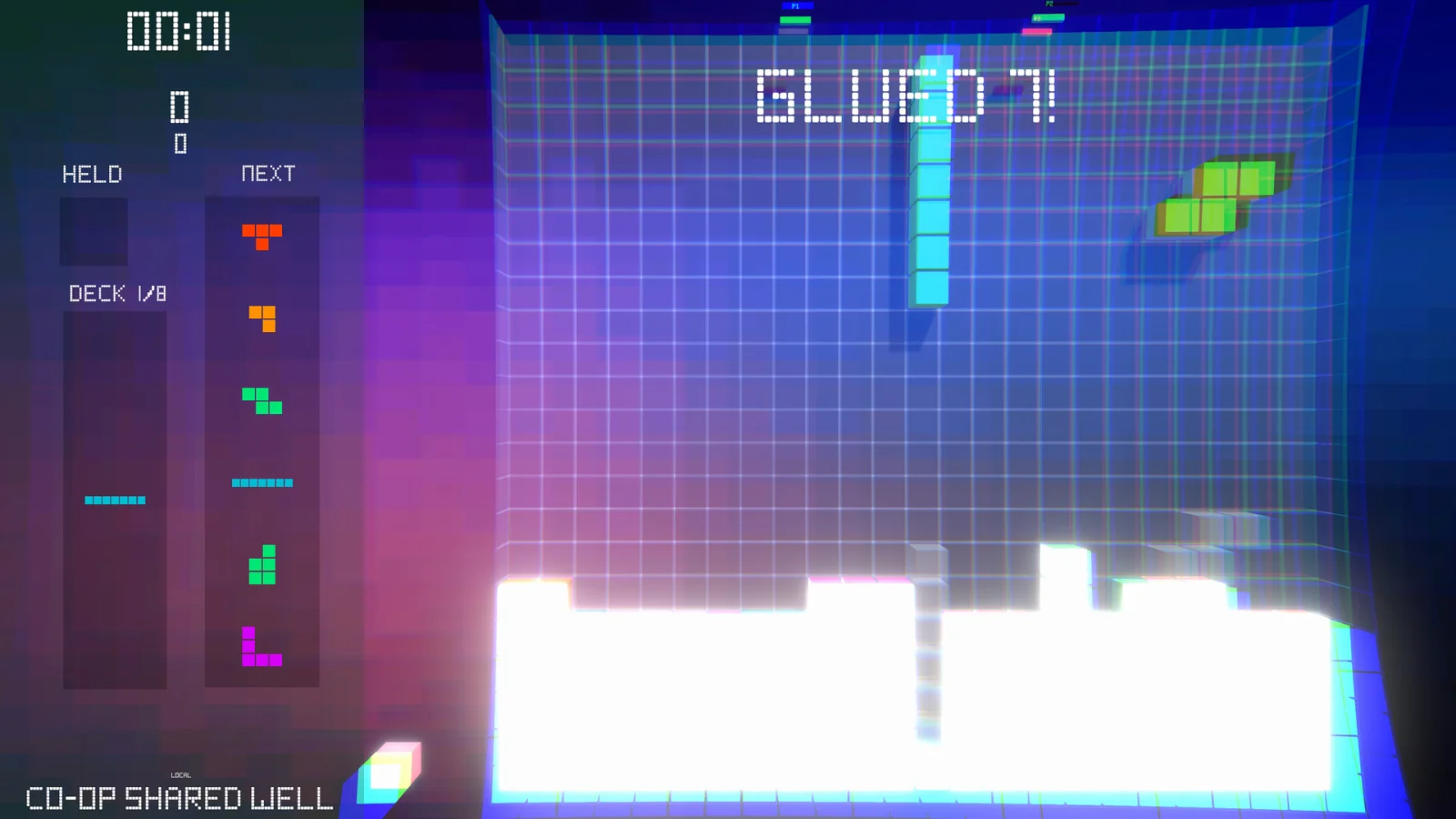
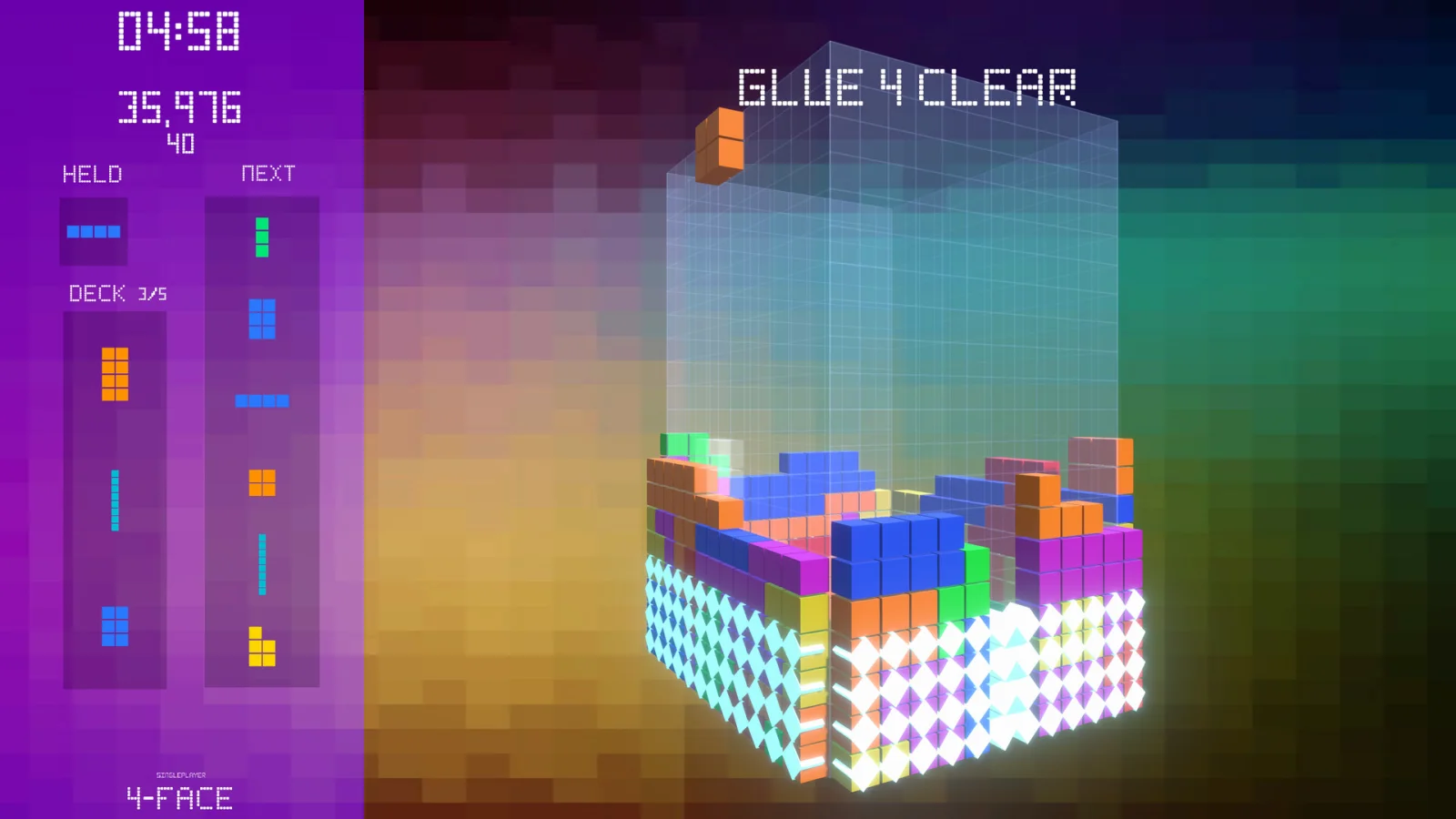
Figmenthol describes GLUE BLOCKS as a falling-block puzzle game built around gluing adjacent blocks into custom larger pieces. Those pieces become part of a deck, establishing a loop with two linked stages. First comes construction: recognizing neighboring blocks that can be productively combined. Then comes placement: finding a home for the custom piece after it returns to play. The game explicitly connects larger glued pieces with higher scoring opportunities and greater placement difficulty.
The tension is appealing because neither side of that trade is ornamental. If a glued object were only a score multiplier, the best strategy could reduce to gluing whenever possible. If it were only a burden, the mechanic could become a trap players learn to avoid. The stated design instead suggests a meaningful exchange: players may seek a large scoring payoff, but they must accommodate the spatial consequences of the exact piece they created. That can turn a score chase into a question of responsibility. Every ambitious shape is also future inventory.
Custom geometry is especially useful in a falling-block game because it can make an otherwise abstract deck feel personal. A player who deliberately creates an L-shaped or sprawling piece has made a prediction about the future well. If that prediction succeeds, the score is not merely awarded for quick placement; it reflects a plan that survived later conditions. If it fails, the board records the cost of that earlier decision. This could give individual rounds a strong internal story without requiring anything beyond blocks, wells, and spatial constraints.
There is an important conditional caveat. The quality of this loop will depend on information and control that have not been fully established here. Players need enough ability to understand what gluing will produce, how that object enters the deck, and what sort of future placement problem it represents. If the relationship between a glued piece and its later availability is legible, difficult shapes can feel like earned commitments. If that relationship is obscure, the same difficulty may read as a punishment detached from a decision players could intelligently make.
Unusual wells and moving gravity raise the readability stakes
Official details say GLUE BLOCKS includes differently shaped wells as well as dynamic and multi-directional gravity. These additions fit the deck-building premise: a piece designed around one local opening may become inappropriate if the effective floor changes, and a well that is not a simple rectangle can make every protrusion matter. They also greatly increase the need for clear visual communication.
In a standard rectangular well with a stable downward pull, players can build durable habits. They know where a dropped piece will settle, where the dangerous stacks are, and which cavities are realistically recoverable. Multi-directional gravity potentially asks them to reassess all three. A shelf can become a wall; a pocket that seemed safely isolated can become an exposed landing zone; a broad glued piece can shift from perfect solution to obstruction. That is fertile territory for puzzle play, because it asks players to reason about the board as a changing system rather than a static container.
But visual novelty alone is not strategic depth. The game will need to distinguish the information that matters at speed: the active gravity direction, the boundaries of a nonstandard well, the location and shape of the active piece, and the likely result of a drop or rotation. This is not a demand that every situation be easy. A hard puzzle game can ask for fast reorientation. It does need to make the source of failure comprehensible. When a placement goes wrong, a player should ideally be able to identify whether the mistake was an inaccurate read of gravity, poor spatial planning, a rushed input, or an earlier decision to add an awkward piece to the deck.
The announced buffers for open wells are notable in that context. An open well can present a special spatial problem: without a closed boundary, it may be less obvious where a piece can rest or how a changing gravity direction will affect it. Buffers may be intended to support those situations, though their exact behavior is not established by the available details. The relevant pre-release question is whether they make open layouts easier to parse without erasing their tactical identity. A support system that clarifies a difficult board state could preserve the challenge; one that merely conceals uncertainty would not solve the underlying readability issue.
Developer updates also mention a retro 10x20 mode. Its familiar dimensions may provide a useful point of reference for players who want to focus on gluing and deck consequences before adding the complication of more unusual wells. That is an inference about its potential role, not a confirmed mode structure or difficulty path. What is established is the mode’s addition, not precisely how it interacts with gravity, scoring, or other rules. Even so, a conventional board size could be valuable as a legible baseline in a game whose headline systems deliberately alter spatial expectations.
Public demo observations point to a teaching challenge
Public feedback on the demo found the central idea intriguing and identified co-op as attractive. Those are encouraging reactions to the game’s most distinctive elements: the glue mechanic has drawn interest, and shared play appears to have immediate appeal. The same feedback also raised concerns that the gluing rules, controls, and tutorial needed clearer explanation. Requests were made for stronger display, audio, keybinding, and timer options.
Those observations do not establish final-game shortcomings. They concern a public demo, and GLUE BLOCKS remains pre-release. They do, however, identify the most consequential development priority suggested by the available evidence. A puzzle game can support complex strategy, but it must teach the difference between an intentional risk and an accidental action. Gluing is not a minor flourish here; it changes future pieces and is tied to the game’s scoring proposition. Players need to recognize when adjacent blocks qualify, what the newly formed shape will be, and why making it helps or harms their position.
Controls matter just as much because the game combines placement with modification of the available piece set. An unclear or awkward input can make a strategically rich system feel unreliable, particularly once time pressure is present. The supplied information does not establish the exact control scheme, the nature of the timer, or whether every requested option will be implemented. It does establish that players asked for keybinding and timer options, alongside display and audio adjustments. Addressing such requests could help different players separate their own spatial decisions from avoidable presentation or input friction.
There is a broader lesson in the feedback. In GLUE BLOCKS, the tutorial may need to explain not only a sequence of buttons but a way of thinking. A useful introduction would make the short-term and long-term effects of gluing visible: here is a valuable larger piece, here is the space it requires, and here is why a board that looks tidy can still be poorly prepared for it. That kind of teaching could prepare players for multi-directional gravity and irregular wells by establishing a stable conceptual core first. The goal would not be to remove discovery, but to ensure that later surprises arise from puzzle interaction rather than an uncommunicated rule.
Same-well co-op could turn planning into negotiation
The announced feature set includes solo play, local versus, online and shared-screen co-op, Remote Play Together, and Family Sharing. The most intriguing part of that list is co-op played around the same well. A shared board gives collaboration a concrete object: partners are not merely pursuing parallel scores but managing one changing space and, potentially, the consequences of a shared deck.
The exact co-op rules have not been established, so it would be premature to claim how turns, pieces, gluing authority, scoring, or failure states work. Yet the premise has clear conditional potential. If partners can both influence the same well, they may need to negotiate whether to preserve a clean opening, spend space on a high-value glued object, or prepare for a gravity-driven reorientation. One player may see the immediate fit while another is thinking about the next awkward custom piece. That difference in attention can create productive coordination rather than simply dividing work.
It can also create the lively friction that makes shared-screen puzzle games memorable. A powerful glued piece may be simultaneously a team asset and a shared obligation. That is a much more interesting social prompt than a generic invitation to “work together,” because the team has collectively authored the problem it must later solve. For readers interested in another game where a shared course makes everyone responsible for the situation, JokingJoystick’s assessment of Patchkins Party considers a different version of that broad design pressure.
Co-op will nevertheless depend on clarity more heavily than solo play. A player can gradually learn a confusing rule alone, but a shared board magnifies ambiguity: partners may disagree about what happened, whether a glue action was intentional, or where gravity will send a piece. Strong indicators, comprehensible controls, and enough configuration flexibility could therefore matter not only as accessibility conveniences but as foundations for communication. If the game makes its state easy to read, coordination can become the challenge. If it does not, players may spend their conversation repairing misunderstandings.
Modes and options could support distinct puzzle appetites
Beyond its headline systems, GLUE BLOCKS is announced to include achievements, leaderboards, controller support, difficulty options, and audio options. Post-game statistics have also been added in developer updates. These details do not prove the depth or exact implementation of each feature, but together they suggest an attempt to serve both repeatable score-focused play and a range of control preferences.
Leaderboards and post-game statistics could be especially compatible with a puzzle game where players shape part of their own future inventory. If the statistics make the effects of gluing understandable, they may help players reflect on whether they were too conservative, too ambitious, or simply unprepared for their chosen shapes. That is only a possibility; the metrics themselves are not described in the provided facts. Still, a post-game view has particular potential here because the game’s central decisions extend across time. It could help convert a failed run from a vague loss into a readable sequence of tradeoffs.
Difficulty options may likewise be important, though their precise adjustments are unknown. The overlap of custom pieces, irregular wells, and dynamic gravity could give GLUE BLOCKS a steep cognitive load even before speed becomes a factor. Different difficulty settings could help players engage with the core risk-reward design at a manageable pace, but their value will depend on what they actually modify. The announced existence of the options should not be mistaken for proof of any specific accessibility outcome.
Pre-release outlook
GLUE BLOCKS has an appealingly self-complicating idea at its center. Gluing neighboring blocks into a deck transforms construction from a momentary board-clearing tactic into an investment with an awkward physical form. That makes high scoring potentially inseparable from accepting future risk, a relationship that suits falling-block puzzles well. Differently shaped wells and multi-directional gravity could deepen that relationship by making “good shape” contingent on a board that refuses to remain simple.
The opportunity is matched by a clear risk. The more the game asks players to track custom geometry, shifting gravity, unusual boundaries, and shared-board decisions, the more carefully it must explain and display them. Public demo feedback already identifies clarity around rules, controls, tutorials, and options as a concern worth taking seriously. The reported additions of retro 10x20 mode, post-game statistics, and buffers for open wells indicate continuing development, but the final effect of those changes remains to be seen.
For now, GLUE BLOCKS looks most promising as a puzzle game about deliberate overreach: make the impressive piece, take the scoring opportunity, and then prove the board can survive it. If Figmenthol makes that chain of cause and effect readable—alone or with a partner in the same well—the game’s custom-piece deck could offer more personality than a standard shape queue. Its announced September 25, 2026 release will be the point at which that potential can be judged on a finished Windows build.