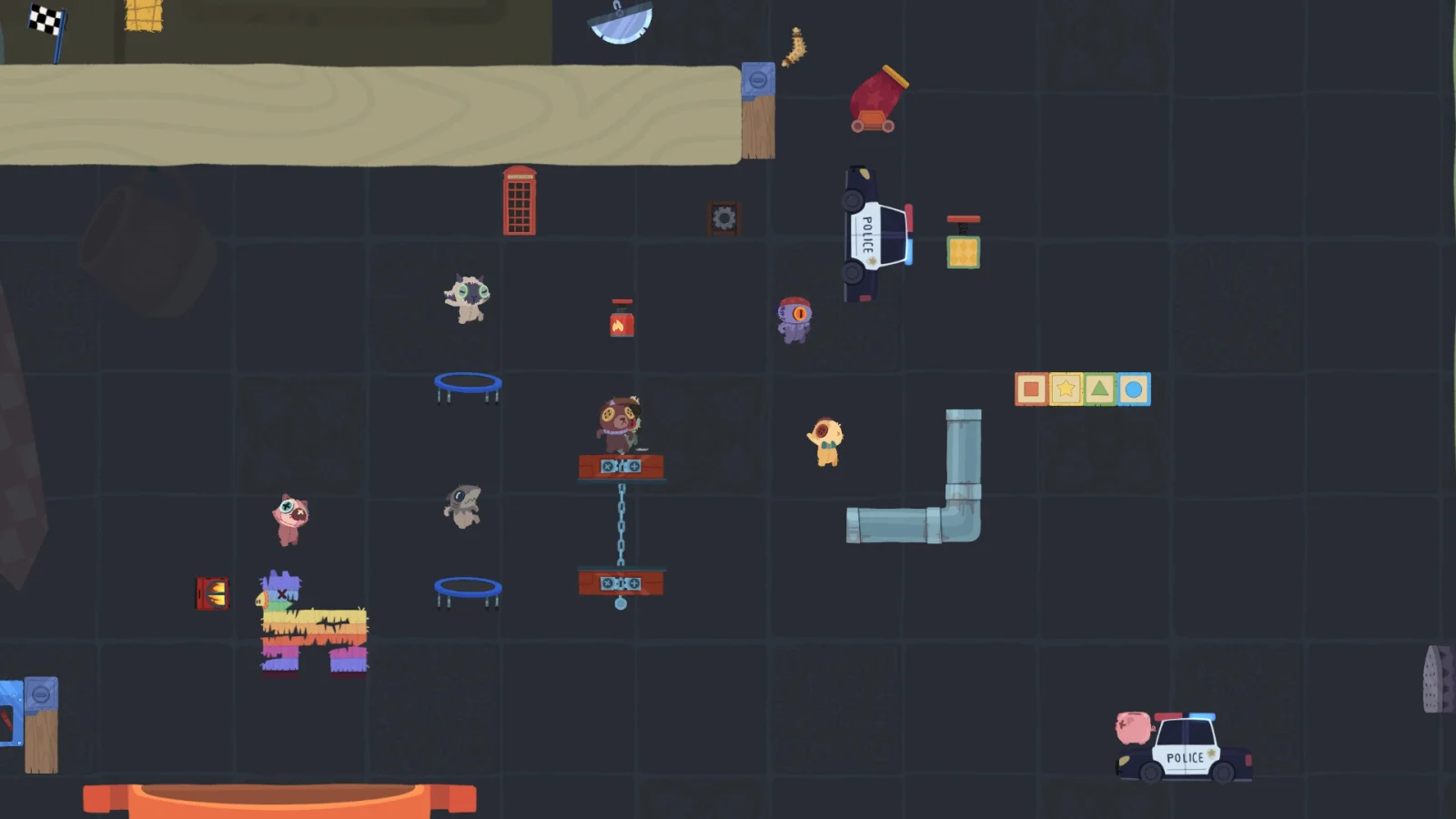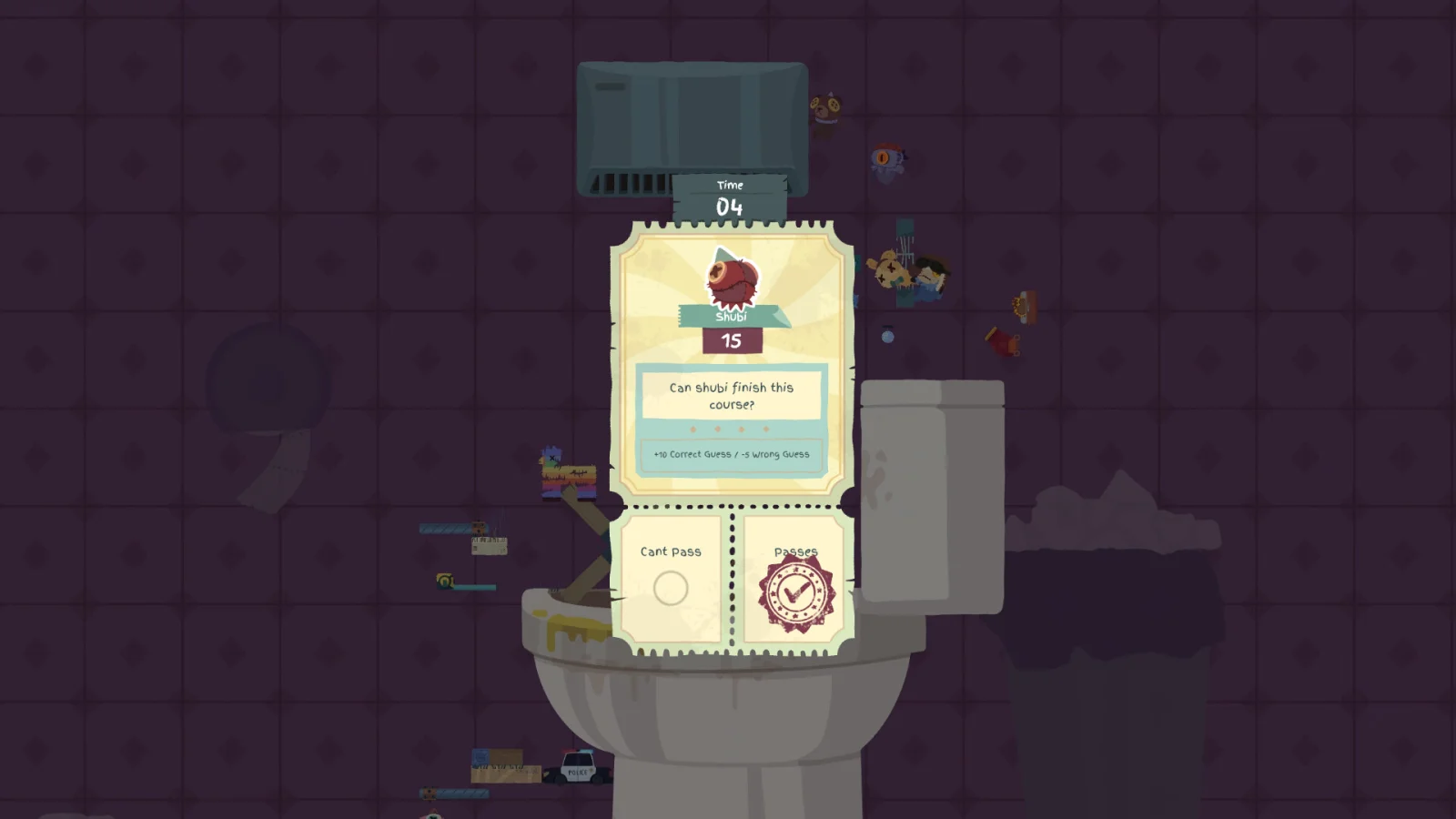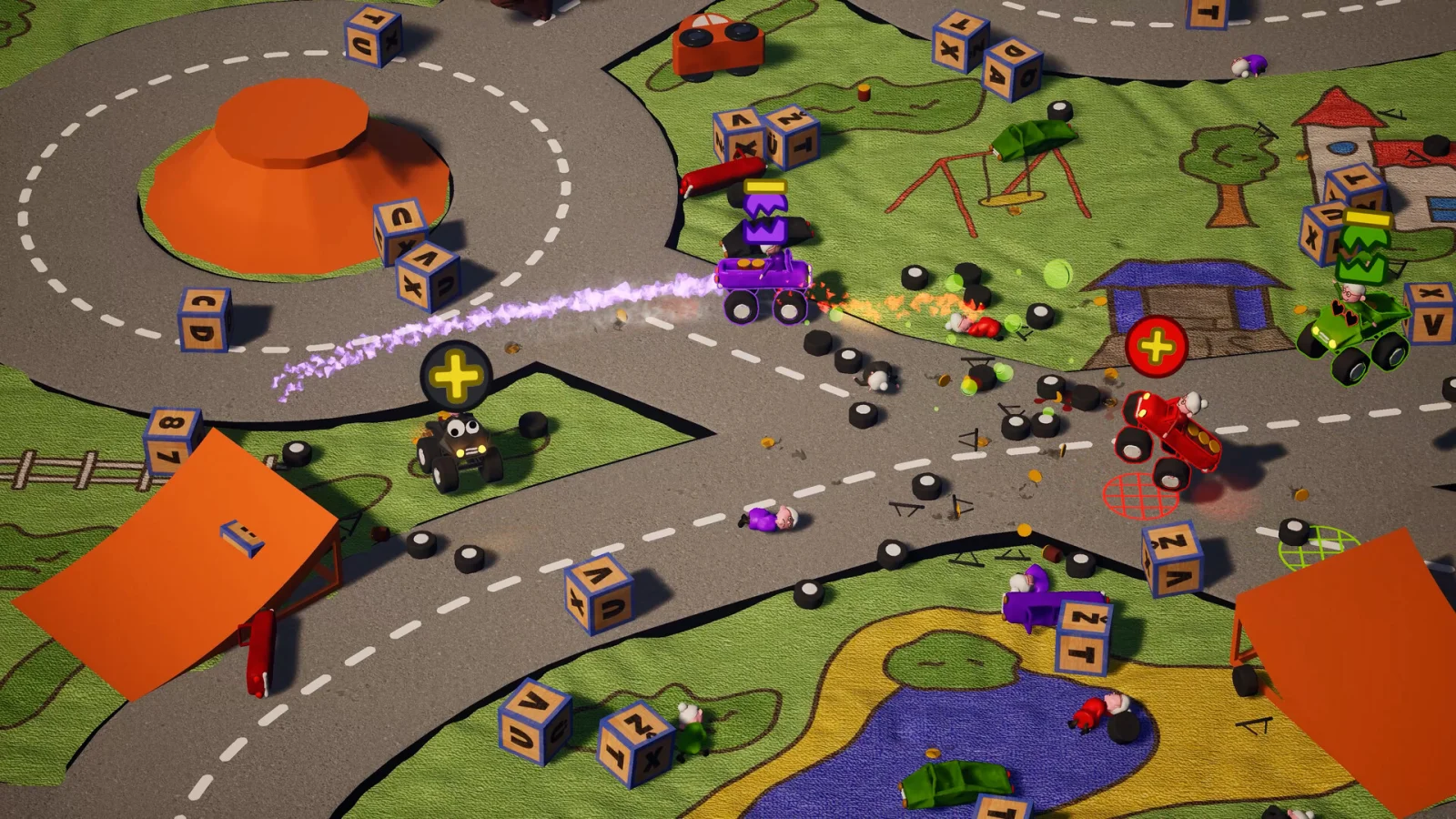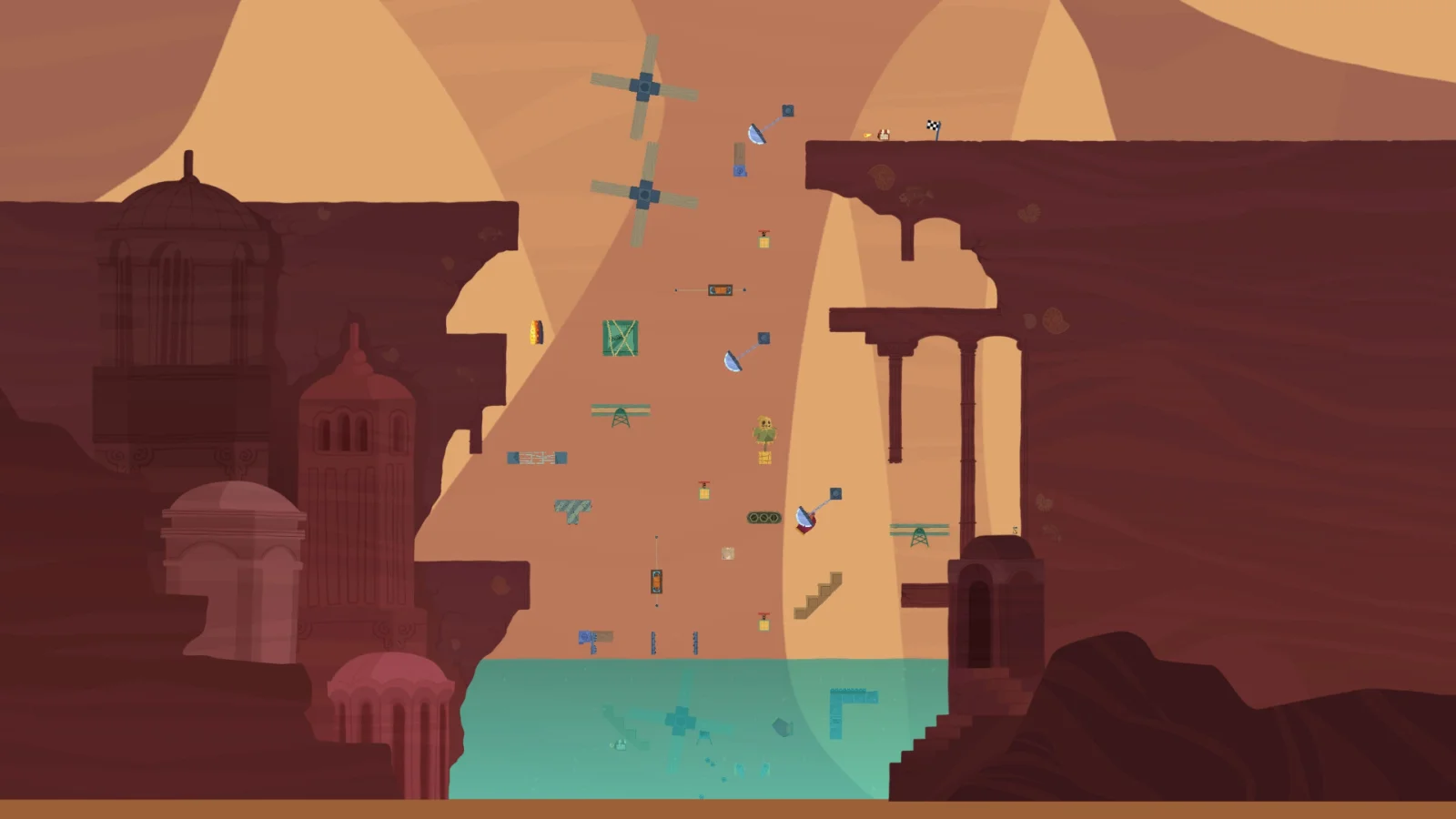
Patchkins Party is built around a premise that makes the finish line only half the contest. Lavega Games’ PC release, launched on June 23, 2026, is described as a two-to-eight-player online party racing game in which players draw shapes to create platforms, traps, and special objects. The course is reshaped each round, and players then race through the shared result. That is the established foundation. It is also a compact design statement: rather than asking players merely to master a fixed route, Patchkins Party asks them to participate in producing the route that will shortly judge them.
This is an unscored assessment, not a hands-on review. The available material establishes the game’s central structure and online PvP support, but it does not establish how any particular control scheme feels, how consistently the drawing tools read player intent, how races are scored, how rounds are paced, or how the game performs under network conditions. Those distinctions matter especially for a game whose appeal rests on a chain of player-created consequences. The idea is clear; the practical texture of that idea remains something prospective players should evaluate through current official information and footage where available.
Verified premise: players build the problem they must solve
At its most legible, Patchkins Party joins two activities that are often kept separate. One is creation: drawing shapes and placing objects. The other is competitive movement: racing across the resulting course. The game’s official description explicitly connects them. Players can make platforms, traps, and special objects; each round can reshape the course; and everybody races through what the group has made.
That structure potentially gives every placement a double meaning. A platform can be a route forward, but it may also change who receives the easiest approach to a later section. A trap can obstruct a rival, but it can also create a crowded or risky area that the placer must eventually negotiate. A special object, whatever its exact function in a given implementation, may become a focal point around which everyone reassesses a route. The important analytical point is not that every object will necessarily create a dramatic reversal. It is that construction is positioned as part of competitive decision-making rather than as a detached setup screen.
Traditional authored racing courses can offer carefully tuned rhythms, memorable landmarks, and deliberate challenge curves. Patchkins Party’s stated design points elsewhere. Its variety can arise from combinations of player choices: which shapes are drawn, where objects go, what hazards are introduced, and how the group responds when racing begins. That does not eliminate the need for strong base rules. It changes where much of the novelty may come from. A stable framework can support a shifting set of social and spatial problems without requiring every moment to originate from a pre-authored track.
There is a useful parallel in Gladio Mori Assessment: Anatomy, Physics, and the Productive Chaos of the Arena: when players are given systems that visibly affect one another, the most interesting outcomes often come from responding to consequences rather than executing a single intended script. Patchkins Party’s formal setup is different, but it similarly puts shared instability near the center of its appeal.
The construction-to-race feedback loop is the core proposition
The most promising part of Patchkins Party is the proposed feedback loop between making a course and running it. A player’s first decision is not simply an attempt to maximize speed. It can be an attempt to define the questions that a future race must answer. Once the race begins, those decisions become physical geography. Players are no longer debating an abstract plan; they are adapting to a shared environment that their recent choices helped create.
In a favorable version of this loop, the construction phase gives racing context. A sudden obstruction matters because the group saw it arrive. A shortcut matters because someone deliberately opened it. A precarious platform can be funny or frustrating for reasons the players understand, rather than because a level designer hid a surprise around a corner. The race phase, in turn, gives the construction phase accountability. An impulsive placement is not only a joke made at someone else’s expense if its author also has to deal with the resulting course.
This mutual accountability could distinguish Patchkins Party from games where player expression is cosmetic or safely separated from competition. The drawing is meant to alter play. The racing is meant to test the alteration. Each half validates the other. If construction had no strategic consequence, it could become decoration. If racing took place on effectively fixed routes, the drawing premise would lose its force. The official description instead presents a cycle in which player authorship remains relevant after the drawing ends.
Still, the quality of that cycle will depend on questions not answered by the available facts. How much time players have to make decisions, how clearly objects communicate their effect, how much one placement can dominate a route, and how readily a group can understand a newly changed space would all shape whether creation feels expressive or merely disruptive. It would be premature to presume ideal outcomes. A compelling concept needs legibility as well as volatility.
Drawing constraints could turn a simple input into social creativity
Drawing is an appealing choice because it lowers the barrier between an idea and an object. Instead of selecting only from a rigid menu of prebuilt pieces, players are invited to make shapes. In principle, that can support expressive, imperfect, and immediately recognizable course changes. A rough line, an oddly angled platform, or a hastily conceived obstacle may carry the personality of the person who made it. In a party game, that recognizability has social value. People can react not just to an obstacle, but to whose questionable solution it was.
Constraints are essential to making that freedom productive. If the available space, object rules, or drawing limits are intelligible, limitations can encourage inventive use of a shared vocabulary. Players may discover that a modest shape has several uses depending on placement, timing, or relation to the current route. Repeated matches could then develop a small culture of tricks, feints, protective placements, and deliberately absurd constructions. The variety would not require unlimited creation; it would arise from players finding new purposes within boundaries.
The same constraints could also become friction if they do not communicate clearly. Freeform input introduces the possibility that a player’s intended shape and the game’s interpreted object diverge. It may be difficult to draw quickly under pressure, difficult to tell where an object will matter, or difficult to read what another player has produced before the race starts. None of those problems is established here, and none should be assumed. They are design risks inherent to a competitive game that makes drawing central rather than incidental.
For that reason, Patchkins Party’s eventual appeal may depend less on whether its drawing is unrestricted than on whether the game makes restricted creation understandable. Good party-game tools often let an inexperienced participant contribute a meaningful idea quickly while leaving room for practiced groups to become clever. If Patchkins Party provides that gradient, its drawing system could turn unfamiliarity into experimentation. If the rules are opaque, the same system could make experimentation feel like guesswork. That is a conditional judgment, not a confirmed verdict on the released game.
Sabotage can create stories, but it needs a shared sense of play
The official premise supports adversarial construction because it includes traps, while one independent critic specifically characterized the game’s appeal in terms of improvisation, shortcuts, sabotage, and shared physical comedy. That is a useful observation about the concept, not a universal judgment. The critic’s view highlights why Patchkins Party may work especially well when participants enjoy reacting to one another’s plans rather than treating every setback as an interruption of pure racing skill.
Sabotage has social value when it creates a story everyone can follow. A rival constructs an inconvenient hazard. Another player notices a route around it. A third tries to convert the disruption into an advantage. The result can be a brief, understandable drama with changing roles: planner, victim, opportunist, and accidental author of an even larger problem. Because the group shares responsibility for the course, the game’s comedy may come from recognition as much as surprise. Players know who changed the situation, even if they cannot fully predict what happens next.
That social quality is also where the design faces its greatest balancing act. A trap that is too weak may be background decoration. One that is too decisive could make a race feel settled by an earlier construction moment rather than by later adaptation. A shortcut that is too obvious may become routine; one that is too obscure may be functionally unavailable to anyone who did not make it. These are not claims about Patchkins Party’s tuning. They are the questions by which its stated competitive structure should be judged.
The healthiest version of this kind of sabotage is likely to be readable and reversible enough that players can answer it. Counterplay need not mean that every obstacle has an identical solution. It means that a changed route invites response rather than merely imposing a result. A player who is hindered should have reasons to look, improvise, and perhaps exploit the situation in an unexpected way. That possibility keeps the race alive after the construction phase and makes the course a shared argument rather than a single player’s decree.
Group availability is part of the proposition
Steam lists online PvP for Patchkins Party, along with achievements, cloud saves, and Family Sharing. The two-to-eight-player description makes the social setting central to the game’s stated identity. However, the provided storefront facts do not establish that online multiplayer is the only way to play, nor do they establish the availability or absence of local play, bots, matchmaking details, cross-platform support, or a solo alternative. It would be inaccurate to convert an online PvP listing into broader claims about those features.
What can be said is that a game designed around shared construction and competitive racing depends heavily on assembling participants who want the same kind of interaction. The value of an improvised obstacle is inseparable from other players seeing it, interpreting it, and responding. The value of a messy route may rise when a group has enough familiarity to laugh at recurring tactics, but a new group might find exactly the same unpredictability refreshing. Either way, people are not merely opponents filling slots. They are contributors to the course’s moment-to-moment identity.
This makes group availability a practical consideration for interested players. Someone with friends who regularly enjoy short-form, high-interaction multiplayer may find the premise immediately legible. Someone relying on occasional online sessions may need to consider whether they can reliably gather a group interested in a game where disruption is part of the stated design. That is not a claim about player population or matchmaking health; no such evidence is supplied. It is a consequence of the game’s emphasis on multiple people collectively shaping the competitive space.
The two-to-eight-player range also suggests that session dynamics may vary by attendance, although the exact effects are unverified. A smaller group could make individual choices easier to attribute, while a larger group could generate more overlapping ideas and more difficult-to-read routes. Whether the game successfully accommodates that range depends on rules and interfaces that are not detailed in the supplied information. The number range communicates flexibility in participation, not proof of equally satisfying balance at every count.
Variety without relying solely on authored tracks
Player-made changes offer a plausible route to replayability because the course is not treated as a finished object. Each round’s construction can alter what counts as the safe line, the risky shortcut, the useful obstruction, or the joke waiting to backfire. This is a different source of variety from a large catalog of authored tracks. Instead of asking players to memorize every turn in advance, Patchkins Party’s premise asks them to re-evaluate a route whose meaningful features can be changed by the people in the match.
That does not mean authored design becomes irrelevant. The spaces in which players draw, the limitations on where objects can go, the behavior assigned to platforms and traps, and the rules governing races would still determine whether creation produces interesting decisions. Player authorship works best when the surrounding design channels it toward readable possibilities. A blank canvas can be less inviting than a well-chosen problem space. Patchkins Party’s stated strength is not the abstract fact that users can alter something; it is the possibility that alteration becomes immediately testable in a race.
The independent critic’s favorable reading focused on this conversion of building into improvisational competition, and that framing is persuasive as a description of the game’s potential identity. It should not be mistaken for proof that every match produces memorable chaos or that every group will value the same kind of interaction. Emergent variety can be lively, repetitive, confusing, or strategically narrow depending on implementation and group behavior. The concept gives Patchkins Party a strong avenue for freshness. It does not, on its own, answer every question about longevity.
Assessment
Patchkins Party has a sharply defined and potentially fruitful premise: players draw and place elements that reshape a course, then compete on the consequences. The official facts support that description, and they establish a two-to-eight-player online PvP party-racing framework from Lavega Games. Steam also lists achievements, cloud saves, and Family Sharing. Beyond that, careful judgment requires restraint. The available evidence does not demonstrate how drawing feels, how objects are regulated, how fair sabotage is, or how comfortably the game serves different group sizes.
Its most interesting design promise is the loop between authorship and accountability. Players are not only racing through a designer’s obstacle course; they are participating in the decisions that make the obstacle course unstable. If the rules make those decisions clear and answerable, the game could create a distinctive form of party-game variety: courses that belong to the group, mistakes that become communal stories, and races where the clever move is as much about reading people as reading terrain. If clarity or counterplay proves weak, the same volatility could become friction. That tension is not a flaw in the premise. It is the central question Patchkins Party must answer.