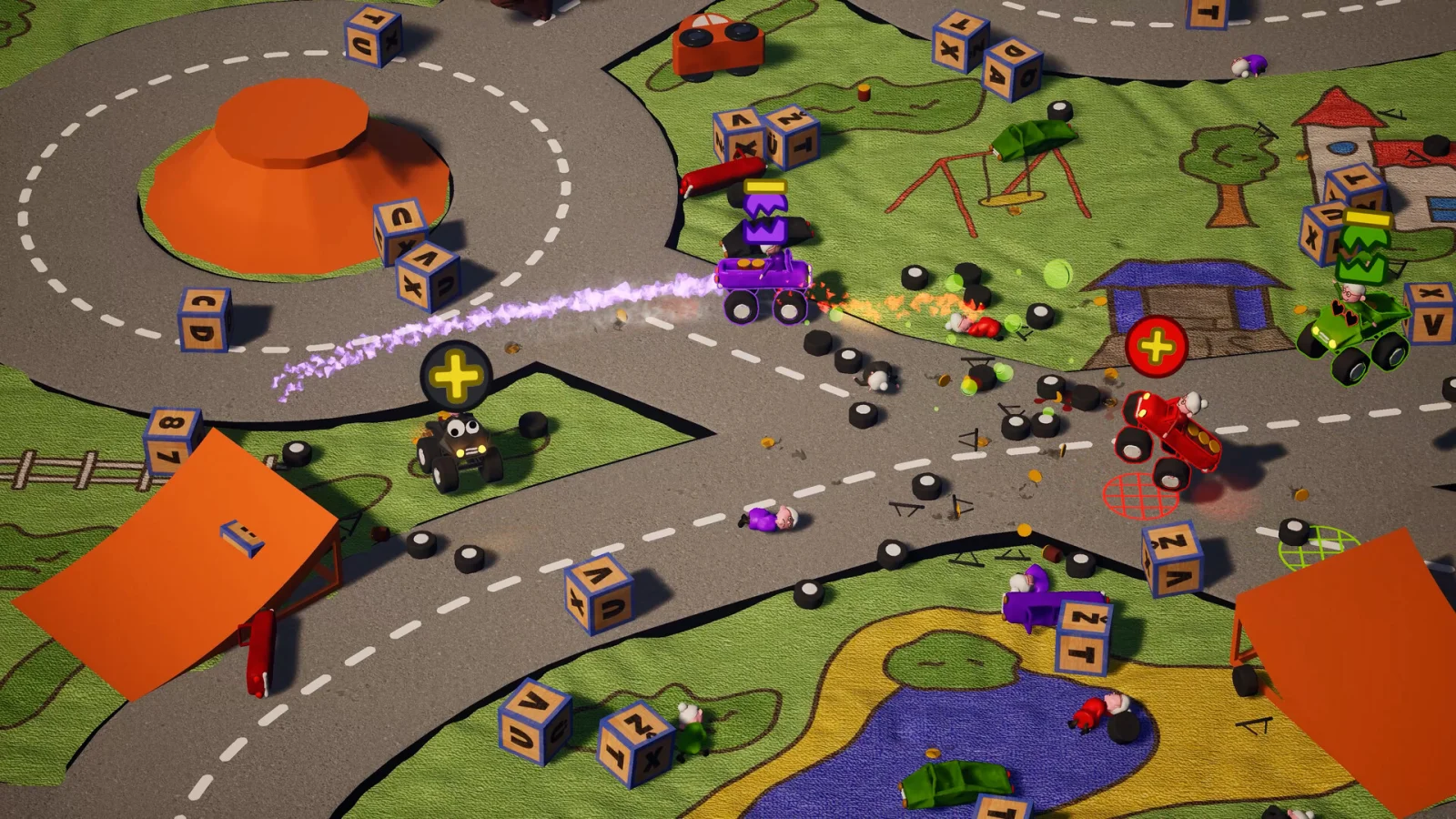
Grannies on Wheels is an announced PC party-racing game from Robot Laser Shark, which is both developing and publishing it. It is currently targeting 2027. Its premise is deliberately unruly: up to four players drive clay-styled grannies in monster trucks through physics-driven, single-screen arenas, competing over jam while minigames and destructive terrain complicate the contest. That is an immediately communicative collection of ideas. A monster truck is an easy fantasy to understand; a granny in one is a comic contrast; jam is a suitably silly prize; and a single shared arena puts every competitor in the same readable space.
This is an unscored preview assessment, not a review. The available information describes the announced game and provisional observations from a build, rather than a finished release. The strongest reason to keep Grannies on Wheels on the party-game radar is not that any one feature sounds unprecedented. It is that its disparate ingredients point toward a particular kind of social play: short-form, tactile contests where collisions, detours, terrain damage, and last-second thefts can be as entertaining to watch as they are to execute. The risk is equally clear. Physics-heavy vehicle play can make a match memorable for the right reasons, or it can turn the simplest objective into an argument with the controls. The final game will need to make its chaos understandable before it can make that chaos enduring.
Established facts: a four-player arena game built around jam
Robot Laser Shark has announced Grannies on Wheels for Windows PC with support for up to four players. The listed feature set includes single-player play, local and shared-screen multiplayer, controller support, Steam Cloud, and Remote Play Together. Those are useful signals for the intended setting. Local shared-screen support fits a game designed around a single arena, while Remote Play Together gives groups another possible route to play without changing the basic shared-screen framing. The announcement does not, however, establish the exact experience of remote sessions, input configuration, matchmaking, or any other online-play details. Those questions should remain open until the final build explains them.
The game’s central activity is described as fighting over jam in physics-driven arenas. It also promises minigames, destructive terrain, customization, and clay-styled grannies driving monster trucks. The combination suggests that racing is being used in the broad party-game sense rather than solely as a conventional finish-line contest: position, possession, collisions, and arena change may all matter. That interpretation is supported by provisional outside observations that identify Smash, Run, and Tag as modes, but those details are build-specific and therefore should not be treated as a final roster or final ruleset.
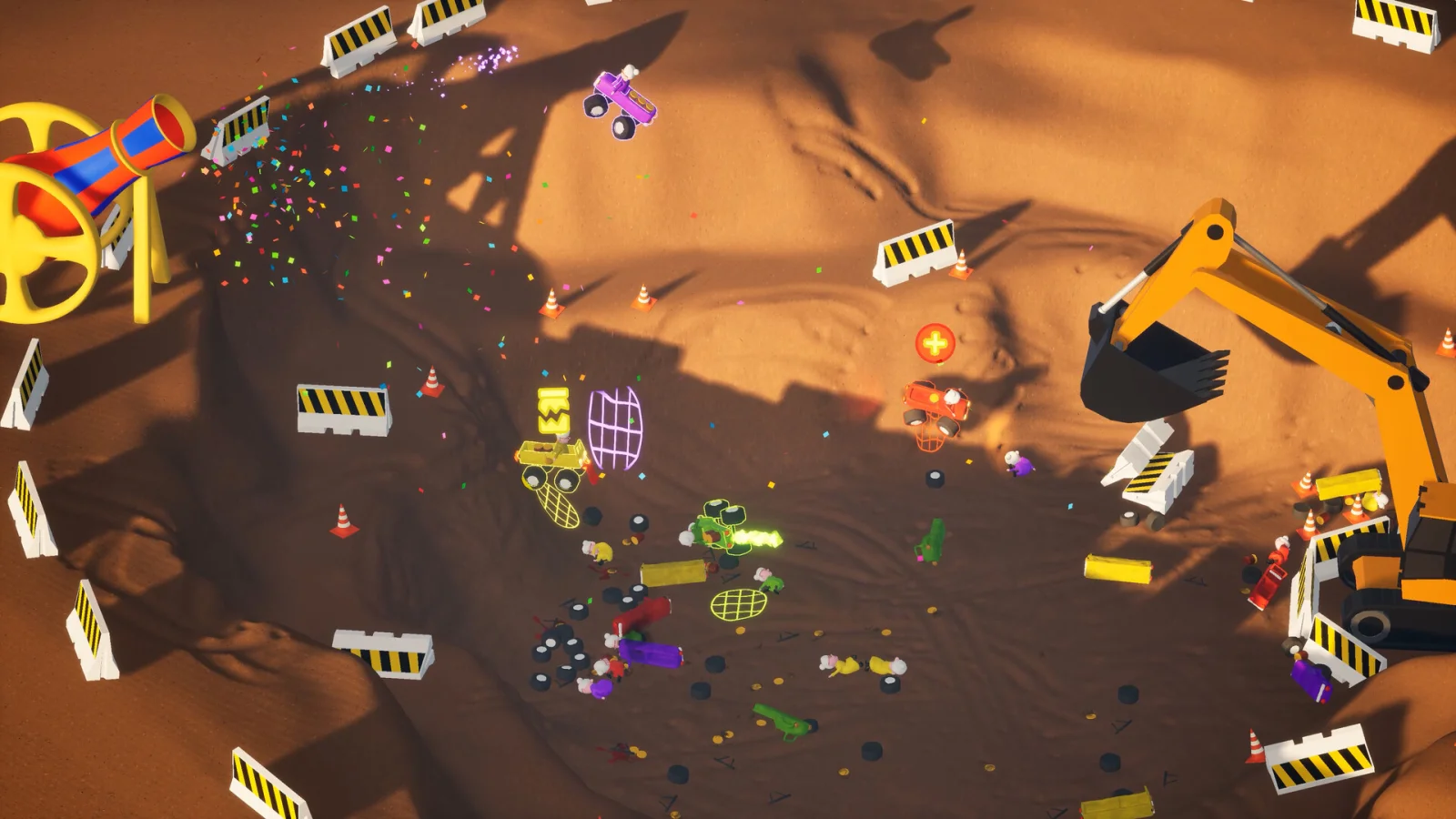
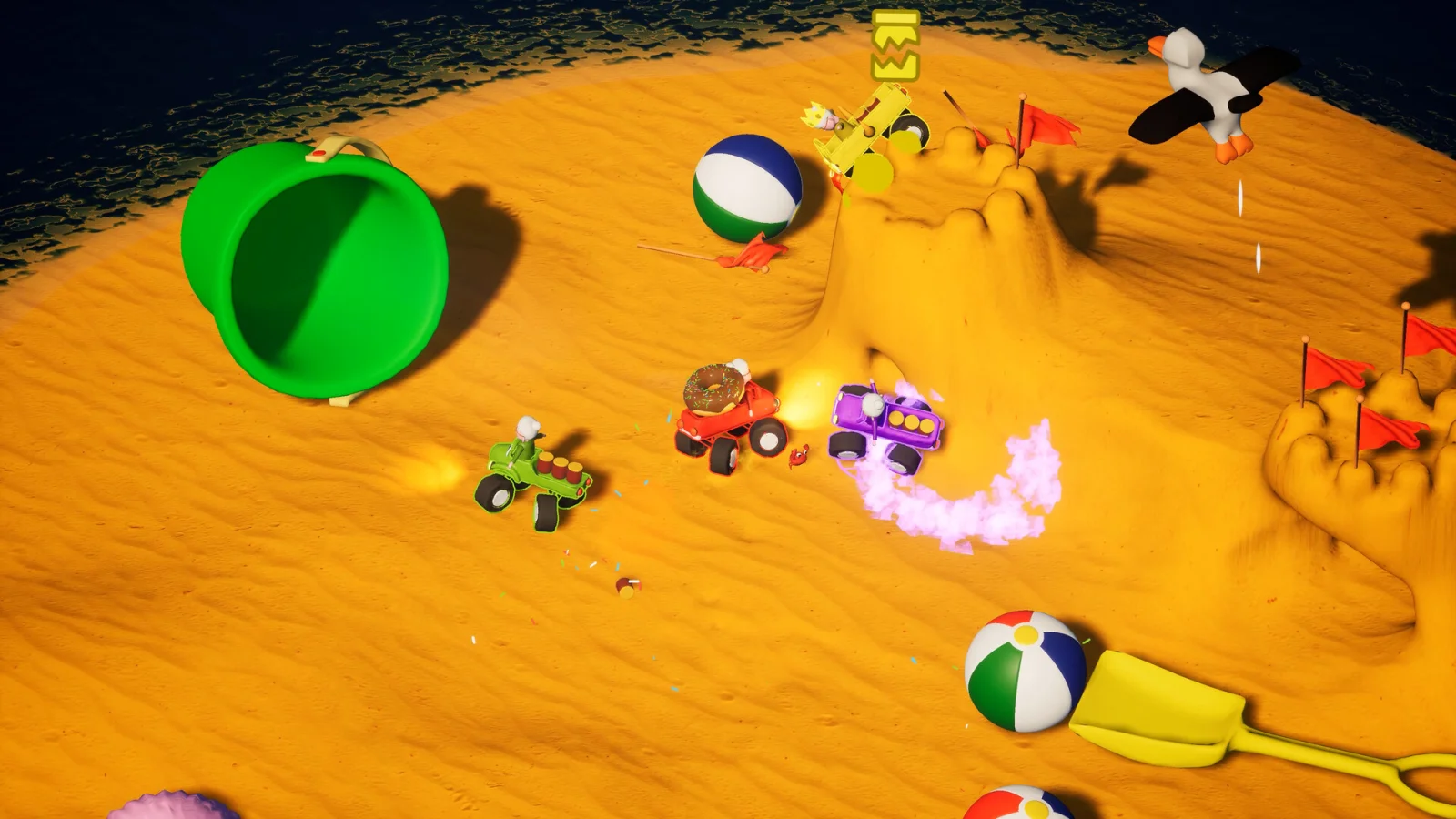
Outside observations also mention toy-like locations including a beach, a play mat, a construction area, a skate park, and a record player. These descriptions align naturally with the announced clay visual style and with the notion of toys being knocked around on a shared surface. They should nevertheless be read as provisional evidence of the game’s direction, not as a complete or guaranteed list of arenas. The same caution applies to reports of simple vehicle options and unlockable match modifiers. They indicate possible variety around matches, but do not establish the eventual size, requirements, balance, or permanence of those systems.
The central promise is social, not merely mechanical
At its best, a local party game turns a rule explanation into a scene. Someone grabs the objective, another person cuts them off, a third accidentally wrecks the route, and the room understands the result without pausing for a systems lecture. Grannies on Wheels appears built for that rhythm. The stated single-screen setup can keep the entire contest visible, and the announced physics and destructible terrain could ensure that the battlefield itself becomes part of the story of a round. A broken shortcut, a pileup near the jam, or a newly awkward route can create shared context immediately.
The announced comic framing may help here. Clay-styled grannies in monster trucks are a visual idea that communicates tone before a mode begins. It promises a low-stakes, deliberately ridiculous atmosphere rather than an attempt at automotive seriousness. Provisional impressions have likewise characterized the presentation as lively and toy-like, and the goals as easy to grasp. That combination matters. A party game can accommodate substantial mechanical depth, but it must first let a newcomer identify what matters now. Who has the jam? Where should a player drive? What action is dangerous? What event changed the arena? If those answers are visible quickly, the absurd theme becomes an invitation rather than a distraction.
For a useful comparison of how readable chaos can become the decisive design question in a compact competitive game, see this assessment of readable competitive chaos. Grannies on Wheels has a different premise and should stand on its own, but the broader issue applies: density is only fun when players can identify causes, consequences, and a practical next decision.
Physics can make the joke land, or undermine the objective
Physics-driven movement is the most important uncertainty in the available picture. Monster trucks invite weight, bounce, momentum, and oversized contact. Those traits can produce the kind of spontaneous physical comedy that no carefully scripted gag can match. A vehicle tipping at an inconvenient moment, a rival being bumped away from the prize, or a route turning rough after terrain damage could make matches feel alive. Physics also fits the toybox visual pitch: toy vehicles are expected to collide, tumble, and behave with a little theatrical exaggeration.
Yet physical comedy is not automatically satisfying control. One outside hands-on observation found steering unexpectedly challenging. That is neither a final verdict on the handling nor a reason to assume the issue will remain at launch, but it is a meaningful caution. In a game whose stated objective involves contesting an item and reacting to other people in confined arenas, directional confidence is fundamental. Players need not have simulation-like precision. They do need enough command over acceleration, turning, recovery, and collision response to believe that a close loss came from a readable mistake, a clever opponent, or a knowingly accepted risk.
The distinction is especially important for mixed-skill groups. Purposeful looseness can be funny if a player knows the truck is unwieldy and can plan around that character. Unclear response is different: it can make newcomers feel helpless while more experienced players exploit knowledge that is difficult to communicate. The final build could address this through well-tuned steering, coherent camera behavior, clear collision feedback, arena shapes that allow recovery, and modes whose objectives suit the vehicles’ actual turning demands. These are design possibilities, not confirmed features. What matters is the relationship between the intended heft of the trucks and the amount of control a player is asked to exercise under pressure.
Destructive terrain adds another layer to that relationship. If terrain changes are visually obvious and their consequences are easy to judge, destruction can turn each match into a developing tactical space. If the damage obscures routes or creates penalties that are hard to anticipate, it may compound the handling problem. The best version of this idea would make a damaged arena legible at a glance: players should see a broken route, understand what it changes, and choose whether to exploit or avoid it. The final game’s arena readability will therefore matter just as much as the spectacle of anything breaking.
Modes and modifiers need a purpose beyond novelty
The provisional mention of Smash, Run, and Tag is encouraging because it suggests an effort to vary the meaning of a truck and an arena. A strong party package does not merely change the scoring label; it gives the same controls a fresh emphasis. One mode might reward pursuit, another route choice, and another direct interference. That sort of rotation can preserve the accessible base while giving different players a chance to shine. It also supports the stated jam-focused premise by preventing every session from resolving into one repeated maneuver.
Still, names alone cannot establish depth. The eventual value of these modes will depend on their rules, their visual communication, their balance across player counts, and whether they produce distinct choices rather than superficial rearrangements. The same is true of reported unlockable match modifiers. Modifiers could give familiar arenas new pressures and help a group tailor the energy of a session. They could also make the game harder to explain if too many rules arrive at once. A good modifier system would ideally be easy to describe, visibly active, and consequential enough to change a decision. Whether Grannies on Wheels meets that standard is unknown.
Customization may contribute to the social appeal as well. In party games, a cosmetic choice can make it easier for players to recognize themselves in a busy scene and can give repeated groups a small ritual before play. The announcement confirms customization but does not define its scope. It would be premature to assume cosmetic categories, performance effects, unlock conditions, or individual character traits. The safer conclusion is simply that personalization is planned, and that clear vehicle identification could be useful in a crowded single-screen contest.
Single-screen design creates an obligation to explain itself visually
The single-screen premise is a particular strength because it gives everyone the same immediate information. Nobody is isolated in a private camera view, and spectators can follow the same chase or collision as the people holding controllers. That shared attention is often where couch-party games find their best energy. It can reduce downtime, invite playful commentary, and make a comeback visible to the whole group.
But a shared camera also intensifies visual demands. The final build will need to distinguish four vehicles, an objective such as jam, arena hazards, terrain alterations, effects from collisions, and any mode-specific instruction without turning the display into a blur. The toy-like locations described in preliminary observations could help by using strong, recognizable landmarks: a record player or skate park can be understood as a place rather than as abstract geometry. Conversely, decorative detail can become noise if it competes with the objective or makes routes difficult to parse. This is not a claim that the announced arenas are unclear; it is the main test their presentation will face.
Player-count scaling deserves similar attention. The official information confirms up to four players and single-player support, but it does not explain how modes, camera behavior, or rules adjust between solo and full-group play. A game can feel appropriately roomy with two competitors and overwhelmingly compressed with four, or vice versa. Since Grannies on Wheels appears to lean on contact and shared space, its final balance across group sizes will be central to its replay value.
What will determine whether the premise lasts
Grannies on Wheels already has a useful hook: it turns a simple, comic image into an announced set of party-game ingredients that fit one another. Clay-styled grannies, monster trucks, jam, toy-like arenas, and destructible surfaces all point toward rowdy, approachable competition. The official local/shared-screen support, controller support, and four-player capacity reinforce that focus. The outside observations about immediately understandable objectives and a low-stakes tone further suggest that the game understands the value of a fast invitation.
Its longer-term appeal, however, cannot be assumed from the joke. The build-specific steering concern identifies the design pressure point. The finished game needs physical movement that is expressive without being opaque, arenas that stay readable when damage and players accumulate, and modes that give repeated sessions a reason to continue beyond the initial laugh. Its online/local balance is also still unresolved from the available facts: Remote Play Together is listed, but that alone does not define how well the game will serve different kinds of groups.
For now, Grannies on Wheels looks most promising as a deliberately messy couch-party proposition with a clear visual identity and an appropriately direct objective. If Robot Laser Shark can ensure that players understand both what happened and what they could have done differently, its physics-driven disorder could become the source of its best stories. If control and readability remain uncertain, the same disorder could make the premise feel more chaotic than playful. With a 2027 target, the decisive answers belong to the final build rather than this early assessment.