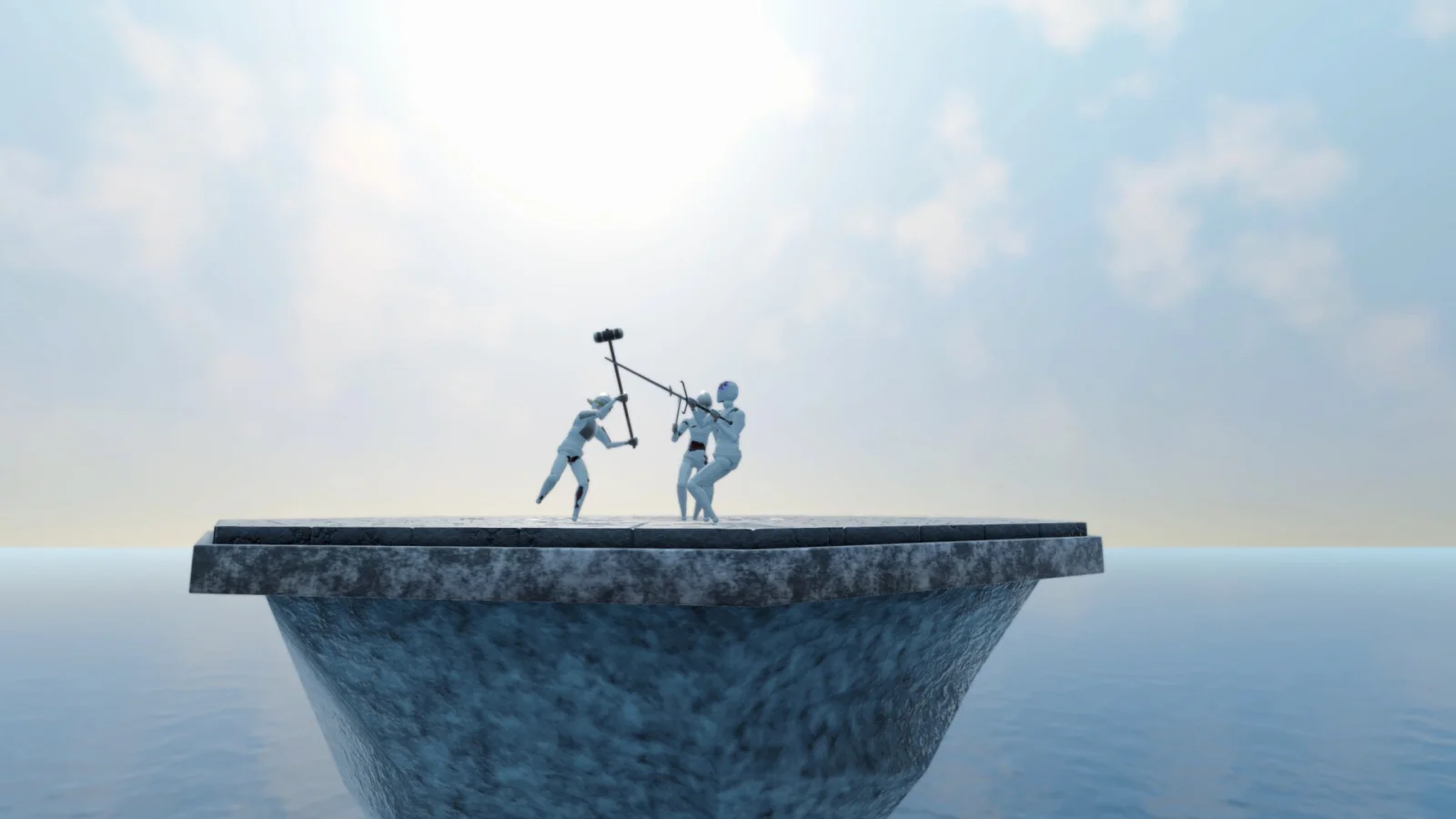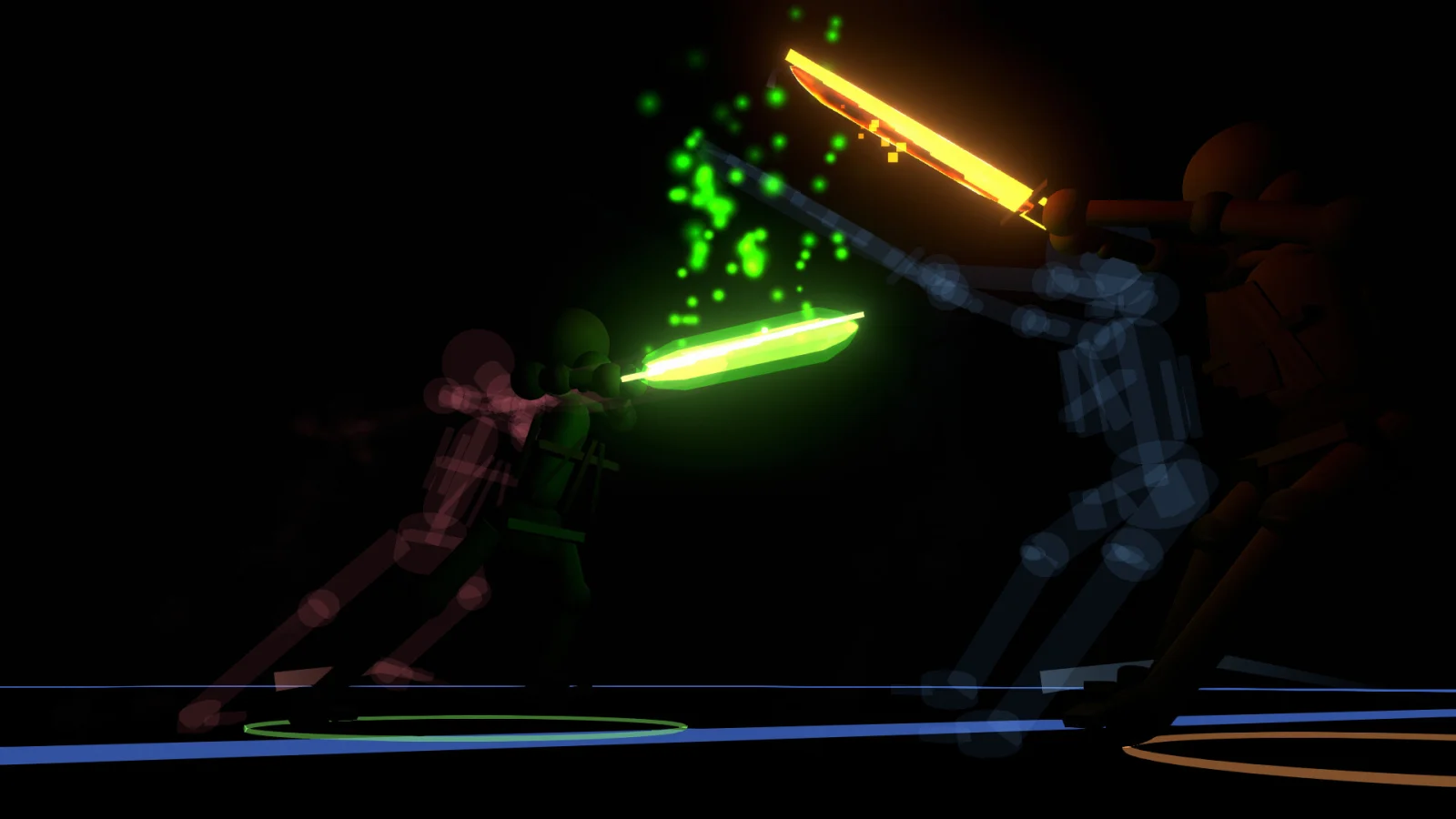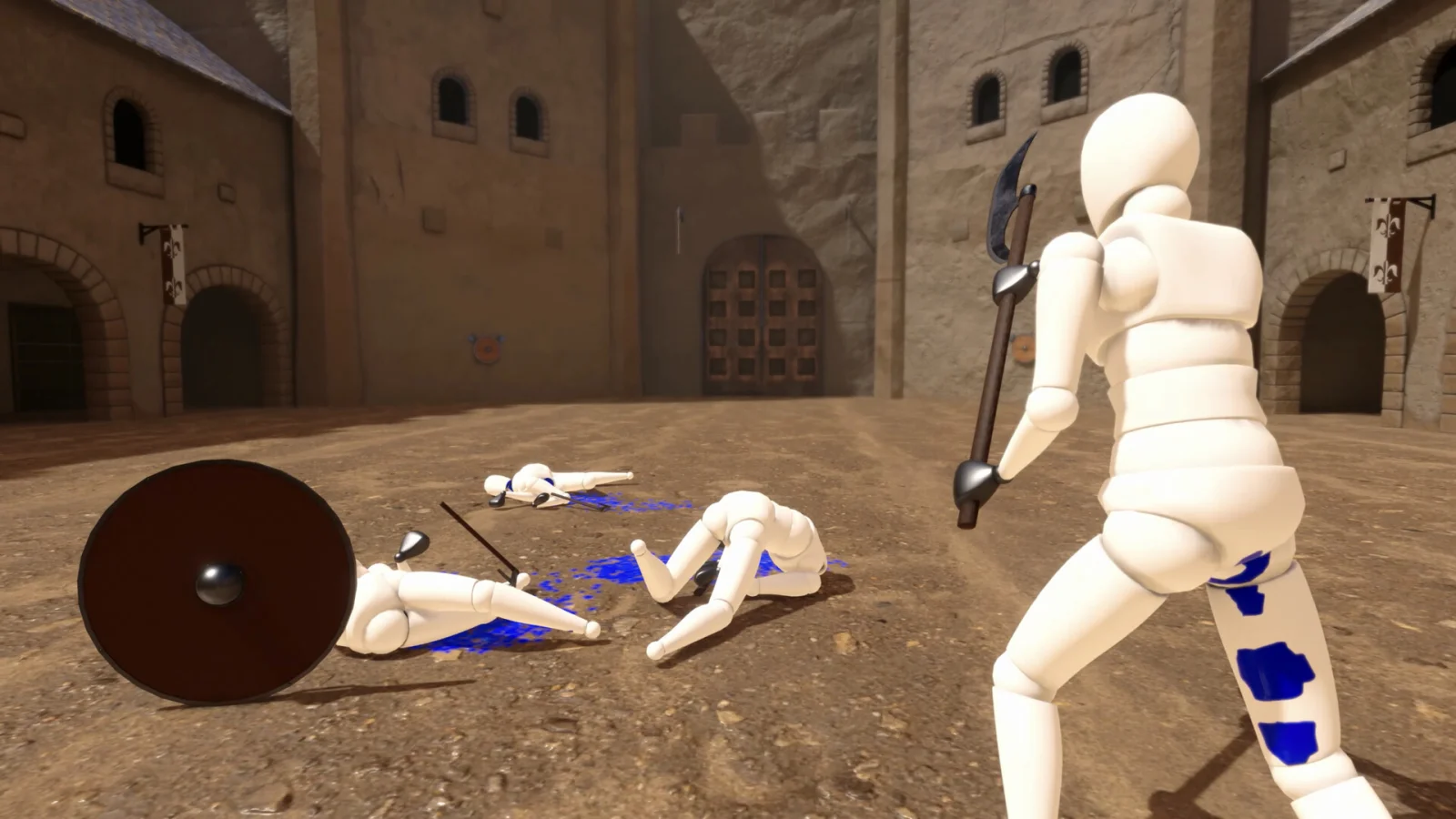
Gladio Mori is an unusually direct challenge to the assumptions behind a conventional fighting game. Rather than centring every exchange on a single abstract health total, Plebeian Studio’s multiplayer gladiator combat game is built around localized, organ-specific injury, dismemberment, physical weapons, armour coverage, and a customizable move editor. The documented design suggests that the important question is not simply how much damage a hit deals. It is where that hit lands, what the target is wearing, what the weapon contacts, and what that injury may change about the next exchange.
This is an evidence-based assessment rather than a report of personal play. The available information nevertheless supports a clear critical reading: Gladio Mori appears to have a strong systems-driven identity, with its most compelling qualities and its largest potential limitations arising from the same source. Physics can make combat expressive, surprising, and darkly comic. It can also make an encounter look less legible or less disciplined than players expect from a tightly standardized competitive fighter. The move editor and community gallery may give the game an unusually long creative tail, but they also ask players to meet the game on more experimental terms.
For players drawn to simulation-minded combat sandboxes, the combination is promising. For those seeking exacting competitive consistency, a broad roster of authored locations, or a traditional ladder of predictable fighting-game fundamentals, the design should be approached with more caution.
Anatomy turns damage into a decision problem
A health bar is useful because it makes a fight immediately readable. Every successful attack contributes to a visible total, and the broad tactical objective is easy to understand: reduce the opponent’s number before they reduce yours. That abstraction does not eliminate strategy, but it tends to convert many distinct strikes into versions of the same basic resource exchange. Gladio Mori’s documented organ-based damage model proposes a different kind of combat arithmetic.
When muscles, arteries, vital organs, and limbs can matter separately, an attack is not merely a deposit into a universal damage account. It can create a specific problem for the opponent. A muscle injury may affect the limb associated with it; an arterial wound may introduce bleeding; a strike to a vital organ can be decisive; and severing a limb is a radically different outcome from landing a glancing cut. These established design elements make the body itself the arena’s changing tactical map.
The analytical consequence is significant. Players may have reason to value attacks that are not immediately final because they alter the conditions of later exchanges. A protected torso, an exposed joint, a weapon arm, and a poorly covered leg need not represent identical targets. That can make targeting, distance, and orientation more meaningful than they are in games where all damage ultimately resolves into one shared meter. The best choice may depend on what is available rather than on a fixed optimal sequence.
This does not automatically make the combat deeper in every practical sense. More variables can also make outcomes harder to read, harder to teach, and harder to evaluate at a glance. But the premise is coherent. By attaching consequences to particular body parts, Gladio Mori has a framework for fights that change character after an injury rather than merely becoming shorter as a bar empties.
Armour gaps and weapon geometry create a positional contest
The game’s ten armour elements matter here because armour is not described as a generic numerical upgrade. Coverage implies geography. If protection is distributed across the body, then a fighter’s stance and facing may affect what an opponent can plausibly reach. A gap is not only a visual detail; it can become an invitation, a liability, or an area that must be actively kept away from an incoming weapon.
That makes positioning more than the familiar question of whether someone is inside striking range. Position can be analysed as the relationship between a weapon’s route, its contact point, a target’s protected and unprotected areas, and the opportunity for the target to answer. A blade angled toward an opening is not interchangeable with a blunt impact directed at covered armour. Available criticism specifically identifies blade angle and blunt-force contact as meaningful to outcomes, reinforcing the idea that weapon use is meant to be materially situated rather than purely animation-driven.
The official list of 17 weapon sets gives this premise some needed breadth. It does not establish that every weapon set is equally useful, balanced, or distinct in practice; those would be claims requiring direct testing. It does establish that the game is not relying on one instrument to carry its injury model. The potential appeal lies in how weapon geometry could interact with the anatomical system. A long reach, a particular striking surface, or a different type of impact may change which openings are attractive and which forms of armour are reassuring.
Such a system can reward attention, but it may also make the game daunting. Players accustomed to games that clearly signal a safe defensive state may find that an armour gap or awkward angle introduces uncertainty. That uncertainty is not necessarily a defect. It is part of what separates a body-specific combat model from a simplified duel. Still, it means Gladio Mori’s appeal is likely tied to an interest in studying messy physical situations rather than mastering a short, neatly bounded set of universal answers.
Precision is the goal; physics is the complication
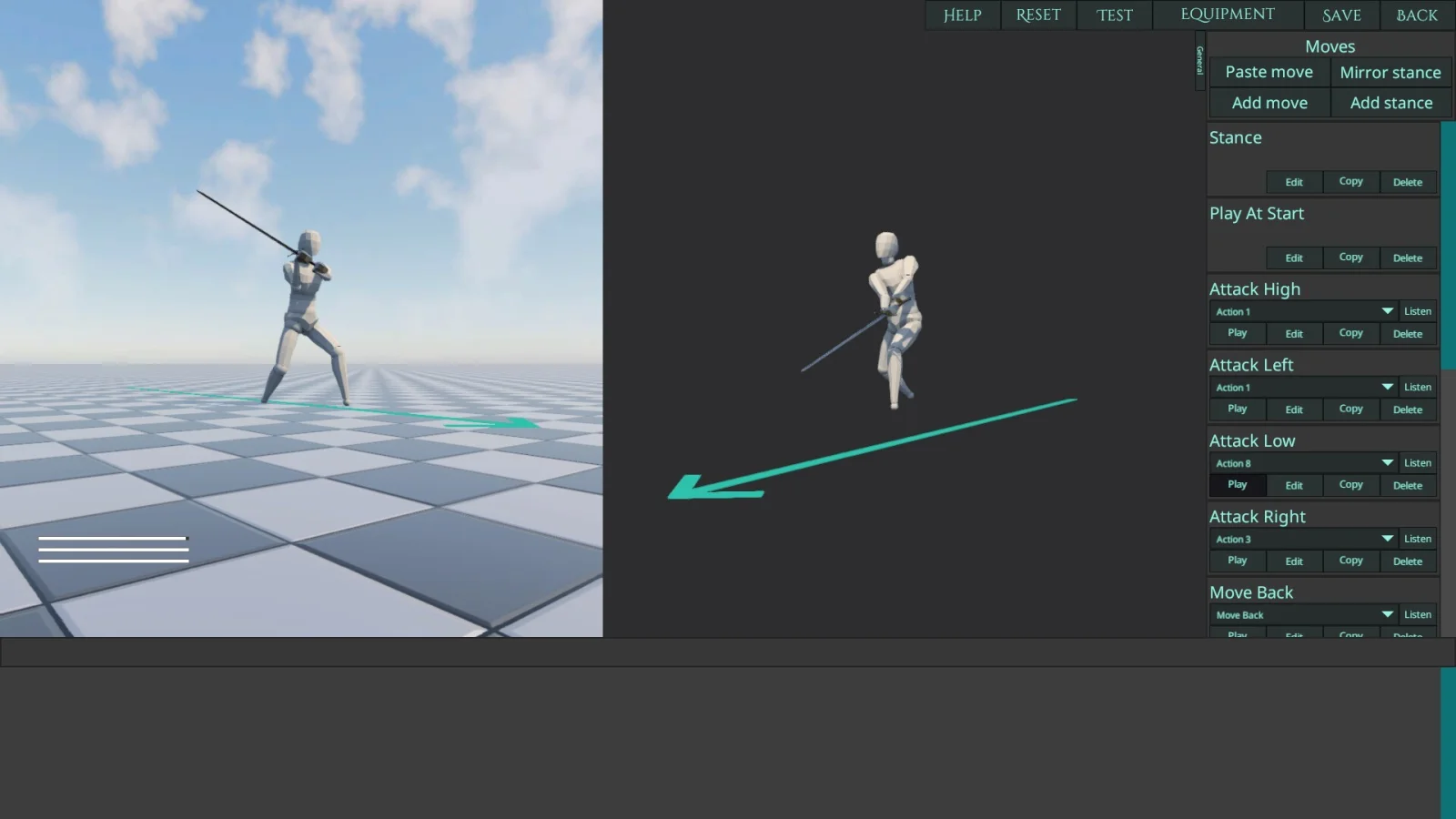
The most interesting tension in Gladio Mori is between deliberate technique and emergent disorder. The game offers a move editor described as frame-by-frame or pose-by-pose, suggesting that players can construct attacks with considerable intentionality. At the same time, the combat is physics-driven. A carefully conceived action enters a world where contact, momentum, bodies, weapons, and injury may produce outcomes that are not fully reducible to an authored script.
That tension is potentially the game’s defining virtue. A move can be designed with a certain line, target, and timing in mind, while the actual encounter still depends on how two fighters meet. In analytical terms, the editor provides authored intent and the physics layer supplies contingent resolution. The result may allow a successful exchange to feel less like a predetermined animation winning a priority contest and more like a physical event with causes and consequences.
Critical evidence describes combat as capable of both tactical precision and messy comic unpredictability. That assessment fits the systems outlined by the official material. Dismemberment, localized damage, and physics are inherently capable of producing memorable reversals or absurd-looking collisions. The caveat is just as important: the same variability can interfere with clarity. Players who value every result being immediately attributable to a repeatable, transparent interaction may find emergent chaos less satisfying than players who view surprise as part of the spectacle.
Neither preference is illegitimate, and Gladio Mori should not be measured exclusively by the standards of a conventional tournament fighter. Its systems appear to invite a different contract. The player is not only executing a familiar sequence under controlled conditions; they may be responding to a changing physical situation. That can generate tension and stories, but it can also make clean competitive interpretation more difficult if disorder overwhelms the intended tactical choices.
The editor could be its long-term engine—and its largest hurdle
Gladio Mori’s customizable move editor is more than a supplementary creation tool. It may be the feature most likely to determine whether the game remains varied after its initial novelty. The official community moveset gallery gives players a mechanism to share their work, meaning the possible vocabulary of combat is not limited solely to developer-authored techniques. This is a substantial proposition: instead of only choosing among fixed fighting styles, players can potentially participate in making the styles that circulate through the game.
That kind of openness can create variety that two arenas alone cannot provide. New movesets may change attack shapes, tactical assumptions, visual identity, and the problems posed by an opponent. It can also encourage a culture of experimentation in which players test strange ideas, refine an effective technique, or seek out designs made by others. Available critical commentary identifies both the editor and community sharing as central strengths, while also arguing that lasting appeal is likely connected to their continued use.
There is, however, an accessibility cost to treating creation as a major pillar. A player interested only in immediate matches may have little desire to work pose by pose through custom attacks. Even if the gallery reduces that burden by offering shared movesets, a large pool of player-made material can be intimidating. Discovery, trust, and personal preference become relevant: more options do not automatically mean that newcomers will know which options are approachable or enjoyable.
There is also a design distinction worth preserving. The existence of community-made moves does not prove that they solve the content limitations of the base game, nor does it prove they are competitively balanced. They expand the possibility space; they do not erase the need for compelling official foundations. But as a source of renewable novelty, the editor is better positioned than a finite weapon list or a pair of arenas to keep conversations moving.
Two arenas are a real constraint
Official information lists two arenas. That is a concrete limitation in an otherwise expansive combat concept. A small arena count need not be fatal to a duel-focused game, especially if the primary variety comes from bodies, weapons, armour, and player-built movesets. Yet locations influence a multiplayer game’s sense of occasion and visual rotation even when the central mechanics are strong. With only two established arenas, players who place a high value on environmental variety may reasonably see a narrower package than the move editor alone suggests.
It is important not to turn that concern into an unsupported claim about map design, stage interactions, or future additions. The evidence only confirms the count. The critical point is simpler: user-made attacks and official arenas solve different problems. Movesets can diversify how combat begins and develops; arenas diversify where it is seen and how repeated sessions feel in presentation. Gladio Mori appears well equipped on the first front and modestly supplied on the second.
A party spectacle, but not necessarily a conventional fighter
Gladio Mori supports single-player play, PvE, online PvP, and local/shared split-screen PvP for up to four players. Those options give the game a social shape beyond one-on-one online duels. Local split-screen is especially compatible with its physics-driven, dismemberment-heavy premise: the same unpredictability that may frustrate a player seeking immaculate competitive order can become a source of shared laughter and spectatorship among a group.
That does not mean the game should be reduced to a party diversion. The localized damage and move construction systems point toward a more deliberate layer of tactical experimentation. Instead, the available modes suggest that Gladio Mori can sit between two audiences. One may arrive for the immediate spectacle of improvised-looking gladiatorial mishaps. Another may be interested in dissecting armour coverage, reach, injury, and custom techniques. The game’s most persuasive pitch is that these impulses can coexist.
Players expecting the familiar architecture of a conventional competitive fighter should nevertheless calibrate expectations. The documented emphasis is on physics, anatomy, customization, and multiplayer formats, not on a standardized genre checklist. Gladio Mori may be at its best when judged as a systems-driven combat sandbox with competitive possibilities, rather than presumed to pursue the same ideals as a tightly scripted fighter.
Violence is a design feature and an audience filter
Dismemberment and organ-specific damage are not decorative details in Gladio Mori. They are fundamental to the tactical model. That integration can make violence feel consequential: bodily harm is tied to the state of the fight rather than existing only as a cosmetic effect. It also narrows the likely audience. Some players will appreciate the game’s willingness to make its physical systems visible; others may find the graphic premise unappealing regardless of its mechanical purpose.
This is not a moral objection or a claim about the game’s tone beyond what its systems establish. It is a practical recommendation issue. The same feature that differentiates Gladio Mori from a cleaner, more abstract combat game will make it unsuitable for players who prefer less graphic action. Potential buyers should treat that as part of the central proposition, not a peripheral content note.
Current context and conditional recommendation
Steam’s checked September 2026 store state showed 82 percent of 1,040 all-time user reviews positive and 88 percent of 76 recent reviews positive, resulting in a Very Positive label. Those figures are a volatile snapshot rather than a permanent verdict, but they provide useful context that the game has attracted a favorable response from a meaningful pool of users. It left Early Access on September 16, 2026, following its November 26, 2024 Steam release.
The conditional recommendation is straightforward. Gladio Mori appears most promising for players who enjoy systems-heavy combat, testing possibilities, building or browsing custom movesets, and accepting a measure of multiplayer unpredictability as part of the entertainment. Its combination of localized anatomy, physical weapons, armour coverage, 17 weapon sets, and shared creations gives it an identity that is far more distinctive than a generic gladiator premise suggests.
Players whose priorities are a large selection of official arenas, consistent and easily parsed outcomes, or the familiar structure of a conventional competitive fighter should investigate carefully before committing. Two arenas are confirmed, physics can produce disorder, and the editor’s depth may not appeal to everyone. For a broader example of how a physics-led game can make uncertainty part of its premise, see this physics puzzler assessment.
On the evidence available, Gladio Mori’s strongest argument is not that it will suit every fighting-game audience. It is that it has a specific, interconnected answer to what a gladiator game can be: a contest of vulnerable bodies, imperfect protection, physical instruments, authored motion, and outcomes that may be both tactical and spectacularly unruly.