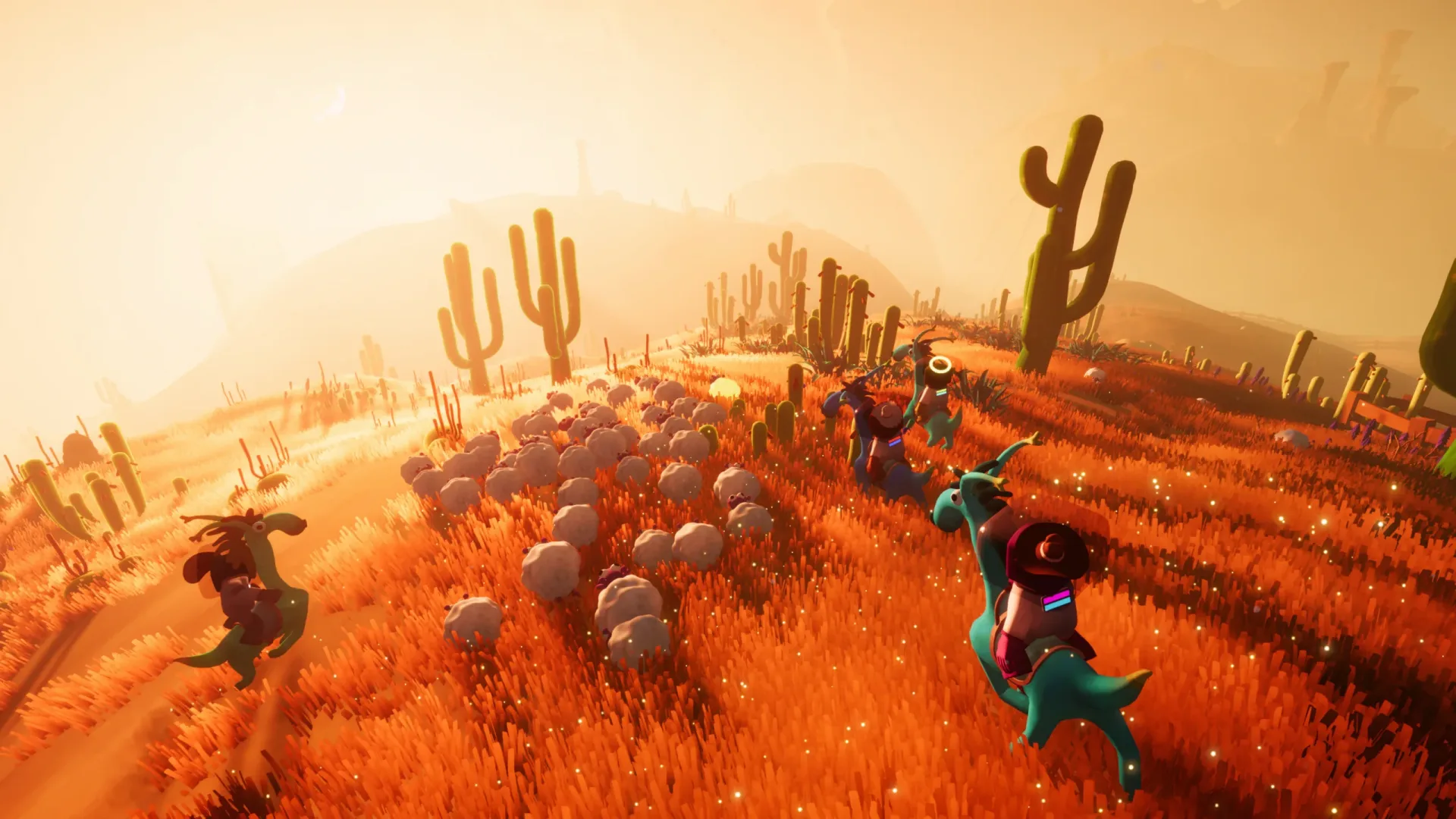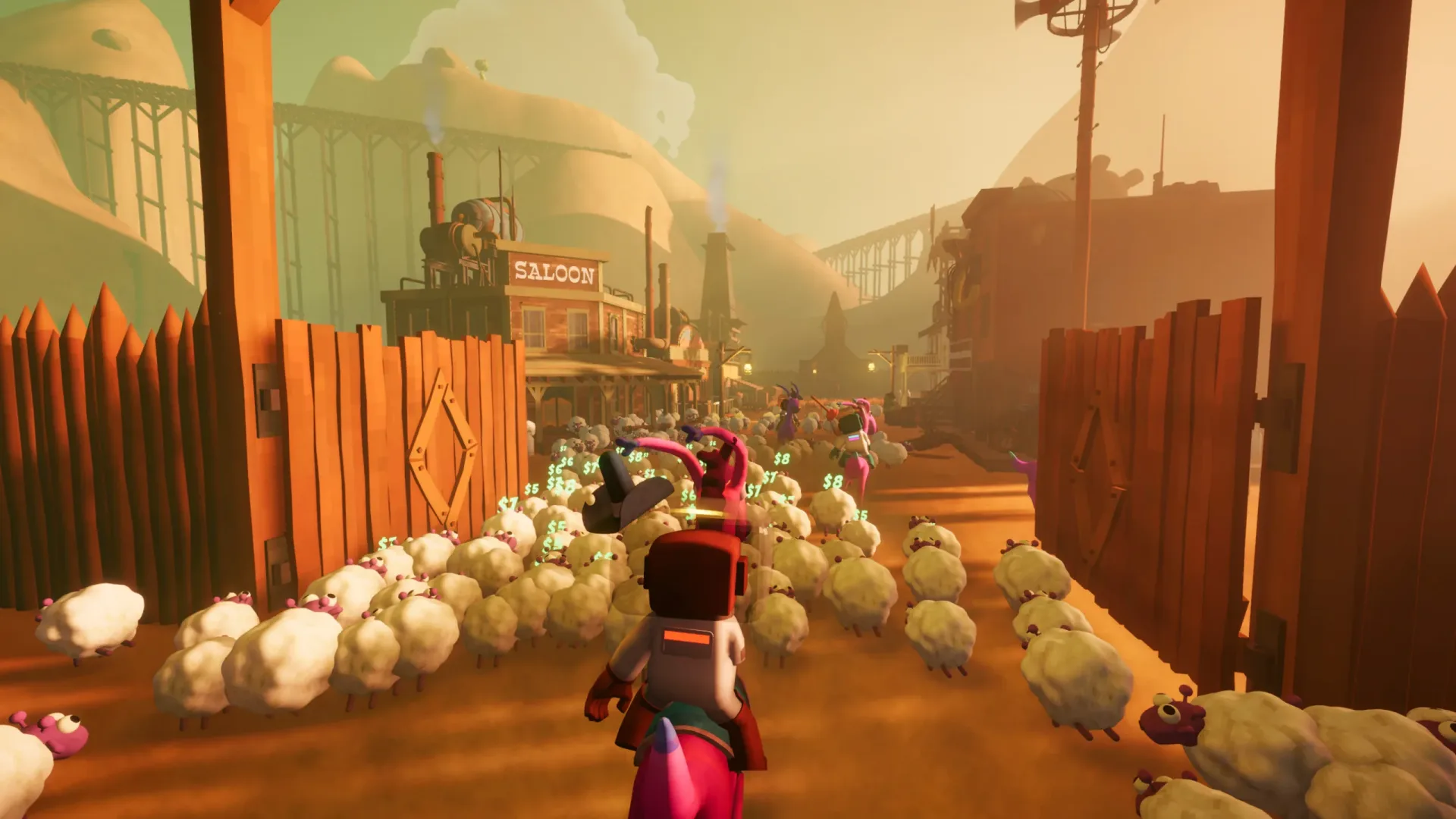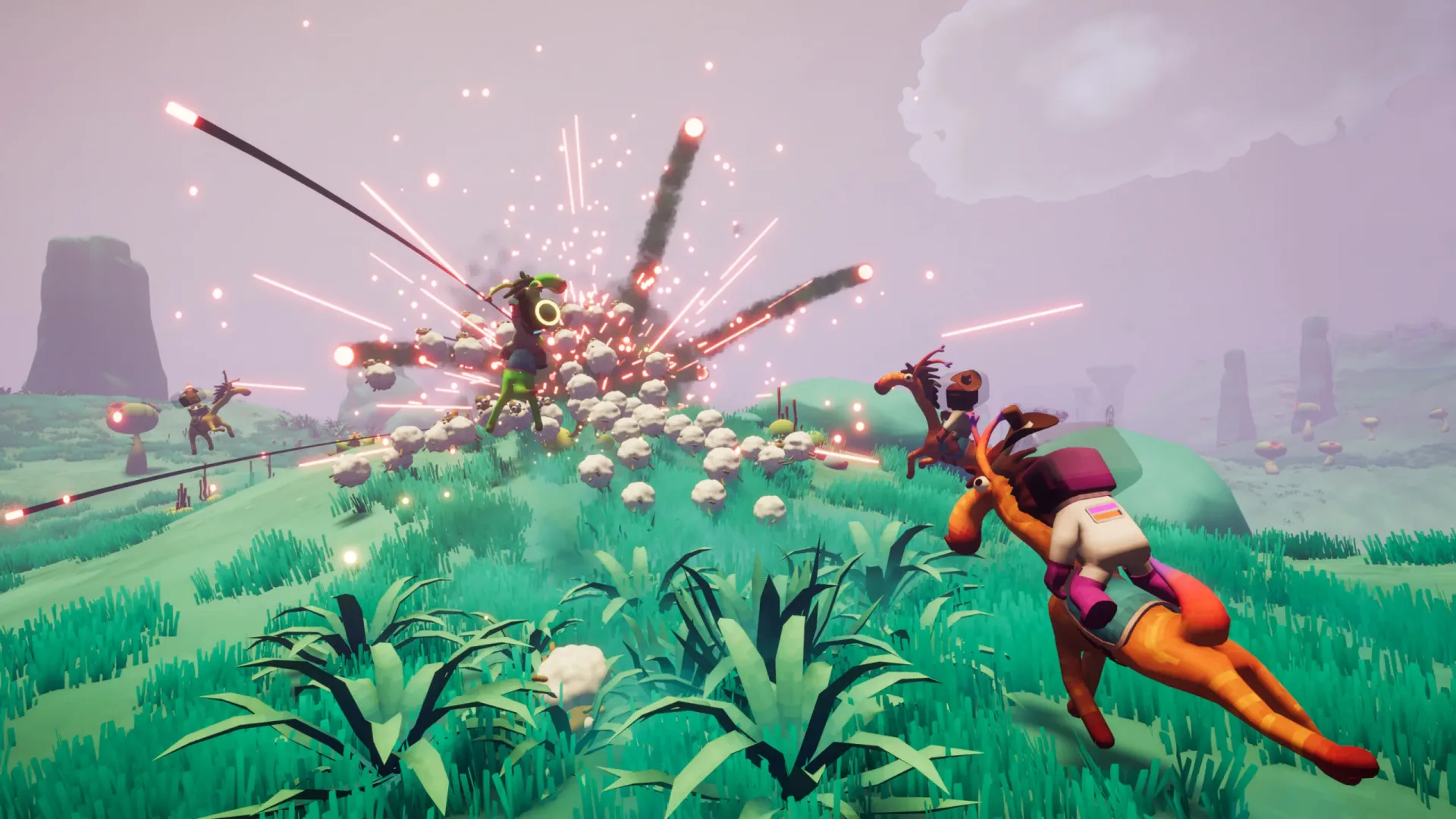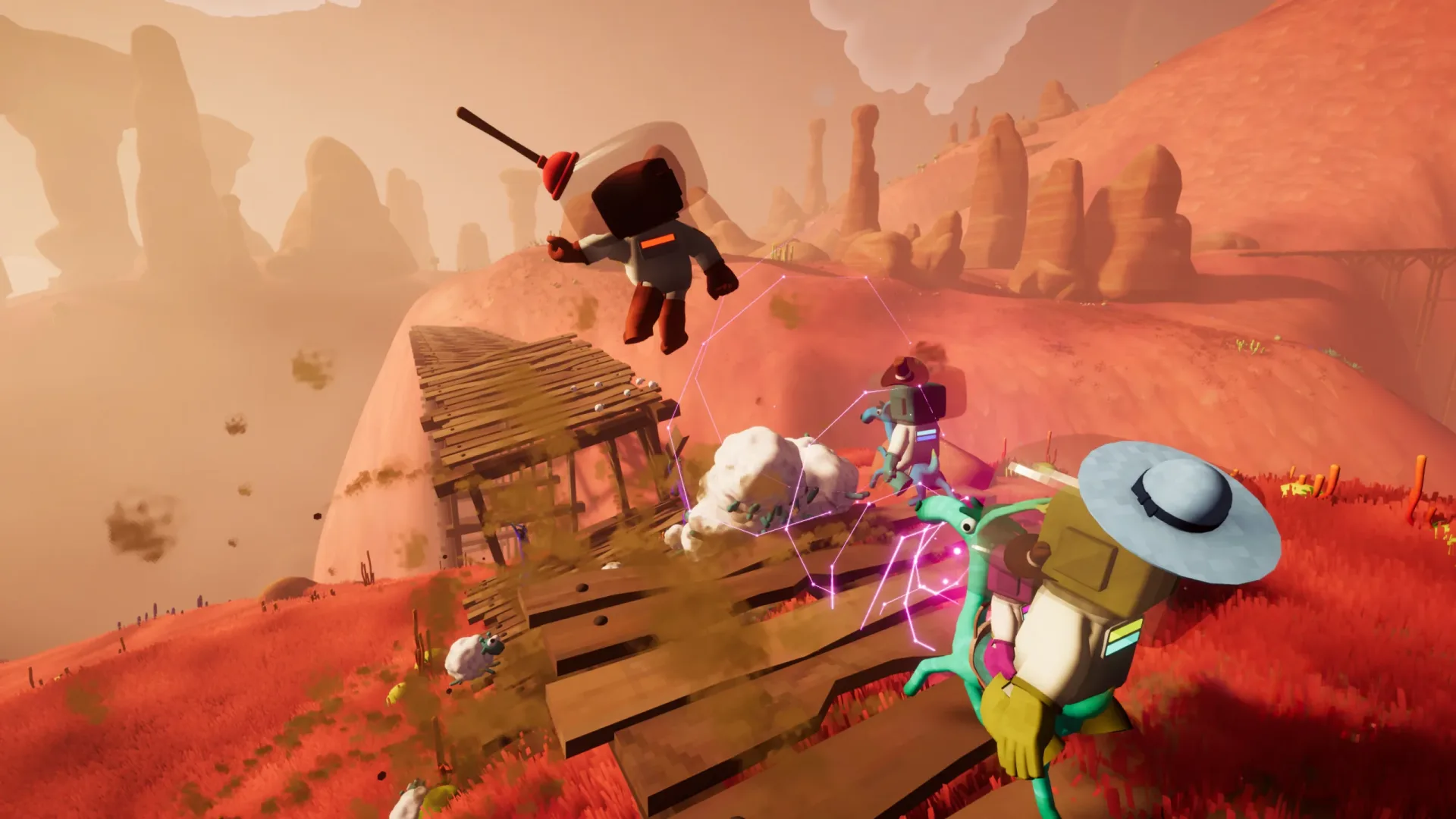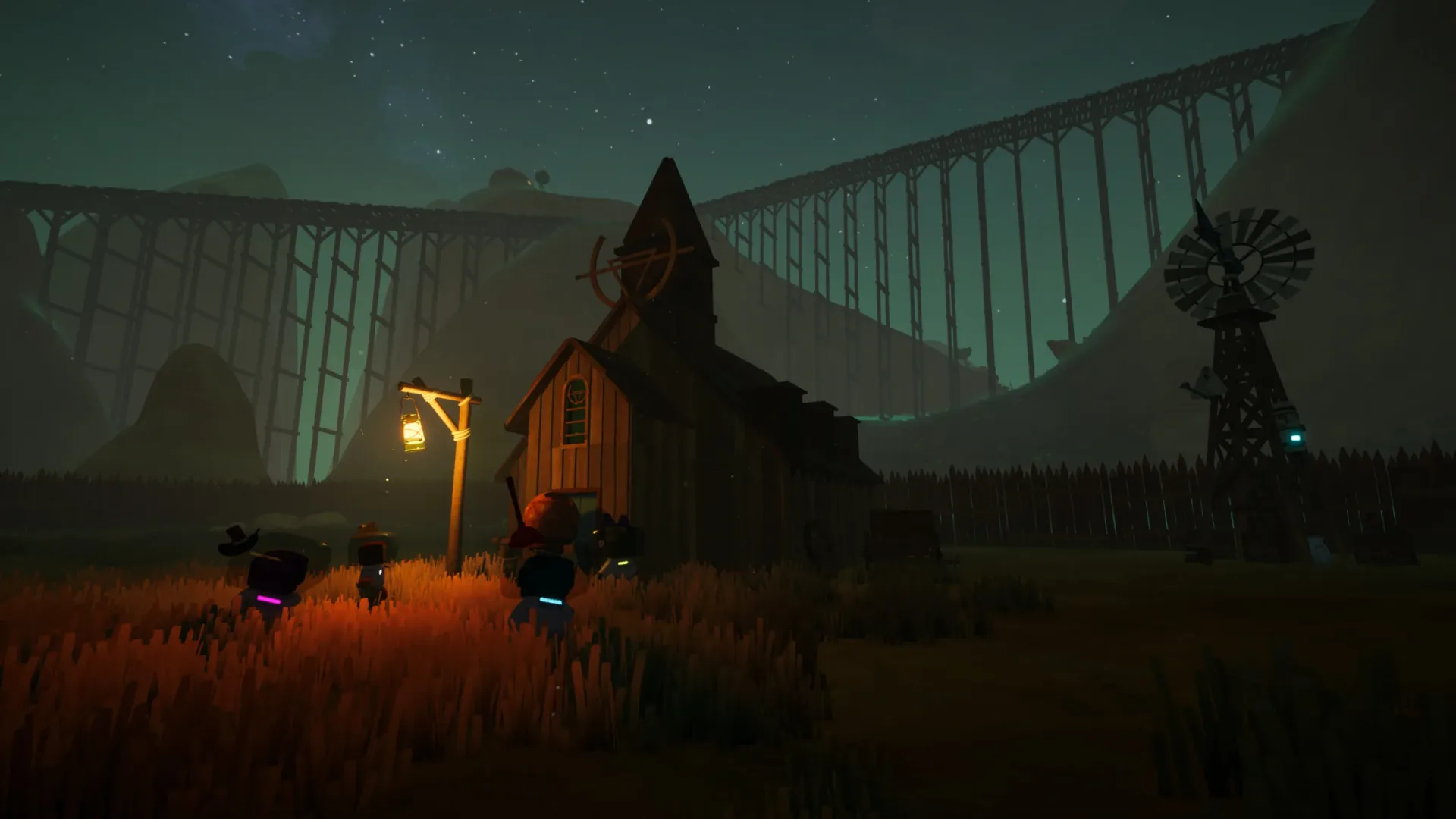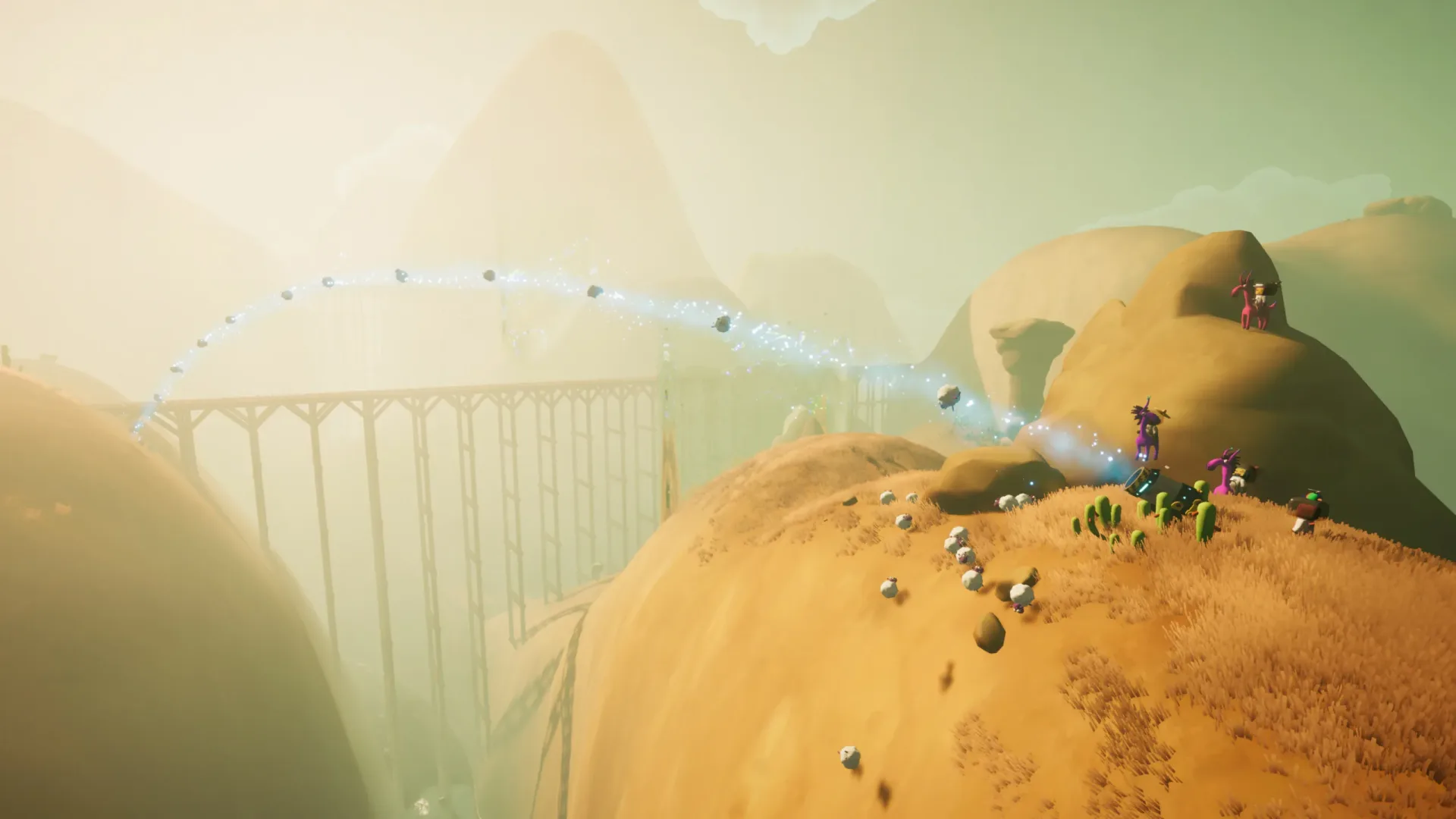
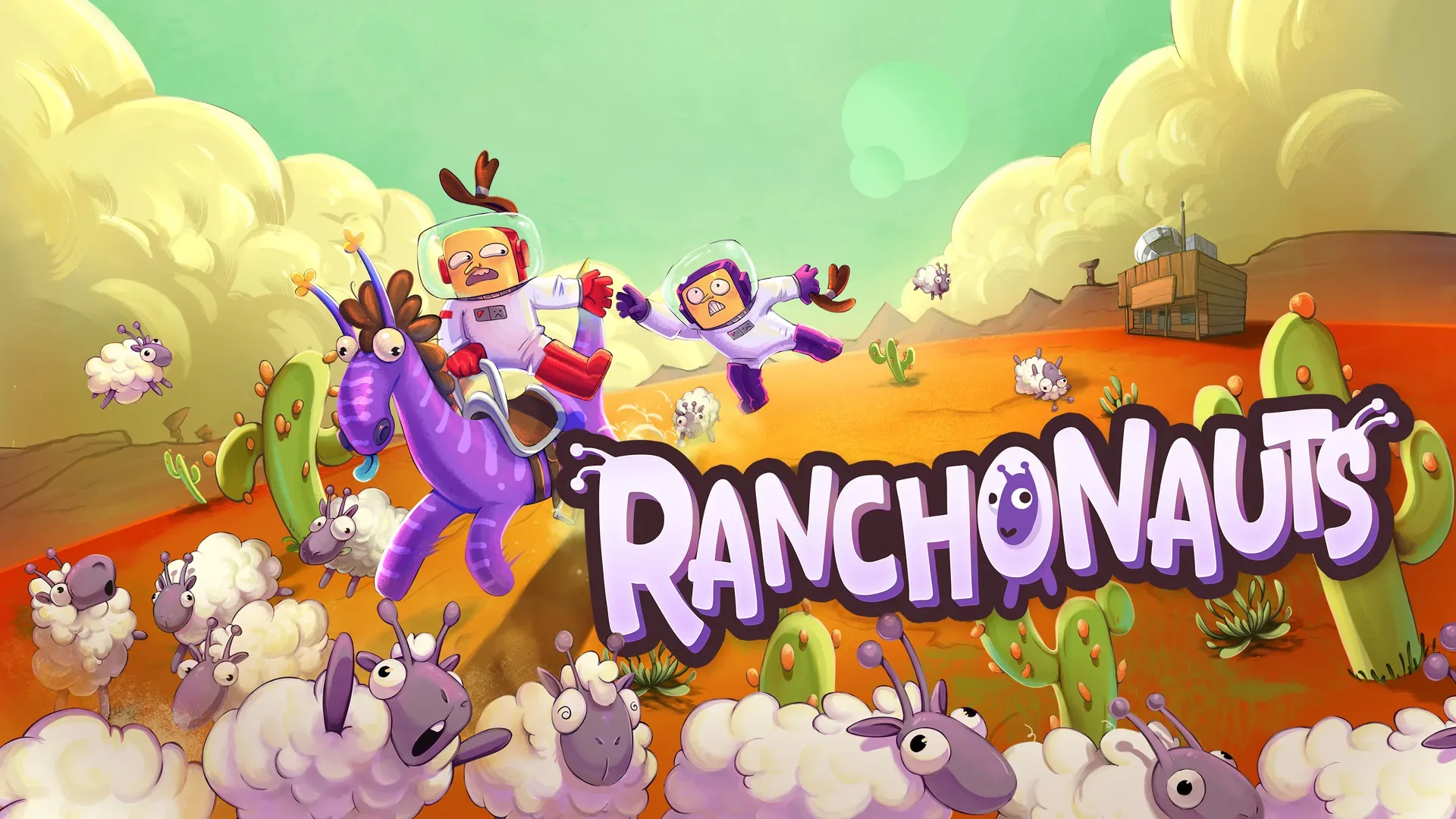
There are easier ways to settle a debt than taking a flock of alien sheep across a hostile sci-fi frontier. Goldfire Studios is nevertheless building a game around precisely that troublesome prospect with Ranchonauts, a slapstick space-western planned for PC next year.
The newly revealed game frames its frontier work as a chaotic, physics-driven adventure. Players will be able to tackle its herding jobs alone or with a group of up to six, attempting to wrangle a flock while lightning storms, gravity anomalies and other physics-fuelled disasters complicate the route. Progression is tied to paying off debt and unlocking upgrades, while proximity voice chat is intended to make the group experience part of the action rather than merely a background utility.
The premise is compact, but it points toward a game where success may depend as much on recovering from a cascading mistake as executing a clean plan. Ranchonauts is not simply about getting sheep from one place to another; the disclosed ingredients suggest the journey itself is meant to become the punchline.
A western job with extraterrestrial complications
Ranchonauts combines familiar frontier imagery with hazards that plainly do not belong on an ordinary range. Herding remains the central job, but the animals are alien sheep and the landscape introduces gravity anomalies alongside storms. That is a useful distinction: this is not being presented as a conventional farming game relocated to space. The emphasis is on managing a flock in conditions that can disrupt movement, positioning and coordination.
Physics-driven generally describes a game in which motion and collisions are important to how situations unfold. In Ranchonauts, that design direction is paired with deliberately exaggerated ragdoll physics. A ragdoll system treats a character body as connected physical parts after a fall or impact, allowing limbs and bodies to react in loose, comic ways instead of playing one fixed animation. It is a staple of slapstick game design because a stumble can become an unpredictable scene rather than a brief, controlled penalty.
Goldfire’s description also explicitly calls out physics-fuelled disasters. The important expectation to set is not that every failure will be random, but that the systems are designed to produce unstable situations. A weather event, a strange gravitational effect, several players converging on the same flock and a badly timed collision could all make an otherwise straightforward task harder to read and harder to rescue. Whether that is funny or frustrating will ultimately depend on how clearly the game communicates danger and how much control players retain once trouble begins.
One ranch hand or six
Ranchonauts supports solo play as well as teams of one to six players. That range matters because herding is naturally a task with competing priorities. Someone may need to keep the flock together, another may need to scout a safer route, and another may be pulled into damage control when the terrain or an environmental hazard disrupts the group.
No specific player roles have been announced, so it would be premature to assume the game assigns formal jobs. Still, the six-player limit creates room for spontaneous division of labor. In a game built around physical comedy, it also gives mistakes an audience: one player’s bad landing or accidental collision can quickly become everyone else’s problem.
Related coverage includes Ranchonauts Sets Its Sights on PC With Alien Sheep Herding Co-Op.
The confirmed inclusion of proximity voice chat is particularly suited to that setup. Unlike standard team chat, where every participant can generally hear every other participant at the same volume, proximity chat changes audibility based on where players are in the game world. Players close together can communicate more directly; those who have wandered away may sound distant or be unable to hear the conversation. The feature can reinforce the feeling of a group spread across a dangerous frontier, while also making separation a meaningful practical problem during a herd run.
It is not yet clear how extensively proximity voice chat can be adjusted, whether there will be alternatives for players who do not wish to use it, or how it will interact with solo play. Those are implementation details for a later update. What is confirmed is the core intention: Ranchonauts wants communication, distance and physical chaos to overlap.
Debt and upgrades give the mayhem a longer-term purpose
Beyond individual trips across the frontier, Ranchonauts includes progression centered on paying off debt and unlocking upgrades. That gives the game a stated forward path: players are not merely completing disconnected herding challenges, but working toward improved capabilities while trying to clear an obligation.
Progression in this context means systems that carry advancement forward across play, such as unlocking new options or improvements. Goldfire has not detailed the specific upgrades, their costs, or how debt repayment is structured. There is no confirmed information yet on whether upgrades affect equipment, movement, animal handling, protection against hazards, or another part of the experience. The sensible takeaway is simply that the studio plans a reward loop beyond the immediate spectacle of a ragdoll mishap.
That progression could be especially important for a co-op game with disorder at its center. The best physics-based group games tend to give players a reason to accept one more risky job after a bad run. Ranchonauts has identified debt and upgrades as that reason, but the eventual balance will matter. If upgrades make the frontier too safe, they could undercut the comic tension; if the debt loop demands too much repeated work, the initial novelty of the premise could wear thin. Those are questions the reveal does not answer, not deficiencies that can be established from the announcement alone.
What the reveal confirms—and what it leaves open
The confirmed picture is clear enough: Ranchonauts is a PC-bound, sci-fi frontier co-op game from Goldfire Studios; it supports one to six players; its central activity is herding alien sheep through lightning storms, gravity anomalies and other physical disasters; it includes ragdoll physics, proximity voice chat, debt repayment and upgrade unlocks. A reveal trailer and press materials have also been released.
Much remains undisclosed. The announcement does not provide a specific release date, a price, PC storefront information, detailed controls, system requirements, online-play particulars, or a fuller explanation of the upgrade system. It also does not establish whether the game will arrive on platforms beyond PC. With only a “next year” window attached to the announcement, the present target is 2027 rather than a more precise launch commitment.
That degree of uncertainty is normal for an early reveal, especially for a game whose appeal rests on how several systems will interact in motion. A trailer can establish tone and a premise, but it cannot yet settle questions about the consistency of flock behaviour, the fairness of hazards or the staying power of the progression loop.
A sci-fi setting built for comedy rather than grandeur
Space settings often promise scale, exploration or technological spectacle. Ranchonauts instead uses its science-fiction elements to make a humble job sillier and more precarious. Gravity anomalies turn terrain into a potential hazard; alien livestock makes ranch work less familiar; the perilous frontier gives the game an excuse to repeatedly put its workers in absurd danger.
That narrower focus is potentially a strength. The fantasy is easy to grasp even before the finer details are known: take responsibility for creatures that do not want to cooperate, cross an inhospitable place, try not to embarrass yourself in front of friends, and use the rewards to become better equipped for the next attempt. The space-western label describes the aesthetic, while the herding and slapstick elements describe the likely moment-to-moment pressure.
Ranchonauts also arrives in a game landscape where science-fiction settings can serve radically different purposes. For a more narrative- and universe-focused example of the genre being discussed elsewhere, see this report on the Mass Effect universe and a planned TV series. Goldfire’s project is taking a far more mischievous route: space is the place where the sheep escape, the weather turns hostile and the crew falls over.
For now, the game’s strongest selling point is the collision of concepts rather than a long feature list. Ranchonauts has a straightforward work assignment, a deliberately ridiculous set of obstacles and enough co-op support to turn bad luck into a shared story. Further details will determine how much depth sits beneath that promisingly chaotic surface before its planned PC arrival in 2027.