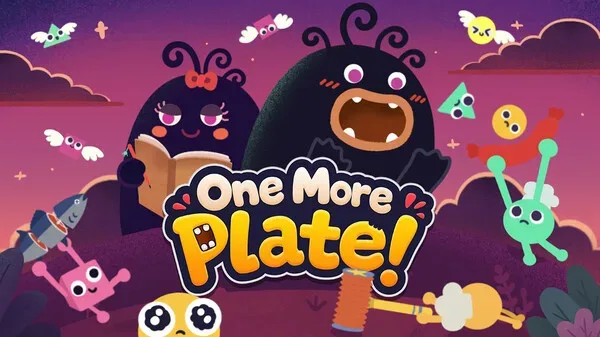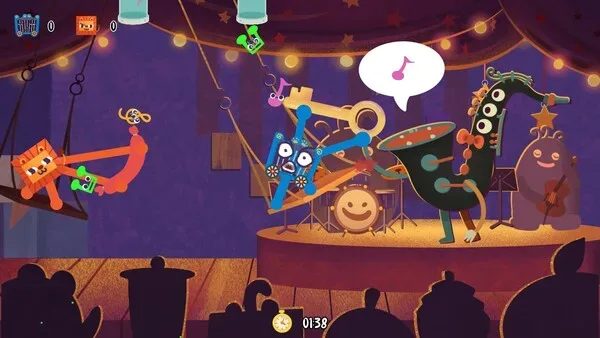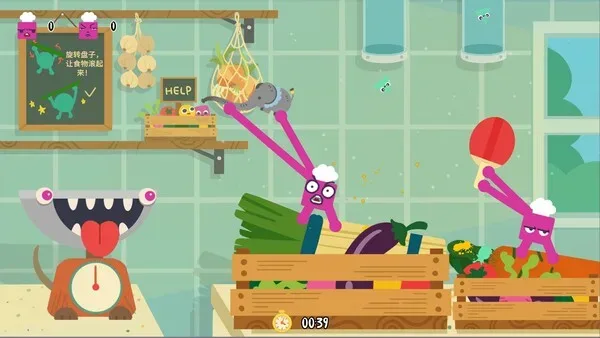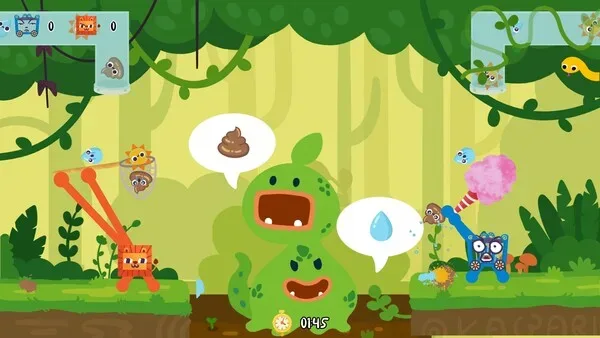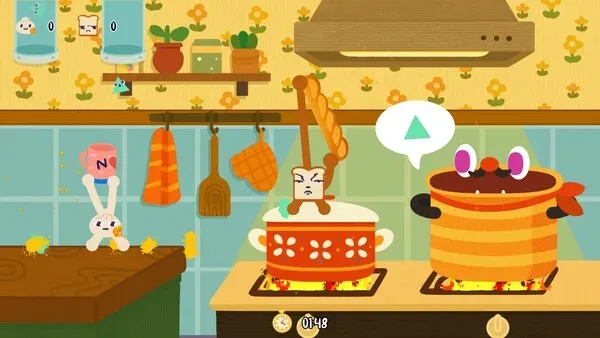
One More Plate!, a physics-driven “feed-em-up” from Okawari!, is scheduled to launch on Steam on November 10, 2026. Its central problem is wonderfully direct: enormous hungry monsters have entered the home, and players need to get the right food to them before the order changes or the situation becomes even more ridiculous.
The game’s answer to that problem is not a calm kitchen workflow. Players will balance, fling and bounce shapes through levels while working around intentionally unruly physics and using an assortment of tools that spans ordinary-looking ladles, croissants and giant legendary swords. That combination positions One More Plate! as a game where execution is likely to matter as much as planning: identifying the requested item is only the beginning; getting it where it needs to go is the actual test.
A meal service where gravity has other ideas
“Physics-based” describes games where objects react to forces such as movement, collision, momentum and gravity instead of simply snapping into pre-set animations. In One More Plate!, that appears to be the heart of the challenge. A player may have a clear route to a monster’s plate or mouth, but a poorly timed toss, an awkward bounce or an overenthusiastic tool choice can turn a straightforward delivery into slapstick.
The phrase “feed-em-up” also usefully signals the game’s priorities. Rather than framing food preparation as a simulation of recipes or restaurant management, One More Plate! focuses on satisfying changing demands under pressure. The invading monsters want particular things, and the orders continually shift. The available information does not establish how many stages, monsters or tools will appear at launch, but the stated premise suggests a loop built around quick adaptation rather than mastering one fixed sequence.
That is a promising fit for the game’s deliberately oversized household chaos. A ladle is plausible enough as a tool for moving food. A croissant is less conventional. A giant legendary sword is positively excessive—and therefore exactly the kind of object that can make a physics game memorable. The joke is not simply that the toolset is silly; it is that players must make those objects work in a task with practical goals.
Solo, sofa co-op and Remote Play options
One More Plate! will support solo play, couch co-op and Steam Remote Play. Couch co-op means multiple people playing together locally, generally on the same system and display. It is an especially natural format for a physics-heavy party game because each mistake is visible immediately, and a failed throw can create the kind of shared disaster that is more amusing with somebody else in the room.
Steam Remote Play is the option intended to extend that shared format beyond the sofa. The game’s stated setup means friends can play together using one copy of One More Plate!. That is a useful practical detail for players considering a co-op session: the group does not need every participant to own the game just to try the chaotic feeding routine together.
Co-op can change the texture of a game like this even when the objective remains simple. One player may concentrate on positioning an object while another attempts the final launch, or both may work at once and accidentally interfere with each other. Neither approach is confirmed as a specific mechanic here, but the balance-and-fling premise makes coordination—and the inevitable lack of it—a central reason the multiplayer support stands out.
Related coverage includes One More Plate! Sets November 10, 2026 Steam Release Date.
What has been shown so far
A new trailer for One More Plate! appeared during the Galaxies Showcase. The game is also set to appear at The MIX Fall Game Showcase, while an updated playable demo is planned ahead of Steam Next Fest. Those appearances give interested players several ways to keep an eye on the project before release, although no exact date for the demo or the showcase presentation details were provided.
The updated demo is particularly relevant for a game whose appeal depends on physical feel. Written descriptions can establish the setup—feed monsters, cope with physics, employ comically impractical implements—but a demo is where players can determine whether the balancing, bouncing and launching have the responsiveness they want. Physics comedy works best when outcomes feel surprising without feeling incomprehensible, and a playable build is the clearest way to judge that distinction.
There is also a broader practical reason to watch the demo rather than assume the launch version from a trailer. “Wayward physics engine” is part of the game’s stated comic identity, but players can have very different appetites for controlled disorder. Some will want exact, repeatable throws; others will be happiest when an attempted delivery ricochets into a spectacularly unplanned solution. A preview build can show how much room One More Plate! leaves for both skillful recovery and gleeful failure.
Why the simple premise has room to escalate
The best part of One More Plate!’s setup may be its clarity. There are hungry monsters. They want food. Get it to them. That is legible almost instantly, which leaves the game free to complicate the how rather than burying players in explanation. Ever-changing orders give the objective movement, while the object interactions and bizarre utensils give the player’s response its personality.
That clarity also makes the game potentially suitable for mixed-experience groups. Someone new to games can understand the broad goal without needing a long tutorial in genre conventions, while players who like mastering movement and timing can pursue cleaner, faster or more inventive solutions. This is analysis based on the announced structure, not a claim about the final difficulty curve; details such as scoring, progression and accessibility options have not been disclosed.
For now, the confirmed facts are concise: One More Plate! is a Steam game from Okawari!, it supports solo play and shared play through couch co-op or Steam Remote Play, and it launches November 10, 2026. The rest of its appeal rests on an appealingly unstable question: when a giant monster wants dinner, is a legendary sword actually the right utensil? The game seems eager to let players find out.
Players tracking the wider PC-development news cycle can also read about another project still at an earlier stage of production. One More Plate!, by contrast, now has a firm Steam date and a planned updated demo on the road to it.