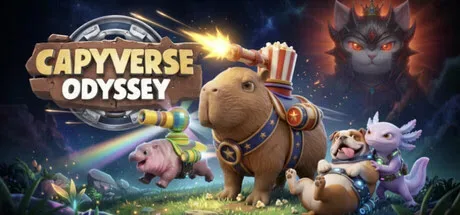
Capyverse Odyssey is heading to PC via Steam in Q4 2026, bringing a squad-based action roguelite in which capybaras—and their animal teammates—take to the air on jetpacks. Metazooie Studios is developing and publishing the game, which supports solo play or online co-op for up to four players. A free Steam demo is available now, while the full release can be wishlisted ahead of launch.
The setup is knowingly strange: Capy and a crew of animal heroes are attempting to stop Ophelia, a spurned cat who is warping worlds in an effort to become internet-viral again. That broad premise sets the tone for an enemy lineup that includes haunted slot machines, hostile playing cards, killer clowns and explosive suitcases. It is less a conventional animal adventure than an escalating cartoon nightmare with jet engines strapped to it.
Jetpacks are the foundation of Capyverse Odyssey’s action
The game’s clearest mechanical identity is its airborne movement. Rather than treating a jetpack as an occasional traversal tool, Capyverse Odyssey makes every player character airborne and continuously mobile. Players will be expected to navigate arenas while avoiding attacks and hazards, creating a combat loop focused on positioning, evasive movement and keeping up with a shifting battlefield.
That distinction matters. In an action game, mobility does not merely mean moving from one combat encounter to the next. When the whole team can fly, space above, below and around a threat becomes part of the encounter. The announced casino environments, for example, feature dangerous playing cards and ATMs capable of dealing damage. Nightmare carnival maps add giant clowns that fire bumper cars. Those hazards suggest players will need to read a cluttered, unpredictable arena while remaining in motion.
The result should be a different kind of co-op pressure from games built around a fixed ground plane. A teammate can be far away vertically as well as horizontally; an objective may require the group to gather in a vulnerable spot; and an enemy attack that claims ordinary floor space may force the squad upward instead of simply backward. The final balance and controls remain to be seen, but the design pitch is clearly centered on velocity rather than cautious room-by-room clearing.
What “action roguelite” means here
Roguelite generally describes games structured around repeatable runs, in which players gain changing upgrades and experiment with combinations rather than following one unbroken, static progression path. In Capyverse Odyssey, a run consists of a sequence of maps and objectives. The maps can ask players to defend a zone, eliminate opponents in an arena or overcome a mini-boss encounter.
This objective-based format is important because it gives each map a purpose beyond defeating every enemy present. A zone-defense scenario can reward team coordination and area control; an elimination arena puts the emphasis on surviving aggression; and a mini-boss can test whether the squad’s developing build is strong enough for a concentrated threat. The game says chaos intensifies as players move into new worlds, so the map sequence is intended to add momentum rather than present isolated challenges of equal intensity.
The progression hook is build stacking. Players earn power-ups and wearables after maps, then combine them across a run into more specialized setups. A “build” is the collection of upgrades and equipment shaping how a character performs during that attempt. The key promise is that these choices can become run-defining: instead of each reward being a tiny, forgettable bonus, combinations are meant to substantially affect a squad’s approach.
Exactly which effects power-ups and wearables provide has not been detailed. Still, the stated structure gives players a reason to think ahead: a reward that complements an existing choice may be more valuable than one that looks strong on its own. That kind of decision-making can also be especially useful in co-op, where players may choose to pursue different roles instead of all building the same way. Those potential roles are not confirmed, but varied heroes and stackable upgrades leave room for squads to experiment.
Capy, Moody and Jim give the roster contrasting starting points
Players can take control of Capy or other crew members, including Moody and Jim. Moody is a baby hippo described as being built and fighting like a tank, while Jim is a fast British Bulldog. The announced roster is therefore not simply a set of cosmetic animal swaps: each hero is intended to bring individual abilities and a distinct playstyle.
In practical terms, the available character choices may matter before a run’s power-ups even begin to stack. Moody’s tank framing points toward a tougher, more direct combat identity, whereas Jim’s speed places the emphasis on quick movement. Since everyone uses jetpacks, these differences may help establish how separate characters occupy the same airborne action space. The game has not yet laid out full ability lists, so it would be premature to assume exact class functions. What is confirmed is a design built around selecting a hero and assembling a squad with different strengths.
That makes the one-to-four-player structure more significant than a simple player-count bullet point. Solo players can choose a character and tackle the short-form run structure alone. Groups, meanwhile, can bring several heroes into the same run and contend with the added logistical challenge of maintaining awareness in a fast-moving aerial fight. The game supports online co-op; local co-op has not been specified.
A casino and carnival gone aggressively wrong
Its worlds are deliberately oversized and surreal. One setting is a casino whose hazards include hostile cards and damaging ATMs. Another is a nightmare carnival, complete with giant clowns launching bumper cars. These details are not background decoration. They signal an approach in which environments contribute directly to the danger and comedy of encounters.
The escalation from world to world is also central to the game’s premise. An individual map can feature a concrete objective, but each new world is meant to increase the disorder. The thematic change—from casino spectacle to carnival nightmare—should help make runs feel like a trip through distinct absurd spaces rather than repeated variations of one arena. The supplied details do not establish how many worlds or maps will be included, but the structure emphasizes replayable, objective-led sessions over a single long campaign route.
There is a useful contrast in the game’s tone. Capy is described as wholesome, yet the surrounding action includes malicious luggage, haunted gambling fixtures and clowns weaponizing amusement-park vehicles. The premise does not position the capybara heroes as grim survivors. It instead leans into a bright, playful absurdity while creating threats unusual enough to read quickly in chaotic fights.
What the Steam demo can establish
With a free demo now on Steam, interested players have an opportunity to assess the parts of the pitch that matter most for an action roguelite: how jetpack control feels under pressure, whether objectives stay readable amid heavy movement, and how satisfying the available upgrades are to combine. A demo can show the foundations of a game, but it should not be treated as a guarantee of the full release’s final breadth, balance or overall content.
For prospective co-op groups, the most useful questions are likely to be practical ones. Does airborne movement help a team coordinate, or make it harder to stay together? Are individual character identities clear enough to make squad composition meaningful? Does the game’s increasing chaos feel exciting rather than visually confusing? The announced features point toward answers, but the playable demo is the appropriate place to judge the game’s moment-to-moment handling.
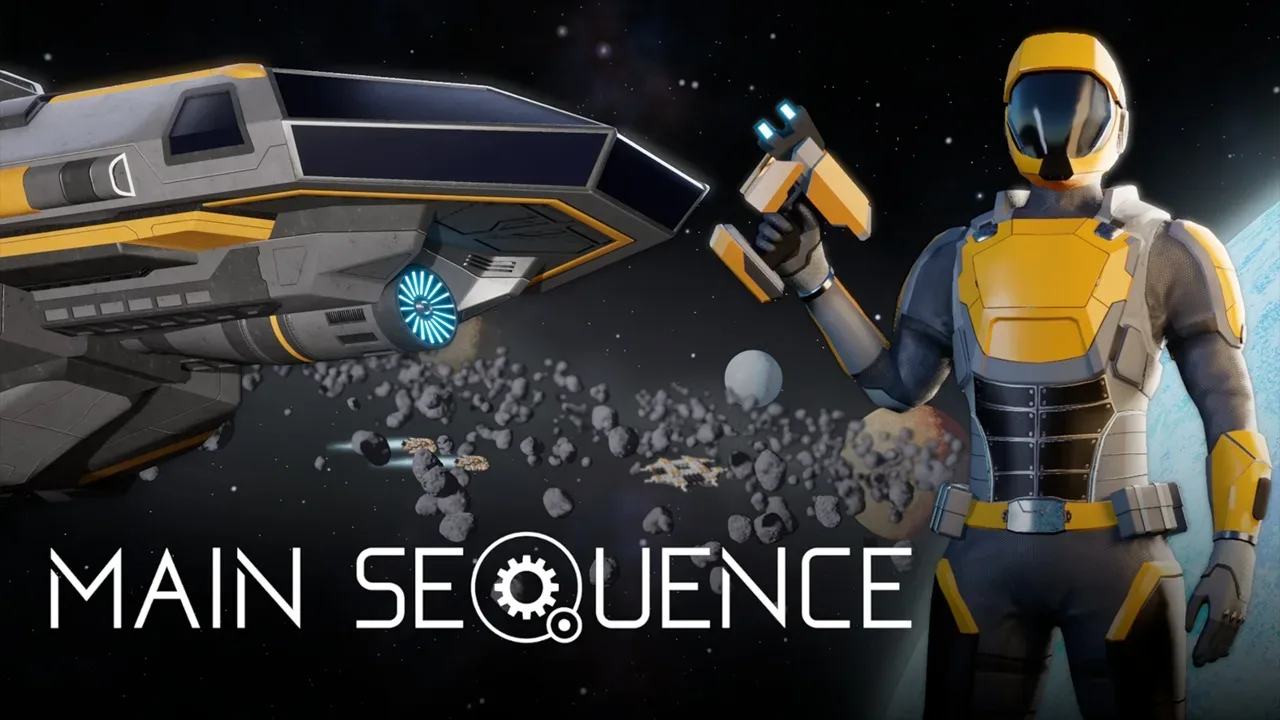
PC players looking for more upcoming Steam projects can also follow Main Sequence’s planned Steam Early Access launch, another example of a PC-focused project approaching its next public milestone.
Release window and confirmed platforms
Capyverse Odyssey is planned for a PC release on Steam later in 2026, with Q4 2026 identified as its release window. Steam is the only confirmed platform at present. No console versions, pricing details or exact launch date have been specified.
For now, the clearest proposition is straightforward: pick an animal hero, strap on a jetpack, build power through a run and survive worlds that appear increasingly determined to turn ordinary objects and entertainment venues into hostile nonsense. The free demo offers the first available look at whether that high-speed co-op formula lands as cleanly as its premise suggests.