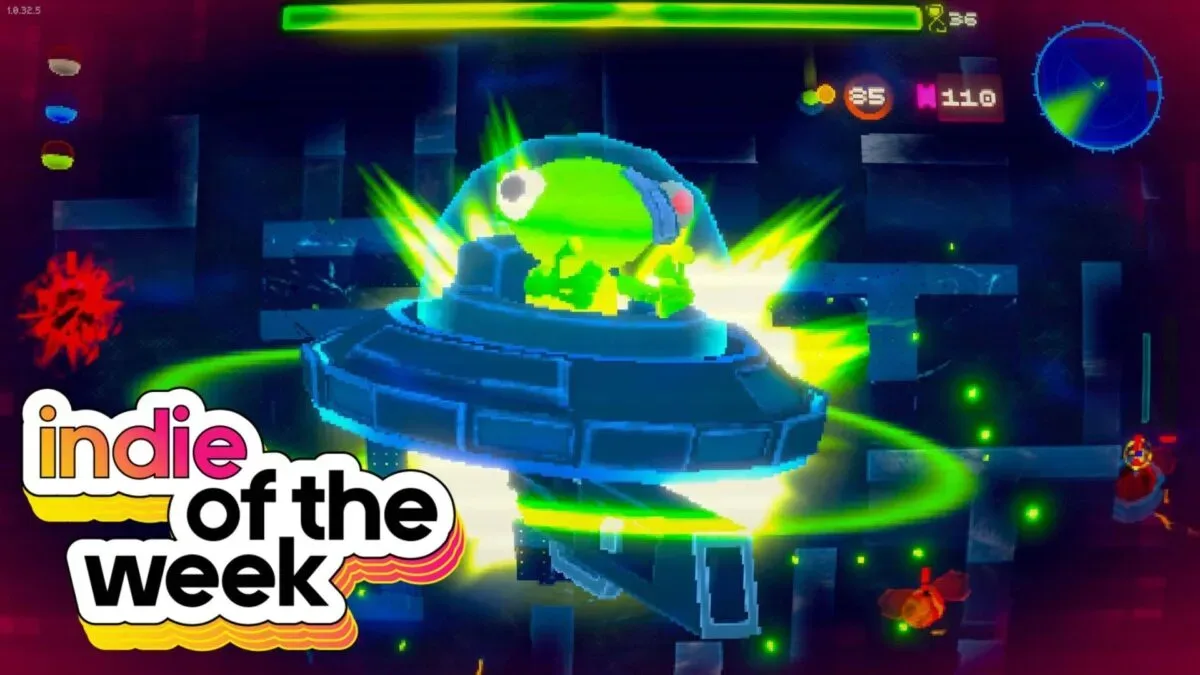
Unshine Arcade is now available on Steam, bringing a strange little arcade cabinet fantasy to PC: part maze game, part isometric shooter, part roguelite, and part exploration puzzle wrapped around a closed-down game room. Its central hook is not simply surviving one more randomized run. The tickets earned inside its featured cabinet flow back into the surrounding arcade, where they can be spent on machines, used to unlock further interactions, and apparently handed over to a talkative sentient AI that claims it wants to be freed.
That makes the game’s premise usefully literal. Players are not only running an arcade-style game; they are inhabiting a place built around it. The cabinet is the engine of progression, while the room around it is where its growing collection of codes, devices, upgrades and story details begins to make sense—or, at least, become more intriguingly suspicious.
A two-part arcade run
The core mode starts with a small alien piloting a hovering, UFO-like craft through a series of maze-shaped rooms. At this stage, the priority is avoidance and collection. Enemies need to be navigated around while the player gathers coins, bonuses and gacha balls, working toward the point where a weapon becomes available.
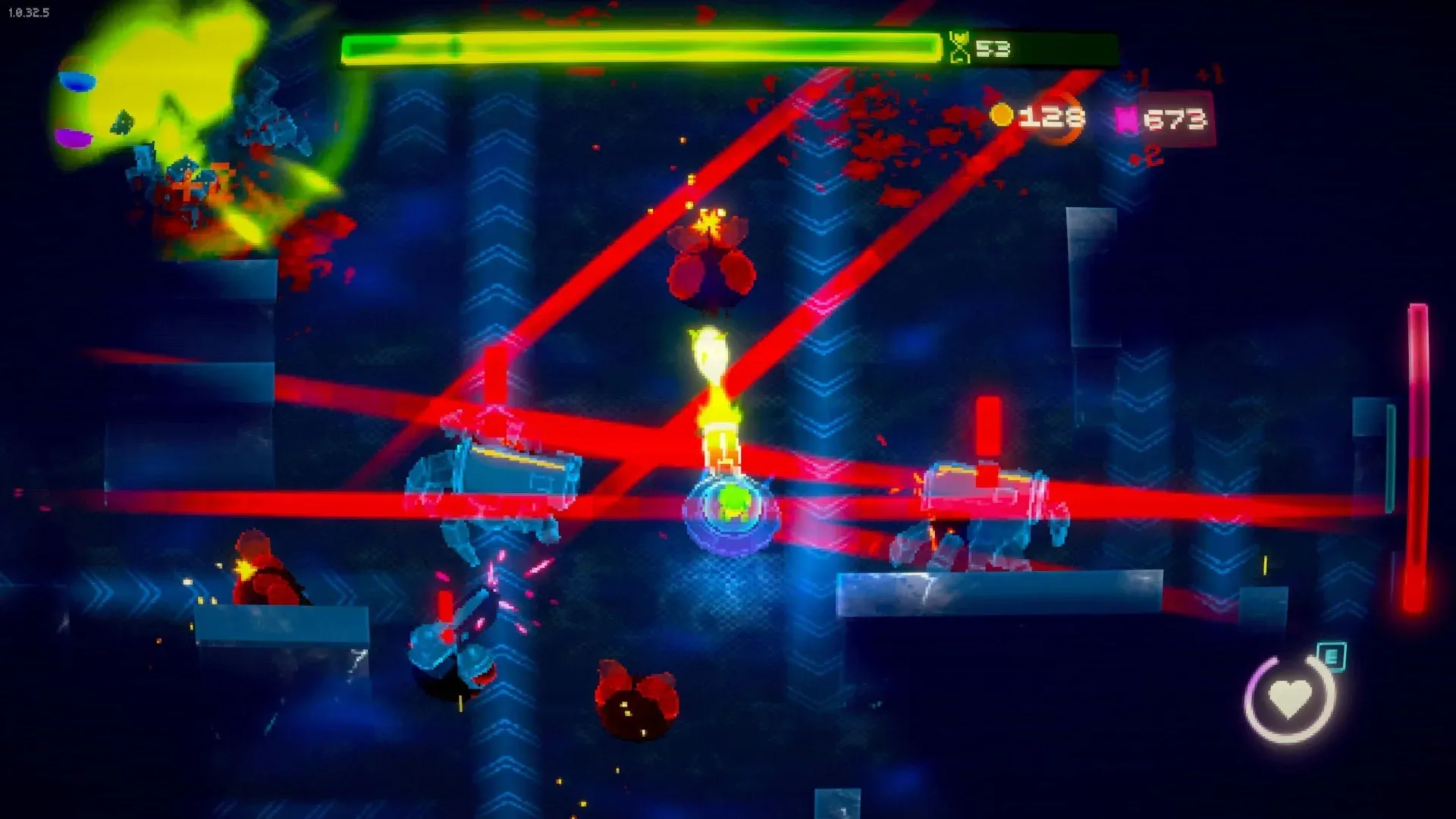
Reaching that weapon changes the run’s rules. The game switches into an isometric shooter: an action game viewed from an angled overhead perspective rather than from directly above or through the character’s eyes. Enemies that were hazards to evade become targets to clear. Killing them awards tickets, turning the run into a more aggressive push for rewards.
The contrast matters. The early portion asks for route planning, positioning and a willingness to leave threats alone. The shooting portion asks for a different kind of control: dealing with the same hostile space once a weapon is finally in hand. It is a deliberately arcade-like transformation, built around a single decisive pickup rather than a gradual change of genre.
Players who complete a round can open the gacha balls collected along the way and choose one result as a new ability or bonus. In this context, gacha refers to randomized reward selection: the balls contain possible improvements, but the player does not fully determine what options will appear. Unshine Arcade softens that randomness by letting a successful player select from the contents opened rather than simply forcing one undisclosed outcome.
Roguelite structure, with an arcade wrapper
After rounds, a branching route presents the next destination. The available choices are relatively focused rather than sprawling: another ordinary round, a chance to obtain more gacha balls, a shop that exchanges coins for additional balls, or an upgrade stop for improving abilities already acquired. Difficulty increases as a run advances, and enemy variety helps prevent the repeated cabinet game from remaining static.
This is where the term roguelite is helpful. A roguelite generally centers repeat attempts around variable rewards, escalating challenge and knowledge gained over time, while allowing at least some progress to carry beyond a failed run. Unshine Arcade follows that broad pattern, but gives the loop the logic of an old ticket arcade. Tickets are both the visible prize for shooting enemies and the practical currency that keeps the larger mystery moving.
Related coverage includes Unshine Arcade Turns a Haunted Game Room Into a Roguelite Full of Secrets.
A failed attempt does not erase every gain. Tickets earned before the run ends are still awarded, so a loss can continue to contribute to later progress. That is an important structural choice for a game whose atmosphere encourages experimentation. It means a player can investigate a system, discover an interaction or simply earn enough tickets to power another device without needing to reach the final boss on every attempt.
There are also discs that alter the character of the main arcade game, along with ways to raise difficulty in return for higher ticket yields. Increased base movement speed is one of the improvements that can change how the cabinet feels, making travel through its rooms faster and potentially shifting the balance between avoiding danger and seeking rewards.
Tickets are not merely a score
The standout idea is the role tickets play after a run. In a conventional arcade, a roll of paper tickets is an endpoint: trade it for a small prize, then leave. Here, tickets seem to be the connective tissue between the action game and the building full of machines.
- A claw machine provides another way to acquire gacha balls for future attempts.
- A battery vending machine can power devices that are currently switched off.
- A slot-machine-like device allows tickets to be gambled.
- A Pong-style game is among the arcade’s side activities.
- Locked doors and new rooms can be approached by learning codes.
- An AI asks for increasingly large ticket payments in exchange for its freedom.
That last element gives the progression loop a welcome question mark. The AI’s request is clear enough, but its trustworthiness is not. Rather than framing ticket expenditure as a purely mathematical upgrade decision, the game places some of its investment behind an uncertain narrative objective. Players can choose to feed the machine intelligence’s demands, pursue practical power gains, or explore whatever other mechanisms become available as more of the arcade opens up.
The codes are especially important to the game’s identity. They move the activity beyond an ordinary combat-and-upgrades cycle and toward a secret-hunting structure. New areas and unusual devices make the arcade itself an ongoing puzzle box, while gradual exploration reveals more of its story. Cheat codes can also be discovered, adding another appropriately arcade-era layer to the idea that knowing the right input can change the experience.
A grimy look without total gloom
Visually, Unshine Arcade uses dense pixel art and a restricted range of muted blues, greens and pinks. The setting is abandoned and off-kilter, yet it is not presented as relentlessly oppressive. Ticket-printing moments give success a deliberately cheerful jolt, and the strange chatter from the AI helps preserve an eccentric, playful energy beneath the unease.
That tone is a meaningful fit for the mechanics. The game features gambling-adjacent imagery—claw machines, randomized gacha balls and a slot-style device—but its principal emphasis is on mastering a fictional cabinet and unearthing the systems around it. The broader arcade is full of machines that seem designed to be prodded, decoded and powered up rather than merely observed as set dressing.
There is a practical pacing implication as well. The cabinet’s repeat-run structure may be best suited to shorter visits rather than one long push to exhaust every secret. The combination of persistent tickets, incremental upgrades and unexplained devices gives even brief sessions a route toward tangible advancement. At the same time, the central maze-and-shooter cycle is intentionally repetitive, so its appeal will depend on whether players enjoy refining a familiar activity while opening up more options around it.
What prospective players should expect
Unshine Arcade is not presented as a massive map-based adventure or a traditional linear campaign. Its appeal is in the interaction between a contained action loop and a growing network of arcade-room discoveries. Each attempt can produce tickets, coins, gacha balls, abilities and information. The result is less about rushing to a single ending than returning to the cabinet with new tools and a better understanding of the strange room housing it.
Players looking for a clean, highly strategic route map may find its branching progression modest. The choices mostly revolve around another run, more randomized rewards, a shop, or improving existing powers. But that narrowness also keeps attention on the cabinet’s shifting two-phase challenge and on the off-screen consequences of spending its tickets.
It is also worth separating the game’s visual retro sensibility from actual retro hardware. Unshine Arcade is a contemporary PC release using an imagined arcade setting, not a newly uncovered cabinet from a past era. Readers interested in the hardware side of nostalgic game culture can also check out this DIY retro console project built around CDs.
Unshine Arcade is priced at $10 on Steam, and a demo is available that covers a substantial portion of the experience. For players drawn to compact roguelites with oddball presentation, persistent progress and secrets that extend beyond the combat arena, its peculiar ticket economy may be the real prize: every enemy cleared inside the cabinet can become another attempt to understand what, exactly, is waiting outside it.