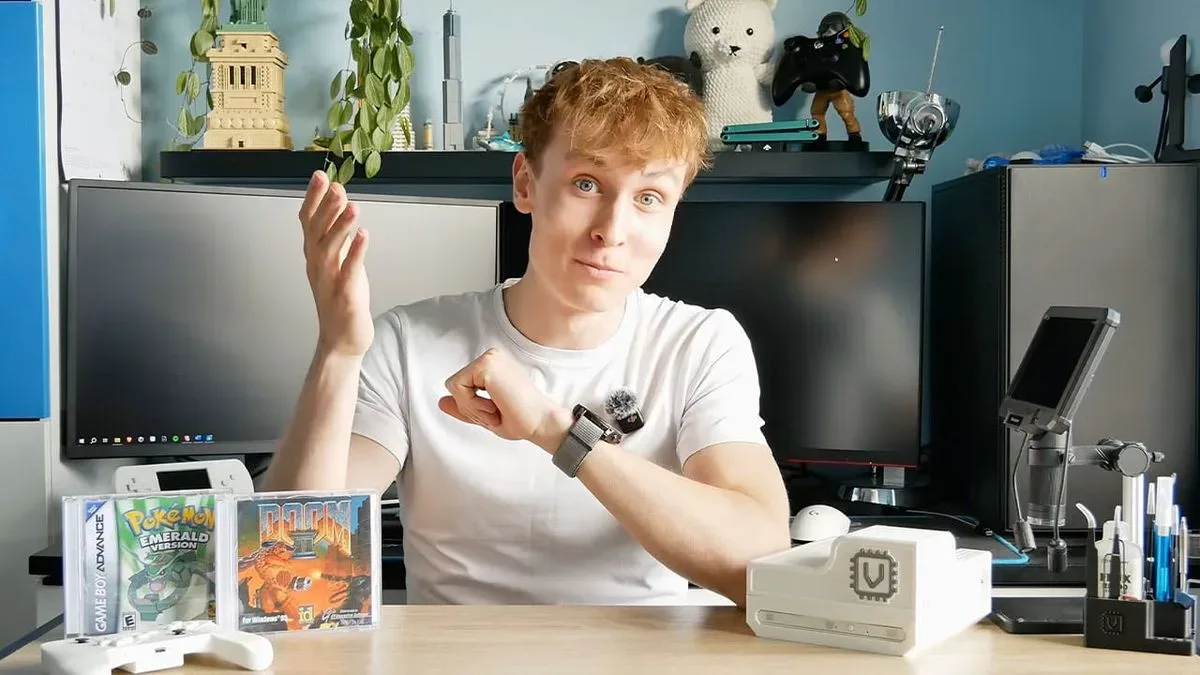
For anyone who misses the tiny ceremony of opening a disc case, reading a label and feeding a shiny circle into a machine, a modder named Emmet has built a delightfully impractical-looking answer to the all-digital age: a DIY retro game console that uses optical discs.
The project is built around an Intel N150 single-board computer running Batocera, a Linux-based retro-gaming operating system. Rather than treating a CD as a conventional game disc from an original console, Emmet’s system uses each optical disc as a physical delivery method for a game’s ROM file and a tailored shell script. Insert the disc, and the script places its associated game into the appropriate location in Batocera’s library.
It is a distinctly modern computer performing a throwback ritual. The hardware is compact and contemporary; the experience asks players to select a labeled disc, slot it in and make a game feel like a separate physical object again. And because this is a proper enthusiast project rather than a bare circuit board on a desk, Emmet has also created 3D-printed cases, printed labels and box art. A wireless controller of Emmet’s own design completes the setup.
A disc is the key, not necessarily the game medium
The important distinction is in how the machine uses the CDs. The discs are not described as running original retail software in the manner of a PlayStation or PC CD-ROM. They contain a ROM file plus a shell script that handles the game’s placement in Batocera’s software library.
A ROM, in retro-gaming usage, is a digital copy of game software that can be loaded by compatible emulation software. An emulator is software that reproduces the behavior of another system closely enough for its games to run. Batocera is designed to organize and launch retro games through such a front end, rather than functioning as a single original console.
The shell script is the project’s quietly clever connective tissue. A shell script is a text-based set of commands used to automate computer tasks. In this case, it means the console does not simply read a game file from a disc and leave the user to sort it out manually. The disc carries instructions for getting that title into the right part of the device’s library. That gives the machine a console-like sense of purpose: a player’s action is not “manage files,” but “put in the game.”
Emmet has shown the concept with Pokémon Emerald loaded onto a CD. The detail illustrates the appeal neatly. A title normally associated with a cartridge-based handheld-era experience is being reintroduced as a labeled optical-disc release for a custom home console. It is not historically authentic, exactly, but it is physically legible in a way a scrolling folder of files rarely is.
Why build a longer route to a game?
From a pure convenience perspective, loading a large library onto storage and selecting a title from a menu would be quicker. That is precisely why the project is interesting. It chooses a little friction on purpose.
Related coverage includes Modder Builds a DIY Retro Console That Boots Games From CDs.
Physical media once made game selection tangible. A shelf, a case spine, a disc label and the act of swapping one item for another all helped define the experience. Emmet’s console recreates parts of that behavior without pretending that an optical disc is inherently the most efficient modern storage solution. The CD becomes an object that represents a game, a trigger for setup and a small piece of homemade packaging design.
That physicality also lends itself to curation. Instead of confronting an enormous all-at-once software list, the owner can make a small, intentional collection of discs. One could imagine differently themed shelves, customized artwork or discs prepared around the games a household actually returns to. Those are possibilities suggested by the format, not announced features of the project, but they explain why an optical-drive interface has charm beyond nostalgia.
There is a social element, too. A disc case can be handed to someone. Its label can be recognized across a room. It can sit in a pile beside the console and silently advertise the evening’s options. Digital libraries are extraordinarily useful, but their abundance can make individual games feel interchangeable. This design makes selecting a game feel more deliberate.
Batocera gives the build its usable foundation
Batocera is the practical half of this whimsical equation. The operating system is aimed at retro-gaming setups, providing a consistent environment for organizing and launching games. That matters because a custom console can easily become a collection of clever components with no comfortable way to use them. By using Batocera, Emmet starts with a retro-gaming-focused software layer and then adds the unusual CD workflow on top.
The Intel N150 single-board computer is likewise a reminder that the project is not attempting to recreate old hardware component by component. A single-board computer places the core computing parts onto one board, making it useful for compact custom devices. Here, it supplies the current-day computing foundation while the optical drive, physical packaging and controller shape the personality of the final machine.
The result is a hybrid of eras rather than a replica of one. It recalls the ritual of installing or launching games from PC CDs and the swapping of console discs, while its actual process belongs to a Linux-based library system. The throwback is experiential: an old interaction pattern repurposed around newer hardware and software.
The handmade presentation is not a side detail
It would be easy to focus only on the disc-loading novelty, but the 3D-printed cases, labels and box art are fundamental to why the idea lands. Without them, the project could amount to a stack of burned discs and a script-driven installer. With them, it begins to resemble a tiny personal game platform with its own physical publishing language.
That is a recurring pleasure of hobbyist hardware: the creator can decide what counts as the “official” version of the experience. Commercial platforms have standardized cases, controller shapes, boot screens and storefronts. A one-off console can be much more specific. Its boxes can be made for one shelf. Its labels can suit one person’s taste. Its controller can be designed around the feel the builder wants.
The project also makes rewritable CDs feel newly useful, if only in a niche and enthusiast context. Their relevance here is not capacity or speed. It is that they are inexpensive-looking, familiar objects that can be labeled, packaged and exchanged in a way that invokes an earlier home-computing and console culture.
What the project does—and does not—promise
This is a custom modder build, not a newly announced mass-market console or an indication that optical media is returning to mainstream game hardware. There is no supplied information about a public release, a price, instructions for reproducing the device or broader compatibility details. The most solid takeaway is the design itself: an Intel N150-based device running Batocera, using CDs that combine game ROMs with scripts to install them into the machine’s library.
Anyone inspired by the concept should also separate the hardware idea from the rights surrounding game software. The supplied details describe ROMs being placed on discs; they do not establish what permissions apply to any particular game file. Rules and rights can differ by title and territory, so a physical-disc workflow does not by itself resolve questions around software ownership or distribution.
As a piece of retro-gaming craftsmanship, though, the console’s appeal is straightforward. It turns a software-management process into a buttonless bit of theatre: choose the art, open the case, insert the disc, pick up the controller and wait for a familiar game to appear. In a hobby that often celebrates original machines, flash storage and ever-larger digital libraries, Emmet’s build makes room for another pleasure—the unnecessary, wonderful ceremony of loading a disc.
For a very different look at where current console technology is heading, see our coverage of PS5’s QSSR AI upscaling. Emmet’s machine makes an entertaining counterpoint: less about shaving seconds off a digital pipeline, more about making the route to a game feel personal.