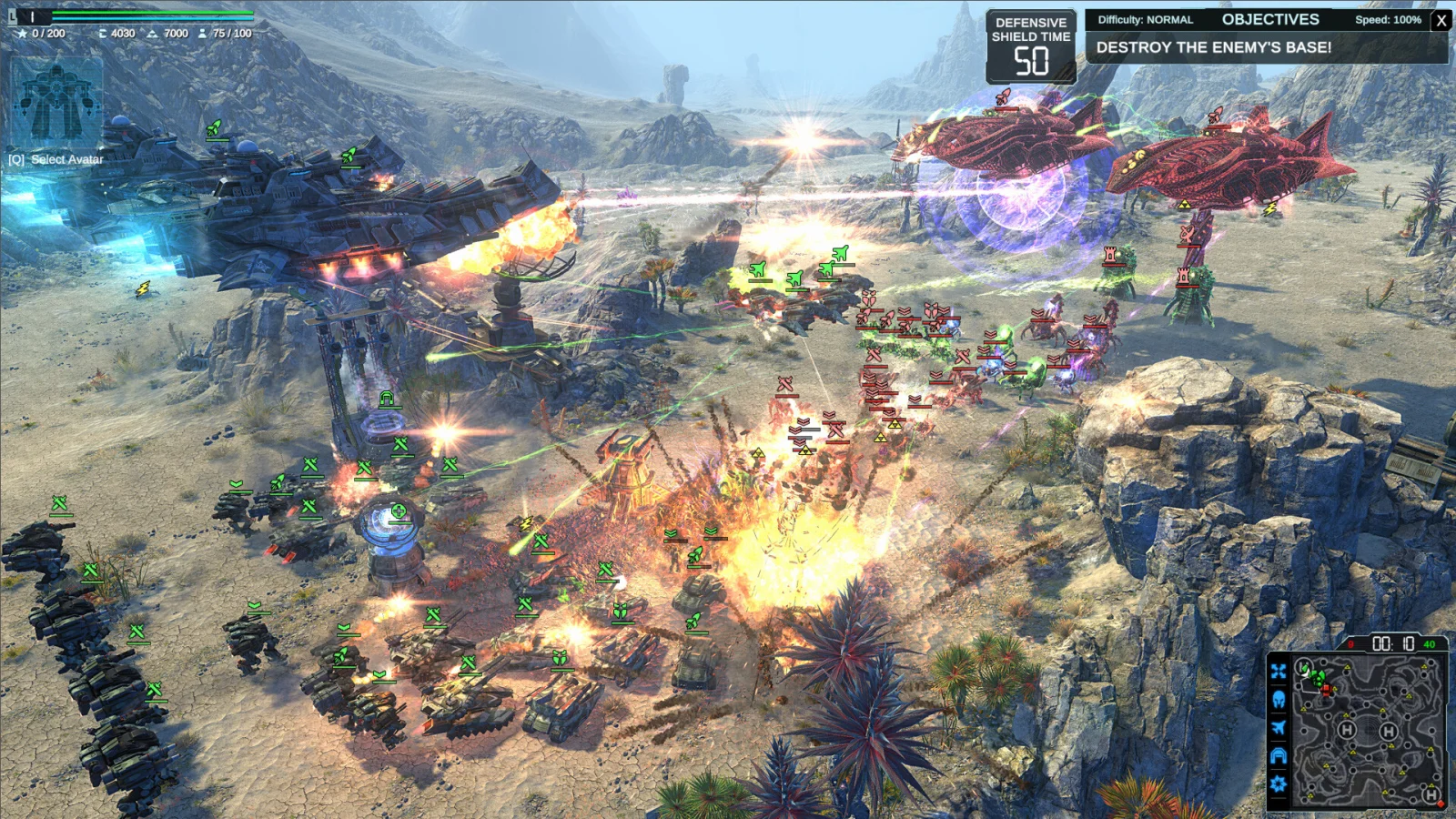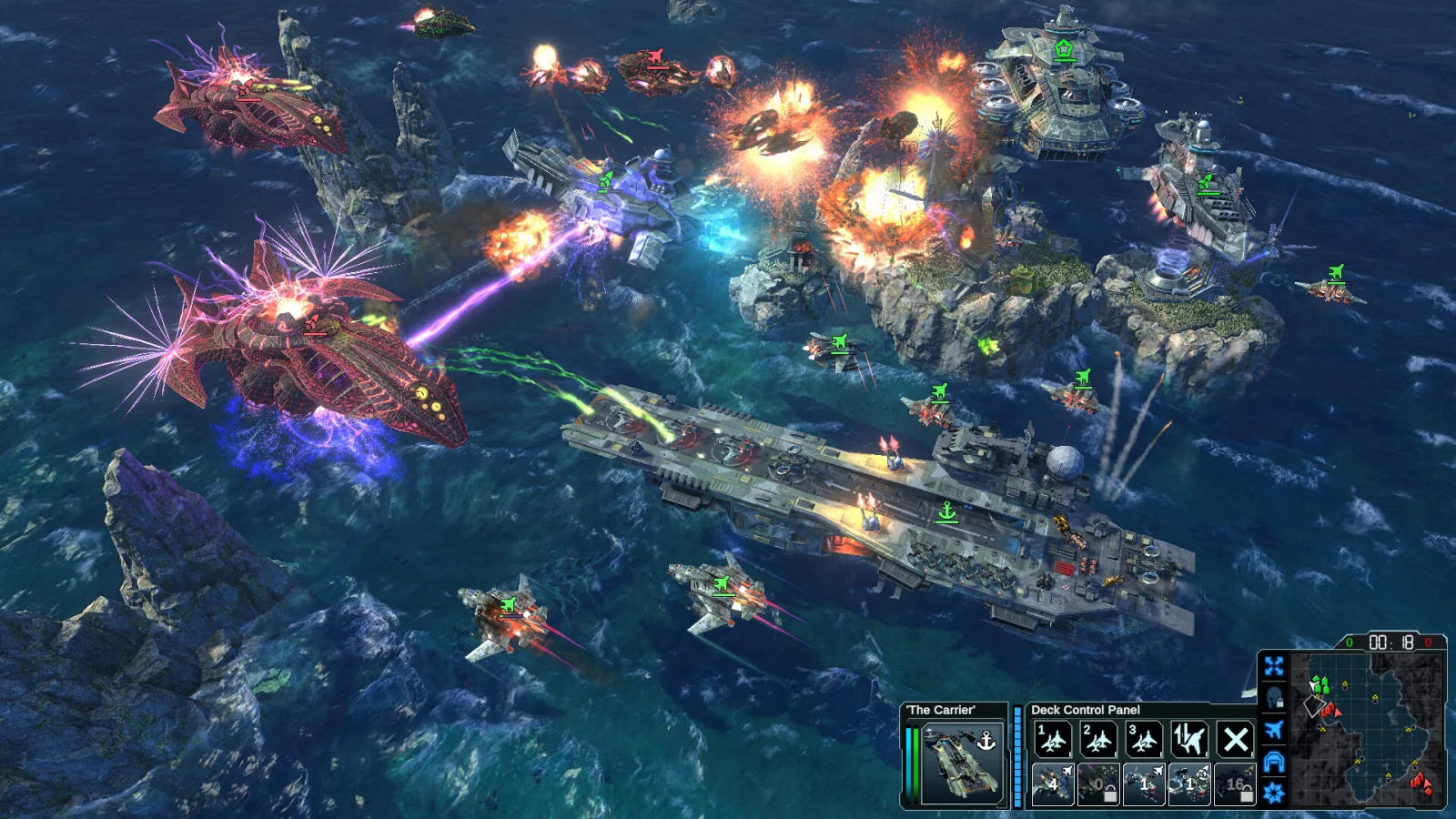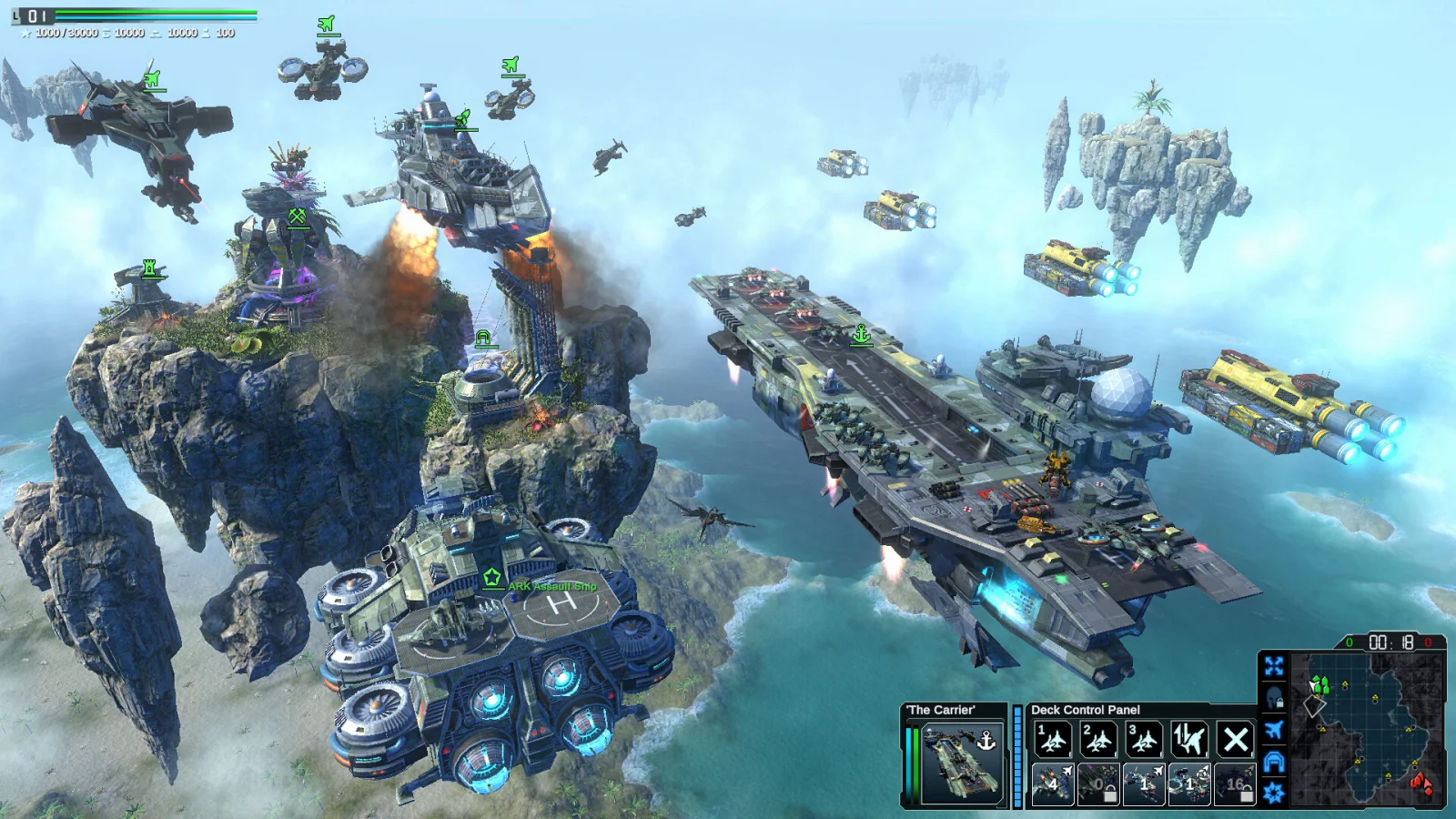
WARSHIFT 2 is built around a particularly demanding proposition: ask players to think like an RTS commander, then let them step into the field as a third-person hero without abandoning the larger war. Developed and published for Windows PC by solo developer Cyril Megem, the game released on July 30, 2026. Its official description promises base construction, resource management, troop command, large combat units including mechs, battleships, and aircraft carriers, hero weapons and upgrades, and the ability to shift from strategic oversight into direct control of a hero unit. There is also a single-player campaign with interactive training missions, custom skirmishes against AI, ten Steam achievements, and a demo.
Those are substantial ingredients, but their coexistence is more important than their count. A strategy game can make resource flow, production queues, unit roles, and map information legible from a high-level perspective. A third-person action game can make aiming, movement, attacks, and immediate danger legible at human scale. WARSHIFT 2 aims to connect those perspectives inside the same battles. That can create a powerful sense that command decisions have physical consequences: an order is not merely issued from a distant interface, but can be followed by joining the push personally. It can also create a severe usability burden. Every layer must communicate clearly enough that the player can understand the war while participating in it.
Established design: command a force, then enter the fight
The verified core is a hybrid of real-time strategy, direct third-person hero control, and RPG progression. At the strategic layer, players build bases, manage resources, and command troops. Large units are part of the stated arsenal, with mechs, battleships, and aircraft carriers specifically named. At the direct layer, players can take control of hero units, whose weapons and upgrades are also listed. The campaign and AI skirmish structure provide contexts for these systems, while interactive training missions indicate that the game formally attempts to teach its moving parts.
This design offers a different fantasy from an RTS that keeps the player permanently above the field. Conventional strategy often asks a commander to solve problems through composition, positioning, timing, and information. WARSHIFT 2 potentially adds a more personal question: when is it worthwhile to stop observing and become an active participant? A hero on the ground can make a confrontation feel immediate in a way that a map icon cannot. Hero upgrades can further tie long-range planning to an individual unit’s development. If the layers reinforce one another, the game can make a battle feel both authored by strategic preparation and lived through at close range.
That possibility should not be confused with a guarantee. Combining systems increases the number of decisions competing for the same attention. A player directing an assault may need to monitor resources and reinforcements. A player personally engaging enemies may need to retain enough awareness to respond when another front changes. The result can be exciting when the game supplies strong information hierarchy, responsive command tools, and automation that behaves predictably. It can become frustrating when the player must repeatedly choose between operating the interface and experiencing the action, or when important events arrive without readable warning.
Scale is part of the appeal. Bases, troops, heroes, mechs, naval units, aircraft carriers, progression, campaign content, training missions, and AI skirmishes amount to a broad design target for a solo-developed game. That breadth is noteworthy because it seeks to bridge categories that are often developed separately. It is not, however, evidence that every category is equally deep, polished, or well integrated. A large feature list establishes intent and scope; the quality of moment-to-moment play depends on how reliably those features communicate and interact.
The central tradeoff: participation versus battlefield oversight
WARSHIFT 2’s most interesting design question is not whether RTS and third-person action can be placed side by side. They plainly can. The harder question is whether switching between them produces meaningful tactical choices rather than administrative interruption. Direct hero control can provide participation and tactical immediacy. It may let a player focus fire, react to local threats, or simply feel closer to a decisive engagement. Returning to the command view can restore the wider context needed for production, positioning, and multi-front decisions.
For this rhythm to work, switching viewpoints needs to preserve orientation. A player should be able to understand what is happening elsewhere after spending time in direct control, and should be able to re-enter the local action without treating the strategic layer as a confusing detour. The interface therefore carries unusual responsibility. It must distinguish urgent information from background information, make unit state comprehensible, and present economy and production data without drowning the battlefield in clutter. A minimap, unit orders, pathfinding, and feedback on commands are not peripheral conveniences in a hybrid like this. They are the connective tissue between the game’s two perspectives.
The economic layer has a similarly high bar. Resource management gives RTS decisions consequence, but it must be readable enough for players to judge what they can build, what they are sacrificing, and why a plan has stalled. If resource information is unclear, direct combat can feel disconnected from the strategic decisions that should support it. Conversely, if the strategic layer demands uninterrupted attention, direct hero control risks becoming a costly distraction instead of a tactical tool. The strongest version of this concept would make the tension deliberate: leaving the overview would be a calculated commitment, not an invitation to lose track of the war.
RPG progression adds another potential bridge. Weapons and upgrades can make a hero’s presence matter over time, while also giving campaign decisions a personal dimension. Yet progression has to coexist with army command carefully. If upgrades make the hero meaningfully more capable, the player may feel encouraged to take part directly. If the wider force remains important, the game can preserve the command fantasy. The stated feature set does not establish how that balance is tuned, so it would be premature to claim whether WARSHIFT 2 achieves it. The valuable point is that the systems are interdependent: hero growth, army utility, economy, and interface clarity all shape whether direct action feels strategically justified.
Reported concerns are especially consequential here
Published criticism has been cautiously positive about the concept while raising concerns about execution. One substantive assessment praised the ambitious blend of top-down command and direct action, identifying moments where the combination suggests a distinctive battlefield experience. The same assessment reported confusing interface and onboarding, awkward direct control, bugs, and a campaign difficulty curve that moves from very simple early missions to far more demanding encounters. Its overall stance was interested in the idea but concerned that the execution needed additional polish.
These reports matter because they point at the exact areas where a hybrid strategy game is most vulnerable. Interface confusion is not merely a cosmetic issue when players are expected to command forces, manage resources, assess the map, and potentially fight as a hero. Onboarding is not a minor optional layer when the game combines several genres with different visual languages and decision speeds. Direct-control awkwardness is especially significant because entering the action is one of WARSHIFT 2’s defining promises. And a sharp difficulty transition can obscure whether a loss comes from inadequate tactics, incomplete learning, or an abrupt change in encounter demands.
Player feedback is mixed-to-positive rather than uniform. At the time checked, Steam’s summary was approximately 70 percent positive from 54 user reviews. That is a small and changing storefront sample, not a critic score and not a stable measure of broad consensus. Individual players have praised the underlying concept, while others have reported pathfinding issues, minimap accuracy concerns, unreliable-feeling unit orders, tutorial pacing problems, and glitches. Those are reports from players, not confirmed universal defects, and the available information does not support claims about their frequency, severity, or present status across all configurations and play sessions.
Still, the pattern is analytically useful. Reports about pathfinding, map information, and orders all concern the trust relationship between a commander and the game’s systems. An RTS can tolerate complexity; it has much more trouble tolerating uncertainty about whether instructions were understood. In WARSHIFT 2, that trust is even more important because the player may be occupied with a hero when a unit needs to navigate, engage, or reposition. If an army’s behavior is dependable, third-person participation can feel like a reward for planning. If the player doubts basic command execution, every moment away from the overview can feel risky for the wrong reason.
Training missions must translate breadth into understanding
The official campaign includes interactive training missions, a sensible inclusion given the number of stated systems. Training has an unusually difficult job in a game that crosses genres. Teaching resource collection or construction in isolation may establish the basics, but it does not automatically teach when to switch into hero control, how to prioritize threats while doing so, or how to recover a strategic overview afterward. A useful learning curve would connect these concerns rather than treating them as separate tutorials that happen to share a menu.
Reported tutorial-pacing concerns suggest that this translation may not always be smooth for some players. That does not establish that the training missions fail outright, nor does it identify a single cause. It does underline the importance of pacing in a design with multiple simultaneous mental models. Early missions need enough pressure to show why systems matter, while later encounters need to build on lessons the player has had a fair chance to absorb. If opening missions are too undemanding, they can leave advanced tools untested. If later missions ask for mastery too quickly, difficulty can feel less like escalation and more like a change of rules.
This is also why conventional RTS fans and action-focused players may evaluate the game differently. An experienced RTS player may be willing to work through a denser interface in exchange for the novelty of personally joining battles. A player arriving primarily for third-person combat may be less interested in managing the structures and resources that make that participation possible. Neither response is inherently wrong. WARSHIFT 2 is not simply offering two separate games; it is asking players to accept the obligations of both sides of its design.
Who the experiment may suit
Players most likely to find value in WARSHIFT 2 are those attracted to genre blends and prepared to meet a systems-heavy premise on its own terms. The draw is not only the presence of heroes, bases, or large units individually. It is the prospect of moving between command and combat within one battlefield framework. Players who enjoy learning an unusual structure, building a force, and then taking a more active role in engagements may find the game’s ambitions compelling, particularly with a demo available to assess whether its basic rhythm feels intuitive to them.
The AI skirmish option also makes the stated package relevant to players who prefer self-contained strategy matches alongside campaign content. What it cannot establish on its own is the long-term depth, balance, or variety of those matches; no such conclusions follow from the feature listing. The safer expectation is simply that WARSHIFT 2 provides a custom-skirmish route against AI in addition to its campaign. For an interested player, that is a concrete part of the offer, not a substitute for confirming how the systems feel in practice.
Players seeking a conventional, highly polished RTS may want to approach more carefully. The reported concerns about interface clarity, onboarding, direct control, technical issues, and difficulty progression cut directly against the qualities this audience often values most: readable information, predictable command behavior, and a dependable learning curve. The same caution applies to players who want third-person combat to stand on its own without regular strategic responsibility. WARSHIFT 2’s identity is inseparable from its hybrid structure, so its potential strengths and its possible points of friction arrive together.
There is a useful parallel in this assessment of tactical clarity: unusual systems become easier to value when the game makes their consequences readable. WARSHIFT 2 has a more expansive stated scope, but the shared editorial question is straightforward. A design can be inventive without being self-explanatory; clarity determines whether players can convert invention into informed decisions.
An unscored assessment
WARSHIFT 2 deserves attention for attempting a difficult union of real-time strategy command, third-person hero action, and RPG progression. Its official feature set gives that effort a tangible shape: base-building, resource management, troops, large vehicles and vessels, heroes with weapons and upgrades, a campaign, training missions, and AI skirmishes. The premise has been recognized in reported criticism as capable of producing distinctive moments. That is a meaningful strength, especially for a solo-developed project whose scope reaches across several design disciplines.
But ambition does not remove the need for precision. Available criticism and player reports identify possible weaknesses in precisely the systems that must carry this concept: interface communication, teaching, direct controls, difficulty pacing, navigation, map readability, orders, and technical stability. These accounts should be read as cautionary signals rather than universal verdicts. They also make the demo especially relevant for prospective players, because no written description can settle whether an individual player finds the shift between commander and hero invigorating or burdensome.
For the right audience, WARSHIFT 2 may be worth examining as an experimental battlefield game with a strong central idea. For players unwilling to tolerate possible friction around that experiment, a more conventional RTS may be the safer choice. The case for WARSHIFT 2 rests on its willingness to make strategy personal. The unresolved question is whether its layers consistently provide the clarity and reliability needed to make that personal involvement feel earned.