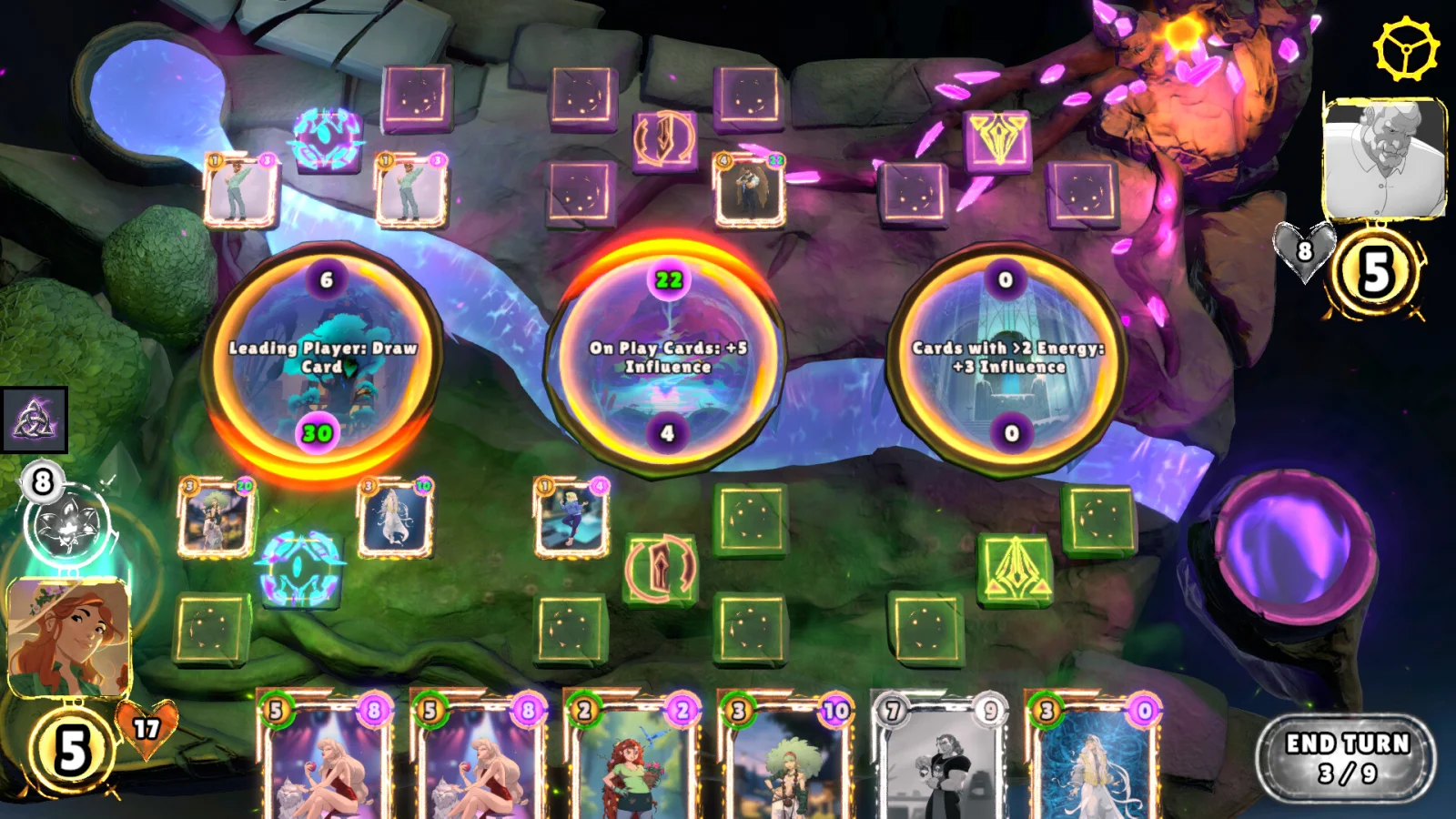
Petty Ungodliness is an in-development single-player roguelite deckbuilder for Windows from CRNG Games, with no release date announced. Its stated premise has immediate character: forgotten gods have lost their power and taken retail jobs. Rather than using divinity merely as decorative fantasy language, the announced design puts relationships with those gods at the centre of deck construction. That creates a promising connection between who the player deals with and what tools become available in combat.
The other central official pillar is tactical structure. Battles take place over three lanes called Places of Power, and strategy is said to be defined by team composition, relationships, cards, and divine powers. That is a substantial set of overlapping considerations for a roguelite deckbuilder. The appeal is clear: a run could potentially be more than a sequence of individually efficient card picks, because the people or gods involved may matter to the shape of the deck and to how it functions on the three-lane board.
At this stage, though, Petty Ungodliness should be judged as a proposition in development rather than as a finished combat system. Public playtest observations point to a tutorial that is colorful, readable in important respects, and potentially quite busy in motion. The game’s defining tradeoff is already visible. Its retail-deity premise and relationship-led deckbuilding could give it a memorable identity in a crowded genre, while the density of its interface, effects, upgrades, abilities, runes, and dialogue will need careful management if that identity is to feel inviting rather than overwhelming.
Officially established: a deckbuilder where relationships are part of strategy
The official description establishes several concrete elements without filling in every rule or progression detail. Petty Ungodliness is single-player. It is a roguelite deckbuilder. It is planned for Windows. Forgotten gods work retail jobs after losing their power. Relationships with those gods shape the player’s deck. Combat is organised around three tactical lanes, the Places of Power. Team composition, relationships, cards, and divine powers are all identified as strategic factors.
Those facts are enough to identify an unusually ambitious design intersection. A deckbuilder generally asks players to evaluate cards not only for isolated strength but for combinations and situational value. A lane-based battlefield adds positional questions: which lane matters now, where pressure is building, and how an action’s placement alters the next decision. Adding a team and relationship layer suggests that card selection may sit inside a broader set of affiliations rather than existing as a detached pool of rewards.
That does not establish precisely how relationships are initiated, represented, changed, or rewarded. It does not establish the number of available gods, the exact form of team-building, the structure of a run, the details of targeting, or how divine powers are activated. Those are not gaps to fill with assumptions. They are important questions because the game’s strongest announced idea depends on the eventual relationship between fiction and function being understandable to the player.
If a relationship has a clear deckbuilding consequence, then characterization can become mechanically meaningful. A player may have a reason to care about a god beyond a line of dialogue or a striking illustration: that connection could inform a deck’s practical direction. Conversely, if the link is too opaque, players may find themselves making choices without a confident sense of how their social decisions shape tactical capability. The eventual design does not need to reduce every character interaction to a numerical transaction, but it will need to communicate enough cause and effect for relationship-driven construction to feel intentional.
The retail-god premise is more than a surface-level hook
Fantasy games have no shortage of powerful gods, ancient grudges, and apocalyptic stakes. Petty Ungodliness shifts the frame toward diminished deities in retail employment. That juxtaposition can support humor, personality, and a more intimate scale without requiring the game to abandon supernatural tactical stakes. A god who has lost power is already a useful thematic contradiction. Put that god into a customer-facing workplace, and the setting gains a built-in source of friction: the grand and the mundane occupy the same space.
Public-facing material and early commentary have highlighted that unusual premise, and that reaction is understandable. It gives Petty Ungodliness an immediate answer to the question of why this deckbuilder might be memorable before a player has learned a card rule. The theme also has an opportunity to reinforce the relationship system. If the gods are not abstract vendors of powers but people with frustrations, history, and retail-day pressures, then a deck connected to relationships has a stronger conceptual foundation than a generic loyalty meter would.
The conditional part is important. The premise will carry the game only if the game’s mechanical communication meets it halfway. A highly distinct setting can attract attention, but turns still need to be readable and choices still need to have interpretable stakes. The more the design asks players to consider team membership, relationships, lane state, cards, divine powers, upgrades, and runes at once, the more it must establish a hierarchy of attention. A player should be able to identify the immediate tactical problem before parsing the longer-term construction opportunity.
Three Places of Power could create productive tactical pressure
The three-lane arrangement is the most concrete combat-specific feature announced so far. Lanes can be valuable because they transform an otherwise broad combat problem into a spatial one. A player is not simply deciding what to play; they may also need to decide where the choice belongs and what it protects, contests, or enables. With exactly three Places of Power, Petty Ungodliness has the potential for a board that is compact enough to scan while still presenting competing priorities.
That potential rests on legibility, not merely on having lanes. The player needs to understand what differentiates one Place of Power from another at a glance, which lane is currently urgent, and what result a card or ability will produce in that space. If multiple game elements can affect each lane, visual distinction becomes a tactical necessity rather than a presentation luxury. It is not enough for a lane to look attractive; its state must be quickly interpretable when the player is considering a hand, a team ability, and a relationship-shaped build direction.
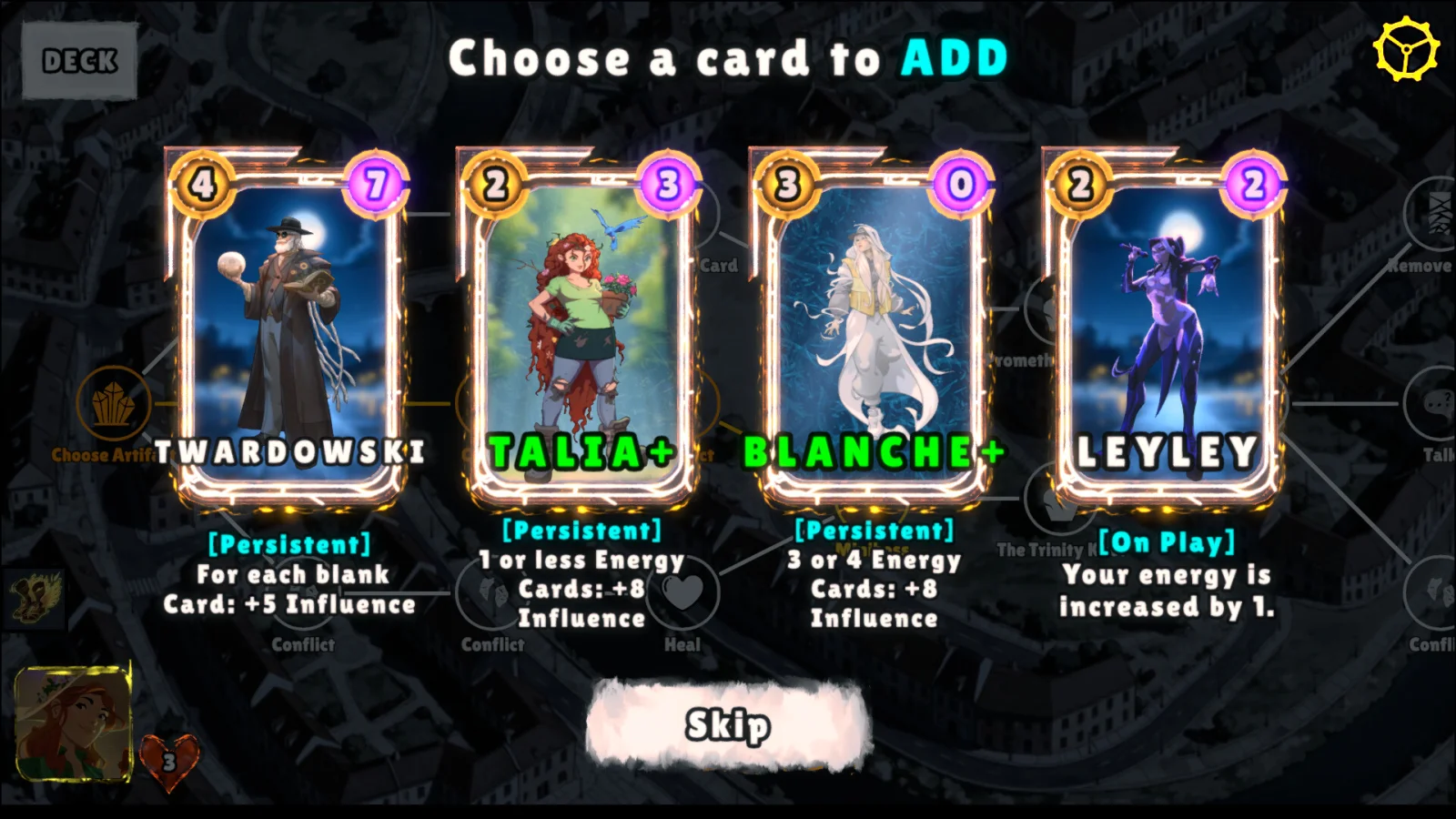
Public tester observations make this the key area to watch. The same feedback that praised large, readable card text also warned that character chatter, upgrades, abilities, runes, glowing effects, and interface information can collectively feel visually busy. These points are not contradictory. A game can make individual cards easy to read while making the total screen harder to prioritise. In fact, that contrast offers a helpful diagnosis: typography may already be doing useful work, while the broader composition of information may need further refinement.
For newcomers to deckbuilders in particular, a dense screen can turn a meaningful choice into an exhausting one. This does not mean complexity is a flaw or that Petty Ungodliness should flatten its systems. A roguelite deckbuilder can benefit from giving experienced players multiple interacting levers. The question is whether the game can stage those levers: first communicate the current threat, then the available response, then the deeper optimisations. If everything calls for equal attention, the player may struggle to discover what actually matters.
There is a useful related perspective in our assessment of tactical clarity in Bloomkeeper: a system can have many moving parts, but the decision space becomes more approachable when the most consequential information is apparent at the moment it is needed. Petty Ungodliness has its own announced systems and should not be treated as a direct comparison. The broader design principle remains relevant. Readability is not separate from tactical depth; it is what lets players perceive and use that depth.
Early observations: a tutorial with strengths and a pacing question
Public playtest feedback describes the tutorial as colorful and brief, with clear explanations of the basics. It also specifically praises the readability of card text and the quality of the artwork. These are encouraging observations for a game whose pitch combines a specific visual identity with several strategy layers. Clear baseline instruction and readable cards are particularly important in a deckbuilder, where a player may repeatedly return to card text while learning how effects interact.
At the same time, the same body of early feedback raises a tutorial-pacing concern through its description of how much information appears around the player: simultaneous chatter, upgrades, abilities, runes, visual glow, and interface elements. A brief tutorial is not automatically too short, just as a longer one is not automatically clearer. But a compact introduction has to decide what players need to retain immediately and what can be allowed to become relevant later.
Petty Ungodliness may benefit if its onboarding introduces a dependable reading order. First, a player needs to know the present lane situation. Next, they need to grasp what their cards and divine powers can do. Then they can absorb how team composition and relationships influence future deck choices. Runes and upgrades may be valuable sources of depth, but their value will be easier to appreciate once the core language of a turn is secure. That is a conditional design reading, not a claim about the current build’s exact tutorial sequence.
The art praise matters here as well. Strong artwork can make character connections and card identity easier to remember, especially in a game about gods whose relationships influence construction. Yet visually appealing assets and visually clear play are related but different achievements. Effects, portraits, interface panels, and chatter can all be individually successful while competing too aggressively during a tactical decision. The strongest version of Petty Ungodliness would preserve its colorful personality while ensuring that urgent combat information remains the visual lead.
Why relationship-driven deckbuilding is the promise worth following
The concept that relationships shape the deck is Petty Ungodliness’s most important announced differentiator because it can bridge systems that are often kept apart. Narrative characterization is frequently presented in dialogue, while deck construction happens in menus or reward screens. If the game makes those elements meaningfully interdependent, then choices about gods could create a stronger sense of authorship over a run’s identity. A deck may feel like it reflects not only a preferred mechanical archetype but also the bonds the player has chosen to cultivate.
This should not be mistaken for a confirmed guarantee that every relationship choice changes every aspect of play. The official information supports the central connection, not the extent or granularity of the implementation. Still, the design direction offers real promise. A relationship system can make rewards easier to contextualise when the player understands why a card belongs to a particular god or team. It can also make characters more memorable when their mechanical contribution reflects their personality or role in the setting.
The risk is that the relationship layer could become one more information category competing for attention rather than a framework that makes the rest easier to understand. The best outcome would be an explanatory relationship: knowing a god and the player’s connection to them helps clarify why certain deck options appear and what strategic role they support. A weaker outcome would leave players staring at additional labels, icons, or meters without gaining a clearer model of their available choices. That distinction will be revealed by future builds, not by the premise alone.
What to watch as development continues
There are several practical questions worth carrying forward without turning them into assumptions. Can a player scan all three Places of Power and identify the immediate tactical priority? Can they tell the difference between a card’s direct effect, a divine power’s role, and any relevant rune or upgrade influence? Does the interface distinguish persistent information from temporary spectacle? When character chatter appears, does it enrich the scene without obscuring decision-critical feedback?
The same applies to relationships. Future material may clarify whether the relationship system makes deckbuilding more expressive, more constrained, or both. Constraints are not inherently negative in a roguelite; they can give a run shape and encourage adaptation. But the player needs enough explanation to recognise a constraint as an interesting strategic condition rather than an arbitrary limitation. Since team composition is also an announced factor, clarity around the interaction between team choices and relationship-driven deck shaping will be especially valuable.
For now, the most defensible conclusion is measured optimism about the core proposition. Petty Ungodliness does not need to rely on generic fantasy imagery to communicate its personality. Its retail-god setup is distinct, its three-lane Places of Power give combat a clear spatial frame, and its relationship-led deckbuilding could connect character and strategy in a satisfying way. The public observations also identify a concrete development challenge rather than an abstract worry: the game must make its many visible systems readable together, especially while introducing them to players who do not already have genre habits.
Preview verdict
Petty Ungodliness has an identifiable design promise: make relationships with fallen retail-working gods part of a three-lane roguelite deckbuilder’s strategic fabric. Officially announced features suggest a game reaching for more than card efficiency alone, while public playtest feedback points to real strengths in artwork, card readability, and introductory explanations. That same feedback appropriately cautions that the cumulative screen load can become busy.
As an in-development project, it is too early to convert that tension into a final judgement. The most encouraging path is also the clearest: preserve the color, character, and layered tactical ambition, while making lane state, priority information, and tutorial sequencing effortless to follow. If the eventual build lets players understand what is happening before asking them to master everything that could happen, its distinctive premise may have the room to become a genuine strategic identity rather than merely an arresting setup.