Nintendo Switch Sports Resort understands the important difference between a sport and a party game wearing trainers. Its 12 events are built for swift explanation, immediate physical comedy, and the small triumph of realizing a motion controller has understood the wildly approximate gesture just made in the living room. That accessibility is the collection’s core strength. It has enough control variety to make its activities feel distinct, enough solo structure to avoid treating unaccompanied players as an afterthought, and an especially strong multiplayer framework. The catch is that many events remain deliberately light once the initial novelty and learning curve have passed.
This is a bundle designed around motion controls rather than detailed athletic simulation. That is not a criticism by itself; it is the reason the game can move so fluidly between bowling, golf, archery, boxing, basketball, volleyball, table tennis, tennis, thumb wrestling, skateboarding, power cruising, and prop plane. The broad appeal comes from being able to understand the premise almost immediately. A player need not memorize a long list of button combinations before joining in. The controller position and the motion being requested generally communicate the intended action before a tutorial has finished its housekeeping.
A dozen events, one clear invitation
The selection balances familiar activities with stranger additions. Bowling, archery, boxing, and golf offer recognizable starting points, while thumb wrestling, skateboarding, power cruising, and prop plane widen the tone beyond conventional sports. This mixture matters because a compilation like this needs events to create different moods, not merely require different arm movements. A round of bowling can support a low-stakes group contest; a prop-plane session has players flying about to pop balloons and visit landmarks; skateboarding shifts the input concept in another direction.
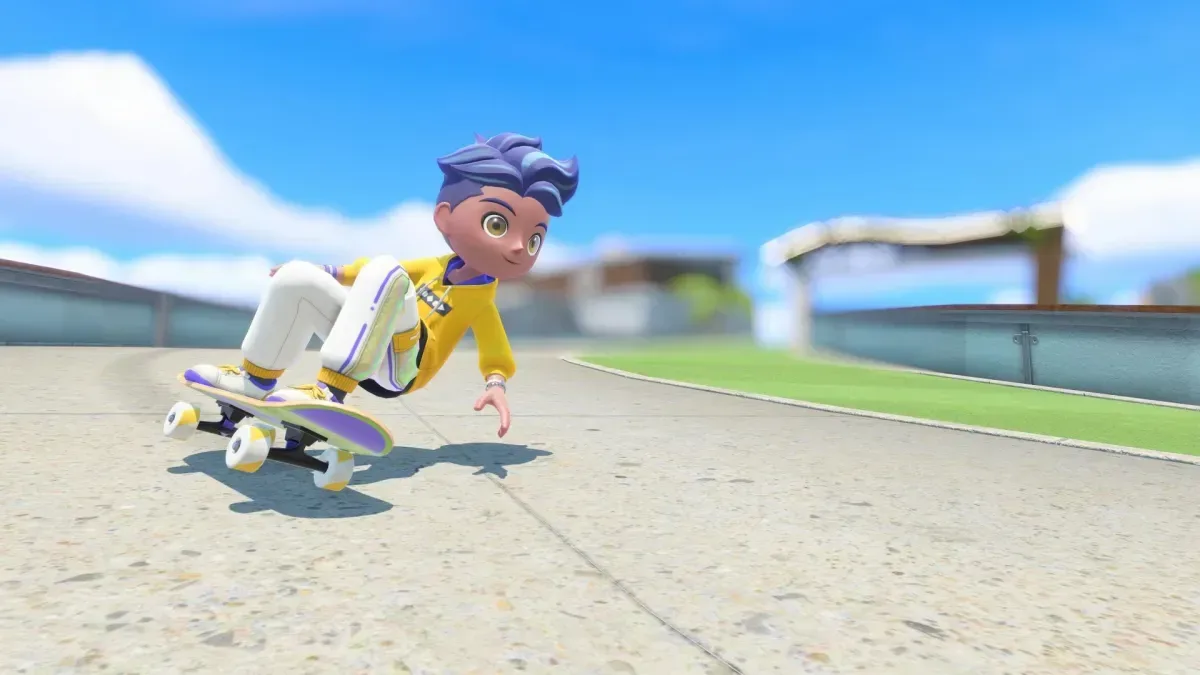
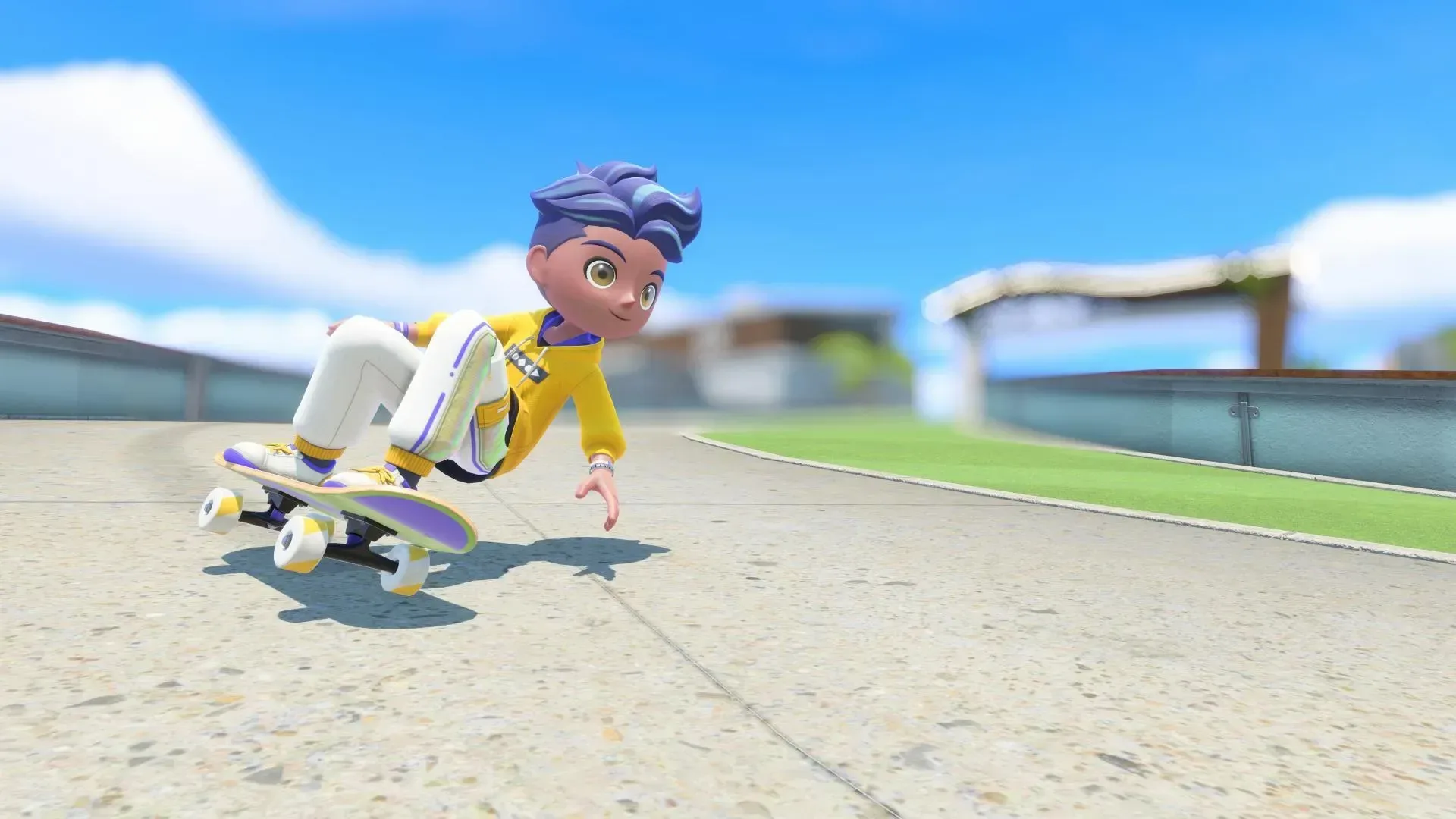
Skateboarding is the most notable example of the game stretching its controls. It uses the Switch 2 Joy-Con mouse mode to mimic a skater’s kick-push. That is a clever use of the hardware because it gives the event an identity beyond simply swinging a controller in a new rhythm. Prop plane is similarly legible in concept, asking players to hold a Joy-Con like a paper airplane. It sounds like the sort of idea that can make spectators smile before they have even had a turn—which is valuable party-game currency.
Not every motion-to-action translation is equally comfortable or intuitive in practice. Holding a Joy-Con in the prop-plane position for extended stretches may cramp a hand. Boxing also asks for a particular interpretation of punching: turning the wrist makes the character sway rather than attack. That is an understandable control mapping once learned, but it introduces a small gap between real-world instinct and the game’s preferred input. For an experience that otherwise earns goodwill by feeling obvious, these exceptions stand out.
Wuhu Island becomes more than a backdrop
Skateboarding, power cruising, and prop plane are grouped as leisure sports, using the renovated Wuhu Island for timed exploration across land, sea, and sky. Their landmarks and collectible Spocco Points lend the island a practical role rather than making it decorative scenery between menus. The result is a useful change of pace inside a sports collection: these activities are not only about winning a direct match, but also about moving through a space with a time limit and a reason to look around.
Spocco Points feed into character customization, unlocking themed elements after activities. Sportsmates are the default cartoon-like character models, with Mii characters still available as an option. That choice is welcome. Players attached to the older avatar style are not forced to abandon it, while Sportsmates provide a more expressive, customizable alternative. The progression itself is modest, but it gives repeat sessions a concrete reward without pretending cosmetic unlocks are a substitute for fresh events.
For players interested in other Switch-focused coverage, Super Dev Quest on Nintendo Switch offers a very different kind of single-player proposition. Sports Resort, by contrast, works best when its brief activities are treated as a rotation: pick an event, settle a score, change sports before the joke or rivalry gets stale.
Island Crown gives solo play a proper lane
The biggest structural improvement is Island Crown, a single-player mode spanning nine sports. Players rise through ranks, take on NPC opponents, and pursue a championship, with some encounters using special rulesets. It gives solitary sessions direction that a menu of disconnected minigames would lack. Increasingly unusual bowling lanes, windier archery ranges, and more strategic table-tennis opponents provide a sense that the game is asking for improved execution rather than simply repeating the first match with a different score target.
Island Crown is valuable precisely because party games often assume the party will supply all momentum. Here, the ladder offers an answer for anyone who wants to practice, unlock customization items, or spend time with the game without organizing a lobby. It also creates a sensible route into events that may otherwise be unfamiliar. A player can learn the contours of a sport alone before finding out whether friends are charitable enough to ignore the first several spectacular misses.
Still, the mode exposes the collection’s ceiling. The events are intentionally surface-level, and tougher opponents do not always add the kind of new decisions that sustain a deep competitive game. Better tennis opposition may demand sharper angles, and golf opponents may become more competent, but heightened proficiency alone is not always the same as heightened excitement. The most successful ladders are those where the rules themselves become more playful. Bowling, with moving obstacles and ramps, asks players to adapt rather than simply perform the same action more accurately.
That distinction is the review’s central reservation. Sports Resort has capable fundamentals and a generous range of activities, yet it does not consistently build enough twists into the higher levels to keep every sport surprising. The collection can be excellent at starting a session, then less persuasive at extending it once players have internalized their favorite event’s basic demands.
Multiplayer is the main event
Local and online play remain the clearest reasons to own the package. The friend-lobby system allows different sports to occur simultaneously within the same lobby, which is an unusually helpful piece of social design. It reduces the need for every participant to agree on a single activity at once and lets a group shift attention without dismantling the session. That flexibility suits a compilation whose individual games have different appeals.
Special variants also provide the welcome sense that the game can change the terms of a familiar sport. Simultaneous archery, 100-pin bowling, skateboard racing, and prop-plane balloon battles create more immediately legible reasons to revisit activities. They are particularly important because the standard events can eventually reach diminishing returns. A variation with a different pace or altered objective is not merely extra menu garnish; it is what helps transform a casual round into a story the group remembers afterward.
The overall multiplayer appeal should be clear. This is a strong fit for households, regular game nights, mixed-experience groups, and players who prefer motion-driven competition that can be understood at a glance. It is less convincing for someone seeking a detailed long-term sports simulation or a solo campaign whose later stages radically transform the game. The package has broad range, but it does not turn every event into a deep hobby.
Small games, sensible ambitions
Nintendo Switch Sports Resort succeeds because it knows how much it needs to accomplish. Its activities are approachable, the controls are generally easy to grasp, the leisure sports make good use of Wuhu Island, and Island Crown gives solo players meaningful structure. Its best moments come from the collision of motion controls, quick rules, and company—especially when variants inject an unexpected wrinkle into a familiar discipline.
Its limitations are just as clear. Physical comfort can be an issue in at least one control posture, boxing’s mapping may feel counterintuitive, and too many higher-skill encounters lean on stronger opposition rather than more inventive conditions. But the collection is varied enough that a weak fit with one sport need not define the whole package. There is no obvious dud among the 12 events, even if some will inevitably become personal destinations while others wait patiently in the changing room.
Buy it for the multiplayer rotation and treat its solo ladder as a worthwhile bonus rather than the sole attraction. With the right group, the game has the ingredients for regular return visits: easy entry, quick resets, different sports in the same lobby, and just enough customization and progression to keep the whistle from blowing too soon.