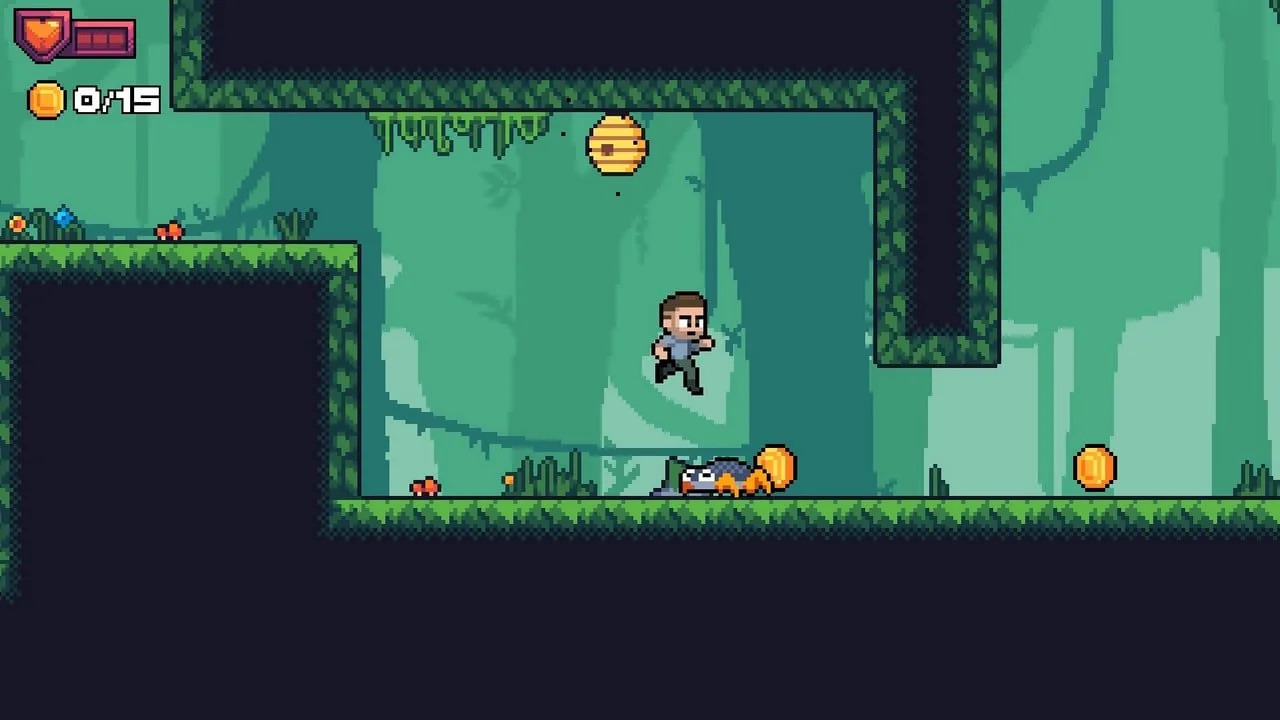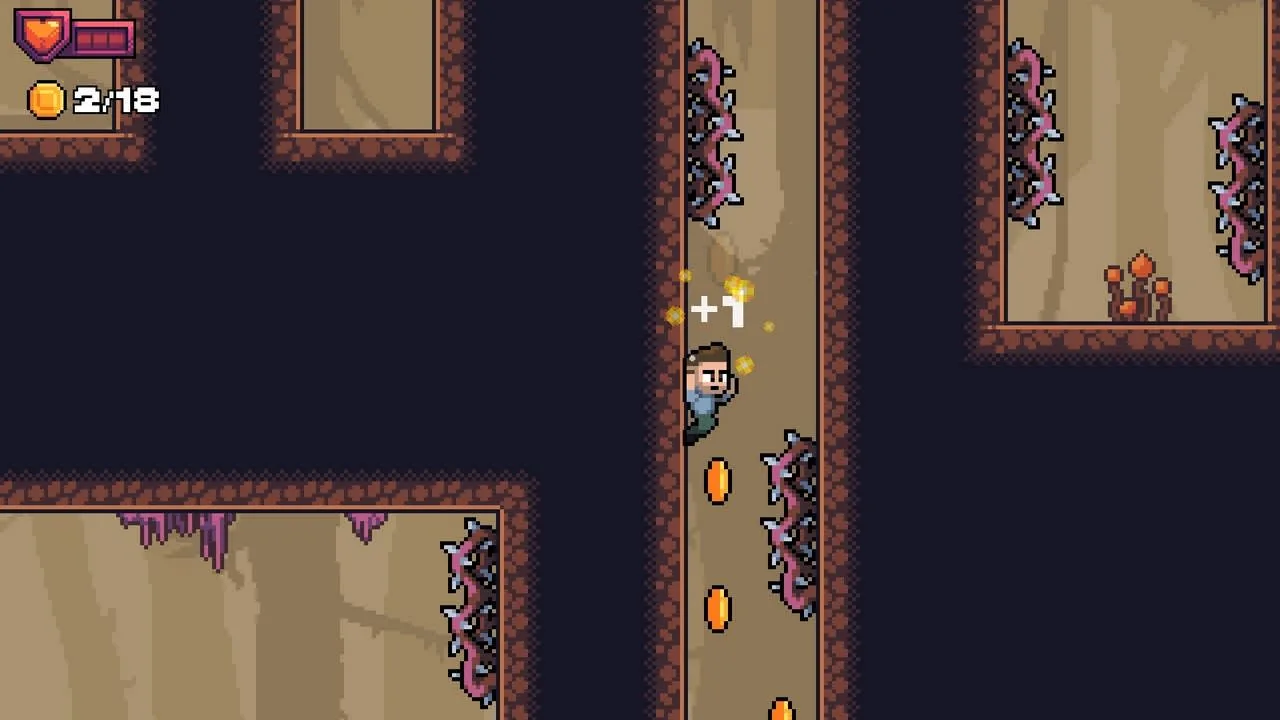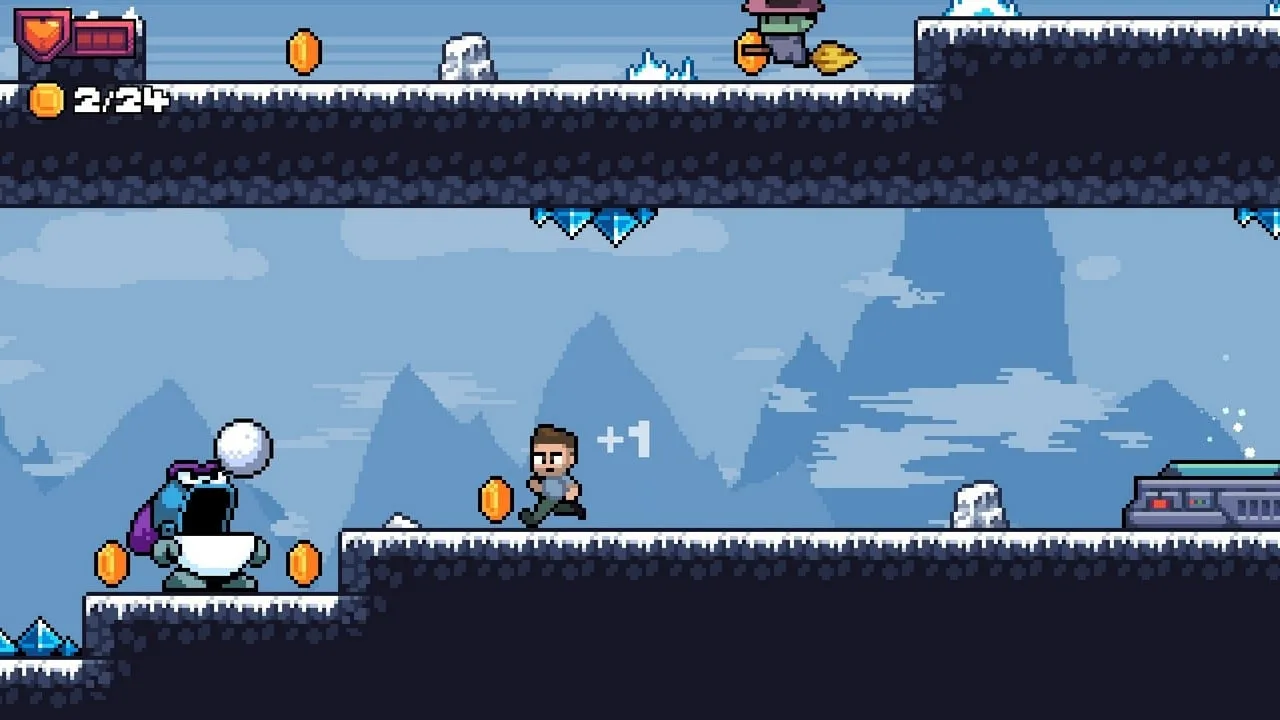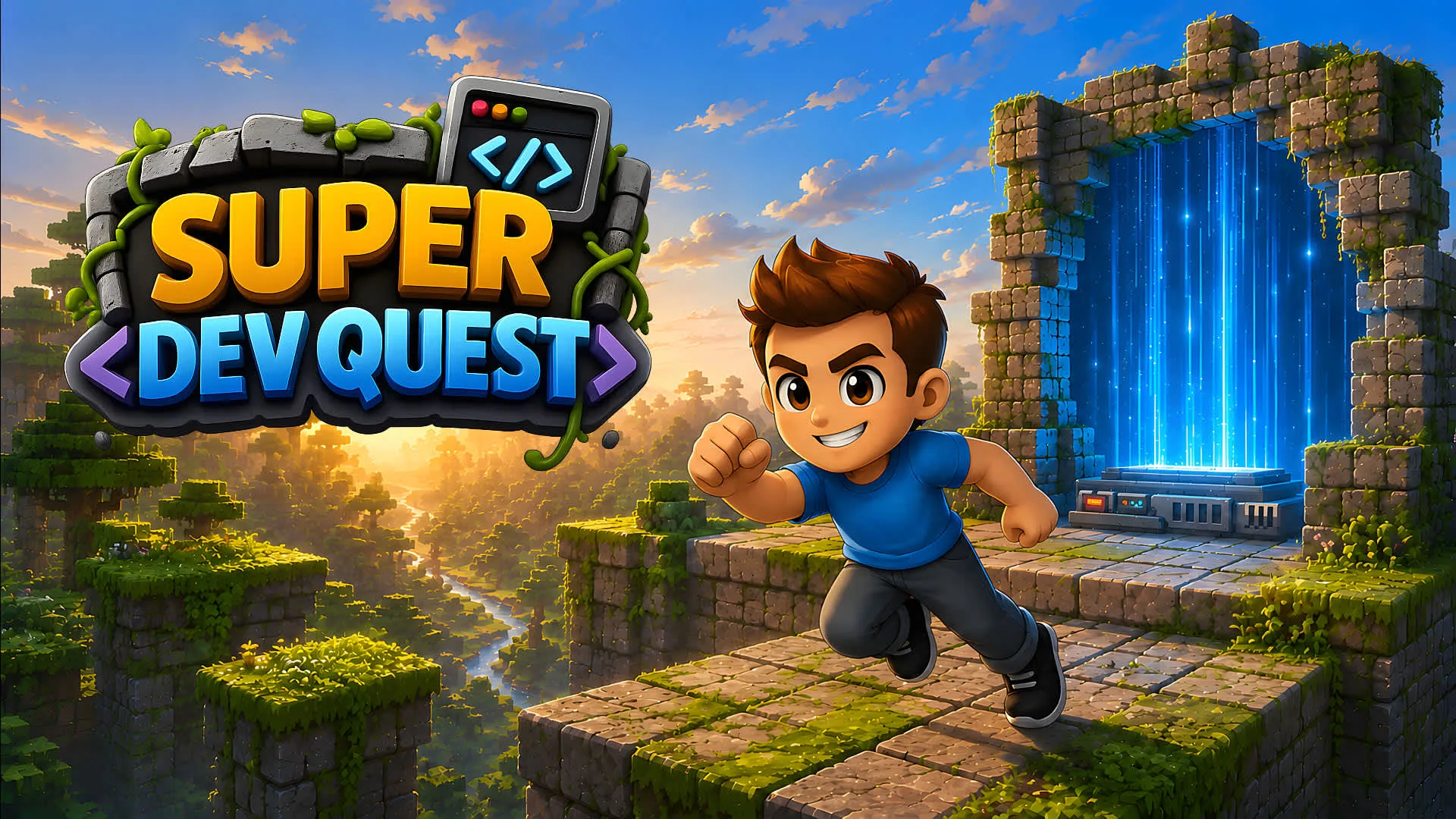
Super Dev Quest is a digital Nintendo Switch release developed by Magnific Studios and published for the platform by Brainium Games on September 24, 2026. It is listed as a single-player pixel-art 2D platformer in which a young developer is transported into a game he created. The stated gameplay vocabulary is immediately recognizable: trap-filled levels, enemies defeated by jumping on them, coins, portals unlocked through collection, and wall slides and wall jumps used to reach new areas.
That combination positions Super Dev Quest as a traditional platformer with a specific fiction wrapped around its familiar tools. The central hook is not that the game abandons genre convention, but that its protagonist finds himself on the other side of those conventions. Traps, platforms, hostile creatures, currencies, and portals become the terrain of a game world he helped make. It is a concise premise that can give a clear identity to an otherwise classic run-and-jump structure.
The official outline also describes multiple levels with progressively increasing difficulty. That establishes the broad intended shape of the game: a series of stages that ask more of the player over time, using a defined movement kit and a set of recurring hazards. It does not establish the precise number of levels, the campaign’s length, the balance of that difficulty curve, the presence or format of bosses, or how the game handles failure and recovery. Those remain important open questions for a platformer, but the available design description is substantial enough to consider what its stated systems are trying to accomplish.
A creator caught inside the machinery of a game
The premise has a useful relationship to platforming’s artificial architecture. In many 2D games, a wall placed at a particular height, a row of coins over a pit, or an enemy stationed beside a ledge is accepted as a simple challenge-room arrangement. Super Dev Quest’s setup can make that constructed quality part of the setting. A developer transported into his own creation is surrounded by deliberate obstacles and obvious game-world devices, whether those take the form of portals, collectible coins, or clearly bounded platforming spaces.
That should not be mistaken for confirmation of a broad meta-fictional story. The supplied information does not establish dialogue, comedy, fourth-wall jokes, branching narrative, commentary on game development, or any particular story structure. The premise may simply provide context for the adventure. Even in that narrower role, however, it is well suited to the kind of straightforward clarity associated with a compact platformer. The character has entered a game world; the player is asked to navigate the rules that define it.
There is a potential elegance in that economy. A platformer does not always need a dense narrative framework to explain why moving upward, avoiding a blade, or entering a portal matters. Its levels can communicate their purpose through space and movement. The creator-in-the-game concept can add thematic flavor without demanding that every obstacle be justified in realistic terms. A locked portal reads naturally as a game-world barrier, while coin collection can read as a direct interaction with a system the protagonist now has to survive rather than merely design.
For players drawn to clear genre premises, this may be part of the appeal. The official description focuses on recognizable actions rather than a long list of unrelated mechanics: traverse hazards, jump on enemies, gather coins, open portals, and apply wall movement to new routes. That focus suggests a game seeking value from arrangement and escalation, not necessarily from mechanical sprawl. Whether its individual stages capitalize on that focus is not established, but the stated foundation is coherent.
Coins and portals could make routes matter
The most consequential progression detail is the stated relationship between coins and portals. Coins are common in platformers, but their purpose varies enormously. They can be score markers, optional completion targets, lives, shop currency, or simple visual guidance. In Super Dev Quest, they are described as a means of unlocking portals. That makes them more than scenery in the game’s published pitch: they are connected to access.
Conditionally, this relationship could encourage a player to study a level rather than only pursue its most obvious exit. If a portal requires coins, then a difficult detour can have progression value. A coin above a wall-jump route, close to a trap, or beyond an enemy may invite the player to judge whether the extra risk is worth taking. A collectible placed directly along the main path asks very little; one placed at the edge of a player’s movement ability can turn route-reading into part of advancement.
The strength of that design would depend on details that have not been supplied. The available information does not say how many coins are required, whether all coins must be collected, whether unused coins carry across levels, whether portals provide linear advancement or access to optional areas, or whether there are alternative ways to proceed. Those details would determine whether collection feels like a rewarding invitation to explore, a gentle completion layer, or a stricter gate. The idea itself nevertheless fits platforming well because it links precision and observation to a visible purpose.
Coin-gated portals could also make a compact move set feel more versatile. A standard jump becomes not only a way to clear a gap but a way to reach a higher collectible line. A wall slide might be a means of safely descending toward a coin, while a wall jump could unlock an elevated route that would otherwise appear inaccessible. The platforming space gains more than one reading: there is the route that keeps a player moving forward and the route that asks them to pursue what will open the next threshold.
That is design interpretation rather than an experienced judgment about the final game. Still, it identifies a promising possibility within the stated mechanics. Portals give coins a defined function, and coins can give level geometry a reason to contain tempting side paths. If the relationship is communicated clearly and scaled sensibly, it could help Super Dev Quest avoid treating collection as a detached score-chasing exercise.
Wall movement expands the language of a 2D stage
Wall slides and wall jumps are the announced movement additions most likely to affect how each level is read. Basic platforming relies on horizontal positioning, jump timing, momentum, and the safe use of landing space. Wall interaction introduces surfaces as active elements of traversal. A vertical shaft can become a climbable challenge. A narrow gap can become a controlled descent. A wall that initially appears to block progress can become the thing that makes a higher platform reachable.
Super Dev Quest’s official information does not define the technical rules of either action. It does not specify jump height, slide speed, the duration of wall contact, chaining behavior, momentum preservation, or interactions with enemies and traps. There is no basis to assume advanced techniques, hidden shortcuts, sequence-breaking routes, or a particular precision standard. But wall movement is inherently capable of widening a platformer’s route vocabulary, particularly when paired with collectible-driven portal access.
Consider the types of choices the stated system could support. A player might slide down a wall to line up a safer landing, then jump away at the right moment to reach a coin line. They might use two opposing walls to rise through a confined space. They might choose between a direct lower route full of enemies and a more vertical route requiring controlled wall jumps. None of these arrangements is confirmed as a specific Super Dev Quest level scenario. They are examples of how the announced tool set could create decisions beyond a single forward jump.
Wall movement also has a natural relationship with traps. Hazards make timing consequential; walls can make timing more layered. A player may have to decide when to hold a descent, when to leave the surface, and when to redirect toward safe ground. In a strong implementation, the wall is neither merely decoration nor a universal escape tool. It becomes part of the puzzle of moving through danger. The degree to which Super Dev Quest achieves that relationship will rest on stage construction, visual communication, and input response.
The game’s publisher describes the controls as smooth and the gameplay as satisfying, but those are promotional claims rather than established editorial findings. For this particular genre, their importance is difficult to overstate. Wall jumps and wall slides can be central attractions when they make directional commitment feel legible and repeatable; they can also expose small control problems more sharply than simpler movement systems. The announced mechanics give players a concrete reason to examine Super Dev Quest, while leaving the final feel of those mechanics unresolved.
Stomps, traps, and escalating challenge
Enemies are described as foes defeated by jumping on them, placing Super Dev Quest within one of platforming’s most enduring patterns. A stomp is a compact rule with several implications. The enemy is a threat, but defeating it requires position as well as timing: the player needs to approach from above and avoid less favorable contact. When an enemy shares space with pits, traps, narrow platforms, or collectible routes, the simple act of landing on it can become part of a broader movement problem.
The confirmed description does not identify enemy types, attack patterns, health systems, rebound effects, checkpoints, or the consequences of contact. It also does not establish whether enemies are frequent obstacles, occasional hazards, or components of elaborate combat encounters. The valuable fact is more modest: Super Dev Quest combines jump-based enemy defeat with traps and level-based progression. That is a recognizably classic 2D foundation, and it places much of the game’s potential on how those ingredients are arranged together.
The same is true of the stated progressive difficulty. In design terms, a gradual ramp could begin by establishing ordinary jumps and basic hazards, then introduce enemy positioning, coin detours, wall slides, and wall jumps in clearer isolation before combining them. Later spaces could ask for faster timing, more attentive route selection, or better command of wall movement. This is one of the ways a limited tool set can gain depth without constantly adding new abilities.
Whether the game’s progression is fair, gradual, demanding, or uneven is not confirmed. Difficulty is not only a matter of obstacle complexity. It can be shaped by checkpoints, readability, collision behavior, recovery opportunities, control response, and the way failure teaches a player what to do differently. Super Dev Quest’s description establishes the intention of tougher stages, not the quality of the curve. That distinction is particularly useful for readers who prefer to know what is solidly known before treating a platformer’s core promise as proven.
What the Switch release establishes
The Switch edition is listed as single-player, in English, and compatible with Nintendo Switch 2. It supports TV, tabletop, and handheld play, includes save-data cloud support, and has a listed file size of 65 MB. Its ESRB rating is Mild Fantasy Violence. These are practical release details for players considering where and how they may want to play.
The 65 MB listing may be relevant for storage planning, especially on a console library with limited available space. It should not be used to infer campaign length, level count, visual variety, replay value, or the amount of challenge on offer. File size is not a reliable measure of any of those things. Likewise, support for the three standard Switch play modes confirms availability across those contexts but does not establish handheld readability, performance behavior, or controller feel.
The available product material includes a primary game image and seven distinct screenshots, indicating a visual presentation beyond the written overview. The official classification of the game as pixel art provides a broad stylistic label, but it does not by itself confirm animation quality, environmental variety, or clarity during difficult sequences. Readers interested in the game’s visual approach can use those materials to judge whether its pixel-art direction matches their tastes.
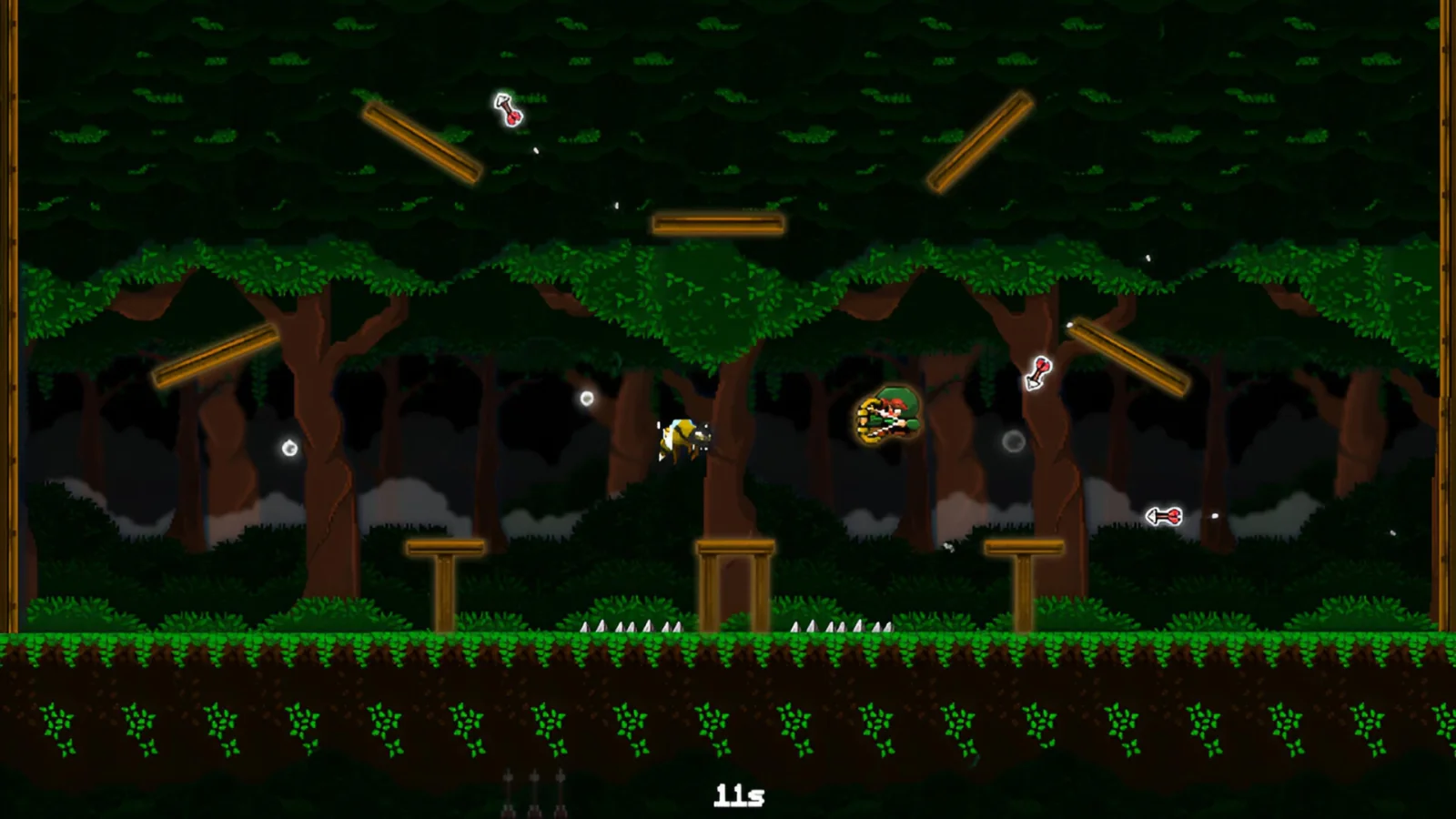
For another design-focused look at a platforming concept on a different game and platform, see Joking Joystick’s Arrow Survival assessment.
Who may want to examine Super Dev Quest
Super Dev Quest may be worth a closer look for players seeking a compact retro-style single-player platformer on Nintendo Switch. Its published premise is easy to grasp, and its stated loop has a disciplined set of priorities: navigate traps, handle enemy stomps, collect the currency connected to portals, and use wall-based movement to reach new spaces. The developer-inside-his-own-game framing gives those systems a thematic hook without obscuring what kind of game is being presented.
Its most interesting design possibility lies in the connection between movement and access. Coins could make the player look beyond the fastest path. Portals could make collection purposeful. Wall slides and wall jumps could turn vertical surfaces into route choices. Enemies and traps could test whether those choices are executed cleanly under pressure. That is a dependable blueprint for a 2D platformer, provided its controls and level design support the demands it creates.
This remains an unscored assessment. The published details establish a clear platforming proposition, not a verdict on its execution. Players who value compact, pixel-art platformers with a traditional movement-and-hazard focus have a concrete set of mechanics to investigate here. Players looking for proof of control quality, balanced progression, technical performance, accessibility settings, scope, or a particular challenge level will need information beyond the currently established outline.