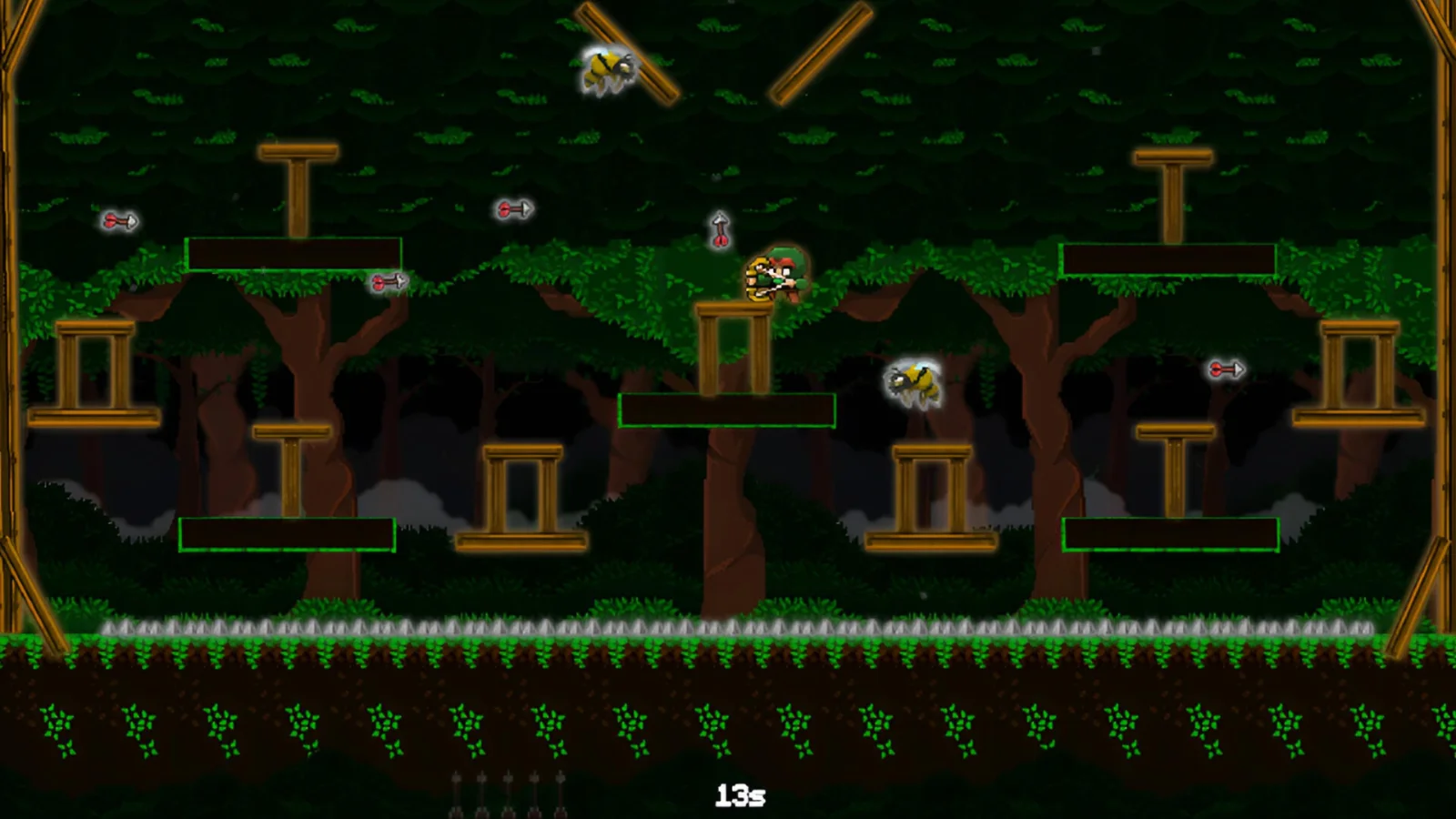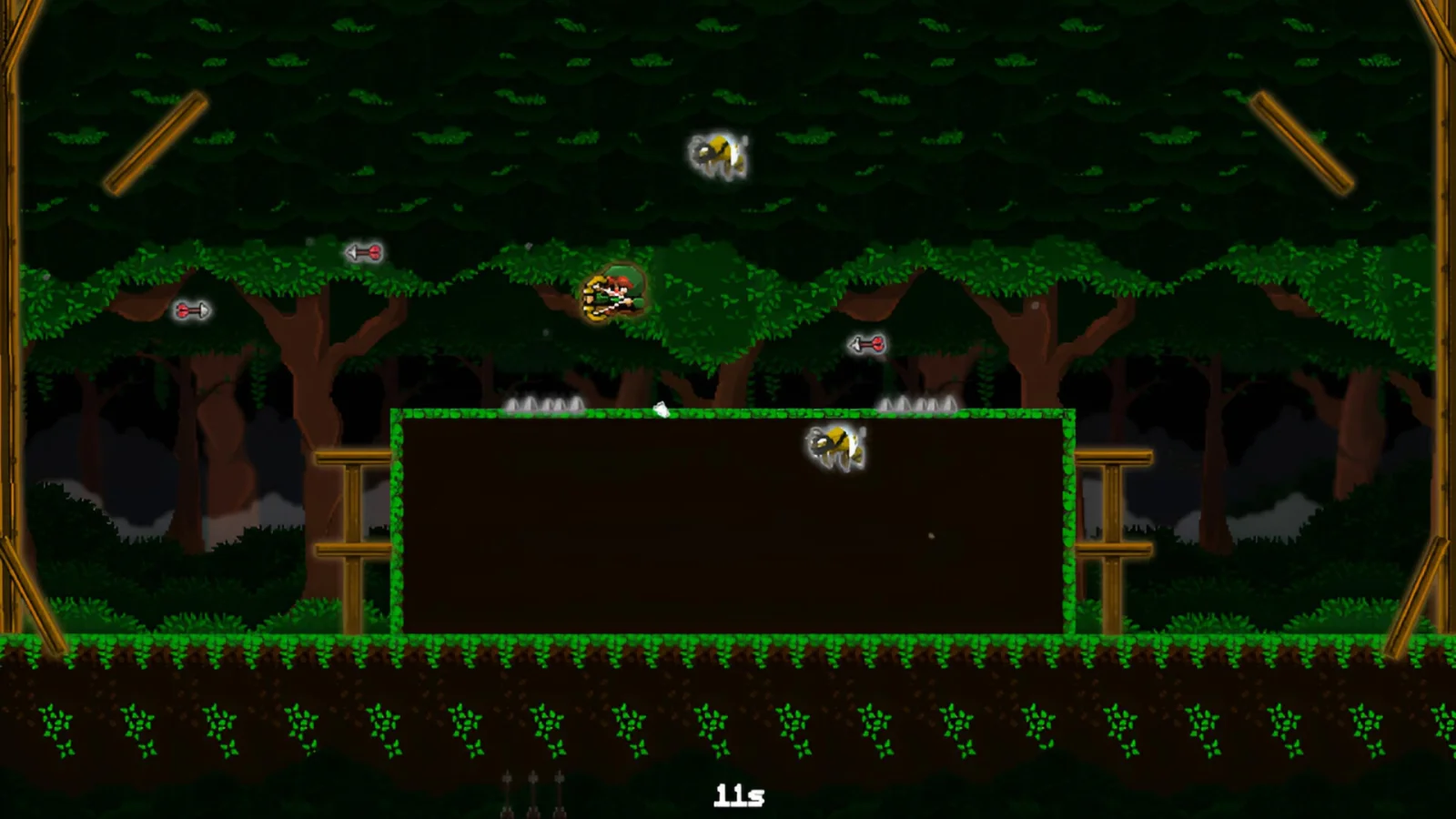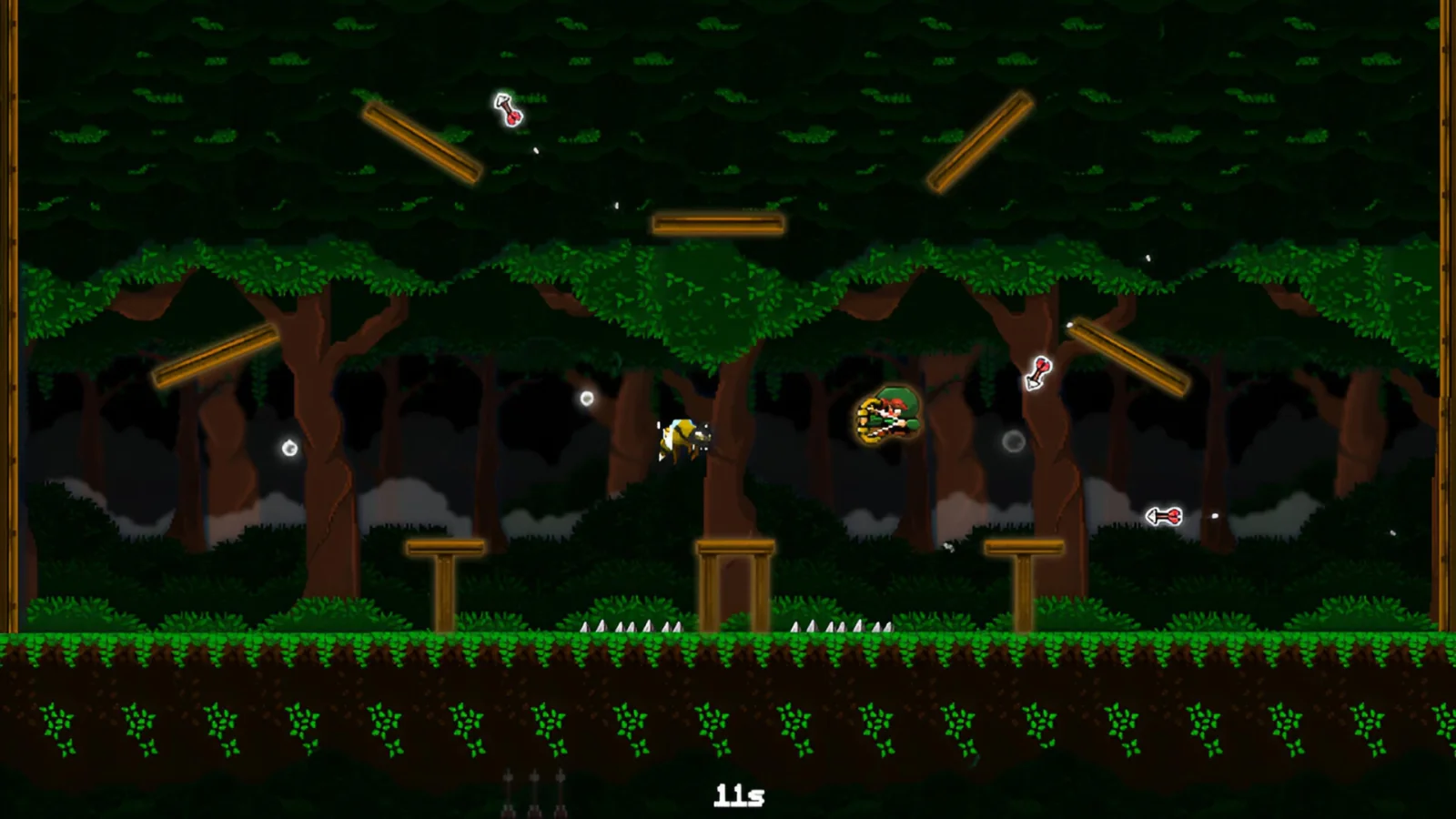
Arrow Survival: 15 Seconds is a Windows PC 2D pixel-art platformer from Brazilian indie developer Low Pixel Byte, released on October 22, 2025. Its premise is both simple and unusually specific: the game contains 40 short stages, each built around staying alive for 15 seconds while dodging hazards and using arrows strategically. That fixed objective gives the game a clear identity before any individual obstacle is considered. The question is not merely how to travel through a platforming space, but how to remain composed until the 15-second survival target has been met.
The advertised hazards include spikes, carnivorous plants, mushrooms and bees. Bouncing platforms can redirect arrows, adding a projectile element to the platforming. New mechanics and increased difficulty are said to arrive across the stage sequence. Together, those details describe a deliberately focused game: a set of contained survival challenges intended to place movement, positioning and decision-making under short-term pressure.
Fifteen seconds changes what success means
A fixed survival target shifts the usual platforming focus in an important way. In many platformers, the broad objective is forward travel: reach an exit, collect a target, or navigate toward a distant destination. Here, the disclosed objective gives equal weight to where the player stands, when they move and whether the next few seconds remain manageable. A safe-looking position may only be safe briefly. A route that provides immediate breathing room may become less appealing if it creates trouble when hazards converge.
Short objectives can also make cause and effect easier to grasp. If a run ends quickly, a player may be able to connect the result to a recent positioning decision or mistimed action without revisiting a lengthy opening section. That structure potentially supports route learning: identifying a dangerous moment, adjusting the response, and returning to the same challenge with a more deliberate plan. In a well-tuned stage, the retry loop can turn a small amount of time into a concentrated puzzle of reactions and judgment. For a different precision-platforming approach to rapid retries, see our Rebounder preview.
Arrows can make movement a planning problem
Arrow Survival: 15 Seconds is not described as a platformer based solely on avoiding hazards. Players also fire arrows, and bouncing platforms can redirect those shots. This is the documented mechanic with the greatest potential to complicate the basic survival task, because it makes the environment relevant to both movement and projectile paths.
A ricochet changes the meaning of an arrow from a simple forward action into something that may need to be considered in relation to the stage geometry. Instead of asking only where to aim, a player could need to think about what happens after a shot meets a bouncing platform. The useful angle may not always be the obvious one. A platform that helps redirect an arrow may also be part of a risky place to stand, creating a possible trade-off between setting up an action and preserving a safe position.
There is risk in that design space as well. More moving elements can raise the demand for readability. If hazards, platforms and redirected arrows all matter at once, the most successful stages would likely need to communicate their immediate priorities clearly enough for players to form a workable response. The developer’s stated approach of introducing new mechanics over the course of the levels is encouraging in principle, since staged introductions can give players time to understand one idea before it is asked to interact with another. The actual effectiveness of that ramp will naturally vary with how those ideas are arranged in the individual stages.
A hazard list with room for contrast
The game’s hazard roster spans spikes, carnivorous plants, mushrooms and bees. Specific behaviors have not been detailed, so these threats should not be treated as interchangeable or assigned assumed movement patterns. Their presence does, however, indicate a broader palette than a stage set built around a single danger type.
Low Pixel Byte says new mechanics appear as difficulty rises. This gives the 40-stage structure a stated sense of escalation rather than presenting it as a flat list of identical timers. The sequence may build a vocabulary of hazards and interactions, then test whether the player can apply that vocabulary under tighter conditions. If that progression is clear, the game’s brevity can work in its favor: each level can introduce or recombine an idea without having to carry a large amount of unrelated activity around it.
A post-launch adjustment worth noting
Version 1.0.1 arrived on October 25, 2025. It fixed an arrow-ground bug, included performance improvements and changed level 18 from two bees to one following feedback about that stage’s difficulty. These are concrete changes rather than a general promise of future refinement.
The arrow-ground fix is similarly relevant to the game’s central hook. When arrows are part of the strategic layer, an issue involving their interaction with the ground can affect how confidently players interpret a stage. Performance improvements matter too, though no exact technical measurements have been announced. What can be said is that update 1.0.1 addressed both a specific arrow issue and a specific difficulty adjustment while also targeting performance.
Release details
Arrow Survival: 15 Seconds is listed as single-player and includes achievements and cloud saves. Its interface and subtitles support English, Brazilian Portuguese, Italian, French and Spanish. These details help make the release more approachable across a range of players, even though they do not answer the more personal question of whether its particular cadence of retries and escalating pressure is a good fit.
Unscored verdict
Arrow Survival: 15 Seconds has a sharply defined PC platforming premise. Its 40 stages are built around a fixed 15-second survival goal, with spikes, plants, mushrooms, bees, strategic arrows and bouncing-platform ricochets forming the documented mechanical foundation. The strongest potential in that setup lies in the interaction between immediate movement and delayed projectile planning: staying safe could demand both a quick response and a thought about where an arrow will travel next.
The early update provides one positive practical sign: an arrow-related bug was fixed, performance was improved, and a difficulty concern in level 18 led to a specific change. With no score attached, the most useful conclusion is simple. Arrow Survival: 15 Seconds is a focused, compact platformer whose identity depends on how much tension and tactical thought its hazards, ricochets and 15-second countdowns can create inside very small spaces.