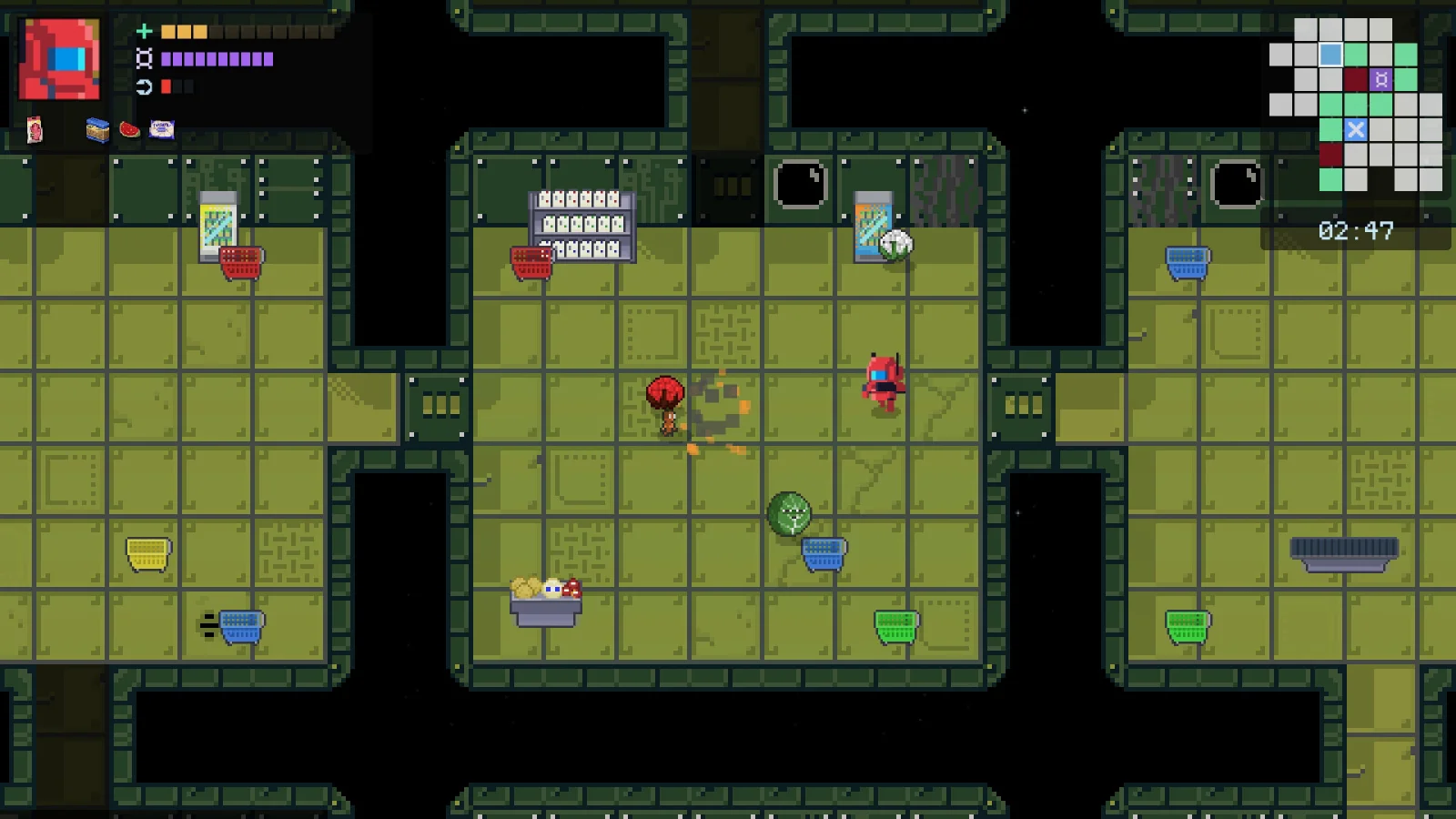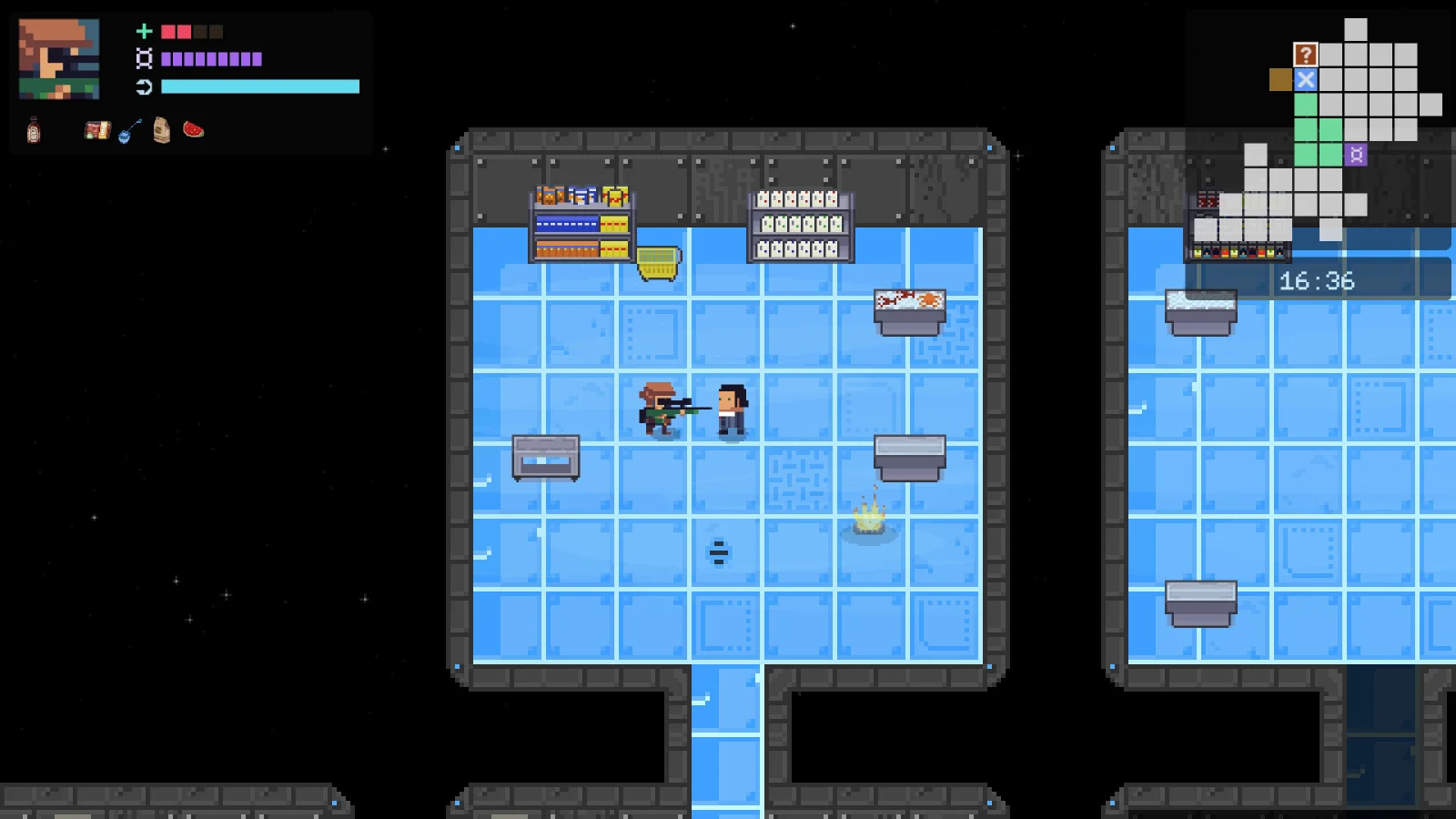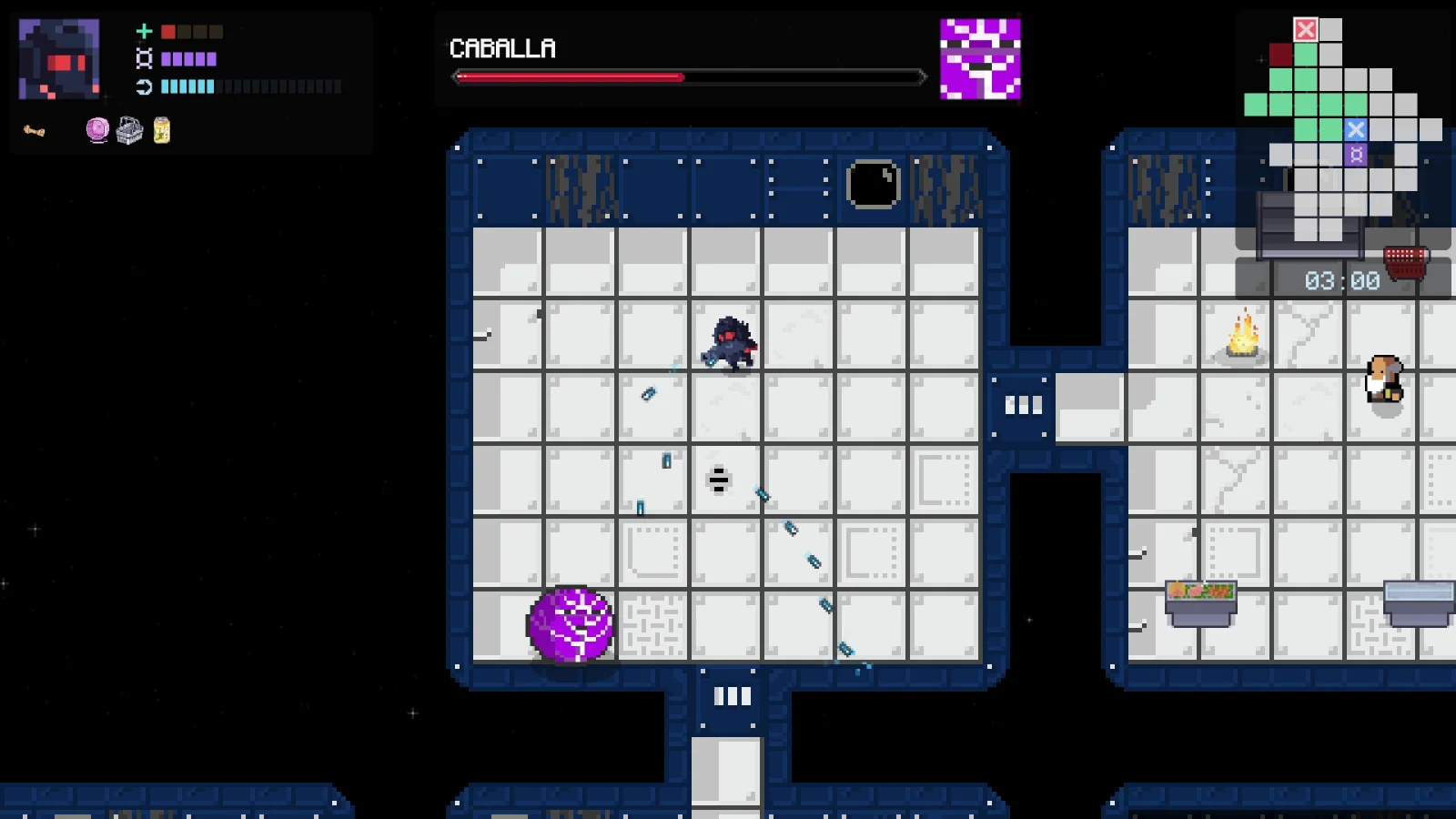
Cosmic Mart is a Windows game developed and published by Barcelona solo developer whipli. Released on July 24, 2026, it casts the player as an extreme-cleaning contractor confronting a flesh-eating alien infestation in a space supermarket. The stated task is to ascend toward the sixth floor and collect a paycheck. That intentionally absurd setup supports a single-player top-down action roguelike and twin-stick shooter built around procedurally generated lethal rooms, enemy and projectile avoidance, item combinations, death, and switching mercenaries between attempts.
This is an unscored editorial assessment, not a hands-on review. The available information establishes a compact action-game proposition, while the critical observations supplied are mixed in a revealing way. Some critics found fast, engaging action, meaningful skill demands, and a broadly well-judged challenge. Another genre-friendly player reported that roughly an hour did not create any desire to return. These are individual judgments rather than a consensus, but together they identify the central question for Cosmic Mart: whether its immediate room-clearing pressure will become a satisfying arcade-like ritual or a loop whose limits arrive too soon for a particular player.
Verified premise and structure
The documented outline is direct. Cosmic Mart asks the player to clear dangerous rooms in an alien-infested supermarket, avoid hostile bodies and incoming projectiles, use items in combination, and progress upward through the building. Its procedural room generation means that room layouts are not fixed in exactly the same arrangement from attempt to attempt. The ability to change mercenaries after death is another stated source of variation, while the sixth-floor paycheck provides a concrete target for the ascent.
That is a solid framework for a focused roguelike, but the labels of those systems should not be mistaken for proof of a specific amount of content or complexity. Procedural generation can produce substantially different tactical situations, or it can reshuffle familiar pressures. Item combinations can lead to choices that substantially alter how a run is approached, or they can have a lighter effect. Mercenary switching might materially change priorities, or it might provide narrower differences. The available facts do not establish where Cosmic Mart sits on any of those scales.
The defensible conclusion is more limited and more useful. The game has several declared systems that could create variation between attempts. Their practical interaction is likely to determine whether returning to the mart feels like solving fresh spatial problems or revisiting a concise action template. Prospective players who prioritize roguelike depth should treat that distinction as the principal uncertainty rather than assume either endless replayability or shallow repetition from the premise alone.
The sixth-floor objective also deserves attention because its simplicity may be an advantage. A compact action roguelike does not necessarily need an elaborate fiction to give its rooms direction. Climbing toward a specific floor turns a sequence of hostile spaces into an ascent with a destination, and the promised paycheck gives the whole premise a dry workplace-comedy frame. The contractor role makes repeated death thematically legible as part of hazardous work in an absurd commercial environment.
That does not establish narrative depth. One critic described the narrative as generic, which should be understood as a personal evaluation rather than a verified account of every story beat. It is nonetheless relevant for players attracted primarily by the alien-supermarket concept. The available evidence supports reading that concept as an identity-setting premise and a clear goal marker. It does not support expecting a story-led science-fiction experience with extensive narrative development.
Immediate pressure and skill demands
Cosmic Mart’s stated genre and systems point toward an action game that reaches its essential demand quickly. In a top-down twin-stick structure, positioning, threat recognition, movement through open space, and the timing of attacks become central concerns. Add lethal rooms and projectile avoidance, and the basic question of each encounter is easy to describe: identify danger, preserve a route through it, commit to offense where possible, and avoid being cornered by the accumulating threats.
That clarity can be a real strength. Players looking for short, concentrated sessions may appreciate a game that does not require a large amount of setup before the core test begins. The room itself supplies the immediate stakes. Death, meanwhile, is part of the declared loop rather than an interruption to a linear campaign. If a player enjoys retrying under pressure and gradually improving movement or decision-making, the structure could make even brief sessions feel purposeful.
A detailed critical assessment characterized the action as fast and frantic, argued that skill is rewarded, and found the overall challenge broadly balanced. A separate positive assessment praised the controls and its perceived difficulty curve. Neither reaction verifies responsiveness or tuning across every PC configuration, every player preference, or every mercenary. They do show that some observers saw an intelligible relationship between failure, learning, and improved execution rather than undirected chaos.
That relationship matters greatly in a game involving both enemy avoidance and projectile avoidance. Fast combat can be exciting when danger is legible enough for the player to recognize a safe lane, react to a developing situation, and understand why an attempt failed. It can become fatiguing when visual density or spatial pressure outruns the available cues. The favorable observations indicate that at least some critics found the game’s action coherent. The negative response indicates that mechanical coherence alone does not guarantee that a player will want to return.
It is important not to turn “frantic” into an automatic compliment. Frantic action may mean energized concentration, but it can also mean that a game demands more visual processing than a player finds enjoyable. Cosmic Mart’s documented structure clearly intends speed and repetition. Whether its encounters feel satisfyingly intense or simply exhausting will remain a matter of personal fit, especially for players with differing tolerances for dense top-down combat.
Players interested in the broader question of readable action pressure may also find a relevant perspective in this assessment of readable chaos in a ricochet bullet-hell concept. That article is not a mechanical comparison: Cosmic Mart should not be assumed to share its systems, structure, or priorities. The common point is simply that fast action games depend heavily on whether players can interpret danger clearly enough to make decisions under pressure.
Replayability has stated hooks, not a guaranteed outcome
Cosmic Mart’s replay case rests on a combination of procedural rooms, item combinations, death, and mercenary changes. Each can potentially interrupt routine. Different room arrangements could change where movement is safe. Different item combinations could change what sort of positioning or offense becomes desirable. Choosing a different mercenary could potentially alter the priorities of a subsequent attempt. Death can then turn another run into a new tactical problem rather than a request to reproduce the previous run exactly.
That is the favorable possibility suggested by the game’s announced design. The counterpoint is not an accusation of weak variety; it is a question the supplied facts cannot answer. If room changes repeatedly present the same solutions, if combinations make only a small difference to decisions, or if mercenary selection has a limited practical impact, the repeated structure may reveal its boundaries faster. Players should not confuse the existence of roguelike ingredients with a firm promise of a certain kind of long-term attachment.
One positive critical assessment identified an upgrade-shop loop as part of what made the package feel substantial. This supports the limited point that one observer saw a recurring layer beyond the immediate act of surviving rooms. It does not document the shop’s inventory, currency, permanence, economy, or progression rules, and none of those details should be inferred. Still, the observation is useful in context. Run-based games often depend on whether defeat leaves the player with a reason to try again, whether that reason is tactical curiosity, long-term accumulation, or simply the desire to improve at execution.
The documented item combinations and mercenary changes, together with that critic’s observation of an upgrade-shop loop, suggest potential continuity between attempts. But different players seek different forms of continuity. Some want distinct builds and changing tactical identities. Some want broader persistent progression. Others are content with a clean chance to perform better the next time. Cosmic Mart may satisfy one of those expectations more readily than another, but the present evidence does not justify specifying which.
The dissenting review is especially useful because it came from someone who normally enjoys roguelites. After approximately an hour, that critic did not feel motivated to keep playing. This does not prove a general retention problem, nor does it invalidate the positive reactions. It demonstrates a simpler point: genre affinity is not enough by itself. Players who enjoy procedural runs may still have very different needs concerning atmosphere, novelty, control feel, reward cadence, and the emotional pull of another attempt.
Cosmic Mart may therefore be best approached as a focused action challenge first and as a presumed long-term hobby second. That framing is not a dismissal. Compact games can be valuable precisely because they establish a sharp loop without requiring the player to commit to an enormous structure. But anyone seeking a roguelike designed to absorb extensive time through documented layers of progression should avoid projecting that expectation onto this smaller independent proposition without stronger evidence.
Readable minimalism and audiovisual variety
The sharpest potential divide may concern presentation. A detailed critic judged the visuals mixed and the audio sparse. Those are individual impressions, not technical measurements, and they do not establish how every room, alien, effect, or sound cue is handled. They do, however, point to a meaningful design tension for a small top-down action game.
Visual restraint can serve combat readability. In a game where the player must separate enemies, projectiles, hazards, and available movement lanes in motion, uncluttered presentation can be functional rather than merely economical. A simplified visual language may help the player understand a crowded room quickly. Likewise, a restrained soundscape can prevent constant combat noise from becoming overwhelming.
Functional clarity and sensory richness are separate qualities, though. A game can communicate threats cleanly yet still feel visually narrow after repeated returns. Restrained audio can leave space for concentration while offering limited dramatic escalation, impact, or atmosphere. For players who chiefly value immediate legibility and mechanical concentration, that trade may be acceptable or even appealing. For players who rely on strong audiovisual evolution to sustain their enthusiasm, the same restraint may make the setting feel less distinctive over time.
The verified premise has a naturally memorable contrast: an ordinary retail space transformed by grotesque alien danger. That contrast gives Cosmic Mart an identity that a purely abstract arena might not have. Yet the evidence does not establish whether the game develops that material into detailed satire, extensive environmental variety, or a rich horror-comedy atmosphere. It is fair to say the premise has evocative potential. It would not be fair to promise the scale or artistic elaboration of that potential.
Practical scope and likely audience
Steam lists achievements, Steam Cloud, stats, leaderboards, Family Sharing, full controller support, and interface and subtitle support across ten languages, including Catalan. These are storefront-listed features and can change over time. Their presence broadens the practical outline of the Windows release, but they do not establish the quality of a given control configuration, the activity of a leaderboard community, or the details of achievement design.
The official minimum requirements list Windows 10 64-bit, a dual-core 2.0 GHz processor, 4 GB RAM, OpenGL 2.1-compatible graphics, and 250 MB of storage. Those are stated minimum specifications, not a basis for claims about performance on particular systems. They do indicate that the official requirements are modest in the specific terms supplied.
The most likely audience is specific rather than universal: players who want single-player top-down shooting, accept death as part of a repeatable structure, and prefer judging a game by the sharpness of room-to-room decisions rather than by sheer scale. The strongest fit may be someone looking for a focused independent action roguelike with an unusual premise, a plainly stated objective, and potential for short arcade-like runs.
The less certain fit is a player whose preferred roguelite depends on substantial narrative weight, consistently varied audiovisual spectacle, or clear assurance of deep long-term progression. Cosmic Mart’s compactness is not a flaw by definition. A smaller game can respect time by being direct about the experience it is offering. The same compactness can become a limitation if the procedural changes and item interplay stop producing interesting decisions after the opening novelty fades.
Assessment
Cosmic Mart has a coherent verified pitch: climb a hostile alien supermarket, clear lethal procedural rooms, evade threats, combine items, die, and choose among mercenaries for later attempts. Its announced design places immediate execution at the foreground. Individual criticism suggests that this can result in engaging, skill-led action and a broadly balanced challenge for some players, while also raising concerns about a generic narrative, limited audiovisual impact, and the possibility that the loop will not hold every roguelike fan.
For the right player, the attraction is easy to see. There is a strange setting, an uncomplicated objective, and a run-based structure that could turn concentrated bursts of play into satisfying repetition. For others, the uncertainty is equally clear. The documented systems provide avenues for replayability, but their existence alone cannot guarantee the breadth, novelty, or attachment different players expect from the genre. Cosmic Mart is best considered a small, focused action proposition whose ultimate appeal depends on whether its room-by-room pressure remains compelling after the initial trip through the mart.