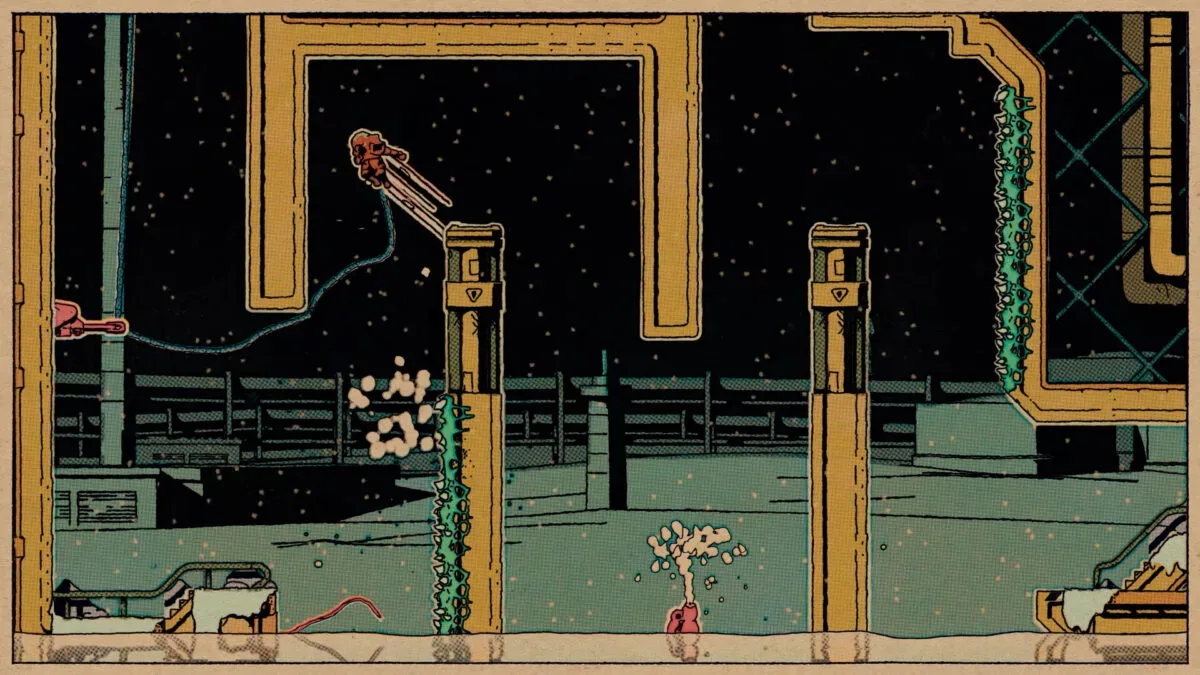
Rebounder looks set to test a very particular platforming fantasy: not merely surviving a difficult screen, but learning to move through it with enough certainty that hesitation disappears. A short PAX West session, lasting roughly 20 minutes, pointed to a game built around that sensation. It is a sci-fi platformer where throwable objects burst into bounce-producing explosions, switches open paths at speed, and failure does not stop the flow for long.
That last point matters. Tough precision platformers often ask players to repeat a small challenge many times, and the best of them know that a quick reset is not just a quality-of-life feature. It is part of the rhythm. Rebounder appears to make the return trip especially diegetic: when the worker-like spacefaring protagonist falls, a line secured at the beginning of the room pulls them swiftly back to the start. The result, at least in the small slice shown, is less like a punitive restart and more like a rubber band snapping the player back into action.
A platformer designed to reduce second-guessing
The early rooms reportedly encourage an initially methodical approach. There are ledges to judge, gaps to clear, suspended balls to grab, and a route that asks the player to predict where a throw and a jump will place the character. Yet after a few rooms, the interaction begins to read more clearly. The balls can be thrown toward the next objective or a nearby switch; jumping after one and pressing A causes it to explode, sending the character upward. A correctly timed chain can carry the worker to a higher platform while opening a door in the same movement.
That combination makes Rebounder sound less interested in slow, isolated jumps than in linked decisions. Players are not simply navigating a room one platform at a time. They are expected to see a target, create a blast-assisted route, and commit. The ideal outcome is a kind of platforming sight-reading: looking at an unfamiliar obstacle layout and understanding its intended sequence quickly enough to execute it without pausing.
It is an ambitious feeling to chase. “Celeste-like” has become a useful shorthand for games featuring exacting movement and immediate room-level retries, but the label covers a broad field. What distinguishes Rebounder in this early account is the confidence its controls seem to instill. The character’s speed and jump height were described as intuitively calibrated, with movement going where it is expected to go. When a game earns that trust, a failed attempt can become information rather than interruption.
Why the fast reset changes everything
There is a huge difference between repeatedly failing a platforming challenge and repeatedly learning one. Delayed reloads, awkward checkpoints, or overly busy death sequences can make a difficult room feel like a toll booth. Rapid respawns preserve the player’s memory of what went wrong: the throw was too low, the button press came too late, the route needed to begin from a different edge.
Rebounder’s tether adds a physical visual idea to that design principle. Rather than an abstract fade to black and reappearance, the character is yanked backward along a line attached to a pole. It reinforces the premise of hauling a cable across an alien landscape while also making a reset feel brisk and thematic. For a game centered on propulsion, it is fitting that even failure seems to have momentum.
- Thrown balls appear to act as both tools and temporary explosive launch points.
- Blast bounces can propel the protagonist to higher terrain.
- Switches and doors support quick sequences in which a projectile clears the path just before the character reaches it.
- The tether returns the player to the beginning of a room after a fall.
- Compact rooms appear to make experimentation and repeat attempts immediate rather than laborious.
An alien job with suspicious corporate vibes
Rebounder’s story remains deliberately unclear from the playable glimpse. The protagonist appears to be an interstellar laborer whose assignment involves dragging a line across the map. The work is presented as important, though the surrounding details suggest a less-than-glamorous employment arrangement. Company housing is depicted as shabby, and the wider tone hints that the corporation behind the job may not be especially generous to its workforce.
Related coverage includes Rebounder's Fast Respawns Turn Platforming Hesitation Into Momentum.
Between maps, the player encounters someone responsible for the housing unit, speaking from behind an unsettling helmet. Crucially, the dialogue does not appear to pause and explain the entire setting in the style of a science-fiction orientation video. Characters converse as if they already live in this world, leaving players to infer the structure of their workplace, the role of the tether, and exactly why this hazardous job has landed in the protagonist’s lap.
That restraint could serve the game well. Platformers benefit from clean visual communication, but narrative world-building does not always need to be equally literal. Rebounder’s apparent willingness to leave some questions open may complement the busy forward motion of its levels. The player is given enough to sense oppressive labor conditions and corporate discomfort, without being asked to stop and digest an encyclopedia before the next jump.
Comic-book visuals, messy text, and satisfying impact
The presentation seems designed to make the mechanical loop feel as tactile as possible. The animation is described as smooth and comic-like, with colors and outlines carrying the softened look of an older printed issue. Against that foundation, bursts of chaotic typography occasionally spill over the scenery in fonts that do not necessarily belong together; one instance reportedly evoked a medieval manuscript.
That visual clutter could be a risk in a game where players must identify routes instantly. But in the small demo, it sounds like an expression of Rebounder’s strange tone rather than a barrier to readability. The player may want to stop and parse the text, yet the level design encourages moving before there is time to do so. It is an unusual tension: an alien industrial setting that seems both grimy and playful, presented with enough energy that even an explosion becomes an invitation to keep going.
Sound and impact are equally important here. The ball detonations come with a reported puff of smoke and a gratifying burst of feedback, while the bounce itself provides a clean movement payoff. In a precision platformer, these details are not decorative. They tell the player that a command has registered, that a route is active, and that a piece of spatial logic has worked. Every click, zap, smash, and launch can help turn a tricky sequence into something players eventually perform on instinct.
The promise is momentum, not just difficulty
Twenty minutes is far too little time to establish how demanding Rebounder becomes later, whether its systems deepen across a full campaign, or how consistently it sustains this first impression. Early rooms are naturally the most likely place for a platformer to make players feel capable. The real test will be whether later challenges maintain clarity as the stakes, speed, and number of interacting objects increase.
Still, the core appeal is easy to understand. Rebounder does not seem to be selling failure as virtue. It is instead trying to make the next attempt so immediate, comprehensible, and mechanically pleasing that players choose to throw themselves back into the room before caution can take hold. That is a more generous design goal than simply demanding endurance.
There is a useful broader context for that appetite for readable, repeatable action on PC and console projects: players are also watching developments around games such as Project Espresso’s apparent gameplay and PS5/PC playtest sign-ups. Rebounder is a very different kind of experience, but both underscore how much presentation and immediate feedback can shape a game’s first impression.
For now, Rebounder’s most compelling idea is the loop between observation, decisive input, and instant correction. Pick up the odd hanging ball. Throw it where it needs to go. Leap. Trigger the explosion. Reach the next place, or get pulled back and understand the miss immediately. If the full game can repeatedly create that feeling of becoming a small, unstoppable engine inside an absurd alien workplace, it may have something more valuable than mere difficulty: flow.