A fresh batch of game listings has put 29 projects on the radar across PC, PlayStation, Xbox, Nintendo Switch, mobile and PSVR2. It is an unusually broad group: a game about operating a shipping company sits beside supernatural hotel restoration, gladiator management, a physics-heavy VR sandbox, and a small jelly attempting to catapult itself out of a laboratory without meeting a saw.
Important caveat: these are newly available announcement listings, not a single synchronized release calendar. The supplied details identify platforms, genres and game descriptions, but do not establish release dates, pricing, storefront availability, developer names or the final feature sets for every title. That distinction matters, particularly for projects listed on several systems or carrying expansive genre labels.
Even with that limitation, the group offers a useful look at the ideas competing for players’ attention: games that ask for fast reactions, games that ask for planning, and games that turn mundane jobs—docking ships, screening park visitors, writing certificates—into the engine for tension.
Strategy is everywhere, but its scale keeps changing
Shardwatch Dominion, listed for Xbox and PS5, takes a familiar tower-defense foundation and changes the geometry. Its arenas are circular, with enemies approaching a central fortress and its crystals from every direction. Tower defense generally means placing defensive units and spending resources to stop incoming waves before they reach an objective. Here, the all-around pressure makes placement less about building a single wall across a lane and more about covering angles, controlling routes and deciding which side can safely receive less attention.
The listing also emphasizes between-wave upgrades and crystal spending. That signals a strategy loop with two linked layers: immediate survival through construction choices, and longer-term survival through resource management. A player may be able to afford an upgrade, for example, but still have to decide whether buying it now compromises the next defensive setup. The premise is concise, yet it identifies the key decision-making points clearly.
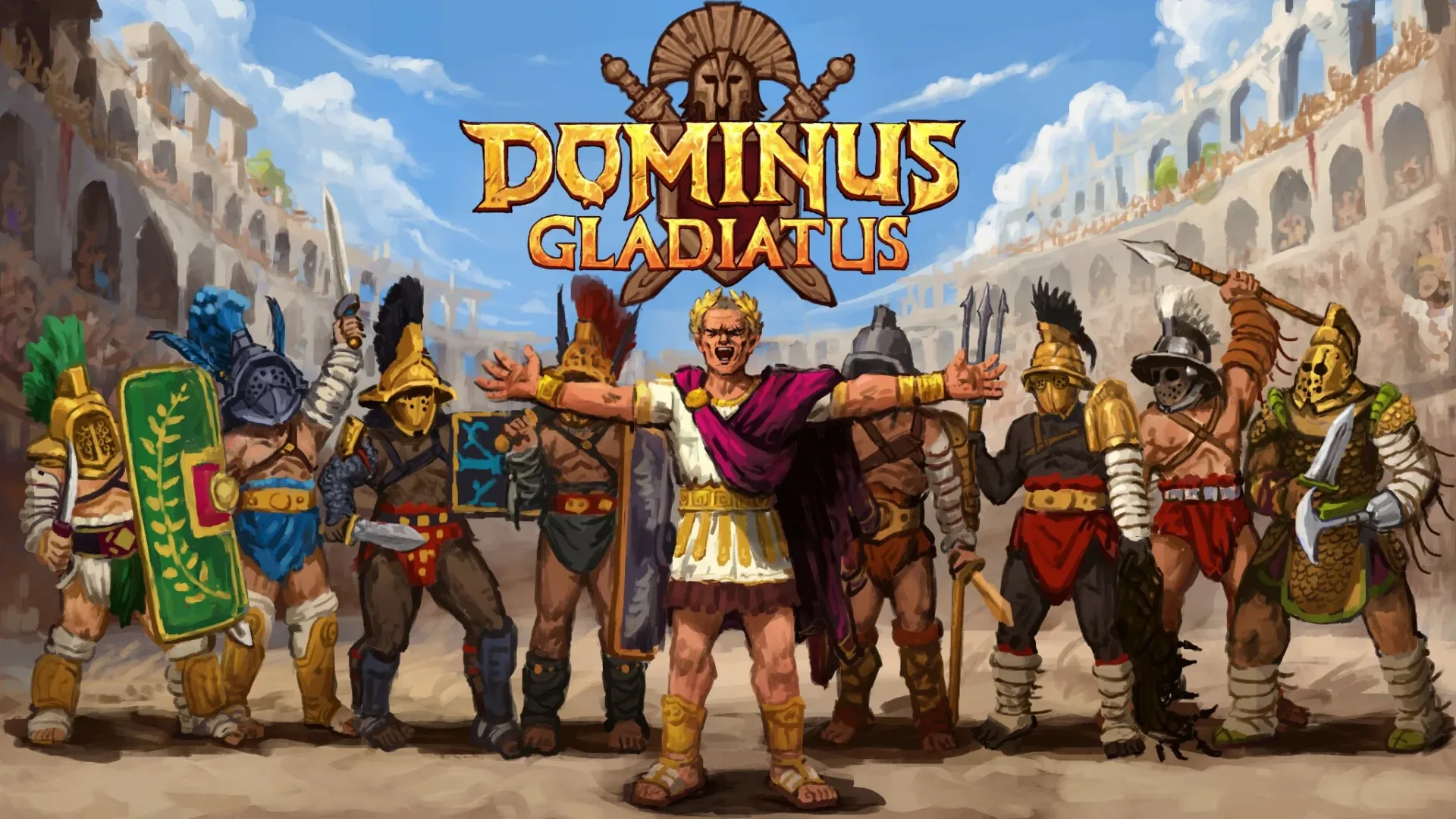
Dominus Gladiatus applies management-game thinking to a lethal tournament. Listed for Xbox, PS5, PC and Nintendo Switch, it has players recruit, train and equip gladiators while making life-or-death calls against rival Domini. Unlike a direct-action arena fighter, a management simulator places the player in charge of the roster, preparation and operational choices. The appeal lies in assembling a capable team and living with the consequences of decisions made before combat begins.
PC also gets How Empires Work, an incremental strategy game framed around the economic and military machinery of empire. “Incremental” describes games structured around accumulation and compounding progress: players establish systems, increase output, then use that increased output to expand further. This game’s stated emphasis on automating economy and military into institutions suggests that process-building, rather than constant manual input, is central to its progression.
Wartide takes another route to low-friction strategy. It is described as a military idle defense game playable either full-screen or as a desktop widget, with infantry, tanks, gunships, air strikes and eight vehicle lines spanning WWII to modern armor. “Idle” design generally allows some advancement with reduced direct interaction; the widget format adds the possibility of keeping the game visible while doing something else. Coin Harvest similarly positions itself as a desktop-friendly idle game, where robotic arms clear a steady stream of coins while players unlock islands, six realms and ascension crystals.
Related coverage includes 30 New Games to Watch Across PC, Console and VR.
These concepts will not suit every player, but they demonstrate that strategy need not always mean a long session at a desk. One game aims for focused positional defense, one for personnel stewardship, and others for a persistent system that can run alongside daily computer use.
Simulation turns work into the challenge
Seaways may have one of the clearest hooks in the selection: start a shipping line, but personally dock every ship. The PC simulation includes cargo contracts in 82 real harbors, ship purchases and naming, hired captains, and growth from a single old coaster in Istanbul toward worldwide routes. The catch is explicit: ships have no brakes. That makes berthing—the act of maneuvering a vessel into its docking position—more than a cosmetic animation. It is presented as a practical skill the player must execute.
The Park Keeper, also on PC, combines national-park ranger duties with visitor screening and an unsettling woods setting. Its cited comparisons point toward a bureaucratic judgment loop crossed with strange phenomena, though the supplied information does not specify the exact screening rules or story structure. The basic promise is that paperwork and people management are not separate from the horror or mystery; they are how the player encounters it.
Cozy Game Restoration goes in the opposite emotional direction. The PC simulator is about bringing old video game cartridges back into presentable condition by removing wrapping, old stickers and grime. It explicitly promises no failure state or pressure. That makes the game less about mastery and more about the tactile, step-by-step satisfaction of a restoration process. Its use of game cartridges is also a notable thematic choice: the objects being repaired are themselves symbols of physical video-game collecting, rather than virtual collectibles placed inside a game.
Then there is There Are No Ghosts at the Grand, listed for Xbox and PC. Its player inherits a deteriorating English hotel, restores it in daylight and fights ghosts after dark. The game is categorized across adventure, casual, indie, RPG and simulation, and its premise adds a sardonic cat, a talking power tool and a musical-mystery structure. It also lists Alex Brightman, Billy Boyd and Elsie in its cast information, although the provided listing cuts off before giving the final name or complete casting details. The hotel’s day-night split implies a built-in rhythm between renovation tasks and supernatural confrontation.
For another angle on PlayStation-focused software activity beyond this week’s game roundup, see the recent DuckStation rendering, timing and PGXP update.
Mysteries favor observation over brute force
Several listed games treat investigation as an active process rather than a brief break between action sequences. Hillthorn is coming to iOS, Android, PC, Nintendo Switch and Nintendo Switch 2. It centers on a disappearance in a secluded mountain village and says its investigation system encourages players to combine actions, clues and characters through logic and imagination. That wording suggests that clues may matter in relation to one another, not merely as a checklist to exhaust.
The Séance of Blake Manor moves its mystery to 1897 Ireland. Available on Xbox, PS5, PC and Nintendo Switch 2, it has players investigate the disappearance of Evelyn Deane in a remote hotel marked by secrets and otherworldly events. The setting and supernatural framing distinguish it from a standard procedural, but the information available does not reveal how its investigation systems work or whether the player can reach different outcomes.
Death at Fleming Manor puts forensic paperwork at the center of its 1959 British-manor mystery. Players investigate scenes and complete death certificates and emergency reports, all presented in a 1960s detective-comic visual style. A death certificate is not simply set dressing in this setup; it is the named job objective. That creates the possibility for a detective game built around interpreting evidence carefully enough to record an official conclusion, rather than simply identifying a culprit in dialogue.
4:AM turns observation into survival. In its near-future dystopia, light is lethal and protagonist Aila must hide, solve problems, run and escape. The listed ability to copy environmental objects implies an adaptive puzzle mechanic: objects are not only scenery but potential tools. That is a compelling premise, though exact limits on copying, stealth rules and puzzle structure remain unspecified.
Action games split between precision, movement and controlled chaos
GeoJelly is an accessible example of a simple control idea carrying a detailed obstacle course. Across 63 levels in laboratory, basement, factory and outdoor areas, the small jelly charges a jump and then launches based on chosen power and direction. Spikes, saws, cannons and moving platforms require accuracy and route planning. It is listed for Xbox, PS5, PS4, PC and Nintendo Switch. Despite carrying a remarkably wide genre set, its supplied description most specifically identifies it as a 2D puzzle platformer.
99 Fails Lite turns minimal input into a high-difficulty proposition. The PC title is described as a one-button “ragequit” platformer with single-player, online multiplayer and a persistent always-online endless mode, plus music by David Wise. A one-button platformer strips away conventional control complexity, making timing and repetition the likely source of challenge. The word “Lite” is part of the supplied title; no information was provided on how it relates to another version, if one exists.
Angry Video Game Nerd 8-bit reaches Xbox, PS5, PS4, PC and Nintendo Switch with frantic platforming, classic AVGN bosses and an Endless Challenge mode. Its 8-bit framing and boss-focused action put it among the most overtly retro-styled entries in the set. RingRacer, meanwhile, is a PC racing game about tricking, shooting, racing and surviving on ringbikes through evolving tracks with adaptive music. It identifies itself as a spiritual successor to Uniracers while invoking the styles of F-Zero, WipeOut, Extreme-G and Rollcage; these are references from the game’s own description, not a claim that it is officially connected to those series.
FIRESTARTERS makes mobility part of its FPS identity. The PC game casts the player as a convicted criminal seeking redemption through a future bloodsport, using skating, shooting and tactical movement against androids. An FPS, or first-person shooter, is normally defined by seeing the action through the player character’s perspective; the “movement FPS” label further stresses traversal skills as part of combat effectiveness.
Quantum Covenant similarly mixes action subgenres on PC. It is a co-op horde-survival shooter with weapons, abilities, upgrades and synergies against a machine god. “Horde survival” means confronting large or sustained groups of enemies, while “roguelike” in this context points to runs shaped by changing upgrades and combinations. The listing also calls it part bullet hell, a term typically used for games that demand navigation through dense patterns of projectiles.
Fragmentosis pushes that hybridity further. It begins as a roguelite deckbuilder and experiment lab, where strange fragments and instruments form scoring combinations, then sends players into 1990s-inspired FPS arenas, horde survival, boss fights and other modes. A deckbuilder revolves around acquiring and combining cards; “roguelite” commonly indicates repeatable attempts with some persistent or run-to-run progression. The announced structure sounds deliberately eclectic, but its exact flow between cards, experiments and shooting modes has not been detailed.
Co-op, party play and the delight of bad ideas
Not every game here is designed for solitary concentration. Plushie Party supports two to six online players across more than 15 mini-games, combining cute characters with violent slapstick stakes. Dumb Ideas With Friends is another PC action title built around reckless childhood-style challenges, including shopping-cart racing, high-altitude plank walking and trying to trampoline over a house roof. Both are shaped around shared spectacle, whether that means competition, disaster or an expertly mistimed leap.
Playground VR, available for PSVR2, PS5 and PC, offers a physics sandbox with vehicles, weapons, sports, city exploration, AI-driver races, parkour and cannon-based self-launching. A physics sandbox is less concerned with a single prescribed objective than with letting players test how objects, vehicles and environments interact. Its listing explicitly embraces that experimental mindset, from setting records to building strange creations.
Other distinctive action premises include Omni Growth, where the last surviving hatchling of an ancient arachnid species explores a huge ship, hunts prey and evolves from vulnerability into a predator; Air Hares, a bullet-hell-flavored farming-restoration adventure starring bunny pilot Captain Rabbo; and Athanasia, an immersive horror FPS set in a research facility overrun by prehistoric predators. Wilderdark also heads toward horror, placing players on an unnatural island where an ectoparasitic organism corrupts dinosaurs and plant life.
Finally, Gravhounds is listed for Xbox and PC as an action game, but no further description was supplied. It is a reminder that a platform and genre tag alone can establish that a project exists in the weekly mix, not what makes it mechanically distinct.
What to watch in the platform spread
PC appears most often across the 29 listings, from single-player detective stories to desktop-widget idle games and multiplayer action. Xbox and PlayStation each have a substantial presence through cross-platform projects such as Omni Growth, Dominus Gladiatus, GeoJelly and Angry Video Game Nerd 8-bit. Nintendo Switch and Switch 2 also show up across the group, while Hillthorn is the only title in the supplied list that spans iOS and Android as well as PC and Nintendo hardware. PSVR2 is specifically named for Playground VR.
The practical takeaway is not that all 29 games will appeal to the same audience. It is that the listings cover a healthy range of play habits: careful solo deduction, brief idle check-ins, deliberate management, chaotic online sessions, immersive VR experimentation and mechanically demanding action. Before treating any individual entry as a purchase plan, players should still verify its release status, region, supported platform and current store information directly. The current details are a promising introduction, not the final word on any one game.