A broad development update for the PlayStation emulator
DuckStation’s latest rolling development build is version latest, published on October 25, 2026, and includes the cumulative changes from v0.1-12083, published on October 13. It is an experimental development build rather than a stable release, so users should expect less testing and the possibility of regressions.
DuckStation emulates the Sony PlayStation, also known as the PSX, on supported Windows, Linux and macOS computers. It combines a PlayStation-focused emulation core with Qt and fullscreen interfaces, hardware and software rendering, save states, memory-card management, controller configuration, enhancements such as upscaling and PGXP, and tools for debugging and patching games.
The latest download is available in Windows x64, Windows x64 SSE2, Windows ARM64, macOS Universal and Linux AppImage variants for x64, ARM32 and ARM64. The project’s normal x64 build is intended for processors supporting SSE4.1, while the SSE2 build targets older x86 systems with lower expected performance. The README identifies Windows 10 version 1809 or newer, macOS 13.3 or newer, and a Linux environment equivalent to Ubuntu 22.04 or newer for the respective builds.
CPU, timing and PGXP changes target accuracy
The newer release contains a substantial set of CPU recompiler corrections, especially for ARM32 and ARM64. The changes cover load delays, pending loads, link-register delay slots, exception handling, indirect jumps, signed arithmetic overflow, multiplication results, shift counts and fast-memory table indexing. These details affect how the emulated processor handles instruction ordering and edge cases that games can depend on, making the fixes relevant to compatibility as well as performance.
PGXP, DuckStation’s system for improving PlayStation geometry precision, receives a particularly large group of corrections. The update preserves precision through several arithmetic, shift and bitwise operations, improves handling of GTE calculations, tracks precision through additional instructions, and corrects depth behavior. It also adds an option to normalize depth by the GTE matrix scale, stores reciprocal Z values in the PGXP depth buffer, and can bias depth according to draw order.
For players, these changes are intended to reduce incorrect geometry, depth or texture behavior in games using enhanced rendering. The project also adds a workaround for a false-positive PGXP warning and an override for preserving projection precision, allowing per-game tuning where a global setting is not appropriate.
The emulator’s timing model is updated across timers, GPU events, SPU transfers, pad transfers and CRTC scheduling. Fixes address target and overflow behavior, prescalers, overclock remainders, gated system-clock timers, one-shot interrupt requests and event rescheduling. The release also adds tests for register writes, coprocessor behavior, timers, GTE operations and MDEC decoding. These changes are aimed at more accurately reproducing hardware timing and reducing problems caused by boundary conditions.
Rendering work spans Vulkan, OpenGL, Direct3D and software paths
Graphics support receives fixes across the major backends. Vulkan changes address render-pass state, swap-chain recreation, descriptor allocation, texture transitions, image layouts, buffer dimensions, resolve operations, synchronization, unsupported extensions and device-creation failures. Vulkan can also use timeline semaphores when available, and the GPU validation option now enables GPU-assisted and synchronization validation.
OpenGL changes correct texture tracking, framebuffer operations, multisampling, render-target formats, sRGB and depth-only framebuffers, shader outputs, persistent buffer mappings, timer-query checks, swap-chain creation and asynchronous downloads. Direct3D 11 and Direct3D 12 receive fixes for pipeline creation races, resource binding, render-pass state, texture uploads and downloads, swap-chain errors, descriptor heaps and feature-level limitations. Metal removes a feedback-loop path, while shared GPU code improves pipeline caching and shader compilation.
The build adds multi-threaded shader and pipeline compilation, uses unique identifiers for shader generation and cache keys, and stores shader-cache data through synchronized archive handling. The practical effect should be more reliable cache reuse and better handling of compilation work, although the release notes do not provide benchmarks or a guaranteed performance increase for every system.
The software renderer also receives important work. The x64 AVX2 rasterizer is enabled, vector operations are reduced or reorganized, palette lookups and sprite texel loading are improved, and drawing and copy tests are added. Fixes cover masked VRAM writes, signed overflow, interlaced 15-bit scanout, colour conversion and texture data handling. A new automatic resolution-scale path also improves how the renderer estimates and restores resolution when loading a save state.
Audio, CD-ROM and memory-card behavior receive corrections
The SPU audio core is optimized and corrected in several areas. Gaussian interpolation is vectorized, ADPCM decoding handles nibbles in pairs, some blocks can use a faster path, reverb processing avoids unnecessary work at zero volume, and reverb coefficients are packed more efficiently. Additional changes model key-on timing and startup delay, improve interpolation precision, handle sustain decay, synchronize pending samples around register and ENDX access, and refine IRQ scheduling.
These changes affect emulated PlayStation audio processing rather than host audio hardware. They are intended to improve correctness and reduce unnecessary work in common sound paths, while the release notes do not claim a universal frame-rate or latency improvement.
CD-ROM handling gains vectorized XA resampling, fixes for track restarts, native-format sector reads and corrected sector sizes for CHD, PPF and other image paths. The emulator also handles non-mode2 sectors more accurately. Memory-card files can now be saved asynchronously, which moves file-writing work away from the main emulation path.
DuckStation supports common PlayStation image formats including bin/cue, CHD, ECM, MDS/MDF, CCD and unencrypted PBP files. Games using LibCrypt protection may require matching SBI subchannel files beside the disc image, as documented by the project. A PlayStation or PlayStation 2 BIOS image is also required to start the emulator; the project does not package one.
Input, achievements and interface updates
Input handling is reorganized for better synchronization and device management. Bindings are reloaded after a controller is connected or removed, persistent identifiers improve SDL mappings, raw-input and pointer state use safer synchronization, and cancelled hold bindings are released correctly. The controller changes also restore 127 as the analog-axis center and produce a centered result when opposing half-axis inputs cancel each other.
DuckStation adds a Toggle Pause Menu hotkey and makes cheats, achievements and leaderboards respond as toggle actions. Input can also activate interface hotkeys, and the Qt controller pages display bound devices. A common base for lightgun controllers and a shared NeGcon base improve the structure of those input systems without changing the emulator’s role as software running on the host computer.
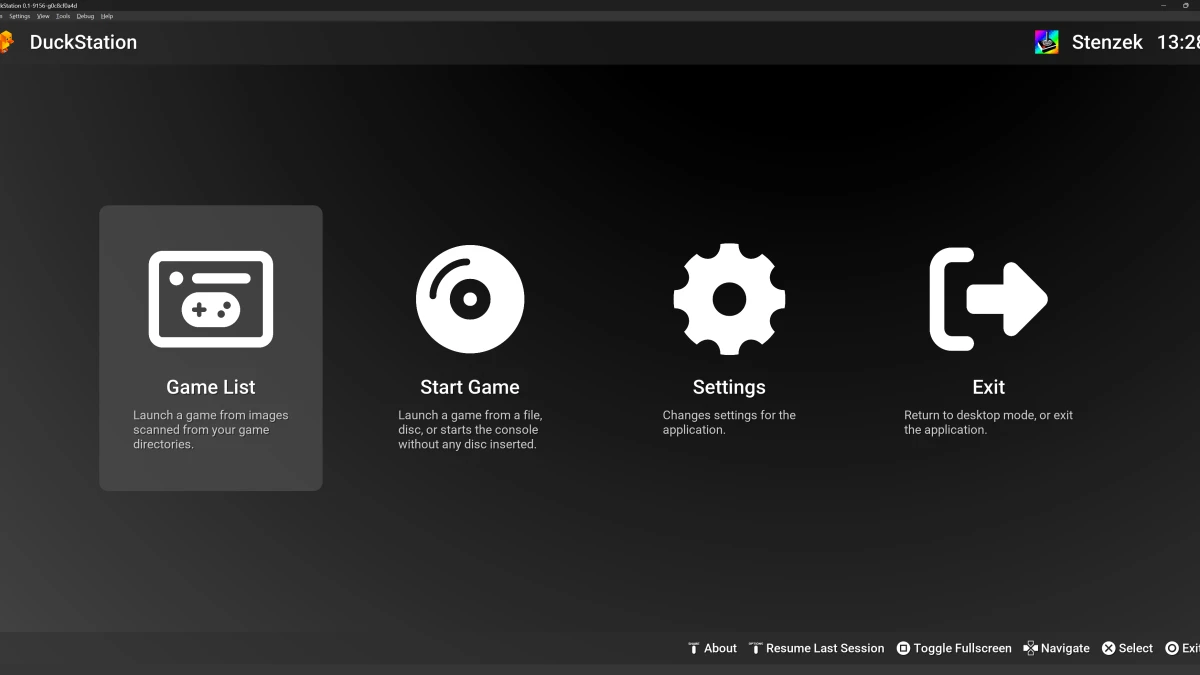
Achievements receive fixes for login handling, credential saving, notification state, deadlocks and live-updating options. The fullscreen interface gains blurred header backgrounds, a Waves background shader, improved footer and badge styling, achievement-point display in the landing window, and corrections for transitions, loading progress, prerotation and focus behavior. Small display changes include an on-screen resolution readout while paused and an optional frame-number overlay.
The Qt interface adds multi-instruction selection in the debugger, persistent debugger-window state, separate log and TTY windows, context-menu icons, manual patch editing and deletion, patch options, setting overrides in the patch editor, and value editing in the memory-editor inspector. It also improves game-list exclusion controls, inherited multisampling display, controller indicators and translation handling. Updated Swedish, Spanish, Italian, Brazilian Portuguese and other translation data is included.
What users should know about this build
The latest package is a rolling development build and should be treated differently from a stable channel release. DuckStation’s documented update system separates stable releases from preview builds; preview builds are produced more frequently and receive less testing. Users who prioritize predictability may prefer a stable build, while testers and developers may want the newest changes in latest.
The available packages include Windows installers and archives, Linux AppImages, and a universal macOS archive. The release also provides Windows symbol archives, which are useful for diagnosing crashes but are not needed for ordinary use. The README documents portable operation on desktop platforms through a portable.txt marker in the program directory.
DuckStation supports hardware rendering through Direct3D 11, Direct3D 12, OpenGL, Vulkan and Metal, along with a vectorized software renderer. Its broader feature set includes upscaling, texture filtering, texture replacements, deinterlacing, post-processing shaders, save states, rewind, runahead, controller presets, lightgun simulation, RetroAchievements, cheat and patch databases, and direct homebrew executable support.
For this build, the most meaningful changes are not a single new headline feature but the cumulative attention given to emulation accuracy and infrastructure. CPU and timing corrections, PGXP precision work, graphics-backend repairs, audio updates and input synchronization all target different layers of the PlayStation experience. Because the build is rolling and experimental, users should review their setup before switching versions.