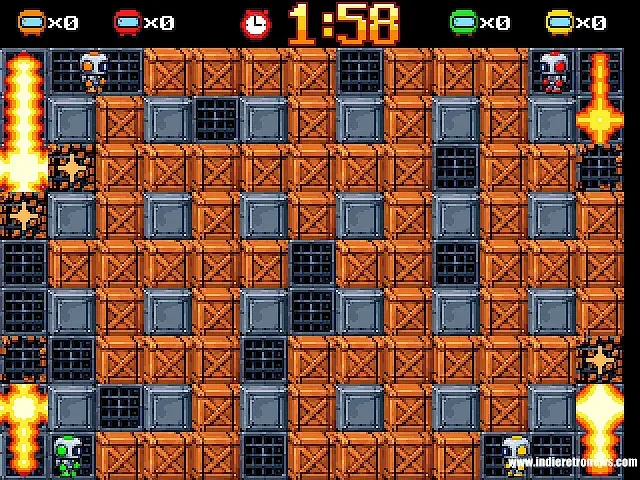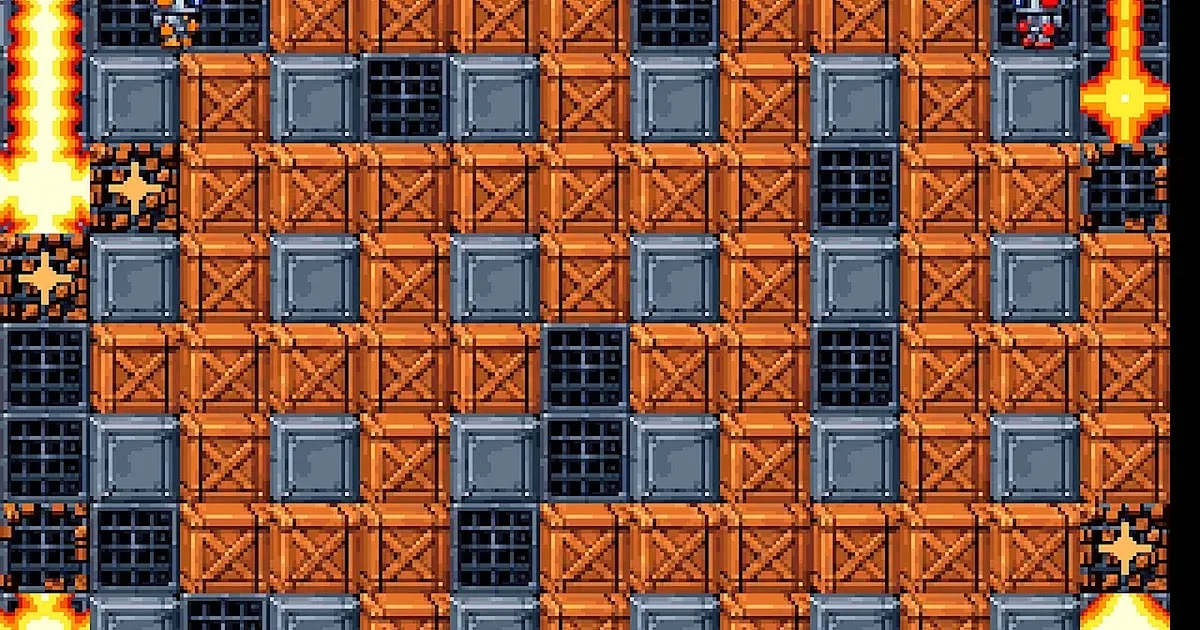
Blast Grid, a Bomberman-inspired action game by sandlbn, is headed to Amiga hardware with a substantial set of single-player and local multiplayer options. Its core proposition is immediately recognizable: players navigate compact, obstacle-filled spaces, use bombs to open routes and defeat opponents, then try not to be caught in the resulting blast paths. But Blast Grid is built as more than a single set of competitive boards, with a 30-stage Story mode, five industrial-themed worlds, boss encounters, secrets and a Battle mode for up to four participants.
The game is designed for AGA Amigas, including the A1200, and requires a 68020 processor, Kickstart 3.1 and 2 MB of chip RAM. An OCS/ECS edition for machines including the A500, A600 and A2000 is planned for later this year. For players keeping classic systems in regular use, the specific hardware information matters as much as the game’s premise: Blast Grid is being tailored to original Amiga setups rather than presented only as a modern retro-styled release.
A campaign built around five industrial worlds
Blast Grid’s Story mode contains 30 stages divided across five areas: Factory, Reactor, Data Lab, Waste Processing and Deep Core. That structure suggests six stages per world, although only the overall total and five-world layout have been specified. Each location has its own enemy types, power-ups and hidden secrets, while every world ends with a boss that has distinct attack patterns.
That boss component is an important difference between a straightforward sequence of versus-style bomb arenas and a campaign intended to develop its own progression. Standard grid-based bomb action asks players to manage space and timing: a placed explosive creates danger in straight lines, so an escape route must be available before detonation. Walls or blocks can shape those lines of attack, making each placement a decision about both offence and survival. A boss with its own attack patterns adds another layer, because success depends not only on navigating explosions but also on recognizing when and where an opponent is vulnerable.
The industrial settings also provide a clear thematic thread for a game whose basic action is inherently mechanical and hazardous. Factory machinery, reactors, laboratories, processing facilities and a subterranean core all suit a campaign based on confined layouts, destructible obstacles and escalating threats. The available details do not spell out how each world changes the rules, but the promise of distinct enemies, power-ups and secrets indicates that the stages are not being framed as mere palette swaps.
What “hidden secrets” can mean for replaying stages
Blast Grid includes hidden secrets throughout its Story mode, though their exact form has not been detailed. In practical terms, that gives players a reason to look beyond simply reaching a stage’s exit or defeating every enemy. Secret hunting can reward careful use of bombs, closer inspection of destructible terrain and revisits to previously cleared stages. It is worth keeping expectations measured, however: no specific rewards, unlock conditions or collectible lists have been confirmed.
The game also includes disk-saving support, allowing players to continue their progress. That is especially useful for a 30-stage campaign, where a save feature turns a longer playthrough into something that can be approached over multiple sessions rather than requiring a single uninterrupted run.
Battle mode supports humans, bots and Sudden Death
For the competitive side, Blast Grid has a Battle mode for up to four participants. Those four slots can be filled by any mix of human players and CPU-controlled bots. The bots offer three difficulty tiers, giving a solo player a way to fill out an arena and allowing groups to adjust the intensity without needing exactly four people in the room.
Related coverage includes Blast Grid Brings Bomberman-Style Action to AGA Amiga.
Battle mode has five arenas and includes Sudden Death matches. Sudden Death generally describes a match state intended to force a decisive result when normal play has not done so; here, it establishes that Blast Grid has a specific option for accelerating the endgame rather than leaving a stalemate unresolved. Details on its exact rules have not been provided, so players should not assume a particular shrinking-arena or hazard system.
Local multiplayer is a natural fit for the format. A shared-screen bomb battle can change direction quickly: one player may clear a passage, another may exploit the new line of fire, and a third may be trapped by a route that seemed safe seconds earlier. Adding CPU opponents means that structure remains available whether the group is one player, two players or somewhere in between. It also gives players an accessible place to learn the arena layouts and the consequences of particular power-ups before facing a full human lineup.
In an industry where attention often centers on releases built for massive modern platforms—such as the enormous interest surrounding GTA VI’s projected pre-order market—a game designed around original Amiga machines and couch multiplayer is a notably different proposition. Blast Grid’s appeal is not scale or online infrastructure. It is focused on a classic computer platform, immediate competitive rules and the practical flexibility to accommodate several control setups.
Control support is a major part of the package
Blast Grid supports standard joysticks, two-button joysticks, CD32 pads, keyboards and classic four-player parallel-port adapters. That broad compatibility is more consequential than a routine bullet point because Amiga users may own very different hardware configurations. Some players use traditional single-button sticks; others have pads or keyboard setups; and a multiplayer game particularly benefits from support for the older adapters designed to put more players into the same session.
The inclusion of two-button joystick support may also be meaningful for player preference, although no individual button mappings have been specified. Likewise, keyboard support provides an alternative where enough compatible controllers are not available. The result is a game that appears intended to fit into established Amiga collections instead of demanding one narrowly defined input method.
AGA requirements, OCS/ECS plans and memory considerations
At launch, Blast Grid targets AGA systems such as the Amiga 1200. AGA, short for Advanced Graphics Architecture, is the graphics chipset associated with later Amiga models including the A1200. The listed baseline is a 68020 processor, Kickstart 3.1 and 2 MB of chip RAM.
Chip RAM is memory shared with Amiga custom chips, including graphics and audio hardware, making the stated 2 MB requirement an important compatibility detail. The game can boot from either floppy disk or a hard drive, and it exits cleanly back to Workbench, the Amiga operating environment. That clean return is a welcome quality-of-life consideration for users who are launching software from a wider Workbench setup rather than treating the computer as a single-game appliance.
It is also set to run at 50 Hz on PAL or NTSC displays. Refresh rate support is important on vintage hardware because display standards can affect smoothness and compatibility. The stated support means the game is intended to operate at 50 Hz on either display type, rather than limiting its intended display behavior to only one regional standard.
Players with 8 MB of Fast RAM can expect near-instant screen changes without disk-loading delays. Fast RAM is memory available to the CPU without being shared with the Amiga’s custom chips. Here, the practical benefit is clearly stated: more Fast RAM reduces transitions that would otherwise require loading from disk. It is a performance enhancement, not part of the stated minimum configuration; the base AGA requirements remain a 68020, Kickstart 3.1 and 2 MB of chip RAM.
An OCS/ECS version is still to come
sandlbn also plans an OCS/ECS version later this year for systems including the A500, A600 and A2000. OCS and ECS refer to earlier Amiga chipset families, so this planned edition would extend Blast Grid’s reach to a broader range of classic machines. No further technical specifications, release date or feature differences for that version have been supplied.
For now, Blast Grid’s most clearly defined version is the AGA release: a 30-stage campaign across five worlds, end-of-world bosses, secrets, flexible saves, five multiplayer arenas, CPU opponents at three difficulty levels, Sudden Death, and control support spanning joysticks, pads, keyboards and parallel-port multiplayer adapters. For Amiga owners who want a new game designed around both solo progression and in-room competitive chaos, it is shaping up as a notably complete bomb-battle package.