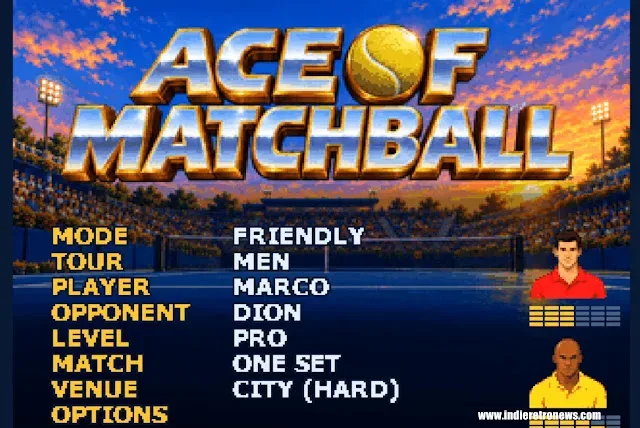
Ace of Matchball is aiming to put a feature-rich tennis simulation on Amiga 1200 hardware rather than treating the sport as a quick arcade diversion. Created by Fliegeralarm Games with AI assistance and built in the ACE engine, the new AGA release is designed for an Amiga 1200 or compatible machine with a 68020-or-better processor, a hard drive, 2 MB of Chip RAM and 2 MB of Fast RAM.
Its stated feature list is unusually ambitious for the target: four venues, a career mode, persistent world-tour rankings, stamina that affects shot accuracy, a rules-focused match structure and a system for challenging disputed line calls. It also has a distinctly theatrical layer around the tennis itself, with reactive spectators, ball kids and players who can visibly lose their composure after a bad moment.
The game arrives amid a broad range of new projects across gaming platforms, from retro machines to contemporary PCs; our look at a busy recent indie PC release slate is a reminder that smaller teams are still choosing very different technical targets. Ace of Matchball’s decision to build around an AGA Amiga configuration makes that target central to the game’s identity, not simply a nostalgic afterthought.
A tennis game built around the longer match
Ace of Matchball’s core pitch is rapid rallies, serves and defensive lobs, but its career structure suggests that the game wants individual points to feed a longer campaign. The world-tour tracking system saves rankings between sessions, allowing results to persist rather than resetting every time the game is launched.
That persistence matters in a sports game because it gives a loss a consequence beyond the immediate match. A player is not only trying to win a single contest; they are attempting to improve or protect a place in a continuing ranking. The supplied details do not spell out tournament formats, opponents or progression rewards, so those should not be assumed. What is clear is that rankings are intended to be retained across play sessions.
The four listed settings include Riviera clay and indoor arenas. A venue can be more than background dressing in tennis games, though no specific court-speed or bounce differences have been detailed here. For now, the safe reading is that the locations provide distinct places to play, not that each surface has confirmed simulation properties.
Stamina is meant to make rallies costly
One of Ace of Matchball’s more important mechanical ideas is its stamina system. In practical terms, stamina is an endurance resource: extended, demanding exchanges can reduce a player’s ability to execute shots accurately. The feature is meant to make exhausting rallies a tactical issue instead of a purely visual spectacle.
That can change the logic of a point. A player may still need to chase a difficult ball, but repeatedly scrambling to keep exchanges alive can make subsequent placement less dependable. Conversely, keeping an opponent moving may carry value even if it does not produce an immediate winner. It is a straightforward way to translate the fatigue of tennis into a game system without claiming that every player needs to master a complex simulation model.
Related coverage includes Ace of Matchball Serves Career Tennis to Amiga 1200.
The description also emphasizes a momentum-based control scheme that has drawn positive early reaction. “Momentum-based” generally means player movement and timing are expected to influence how cleanly a shot comes off, instead of the game treating each button press as an identical strike. Specific inputs, shot types and timing windows have not been provided, however, so players should not infer a particular control layout from that label alone.
Challenge the Call brings a review system to the court
Perhaps the clearest modern sports-game touch is Challenge the Call. Players can dispute a line judge’s ruling and view a slowed, zoomed-in replay of the relevant ball landing. A line call is the decision over whether a shot landed in or out; challenging one introduces a moment of uncertainty and a formal review into a match.
It is an especially fitting inclusion for a tennis game because close boundary decisions can be as memorable as a rally. The replay presentation gives the dispute a visible payoff rather than reducing it to a menu notification. At the same time, the available information does not explain limits on challenges, the exact rules governing them or whether every call can be reviewed. Those are meaningful details for competitive play, but they have not been established.
The feature also illustrates the release’s larger design direction. Ace of Matchball is not described only through strokes and scores; it is trying to stage the atmosphere around a match. Reactive crowds and active ball kids help fill out the venue, while the players themselves can throw rackets, swear in their own voices and otherwise react angrily when play goes badly.
Those touches will not decide whether the ball physics or controls feel right, but they can make momentum swings legible. A missed chance can be followed by an animated outburst rather than silently disappearing into the next serve. The available material calls attention to a celebration update as well, suggesting that successful moments have received additional presentation attention.
The animation update and bug fixes
The release information specifically notes an update containing 288 new animations. That is a sizeable numerical addition, although the supplied details do not break down precisely which player actions, court interactions or reactions are included. It would be premature to translate that number into a claim about smoother movement, entirely new shot categories or expanded game modes.
Still, animation volume is relevant to a tennis game. Tennis is full of small transitions: preparing for a serve, recovering after a swing, changing direction, reacting to a close call and celebrating or venting frustration. A greater range of animation can help avoid a match looking repetitive, especially when the game is also trying to depict ball kids and emotional players.
The update notes also cite fixes for ball boy and bottle bugs. The wording does not give technical detail, so there is no basis to describe the exact faults or their impact. What it does indicate is that attention has been paid to court-side presentation elements as well as to the central match action.
What Amiga players need to run it
Ace of Matchball is not presented as a universal Amiga release. It targets AGA-capable Amiga 1200-class setups or compatible systems, with a 68020 processor or better. It requires 2 MB of Chip RAM and 2 MB of Fast RAM, plus hard-drive installation.
AGA, short for Advanced Graphics Architecture, identifies the graphics hardware family associated with the Amiga 1200. Chip RAM is memory shared with Amiga custom chips, while Fast RAM is additional memory intended for the processor. For this game, the distinction is not merely technical trivia: both memory requirements are explicitly listed, so an otherwise working Amiga configuration may still fall short if it lacks the specified Fast RAM.
Installation is described simply: unpack the archive and start AceOfMatchball from its drawer. The game is also stated to run in WinUAE and FS-UAE when configured as an A1200 with 2 MB of Fast RAM. An emulator is software that recreates the behavior of another machine, allowing Amiga software to run on contemporary hardware when the appropriate configuration is used.
An ambitious fit for a focused platform
The most interesting part of Ace of Matchball is the combination rather than any one feature. A persistent tour ranking, fatigue-driven accuracy, formal line-call challenges and extensive courtside animation are all systems intended to make matches feel like events with consequences. The game’s reported origin in a casual exchange about making a tennis title for the community only adds to the sense of a project shaped around a specific audience.
There are sensible limits to what can be concluded before more detail is available. Four venues do not by themselves prove four distinctive court behaviors; a career mode does not automatically reveal the depth of its tournament structure; and 288 new animations do not tell us which actions changed. But the disclosed feature set makes the intent easy to see: Ace of Matchball wants an Amiga 1200 tennis match to include pressure, fatigue, argument, recovery and a memory of what happened after the court has cleared.