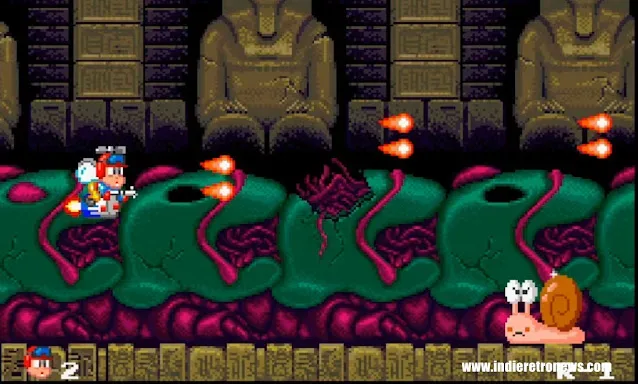
An early, unofficial Commodore Amiga port of Taito’s 1989 horizontal shooter Insector X is now in circulation, offering a technically unusual route for bringing an arcade game to Amiga hardware. Developed by caiusarcade, the work-in-progress build does not attempt to recreate the shooter’s systems manually from scratch. Instead, it uses static recompilation to convert code from the original arcade machine’s two Z80 processors into native Motorola 68020 code for the Amiga.
That distinction is central to what the project is trying to achieve. The stated aim is not simply an Amiga-inspired remake of the coin-op, but a conversion that retains the original game logic, visual assets and sound data while running them through code generated for the target platform. The developer has also described frame-by-frame code verification and pixel-by-pixel display comparison against the arcade version, with AI assistance used throughout the code, graphics, sound and text work.
It is an ambitious preservation-minded approach, albeit one that remains early and unfinished. Anyone assessing the build should also treat an apparent audio issue in a circulating video cautiously: the sound may be broken in that footage, potentially because it is an early beta version rather than representative of the intended final behaviour.
What static recompilation means here
Static recompilation is different from emulation and different from a conventional remake.
- Emulation generally imitates the original hardware environment while the original program runs within it.
- A remake is normally new game code written to reproduce, reinterpret or expand an earlier game.
- Static recompilation, as used by this project, translates the original program code ahead of time into code intended to run natively on another processor.
In this case, the starting point is arcade software designed around dual Z80 processors. The destination is 68020 code for the Amiga. The practical appeal is clear: rather than requiring the target machine to behave like the original arcade hardware at runtime, the translated program can be tailored to the Amiga processor family.
That does not automatically make the job easy. Converting processor instructions is only one part of a game port. A coin-op game’s timing, display behaviour, audio handling, controls and memory arrangement still have to align closely enough for the result to behave as expected. The reported frame-by-frame and pixel-by-pixel checking suggests that accuracy is being judged not only by whether the game boots and accepts input, but by whether its on-screen action closely corresponds with the original.
The project’s use of original game logic, art and audio also explains why it should be understood as a fan conversion rather than a newly authored successor. It is unofficial, and prospective users are expected to have the required ROMs when assembling the build.
An AGA Amiga target, not a low-spec installation
The port is aimed at an Amiga 1200 or another AGA-equipped Amiga system. AGA, short for Advanced Graphics Architecture, identifies the Amiga hardware family the build expects rather than every Amiga model ever made. The listed requirements are specific enough that interested players should check their machine before setting aside time for installation.
Related coverage includes Insector X Gets an Early Unofficial Amiga Port Using Static Recompilation.
- Amiga 1200 or another AGA-based Amiga
- Hard drive
- Kickstart 3.x
- Approximately 1.3 MB of free chip RAM
- At least 4 MB of fast RAM
- 8 MB of fast RAM preferred
For readers new to Amiga terminology, chip RAM is memory shared by the system’s custom hardware, while fast RAM is additional memory intended for the CPU. The distinction matters because a game can need enough chip RAM for audiovisual resources while also benefiting from enough fast RAM for the processor-side workload. The 1.3 MB figure is described as free chip RAM, so total installed memory alone is not necessarily the relevant number; available memory after the system environment is accounted for matters too.
The hard-drive requirement likewise makes this a setup aimed at a configured Amiga rather than a purely disk-first experience. Kickstart 3.x is also a stated prerequisite, so owners of older firmware configurations should not assume that the build will be plug-and-play.
Processor speed affects the smoothness ceiling
A stock 14 MHz 68020 is said to keep gameplay and music at full speed, but the refresh rate can fall during busier scenes. In plain terms, the game’s underlying action and soundtrack are intended to maintain their pace, while visual updates may occur less frequently when the screen is especially demanding.
That qualification is valuable because it separates two performance concerns that are often bundled together. “Full speed” can refer to the rate at which gameplay logic and music progress; refresh rate concerns how often the image is redrawn. A demanding action sequence can therefore retain its intended tempo while looking less fluid than it would on faster hardware.
The recommended upgrade path is a 50 MHz 68030 or faster processor, which is expected to provide quicker performance through most of the action. It is not presented as a strict requirement to make the port work, but it is the more appropriate target for players seeking the best chance of consistently brisk visual performance. There is no supplied benchmark data or guarantee of a fixed frame rate, so it would be premature to reduce that advice to a single universal performance number.
How the build is assembled
The distribution model described for this early port is a build process for users who have the ROMs rather than a conventional self-contained package. On Windows 10 or Windows 11, the compilation step can be handled by a one-click tool. Linux and macOS users can assemble it with Python 3 and vasm.
Vasm is an assembler: a tool that turns assembly-language source into machine-oriented output for a processor architecture. Its presence fits the project’s low-level nature. The platform-specific instructions are fairly straightforward, but they also mean users need to pay attention to their operating system, the ROM requirement and the stated Amiga hardware prerequisites before expecting a successful result.
This is the kind of release where “available” and “ready for every retro setup” are not the same thing. The Windows option lowers one part of the barrier by offering a one-click compilation route, while the Linux and macOS path calls for Python 3 and vasm. On the Amiga side, the AGA, Kickstart, storage and memory conditions remain important regardless of which computer is used to prepare the build.
Why the verification method matters
Fan ports often invite a simple question: does it feel like the original? This project puts forward a more measurable standard in addition to that subjective one. Comparing translated code frame by frame and matching output pixel by pixel makes fidelity a technical target, not merely an aesthetic promise.
That process does not mean every early build should be treated as final or flawless. Work-in-progress software can expose bugs, compatibility gaps and presentation problems as development continues, and the potentially broken video audio is a reminder to distinguish the build’s goals from the condition of every demonstration. Still, the methodology is notable. A conversion built around original data and native translated code can be evaluated closely against its arcade counterpart rather than only through broad impressions of similar gameplay.
AI assistance is explicitly disclosed for the project’s code, graphics, sounds and text. That disclosure is useful because it identifies the scope of the tool-assisted workflow without changing the more concrete technical claim at the heart of the port: dual-Z80 arcade code is being statically recompiled to native 68020 code and checked against the coin-op presentation.
For retro developers and hardware enthusiasts, the build is also another example of why static recompilation remains interesting: it can offer a path between a full rewrite and emulating an entire original machine. Readers following experimental software that bridges old systems may also be interested in this experimental emulator snapshot, though emulation and static recompilation are distinct approaches.
What prospective players should take away
The immediate takeaway is measured optimism. Insector X has an early unofficial Amiga conversion with demanding but clearly stated hardware needs, an accessible Windows build route, alternative Linux and macOS tooling, and a focus on arcade-faithful output. An Amiga 1200-class AGA system with the listed memory and firmware is the baseline, while a 50 MHz 68030 or faster is the better fit for improved performance during the bulk of the game.
It is equally important to keep the WIP label in view. The known concern about sound in video footage may be beta-related, and no completed-release claim is attached to the build. For now, the project is most compelling as a technically focused conversion effort: one trying to bring a 1989 horizontal arcade shooter to Amiga hardware by translating the original program rather than replacing it with an approximation.