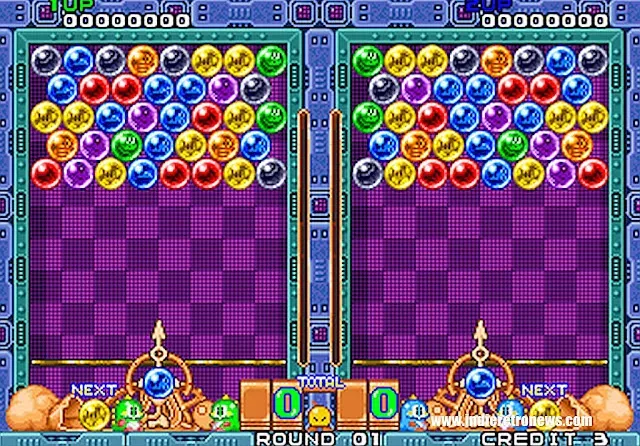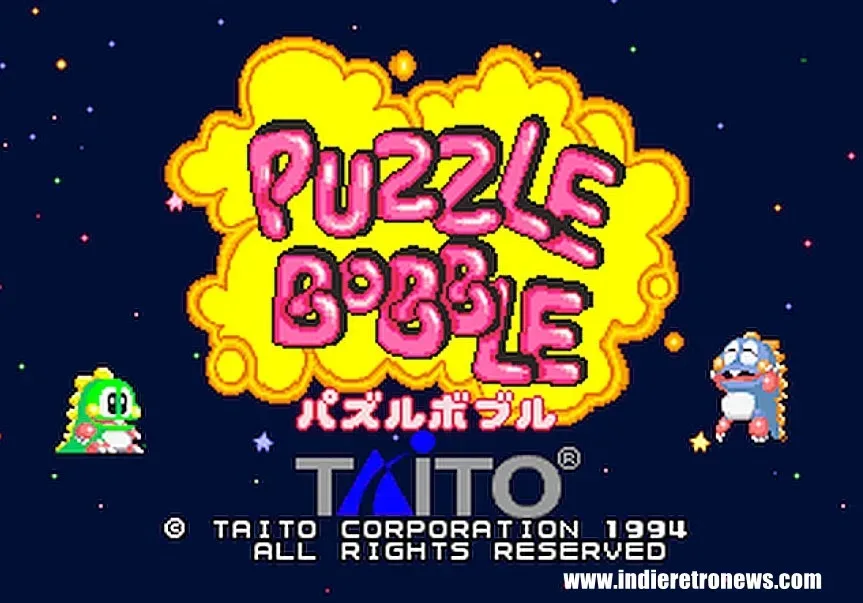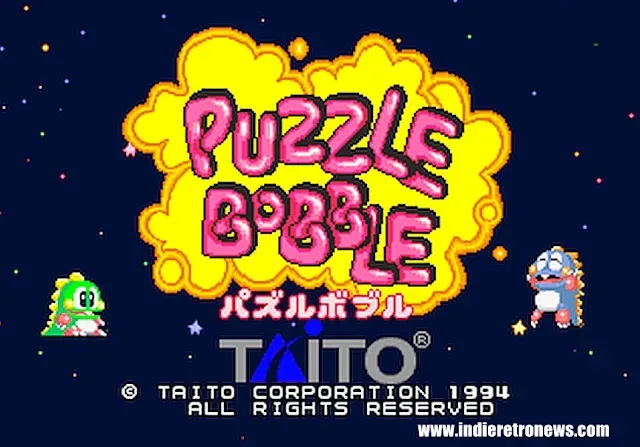
Puzzle Bobble AGA is now available for the Commodore Amiga 1200, bringing Taito’s 1994 bubble-matching arcade game to the machine through a native 680x0 assembly-language port. The project comes from dlfrsilver, whose recent Amiga work also includes AGA AI ports of Monkey Island 2: LeChuck’s Revenge and Indiana Jones and the Fate of Atlantis.
It is a notable fit for the A1200: Puzzle Bobble is built around immediate visual feedback, simple controls, rapidly accumulating on-screen objects and an arcade loop that becomes increasingly demanding as the ceiling of bubbles descends. The game’s cheerful look and music may make it seem lightweight, but its responsiveness matters. A shot that feels late, a screen that stutters when a cluster bursts, or a sluggish transition during a crowded board changes how the game feels.
The port is described as the first direct conversion to the A1200 of a game from Neo Geo hardware or Taito’s System B arcade platform. It has been written in 680x0 assembly and optimized around the A1200 processor and its Advanced Graphics Architecture, more commonly called AGA.
What Puzzle Bobble is—and why its pace matters
Puzzle Bobble is a tile-matching puzzle game in which players fire colored bubbles into a hanging arrangement. Connecting matching colors pops the linked group; removing a supporting connection can also make unsupported bubbles fall away. That creates the game’s central tension: every shot can either clean up a dangerous section of the board or create an inconvenient new structure overhead.
Its controls are direct enough to suit a joystick. Players aim, fire and react to the next bubble in the sequence, while the board steadily becomes more threatening. The mechanics are easy to explain but reward planning: an apparently minor opening may be enough to detach a much larger mass, while a poorly placed shot can make the next several colors harder to use.
This is not the sort of arcade game where performance is merely a technical footnote. The player is continuously judging angles and gaps, then adjusting before the playfield grows too crowded. Smooth animation and stable response help preserve the quick, readable rhythm that defines the original format. For a game intended to be played in short, repeatable sessions, that rhythm is the entire bubble economy.
A native Amiga 1200 project
The A1200 was the Amiga model equipped with the AGA chipset. In practical terms, a chipset is the collection of specialized hardware that helps the computer handle duties such as display output and graphics operations. The AGA designation matters here because the project is specifically intended for the A1200 rather than being presented as a broadly interchangeable Amiga release.
The stated use of 680x0 assembly code is also worth unpacking. The Motorola 680x0 family is the processor line associated with this class of Amiga hardware. Assembly language is a low-level programming language designed closely around a processor’s instructions. Rather than automatically guaranteeing a faster game, it gives a developer unusually direct control over how a program is structured for its intended hardware.
Related coverage includes Puzzle Bobble AGA Brings Taito's Arcade Bubble Classic to Amiga 1200.
That control can be particularly valuable in an arcade conversion. A port must account for the behavior of its target machine while retaining the elements players recognize: the game’s timing, its bubble grid, visual clarity, sound and input. The result may be informed by the arcade original, but it is still software built to run within the memory, processor and display constraints of the Amiga 1200.
The project’s technical framing is part of the appeal. Retro conversions are not only about making an older game launch on another system; they are also about the choices required to make that version feel credible on its own hardware. Native code and a focused A1200 target suggest an effort to treat the machine as the primary platform rather than as a generic destination.
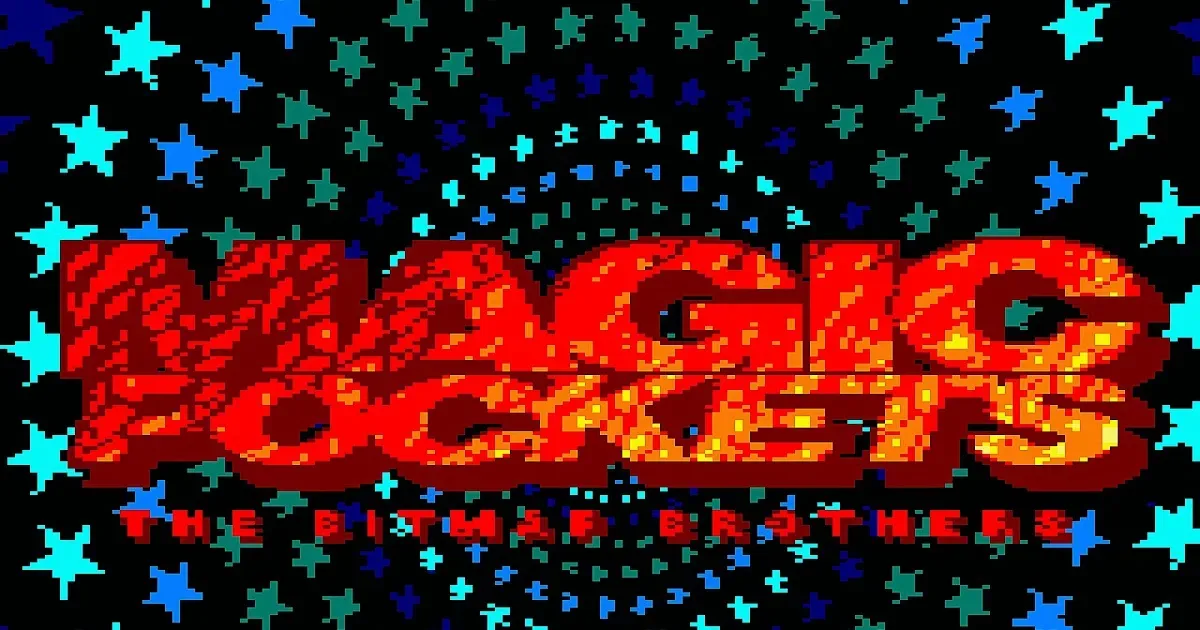
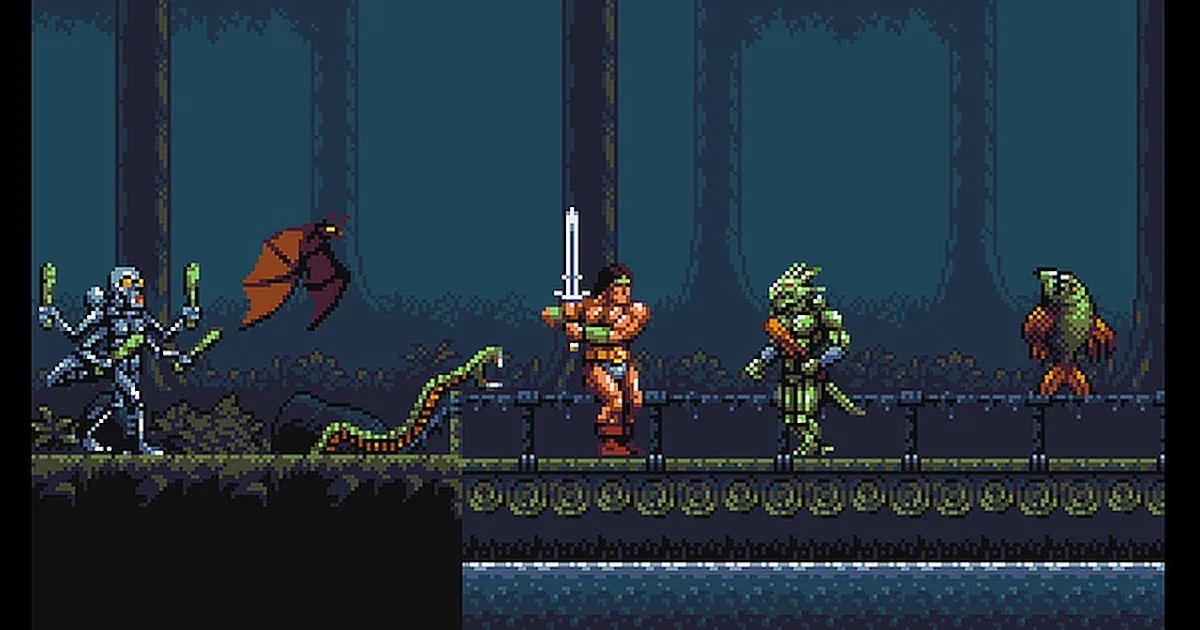
There is a wider wave of new work for legacy computers, including projects such as this Amstrad CPC 6128 conversion of Magic Pockets. These releases can vary dramatically in approach, but they share a useful reminder: old hardware remains a live development target for programmers willing to work inside its specific boundaries.
Minimum requirements versus the smooth-play question
The supplied requirements list a PAL Amiga 1200 with a stock 14 MHz 68EC020 as the minimum processor setup. It also calls for 2 MB of Chip RAM, 4 MB of Fast RAM, Kickstart/Workbench 3.0 or later, and 20 MB of available storage. One or two joysticks are supported.
- Minimum CPU: PAL Amiga 1200 with a 14 MHz 68EC020
- Memory: 2 MB Chip RAM plus 4 MB Fast RAM
- System software: Kickstart/Workbench 3.0 or later
- Storage: 20 MB free
- Controllers: one or two joysticks
- Community recommendation: 68030 at 50 MHz for full speed and smoother play
For readers less familiar with Amiga terminology, Chip RAM is memory shared with the machine’s custom hardware, including its graphics-related systems. Fast RAM is additional memory intended to give the processor access without that shared contention. The distinction is relevant on an Amiga because available memory is not just a single number; where memory sits and which hardware can use it can influence the software environment.
There is an important qualification, however. Community users have reported that a 68030 running at 50 MHz is advisable for the game to feel fully smooth and run at full speed. That is a stronger configuration than the stated 68EC020 minimum. The developer’s position is that the game works properly on a 68020 with 4 MB of Fast RAM.
Both statements should be read carefully rather than flattened into one claim. A minimum requirement normally establishes that software can run in a supported configuration; it does not necessarily mean every player will judge performance identically. A recommended configuration is a practical suggestion aimed at a more consistently comfortable experience. In this case, the available information establishes a real distinction between the official baseline and feedback from users seeking the smoothest result.
That distinction is especially useful for prospective players with original hardware. An unexpanded PAL A1200 setup may meet the listed CPU baseline, but the memory requirement remains specific: the game calls for 4 MB of Fast RAM in addition to the machine’s 2 MB of Chip RAM. Players with an accelerated 68030/50 configuration have a community-backed recommendation for better fluidity, but it should not be recast as an official mandatory requirement.
Practical setup checks before installing
The hardware list makes this a release worth checking before copying files over. Start with the processor and memory configuration, then confirm the operating environment and storage space. Because the release specifies PAL A1200 hardware, users should also note that this is the stated target rather than assuming every Amiga configuration is equivalent.
- Confirm that the machine is an Amiga 1200 configured for PAL operation.
- Verify the processor baseline: a 14 MHz 68EC020 is listed as the minimum.
- Check for 2 MB Chip RAM and at least 4 MB Fast RAM.
- Ensure Kickstart/Workbench is version 3.0 or newer.
- Make 20 MB of storage available.
- Prepare one joystick for solo play, or two for multiplayer.
- If the system has a 68030/50 accelerator, recognize that users have specifically recommended it for smoother full-speed play.
The joystick requirement is more than a line-item detail. Arcade puzzle games tend to benefit from a predictable directional input method because aiming is continuous and mistakes can be costly in the later stages of a round. Support for two joysticks also preserves the multiplayer side of the formula, allowing the game’s bubble-chain tactics to become a head-to-head contest rather than a purely solitary score chase.
Why this conversion is interesting beyond nostalgia
The appeal of an Amiga release like this is not simply that a famous arcade game is playable on a vintage computer. Puzzle Bobble has a design that still makes sense on constrained, joystick-first hardware: rounds are readable at a glance, the core action is immediate, and the rules produce replay value without relying on extensive menus or lengthy setup.
Its arrival also puts attention on the craft of targeted retro development. A direct port from the Neo Geo or Taito System B lineage to an A1200 requires the game’s defining pieces to be reconsidered for different hardware. The supplied information does not detail every technical decision behind the conversion, so it would be premature to claim exact feature parity or characterize its performance beyond the listed specifications and user reports. What can be said is that the project is presented as native 680x0 work built for AGA-equipped Amiga 1200 systems.
For Amiga owners, the immediate takeaway is straightforward: Puzzle Bobble AGA offers a new way to play an enduring 1994 arcade puzzle game on the A1200, with a clearly defined memory and software baseline. For enthusiasts chasing the smoothest presentation, the reported 68030/50 recommendation is the key caveat to keep in mind. The bubbles may be cute, but the configuration check is serious business.