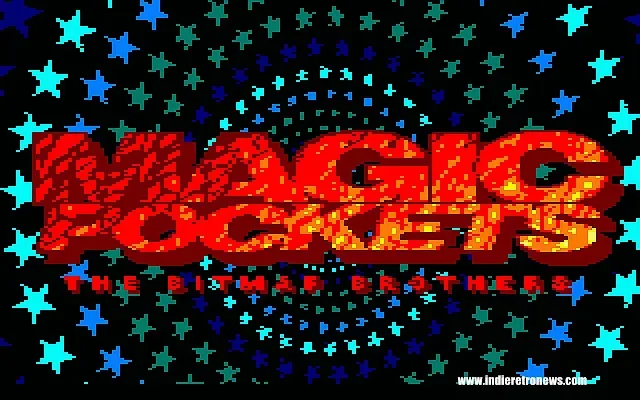
Magic Pockets, the 1991 platformer created by The Bitmap Brothers and published by Renegade, is being converted for the Amstrad CPC 6128 by Lake Software. The project is aiming to bring Bitmap Kid’s toy-recovery adventure to standard, unmodified CPC 6128 hardware while retaining the original game’s fast-moving platform action, animated introduction and musical identity.
The conversion has an unusually direct technical ambition for the machine: fluid movement using hardware scrolling and double-buffering, plus native use of the CPC’s AY sound chip for effects and jingles. Lake Software has also disclosed that AI assisted with code and sounds. That is a meaningful disclosure, particularly in a retro project where enthusiasts often want to understand not only what is being recreated, but how the new work was made.
A four-world platforming expedition
Magic Pockets follows Bitmap Kid as he sets out to recover toys that have gone missing from his seemingly bottomless trousers. It is a wonderfully peculiar premise, and one that frames a campaign split across four distinct settings:
- The Cave
- The Jungle
- The Lake
- The Mountain
Across 30 levels, the basic task is familiar platform-game business—run, jump and survive the route ahead—but the game’s equipment changes with the environment. The reported conversion includes the world-specific weapons associated with the adventure: whirlwinds, rolling balls, ice cubes and snowballs. That detail matters because these tools are more than decorative reskins. They give each setting a different visual and mechanical character while maintaining the central rhythm of traversal and blasting through hazards.
For players discovering it through the CPC version rather than through its 1991 origins, the design can be read as a level-by-level platformer built around a single expressive protagonist and a deliberately offbeat toy theme. The four-world structure should also provide a clean sense of progression: the player is not simply repeating one backdrop for 30 stages, but moving through a sequence of differently themed regions and their corresponding projectile styles.
The CPC 6128 challenge is about consistency, not just fitting the game on disk
Porting a platformer is not only a matter of drawing similar-looking sprites. The game has to feel coherent during movement, jumping, weapon use and scene changes. Lake Software says the CPC 6128 conversion uses hardware scrolling and double-buffering to pursue that result.
Hardware scrolling means that the computer’s display capabilities are used to shift the visible screen area, rather than requiring every part of the scene to be redrawn in the same way each time the view moves. In a scrolling platform game, that can be important because the background is constantly in motion as the character travels through a stage. The intended payoff is smoother apparent movement and less work spent updating the display.
Double-buffering is a separate display technique. Broadly, it involves preparing a new frame in a second area of memory and then switching what is shown, instead of visibly building the next image piece by piece on the display currently being viewed. Its purpose is to make animation appear cleaner and steadier. In practical terms, combining it with hardware scrolling is a logical approach for a game whose identity depends on responsive, flowing movement rather than screen-by-screen progression.
Related coverage includes Magic Pockets Is Heading to Amstrad CPC 6128 in a New Retro Conversion.
Lake Software’s stated goal is for this to run smoothly on an unmodified Amstrad CPC 6128. “Unmodified” is the key qualifier: the project is targeting the standard machine rather than assuming extra hardware or user-installed upgrades. That makes the technical choices especially relevant. A conversion can be ambitious in concept, but a responsive result on baseline hardware is what determines whether a fast platform game retains its defining feel.
Sound is part of the planned preservation effort
The conversion is also set to include the original animated intro sequence and title track, alongside sound effects and jingles produced through the CPC’s AY audio chip. The AY chip is the system’s native sound hardware; using it means the project is working within the audio capabilities of the computer rather than presenting sound as an afterthought.
Title music, brief jingles and in-game effects do different jobs. The title track establishes a game’s personality before play begins, while effects give actions such as attacks and encounters immediate feedback. Jingles can punctuate transitions or achievements. Together, they help a platformer feel animated even when the player is focused on split-second movement.
The promise of the original intro is notable for a conversion of this kind. An opening sequence is easy to treat as expendable when a project is chiefly judged on gameplay, but it establishes the presentation surrounding the levels. Retaining it alongside the title music suggests that the target is not merely a stripped-down interpretation of the core stages, but a version attempting to carry over recognizable parts of the game’s overall identity.
Custom loading is doing essential work behind the scenes
Storage is another major part of the conversion’s design. The release uses a custom disk loader said to place 210 KB of data on each side of a disk across 42 tracks. That is not a flashy feature in the way an animated intro or weapon effect is, but it is central to making a multi-world, 30-level game workable in this format.
A disk loader is the routine responsible for bringing required game data from the disk into memory. In a project with substantial art, stage data, audio and presentation elements, the loader becomes a practical bridge between what the game contains and what the computer can access while running it. The reported 210 KB-per-side figure illustrates that Lake Software has had to plan carefully for the available disk space rather than treating the physical media as a blank canvas.
It is also a reminder that retro conversion work has multiple interlocking disciplines. The visible result is a platform game. Underneath that are choices about display updates, memory management, audio playback and disk organization. None of those elements alone guarantees a satisfying version, but each can limit the final experience if handled poorly.
What the AI disclosure does—and does not—tell us
Lake Software’s disclosure is concise: AI assistance was used for code and sounds. It establishes that AI was involved in the production process, but it does not specify which tools were used, which particular portions of code or audio were AI-assisted, or how that assistance was reviewed and incorporated. Those details should not be inferred from the disclosure alone.
What can be said is that the project presents its AI involvement openly rather than leaving audiences to guess. For players interested in the conversion itself, the more immediate practical questions remain familiar ones: how closely does the finished game reproduce the intended movement and weapons, whether the scrolling remains smooth on standard CPC 6128 hardware, and how successfully the audio presentation translates through the AY chip.
The announcement sits within a wider retro-gaming scene in which older games continue to find new homes on period hardware. That activity has a different focus from the modern release calendar covered in recent indie release news: instead of new games arriving on current platforms, projects such as this one revisit old technical boundaries with fresh development work.
Why this conversion stands out
The strongest appeal of the CPC 6128 Magic Pockets project is the combination of scope and constraints. It is not described as a single-level tribute or a simplified character cameo. It is targeting four worlds, 30 levels, distinct world-based weapons, the animated opening, title music, sound effects and jingles—all while running on standard hardware.
That leaves substantial execution questions for the finished conversion, and Lake Software’s language appropriately frames smooth performance as an objective rather than a proven outcome. Still, the design outline is clear. If the hardware scrolling, double-buffering, AY audio and custom loading come together as intended, Amstrad CPC 6128 owners will have a new way to experience Bitmap Kid’s strange mission to reclaim his toys from those famously bottomless trousers.