Commodore Amiga owners have a new, deliberately strange platforming adventure to investigate. Freestyle – Tales of Itch, from Mute.ink, is now released as a game built with Earok’s Scorpion Engine. Its pitch is notably ambitious for a project targeting the Amiga: more than 50 distinct levels, 24 hand-drawn comic pages, changing gameplay genres across the campaign, 51 enemy variants, 15 supporting characters and eight hidden bonus characters.
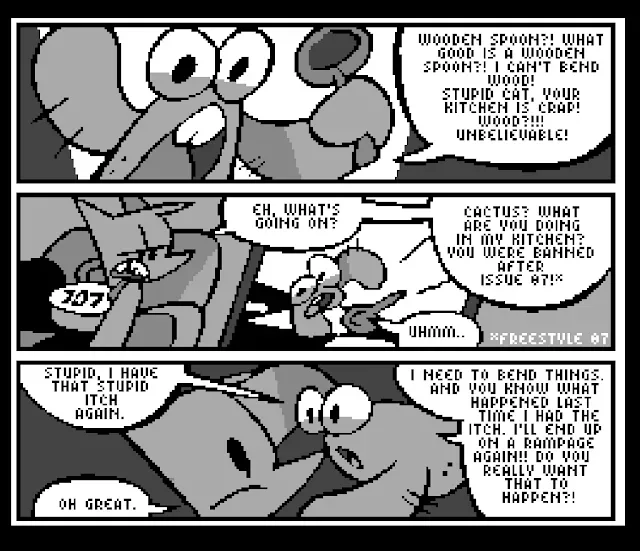
That scale is paired with a premise that does not mistake restraint for a virtue. The antagonist, Cactus, is described as a fingerless villain who has become obsessed with the idea that a person’s value should be judged by the amount of kitchen cutlery they can bend. The burden of stopping this silverware-bending campaign falls to Stupid Cat, a grumpy feline protagonist who apparently has little choice but to get involved.
It is a setup that signals the game’s interest in comic-book exaggeration rather than straight-faced heroics. More importantly, the comic presentation is not just an external description of the art style: the campaign is driven by 24 illustrated pages. That places sequential artwork directly within the game’s storytelling structure, giving the adventure a defined visual narrative thread between its platforming encounters.
A large campaign with an intentionally mixed format
More than 50 levels is a substantial stated scope, but Freestyle – Tales of Itch is not presented as one uninterrupted run of identical platform stages. Mute.ink describes its structure as open-ended and “freestyle,” with the campaign moving among multiple gameplay genres and increasing in difficulty as it progresses.
That does not specify every genre or mechanic involved, and players should not read more into the label than has been detailed. What is clear is that the project is designed around variation. The listed 51 enemy variants and 15 members of the supporting cast reinforce that aim, while the eight hidden bonus characters provide an extra discovery layer for players who want to search beyond the most direct route through the adventure.
What “freestyle” means here: it refers to an open-ended design approach and a campaign that changes genre over time, rather than a guarantee of any particular movement system, level order or player-created content. The important practical point is that the game is not being framed as a single-mechanic platformer with dozens of interchangeable stages.
The hand-drawn visuals are equally central to its identity. Reviving 1990s comic-book properties in game form gives the project an unusually specific creative foundation: it is not merely using comics as a broad aesthetic reference, but bringing related characters into a newly made Amiga platforming epic. For a wider look at how comics and gaming continue to share event space and audience attention, see this look at comics, cosplay and gaming at New York Comic Con 2026.
Amiga compatibility: what has been tested
The key hardware message is encouraging but qualified. AGA is not required. AGA, short for Advanced Graphics Architecture, is a graphics chipset associated with certain Amiga models. In practical terms, the stated lack of an AGA requirement means the game is not restricted to Amigas that rely on that chipset.
Related coverage includes Freestyle – Tales of Itch Brings a 50-Level Comic Platformer to Amiga.
That should not be confused with a claim that every baseline configuration will offer the same performance. The stated best-case experience calls for additional RAM and potentially a CPU upgrade. Testing is reported on Amiga 500 and Amiga 600 systems with PiStorm or Furia upgrades, where the game is said to run flawlessly.
PiStorm and Furia are mentioned specifically as upgrades in the tested configurations; the important takeaway for prospective players is that upgraded hardware was part of the successful test environment. The available information does not establish identical results for every Amiga revision, accelerator or memory arrangement.
Reported configurations and results
- Amiga 500 and Amiga 600 with PiStorm/Furia-style upgrades: reported to run flawlessly in testing.
- Amiga 600 with 1 MB or 2 MB chip RAM and 4 MB fast RAM: tested with some slowdown at times, though it was reported not to affect gameplay.
- Pi 4 400: reported to work well.
- A500 Mini: reported to struggle.
- Amiga 1200: no result has been provided yet; testing is planned when the relevant machine is available.
Chip RAM and fast RAM are the memory categories named in the reported Amiga 600 configuration. For someone checking their own setup, the figures worth noting are 1 MB or 2 MB of chip RAM plus 4 MB of fast RAM. That configuration did run the game in testing, with intermittent slowdown rather than a reported gameplay failure.
“Slowdown” here means the game can lose speed at times. It is distinct from a compatibility issue that prevents play altogether. Still, the recommendation for more RAM and possibly a faster CPU is meaningful: those with a choice of Amiga configurations are being steered toward expanded hardware for the most enjoyable experience.
What the technical credits establish
Freestyle – Tales of Itch was developed for Amiga using Scorpion Engine, which is credited to Earok. The engine credit identifies the development framework behind the game; it does not by itself define the game’s level design, performance on untested configurations or feature set. Those details should instead be taken from the stated campaign and hardware information.
Mark Pursell is credited with everything other than the music. The music is credited to curt_cool through The Mod Archive. Mute.Ink and its related characters are credited to Mute.Ink and Mark Pursell for 2026.
Those credits matter because the project’s presentation rests on multiple distinct pieces: platforming design, hand-drawn comics, a roster of characters and enemies, and a separate music contribution. The result is positioned as a purpose-built Amiga release rather than simply a comic idea placed around a short retro-game concept.
What Amiga players should take from the release
Freestyle – Tales of Itch offers a clear proposition for players with compatible Amiga hardware: a large, comic-led platformer that favors surreal characterization and varied campaign pacing. Its published scope is unusually easy to summarize—50-plus levels, 24 comic pages, 51 enemy variants, 15 supporting characters and eight hidden characters—but the caveat is equally straightforward. Expanded RAM and possibly an upgraded CPU are recommended, even though AGA is unnecessary.
For owners of upgraded Amiga 500 or Amiga 600 systems, the reported testing is the most reassuring part of the compatibility picture. Owners of a modest Amiga 600 configuration have a more nuanced answer: the game has been tested there and remains playable, but some slowdown was observed. A500 Mini users should be particularly cautious, as that platform is reported to struggle. And Amiga 1200 owners will need to wait for an actual test result rather than infer one from the absence of an AGA requirement.
In creative terms, the game’s appeal is likely to rest on whether its blend of platforming, comic pages and shifting genres lands with players. The available details establish the intent: an open-ended, increasingly difficult adventure in which a disgruntled cat confronts a villain whose worldview has somehow escalated into a crisis of bent cutlery. For an Amiga game, that is a wonderfully specific problem to be asked to solve.