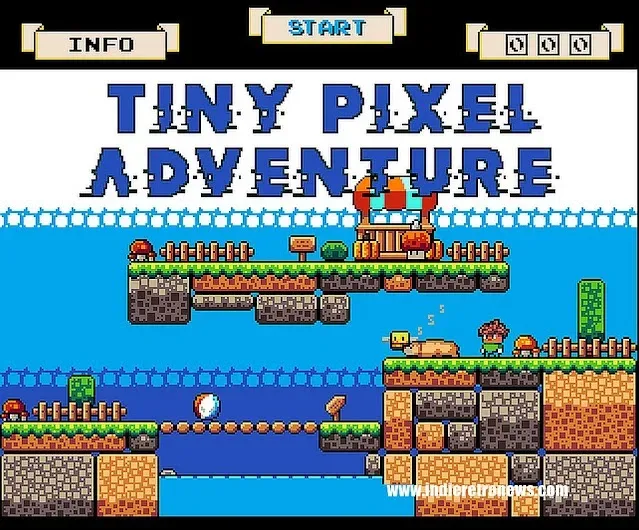
Tiny Pixel Adventure, a new Commodore Amiga release from HooGames2017, has received a substantial update. The game presents a colorful pixel-art world built around successive quests, hazardous enemies, locked routes and the keys needed to advance into new areas.
The developer’s broad pitch is a familiar but still potent one for an action-platform adventure: take a small hero into a dangerous place, make each challenge survivable, and use progress in one section to open the next. In Tiny Pixel Adventure’s case, the stated structure is especially clear. Completing a quest earns a key, and that key provides access to further areas. That turns progress into more than a score or a level-complete screen; it is the mechanism that moves the player through the game.
The newest version is accompanied by a new video, while the update itself is described as extensive. Its changelog includes bug fixes and performance improvements, though the available information does not specify every individual fix, altered mechanic or technical target. Players looking for the precise scope of the patch should therefore check the developer’s update notes rather than assume changes beyond those confirmed categories.
A quest-and-key structure at the center
“Quest” can mean many things in games, from a short task to a sprawling narrative objective. Here, it is best understood in practical terms: a sequence of obstacles and enemies that must be overcome in order to receive a key and move onward. The keys are not described as optional trinkets. They are progression items, meaning they unlock access to the next areas and establish the game’s forward momentum.
That design gives Tiny Pixel Adventure a simple, legible loop:
- Enter an area or quest.
- Navigate its obstacles and confront its enemies.
- Complete the challenge.
- Receive a key.
- Use that key to reach a new area.
It is a framework that can make each completed objective feel tangible. A player is not merely told they have progressed; a new path becomes available. It also places the emphasis squarely on execution. The supplied details frame the appeal less around collecting for its own sake and more around surviving the immediate danger long enough to earn the right to see what is ahead.
Strange enemies, distinct movement problems
The hostile roster described for Tiny Pixel Adventure is deliberately odd: bouncing mushrooms, rolling balls, aggressive bees and dangerous plants are among the creatures waiting in its stages. Even without a complete breakdown of behaviors, those labels suggest enemies defined by movement and placement as much as appearance.
A bouncing foe implies changing vertical space and timing. A rolling enemy suggests a threat that crosses ground quickly or follows a horizontal route. Bees evoke aerial pressure, while hazardous plants suggest an enemy that may make a particular patch of terrain unsafe. These are interpretations of the enemy descriptions rather than confirmed move sets, but they illustrate why the creature list matters. Different silhouettes and movement ideas can make a platforming space easier to read at a glance—provided the game communicates their danger clearly.
That variety also suits a quest-based progression system. If every new key opens a different area, new enemy combinations and obstacle layouts can keep advancement from becoming a purely cosmetic change of scenery. The core question is not simply whether the player can reach the exit; it is whether they can understand and respond to the next strange hazard placed in their route.
Action and puzzles, rather than action alone
Tiny Pixel Adventure is described as mixing puzzles with action. That distinction is useful. In an action-focused platform game, success commonly rests on reactions, positioning and timing. A puzzle asks the player to identify a relationship or solution before, or alongside, executing it. Combining the two can create levels where getting past an enemy is only one part of the task; the player may also need to recognize how an obstacle should be approached.
No specific puzzle types have been detailed, so it would be premature to label the game a particular subgenre or claim a certain level of complexity. Still, the stated combination tells prospective players that the intended experience is not solely about dispatching enemies. The route through a quest may ask for observation and decision-making as well as reflexes.
For an Amiga release with retro pixel presentation, this focus has a practical appeal. Pixel graphics are not merely a visual filter when they support clear play spaces: enemy shapes, hazards, interactive objects and traversable ground all need to be distinguishable quickly. The developer also highlights a soundtrack as part of each level’s identity, placing sound alongside graphics as a key part of the game’s atmosphere.
What the update means—and what remains unspecified
Large update notes can cover very different kinds of work. Bug fixes generally address unintended behavior, whether that concerns gameplay logic, collisions, progression, audiovisual issues or other faults. Performance improvements concern how smoothly and reliably software runs, potentially affecting consistency or responsiveness. Neither phrase, by itself, confirms exactly what a player will notice in a particular level.
That uncertainty is worth keeping in view. The update is described as huge and its changelog as lengthy, but the supplied information does not enumerate the entries. It does confirm active post-release support for Tiny Pixel Adventure and identifies fixes and performance work as central parts of that support. It does not establish a new campaign, additional worlds, new enemy types, revised controls or any other unlisted feature.
For returning players, the sensible takeaway is to review the full notes for changes that may affect their own play. Someone who encountered a progression issue will care about different entries than someone concerned with smoothness or general polish. For newcomers, the latest version is the relevant build to investigate, especially because the update explicitly includes technical improvements.
A modern release for a classic Amiga audience
Tiny Pixel Adventure is positioned directly around the Commodore Amiga and classic pixel-game sensibilities, but it is not presented as a museum piece. It is a newly available game receiving a newly described update, with a design centered on keys, quests, puzzles, action and a menagerie of unconventional enemies.
That matters in the broader retro-gaming space: the appeal is not only revisiting familiar hardware, but finding contemporary projects designed for it. The Amiga’s identity in this release comes through in the platform and visual approach, while the game’s actual hook is the forward drive of its challenges. Each completed quest is meant to create access to the next one, ensuring the player’s objective remains concrete even as the threats become stranger.
Readers interested in other examples of old hardware being used in unusually playful ways can also explore the Dreamcast VMU, the memory card that doubled as a tiny game system.
What to expect from Tiny Pixel Adventure
- A Commodore Amiga adventure from HooGames2017.
- Pixel-art presentation and a soundtrack positioned as part of the level experience.
- Quest completion that rewards players with keys to unlock further areas.
- Action-platform hazards involving bouncing mushrooms, rolling balls, bees and dangerous plants.
- A stated blend of puzzles and action.
- An updated version with an extensive changelog, including bug fixes and performance improvements.
The available details make Tiny Pixel Adventure sound like a compact, progression-led challenge: reach the next area by surviving the current one, learn the behavior of its strange opposition, and keep earning keys. Its latest update adds an important practical reason to look at the current build, even if the complete list of changes needs to be consulted separately.