Flashback: 25th Anniversary Edition is heading back to the platform where Conrad B. Hart’s sci-fi escape first began. AmiKIT has introduced an Amiga conversion built around the modern anniversary release, offering separate versions for different Amiga hardware configurations. The project reaches from an Amiga 1200-compatible AGA presentation at 640×256 to an RTG option at up to 1024×896 for systems fitted with a graphics card.
That hardware split is central to what this release is trying to do. It is not simply a preservation-style return to the look of the original Amiga 500 game. The conversion uses files generated from a player’s own copy of Flashback: 25th Anniversary Edition, with upgraded artwork, music and sound effects brought over into Amiga-ready files. Depending on the selected configuration, the game can present smoothed visuals or substantially repainted high-definition imagery.
The premise has a pleasing full-circle quality. Flashback originally debuted on Commodore Amiga in 1992 before reaching PC and console audiences. This conversion revisits that Amiga lineage, but it does so through the assets and enhancements of the anniversary edition rather than by attempting to reproduce the original release unchanged.
Three versions, built around the machine you have
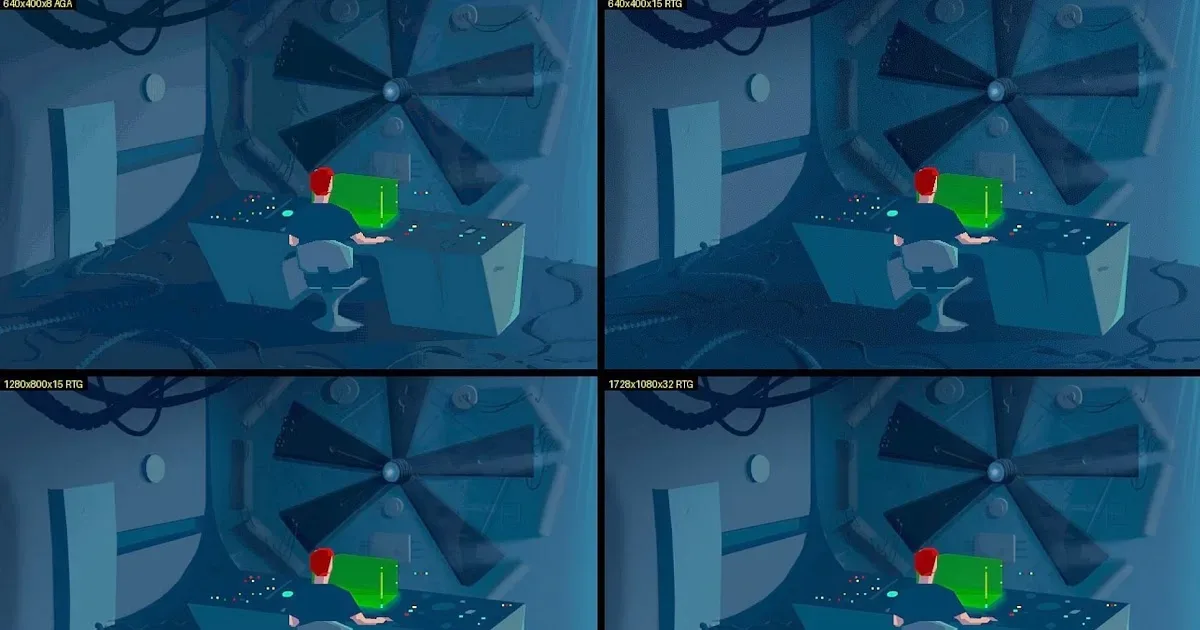
The conversion is offered in three distinct versions aimed at different setups. The supplied details identify the Amiga 1200 AGA version as running at 640×256, while the upper RTG presentation can reach 1024×896 on Amigas with a graphics card.
AGA, short for Advanced Graphics Architecture, is the graphics chipset associated with later classic Amiga systems including the Amiga 1200. RTG, or retargetable graphics, refers here to graphics-card-driven display modes rather than relying solely on the system’s original chipset. In practical terms, RTG is the route to the conversion’s highest stated resolution and its fullest visual treatment.
The distinction matters because the project is designed to scale rather than present every owner with an identical build. A player using an Amiga 1200 has a defined version intended for AGA hardware, while a graphics-card-equipped RTG setup is positioned for the larger image, improved cutscene resolution, real-time smoothing and more extensive character-art upgrades.
At the RTG end, cutscenes can run at up to four times their original resolution. Moving objects are also smoothed in real time. Those are meaningful changes for a cinematic platformer, a genre in which animation, staging and scene transitions do much of the storytelling work. A higher-resolution cutscene does not rewrite the game, but it can make image composition and detail easier to parse on modern display setups connected to Amiga hardware.
Why the backgrounds are the headline feature
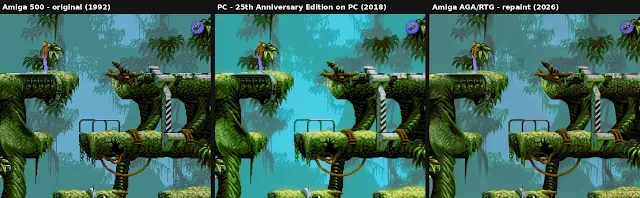
The release’s most ambitious visual claim concerns its backgrounds. Rather than enlarging the legacy 256×224 art through straightforward scaling, the conversion sends backgrounds through the ArtStation neural model to produce painted HD textures from the original dithered imagery.
Related coverage includes Flashback: 25th Anniversary Edition Returns to Amiga With Repainted RTG Visuals.
Dithering is a pixel-art technique that uses patterned arrangements of limited colors to imply extra shades, texture or gradual transitions. It was an effective way to suggest detail under older hardware constraints. But when such art is enlarged without careful processing, those patterns can become more conspicuous, and an image may look soft or blurred rather than deliberately detailed.
The approach described for this conversion aims for a different result: replacing that enlarged-pixel appearance with fresh, painted-looking surfaces. That is a major aesthetic choice, not merely a resolution setting. It means the RTG version is intended to resemble a reworked interpretation of the game’s environments rather than a pristine display of every original pixel.
For retro players, that difference is worth understanding before choosing a version. Traditional scaling seeks to preserve the source image while making it fit a larger output. Repainting prioritizes a new presentation built from that source. Neither goal is automatically better; they answer different preferences. The supplied configuration range gives owners a way to select the version that best aligns with their hardware, while the project’s emphasis clearly falls on the upgraded RTG look.
Characters receive their own RTG pass
The background work is not the only graphical change. On RTG systems, Conrad and enemy animations are also updated using the BigFArt model. The stated goal is cleaner, more modern character artwork in place of the original rigid pixel presentation.
That is important because a cinematic platformer is constantly asking the player to read a character’s movement: where a leap begins, where a landing ends and how close danger may be. The conversion’s visual upgrades do not, on the provided details, claim gameplay revisions or new mechanics. Instead, they focus on how the existing action is displayed—particularly in the environments, cutscenes and animated figures that define the game’s on-screen identity.
It also separates this release from an upgrade that only treats static scenes. With both scenery and animation addressed, the RTG version is positioned as a broad audiovisual reinterpretation. Players interested in the original Amiga-era look should bear in mind that its high-definition mode is expressly designed to move beyond it.
Remastered music and panoramic stereo sound
The audio side is equally prominent. The conversion includes remastered music and panoramic stereo sound effects. “Panoramic stereo” describes a wider left-right sound field, allowing effects to be placed with more spatial separation than a narrower presentation. In a game shaped around atmosphere and dramatic movement, that can contribute as much to the sense of modernization as a cleaner picture does.
The conversion tool is said to extract and prepare those remastered audio assets alongside the visual files. This is not presented as a separate soundtrack add-on: the music and sound effects are part of the conversion output created for the Amiga installation.
The release specifically contrasts this audio treatment with the 2018 PC remaster, identifying the remastered music and panoramic stereo effects as enhancements not included there. That makes the project more than an exercise in returning a game to an old platform. Its goal is to bring a particular upgraded audio-visual form of Flashback to Amiga systems, including elements characterized as absent from that PC remaster.
What owners need to use it
This is a conversion workflow, not a standalone copy of the game. Users need to own Flashback: 25th Anniversary Edition on Steam. They then use the Convert2Amiga tool, available for Windows or Mac, to turn their owned game files into files for the Amiga release.
That requirement has two practical implications. First, the Steam edition supplies the assets used by the conversion, including the HD backgrounds and remastered music and sound effects. Second, potential users should account for access to a Windows or Mac computer for the conversion stage, even if their intended destination is Amiga hardware.
- Required game: an owned Steam copy of Flashback: 25th Anniversary Edition.
- Required conversion step: Convert2Amiga on Windows or Mac.
- AGA target: an Amiga 1200-oriented 640×256 version.
- RTG target: up to 1024×896 for systems with a graphics card, alongside the most extensive stated graphical enhancements.
A modernized homecoming rather than a museum piece
There is a useful contrast between historical platform association and technical intent here. Flashback has a genuine Amiga origin, so a return to Amiga naturally has preservation appeal. Yet the conversion is not framed as a strict archival package. Its use of neural-model-generated repainted textures, smoothed motion, high-resolution cutscenes and remastered stereo sound places it firmly on the enhancement side of retro software projects.
That can be especially appealing to Amiga owners who want to see what an established classic looks and sounds like when its later assets are adapted for more capable configurations. At the same time, the AGA-to-RTG range acknowledges that “Amiga” is not one fixed technical target. The experience varies meaningfully with the machine and graphics setup available.
For a broader look at how unofficial work continues to revisit classic hardware in new forms, see our coverage of an unofficial native Mega Drive conversion of Shadow of the Beast III. In Flashback’s case, the notable twist is that the project pairs an Amiga return with a deliberately contemporary visual reconstruction, instead of treating the platform’s original image as untouchable.
The result is a technically tiered route back into Conrad B. Hart’s adventure: an AGA-compatible option for Amiga 1200 hardware, and a high-spec RTG mode that pushes toward repainted HD imagery, sharper cinematics and expanded stereo presentation. Owners will need the Steam release and the conversion utility, but the payoff promised by the project is unusually specific—a version of Flashback built for Amiga hardware that embraces the anniversary edition’s assets while going further with its own RTG treatment.